
When Maya, a network planner in Manchester, approved a fiber route for internet and video, the first access-cabinet handoff failed during field testing. The reversal was in the specification: “FTTM” had been treated as a universal architecture without naming the access technology, endpoint, or duct interfaces. This illustrative scenario shows why the label needs a documented design.
Resumo: FTTM usually means “fiber to the multimedia” in descriptive writing, linking fiber access with services such as internet, video, and voice; it is not a universally defined ITU-T access architecture. ITU-T G.984 covers GPON recommendations, while ITU-T G.9807.1 covers XGS-PON, so the recommended action is to name the actual PON or Ethernet design, service handoff, fiber type, pathway, and acceptance test before buying components. Treat FTTM as a service goal, not as a substitute for a topology and bill of materials.
What does FTTM mean, and why is the term ambiguous?
FTTM is commonly expanded as “fiber to the multimedia.” In that usage, it describes the intention to use a fiber-based access network to carry more than one service, such as data, television distribution, and voice. The term can be useful in a project brief, but it does not by itself state where the fiber terminates, which access protocol is used, how services are separated, or which customer equipment is required.
That distinction matters because FTTx is a family of location-based labels: the final letter describes the endpoint, as in fiber to the home (FTTH), building, cabinet, or another defined point. FTTM is better read as a service-oriented phrase unless the operator’s documentation gives it a precise local definition. A procurement document should therefore replace the acronym with a network diagram, an interface schedule, and a service map.
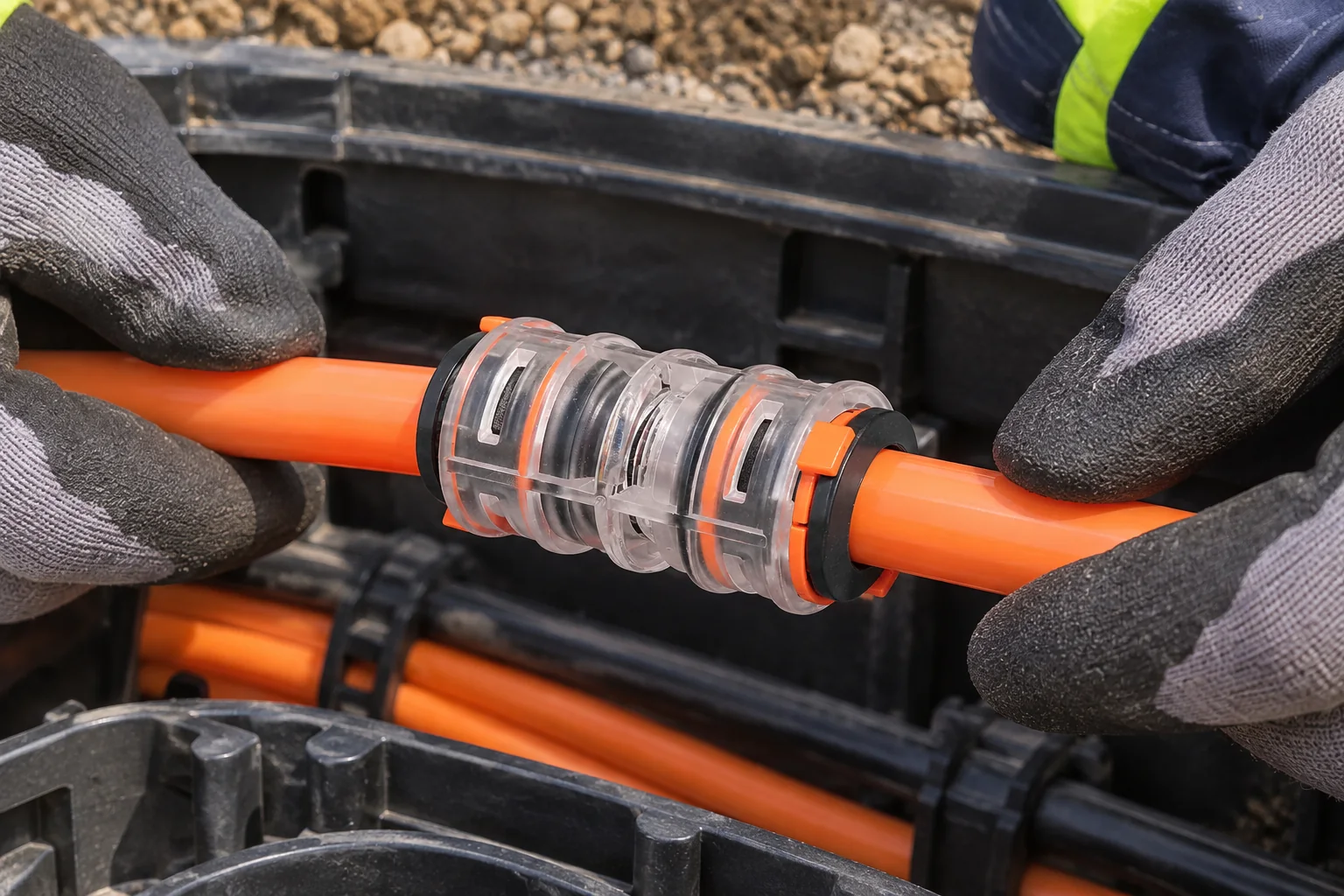
For a practical look at the physical pathway, see microduct connectors in FTTH networks. The fitting supports the duct route; it does not define the optical access protocol or guarantee any multimedia service.
How does a fiber access network carry multiple services?
A fiber access network carries encoded optical signals between an access node and customer-side equipment. The service mix is then handled by the operator’s optical line terminal, optical network unit or terminal, Ethernet equipment, service gateways, and the relevant video or voice platforms. Fiber is the transmission medium; it is not itself a promise that every service will be available on every installation.
GPON and XGS-PON illustrate why the underlying technology must be named. ITU-T G.984 is a family of recommendations for gigabit-capable passive optical networks, while ITU-T G.9807.1 specifies a 10-Gigabit-capable symmetric passive optical network system. These references describe different access-system capabilities and interfaces; they do not turn the informal FTTM label into a standard architecture. The selected optical network equipment and operator service profile remain controlling evidence.
Service convergence also requires correct separation and provisioning. Internet, voice, and video may use distinct logical services, VLANs, quality-of-service rules, multicast handling, or customer premises equipment. Those details belong in the operator’s design and acceptance criteria. Do not infer them from the phrase “fiber to the multimedia,” from a connector photograph, or from a headline about future access networks.
The wider FTTx discussion can help compare endpoint concepts, but it should not be used as proof that one FTTM architecture is commercially universal.
Which physical interfaces matter before an FTTM quote?
Once the service and access technology are defined, the physical route becomes a sequence of interfaces: feeder or distribution fiber, closures and cabinets, microduct or conduit, connectors, bend locations, and the customer-side termination. The route drawing should show where each interface starts and ends, how it is protected, and how it will be opened for maintenance.
For a microduct route, verify the actual duct material, inside and outside dimensions, cable or fiber-unit dimensions, bend plan, joint arrangement, and environmental exposure. A connector that fits one duct outside diameter may not fit another, and a physically compatible fitting does not prove air tightness, water blocking, or suitability for a particular installation method. Request the supplier’s dimensional drawing and installation instructions, then match them to the route records.
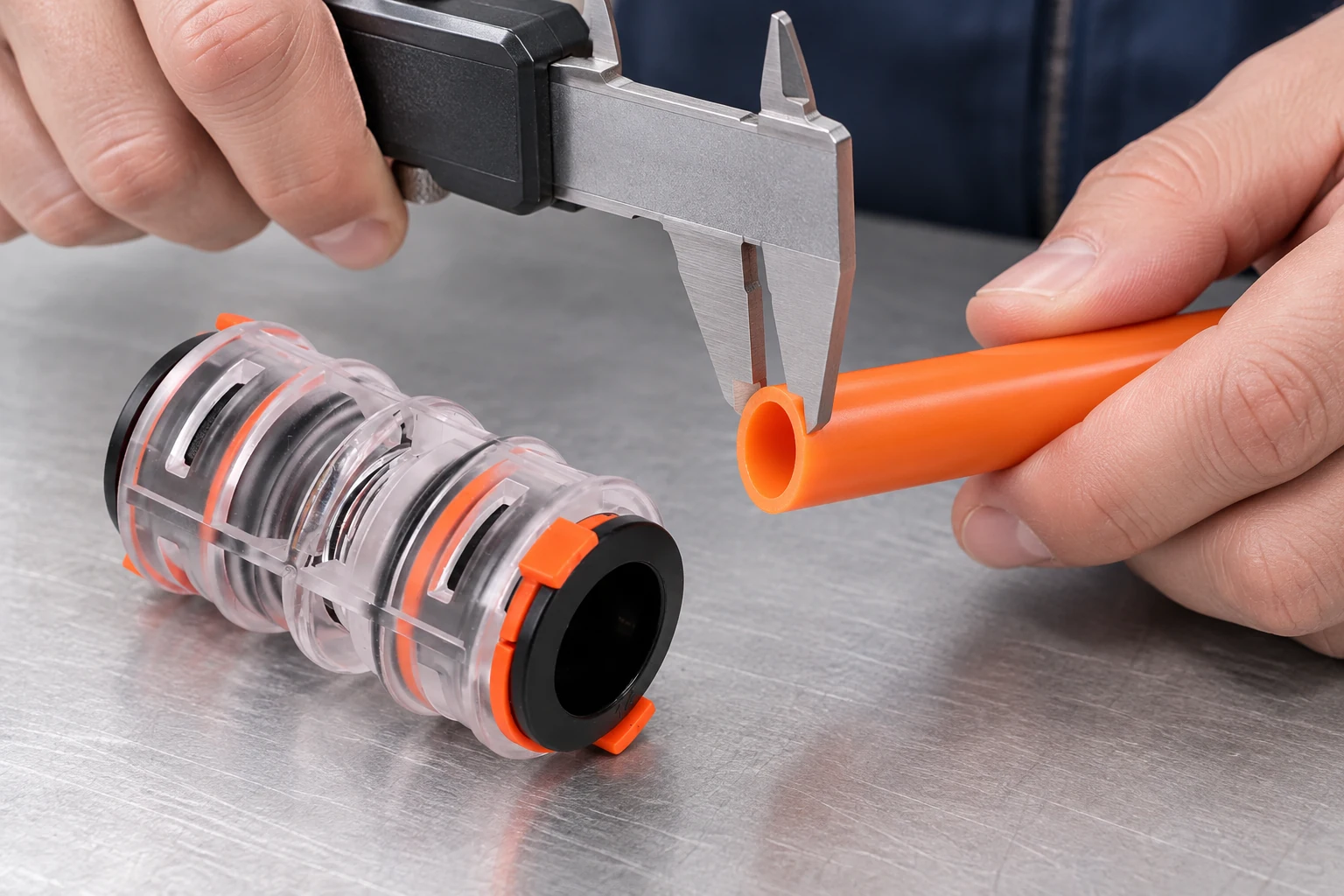
Fiber carries the service signal, while the microduct connector retains the pathway joint. Keep those responsibilities separate in the specification. A route designed for air-blown fiber should also state the duct continuity, allowable bends, end preparation, sealing approach, and the checks required before blowing. For background on the transmission medium itself, read how optical fiber communication works.
How should buyers compare FTTM, FTTH, and other FTTx choices?
The useful comparison is not “which acronym is best?” It is whether the proposed endpoint, access technology, service handoff, route, and maintenance plan fit the actual project. The table below keeps FTTM in its proper place as a service description and separates it from endpoint-defined FTTx terms.
| Label or design choice | What it communicates | What it leaves open | Evidência a solicitar |
|---|---|---|---|
| FTTM (fiber to the multimedia) | A stated intention to deliver multiple services over a fiber-based access network. | Endpoint, protocol, service separation, equipment, and acceptance limits. | Network diagram, service map, access-system name, endpoint equipment, and test plan. |
| FTTH | Fiber reaches the home or dwelling endpoint in the defined project scope. | Whether the access system is GPON, XGS-PON, Ethernet, or another design. | Termination location, optical budget, customer equipment, and operator interface requirements. |
| Other FTTx endpoint | Fiber endpoint is identified by the final letter and project definition. | How the remaining segment is built and which services are activated. | Endpoint drawing, copper or radio segment where applicable, and service handoff requirements. |
| Access technology | Defines the optical or Ethernet system used to transport the services. | Physical route quality and compatibility of ducts, fittings, and terminations. | Applicable ITU-T or equipment specification, wavelengths, optics, and loss limits. |
| Pathway and fittings | Provides the protected physical route for the cable or fiber unit. | Service availability, bandwidth, and protocol behavior. | Dimensional drawings, material and environment requirements, installation method, and records. |
| Scope item | Confirm before quoting | Evidence or condition |
|---|---|---|
| Access endpoint | Home, building, cabinet, or another project-defined termination point. | Approved topology drawing and service handoff; the FTTM label alone is insufficient. |
| Pathway | Duct or conduit dimensions, route geometry, access points, joints, and environment. | As-built or survey records, dimensional drawings, and the selected installation method. |
| Passive components | Splitters, closures, connectors, couplers, and terminations where the design uses them. | Manufacturer data sheets, compatibility checks, and a route-specific optical budget. |
| Active electronics | OLT, ONU/ONT, Ethernet equipment, gateways, and service interfaces in the operator design. | Equipment documentation and the applicable access-system reference, such as ITU-T G.984 or G.9807.1. |
| Evidência de aceitação | Physical inspection, optical loss measurement, event location, and required service tests. | Contract method, wavelengths, limits, fiber identifiers, test records, and as-built route. |
What should the design and acceptance plan measure?
Start with the access equipment’s published optical parameters and the route length. Build a project-specific loss budget that accounts for fiber attenuation, splices, connector pairs, splitters where used, and an agreed engineering reserve. The component values must come from the selected equipment and route; there is no universal FTTM loss limit.
At acceptance, use the method named in the contract. An optical loss test set can measure end-to-end insertion loss at specified wavelengths; an optical time-domain reflectometer can help locate events and characterize the route. These methods answer different questions, so an OTDR trace should not silently replace an agreed end-to-end measurement. Record fiber identifiers, reference method, wavelengths, limits, results, and the as-built route.
Service acceptance may need additional checks for the operator’s provisioning, voice registration, video or multicast behavior, latency, and failover design. Those are service and system tests, not properties that can be inferred from the fiber or a microduct connector alone. Document who supplies each test, which equipment is in scope, and what happens when a result falls outside the agreed limit.
Which standards and claims should appear in the procurement file?
ITU-T G.984 and ITU-T G.9807.1 are named access-system recommendations with different scopes. They are not product certificates for a duct fitting, nor do they certify a completed route or a service provider. The procurement file should identify the exact recommendation or equipment specification that applies, its edition where relevant, and the interface requirements that must be demonstrated.
FTTH Council Europe provides public resources about fiber deployment and market context, but a market resource does not establish a technical requirement for an individual project. Likewise, a supplier’s “FTTM-ready” phrase should be treated as a claim to verify, not as a recognized compliance category. Unsupported claims can lead to rejected submittals, incompatible optics, or rework at the access cabinet.
How can a buyer turn an FTTM brief into a buildable specification?
- Define each service, customer endpoint, handoff, availability expectation, and ownership boundary; replace FTTM with the actual topology in the drawing.
- Name the access technology and equipment family, including optics, wavelengths, splitters or Ethernet devices, and the published loss budget.
- Survey the pathway: duct dimensions, route geometry, access points, environmental exposure, joints, and the cable or fiber-unit installation method.
- Request dimensional drawings, material data, installation instructions, and test evidence for every connector and closure in the route.
- Write the acceptance plan before purchase, separating optical loss, physical inspection, and service-level tests with named records and limits.
Microduct Connector can help review the pathway and fitting portion of that package against the documented duct dimensions and application. Browse the microduct connectors range and send the route drawing, duct data, and installation method for a specification discussion; the access protocol and service platform should still be confirmed by the network operator.
Frequently asked questions about FTTM and fiber access
Is FTTM an official fiber access standard?
Usually, no. FTTM is commonly used as shorthand for fiber to multimedia services, while formal access recommendations such as ITU-T G.984 and G.9807.1 define specific PON systems. Ask the project owner to state the topology and access technology rather than accepting the acronym alone.
How is FTTM related to FTTH?
FTTH describes the fiber endpoint at the home or dwelling; FTTM describes a service intent in which fiber supports multiple media or communications services. An FTTH network may carry multimedia services, but the terms answer different questions. Confirm both the endpoint and the service architecture.
Does FTTM mean internet, television, and telephone always share one fiber?
They may be transported over one fiber access network, but the exact logical services, equipment, and provisioning depend on the operator design. Voice, video, and data can have separate service profiles even when they share a physical route. Require the service map and customer equipment specification.
Does a microduct connector determine FTTM performance?
No. A connector supports the physical duct pathway and its joint; it does not set the PON protocol, optical budget, or service quality. Verify dimensions, sealing, environmental requirements, and installation records separately from the optical and service tests.
Which PON technology should an FTTM project use?
There is no universal answer. GPON under ITU-T G.984, XGS-PON under ITU-T G.9807.1, Ethernet, and other designs may fit different equipment, capacity, migration, and service requirements. Select from the operator’s endpoint, optics, capacity plan, and acceptance criteria.
What should be tested before a multimedia fiber service goes live?
Test the physical route and optical loss using the agreed method and wavelengths, then perform the operator’s service tests for provisioning and the required voice, video, or data behavior. Keep results tied to fiber IDs and the as-built route. A connector inspection alone cannot prove end-to-end service readiness.
Referências
- ITU-T G.984, Gigabit-capable passive optical networks (GPON).
- ITU-T G.9807.1, 10-Gigabit-capable symmetric passive optical network (XGS-PON).
- FTTH Council Europe, public fiber deployment resources.
The practical rule: use FTTM to describe the service ambition only after the endpoint, access system, pathway, and tests are written down. Match conectores para microdutos to the route evidence, then contact Microduct Connector with the duct drawing and interface schedule for a fitting review.


