
Lorsqu’un responsable de la construction de réseau à Bristol a été confronté à un signal d’alerte de perte d’air lors d’un contrôle préalable au soufflage, l’équipe a remplacé le raccord apparent — mais l’essai a de nouveau échoué. Dans ce scénario illustratif, aucun défaut du produit n’a été constaté : la nomenclature avait considéré comme interchangeables des “ raccords ” un joint en ligne, une dérivation inutilisée et une transition de diamètre. L’équipe a corrigé la spécification en attribuant à chaque emplacement une fonction et une interface de conduit précise.
Résumé : La phrase Raccords de conduits FTTH décrit une catégorie générale ; un coupleur droit est un type utilisé pour raccorder deux conduits compatibles en ligne. Avant de choisir un modèle, vérifiez le diamètre extérieur, la construction des parois, l’insertion, l’environnement et l’essai d’acceptation. Les séries ITU-T L.79 et IEC 60794 fournissent un contexte systémique et d’essai, mais ne constituent pas la preuve qu’un connecteur convient à votre projet.
Choisissez le composant en fonction de sa fonction, et non de son nom de catalogue.
Les tracés FTTH utilisent des conduits pour guider et protéger les câbles à fibres optiques ou les unités de fibre soufflable. Voir le rôle des connecteurs de microtubes dans les réseaux FTTH pour le contexte système. Une terminaison, une dérivation, une transition et une réparation constituent chacune une tâche de raccordement distincte.
“ Raccord de conduit ” est une appellation générique qui englobe les raccords droits, les réducteurs, les bouchons d’extrémité, les branchements et autres interfaces. “ Coupleur ” est plus spécifique lorsqu’il désigne un raccord droit à deux extrémités, bien que la terminologie varie selon les fournisseurs. Une expression de recherche tel que Connecteur pour microgaine, pièce télécom ne précise ni la géométrie, ni la taille des conduits, ni les conditions d’exposition, ni les exigences d’acceptation ; seuls les plans contrôlés et les données produit exactes peuvent le faire.
Cet article compare des catégories génériques, et non des modèles spécifiques. Les pages de produits liées illustrent les formes des composants ; elles ne prouvent pas la compatibilité avec un conduit, une pression, un itinéraire, un climat ou une spécification client précis.
Lorsqu’un raccord de conduit complet est nécessaire à la place d’un coupleur droit
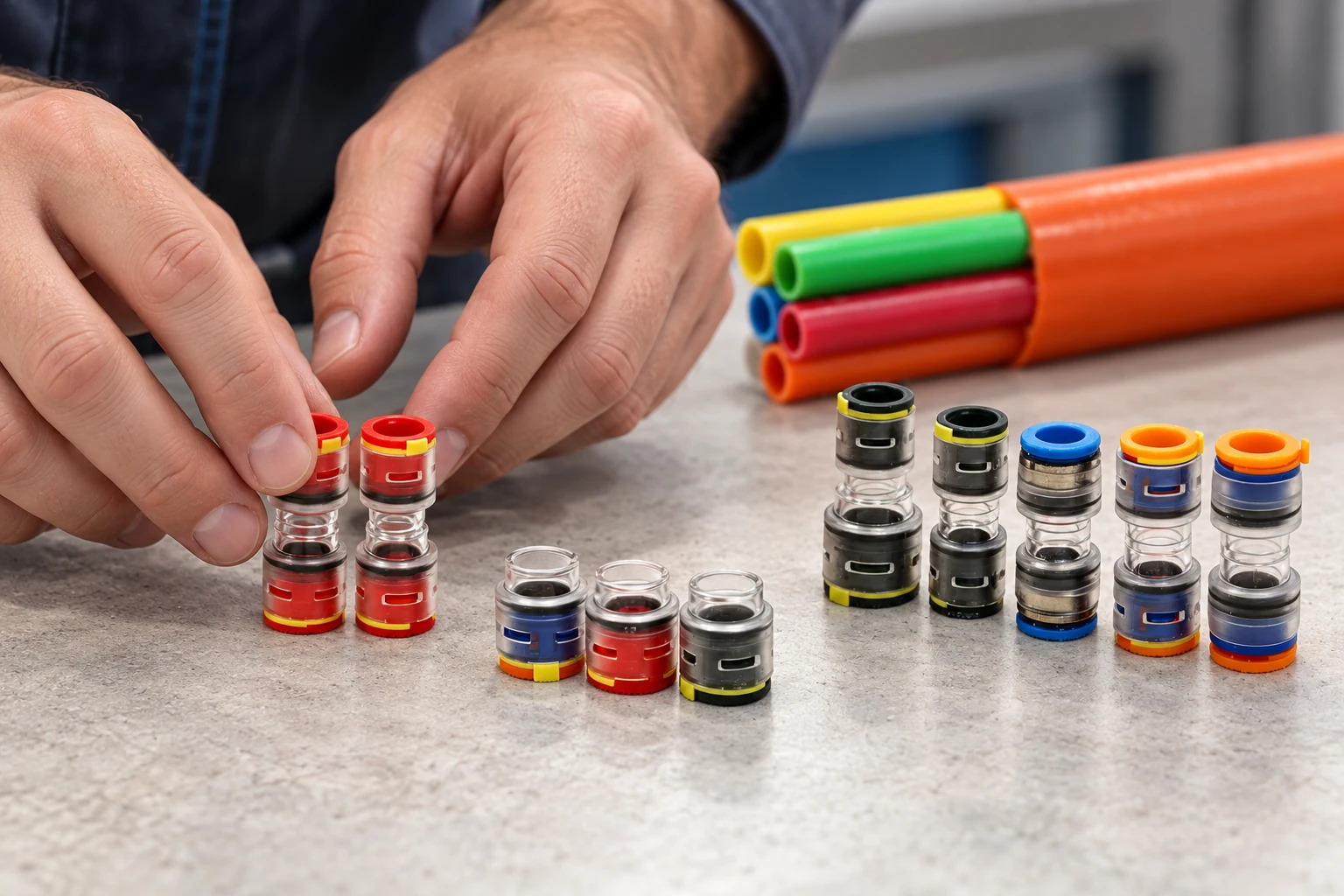
Un coupleur droit relie deux extrémités de conduit compatibles sur un même axe. Il peut prolonger ou réparer une conduite lorsque la documentation technique l’autorise. La seule possibilité d’insertion ne garantit ni l’étanchéité, ni la retenue, ni la continuité de l’alésage, ni l’aptitude aux conditions environnementales.
D’autres catégories répondent à des questions différentes : un réducteur assure un changement de diamètre défini, tandis qu’un bouchon d’extrémité ferme un conduit inutilisé. Les fonctions d’obturation contre le gaz ou l’eau ne doivent jamais être déduites d’un simple raccord. Ceci exemple de produit de butée montre pourquoi “ ajustement ”, “ bouchon ”, “ joint ” et “ coupleur ” ne sont pas des synonymes fiables.
La phrase Connecteur pour microgaine à fibre optique est également une abréviation de recherche, et non une spécification. Une description d’achat doit préciser la fonction, les données relatives aux conduits des deux côtés, l’emplacement du parcours, la méthode d’installation et les documents d’agrément. Cela évite qu’un raccord droit ne remplace un dispositif d’obturation ou une transition requis.
Un coupleur droit nécessite des raccords de conduit correspondants.
Commencez par le diamètre extérieur et les tolérances fournis par le fabricant du conduit, puis notez le diamètre intérieur ou la structure de la paroi. Des conduits portant la même désignation nominale peuvent différer en termes de tolérance, de rigidité, d’état de surface ou de gamme de raccords autorisés. Obtenez une confirmation écrite concernant l’interface exacte.
Examinez ensuite la géométrie du joint. L’installateur doit disposer d’une extrémité droite et non endommagée, respecter la profondeur d’insertion spécifiée et disposer d’un moyen de vérifier le bon enfoncement. Un corps transparent ou une marque de contrôle peut faciliter l’inspection, mais ne saurait garantir l’étanchéité sous pression ; les instructions et la procédure d’essai du projet demeurent déterminantes.
Enfin, définissez l’environnement d’installation : les conditions de pose en souterrain, dans une boîte de tirage, à l’entrée d’un bâtiment ou en armoire exposée peuvent varier. Vérifiez la conformité dans la documentation technique précise du produit. Ceci Exemple de produit : microconduit en PEHD Il est possible d’initier une discussion sur le système, mais cela ne confirme pas qu’un raccord et un conduit sélectionnés forment une paire approuvée.
Comparer les raccords par fonction, ajustement et preuves
| Facteur de décision | Catégorie générique de raccords pour conduits FTTH | Catégorie de coupleur droit |
|---|---|---|
| Objectif principal | Couvre les fonctions de raccordement, de réduction, de fermeture, de dérivation, d’isolement ou de transition. | Relie deux conduits compatibles en ligne |
| Point de départ de la sélection | Fonction réseau requise au niveau du site | Données d’interface pour les deux extrémités du conduit |
| Question de compatibilité | L’ajustement exact remplit-il la fonction requise dans les conditions spécifiées ? | Le modèle exact accepte-t-il à la fois les conduits et préserve-t-il le trajet requis ? |
| Vérification de l'installation | Dépend du type de raccord et des instructions du fabricant. | Cut quality, cleanliness, insertion, retention, and specified leak or pressure check |
| Tendance du coût unitaire | Varies with function and documentation; no category-wide assumption is reliable | Often simple in function, but purchase price alone excludes rework risk |
| Maintenance and TCO | Driven by access, inspection, replacement process, and failure consequence | Driven by joint count, accessibility, installation control, and verified fit |
The total-cost issue is practical: an inexpensive but incorrectly specified connection can consume crew time during fault isolation and delay the next installation stage. That statement is procurement logic, not a field-performance claim about a particular model. Compare the evidence package and the cost of access or rework, not merely two unit prices.
Use Route Conditions to Build the Selection Matrix
| État du projet | Likely fitting category to investigate | Evidence to obtain before approval |
|---|---|---|
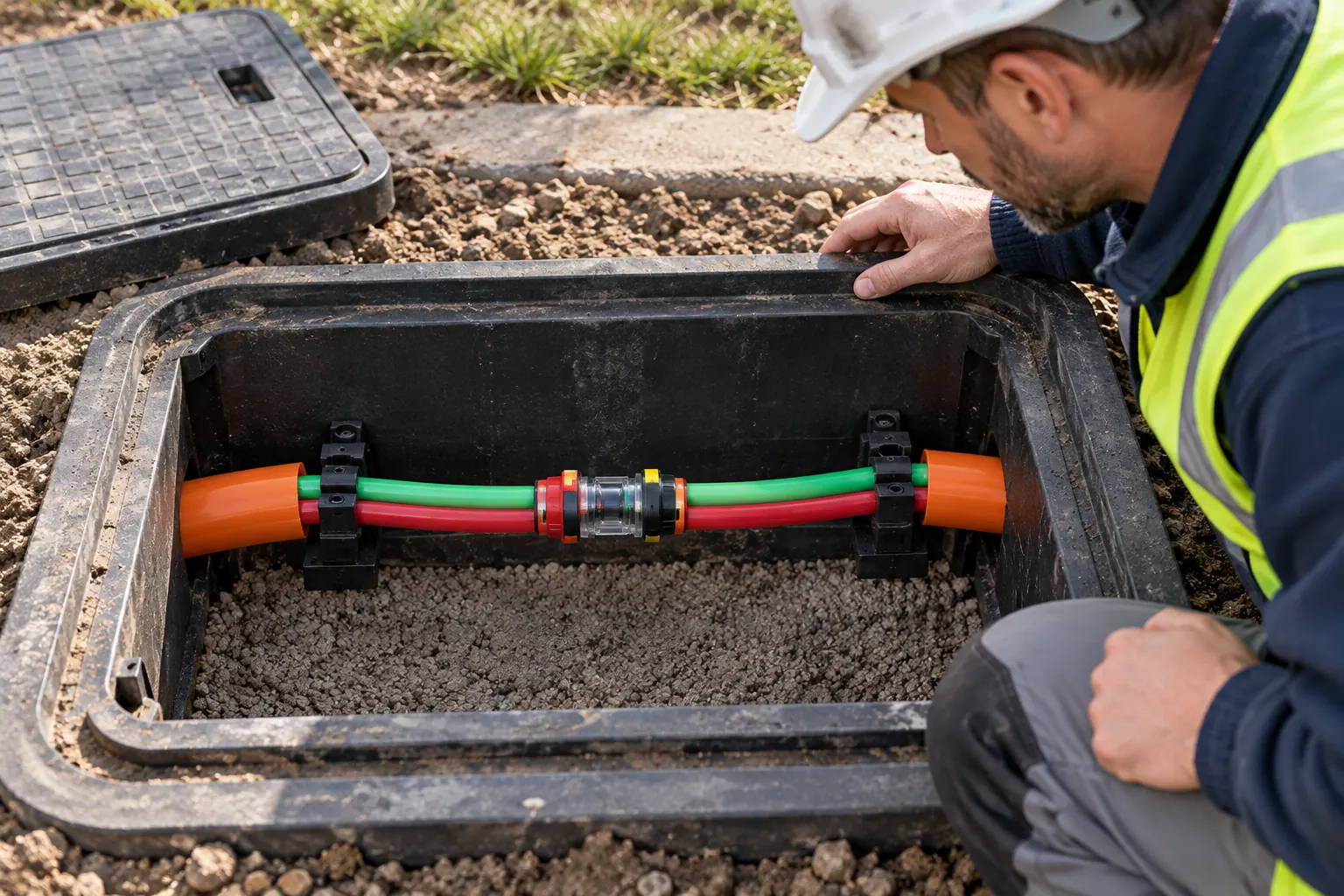
| Two like-for-like duct ends in one run | Manchon droit | Accepted duct dimensions, insertion instruction, environmental limits, and test conditions |
| Ducts with different outside diameters | Purpose-designed reducer or transition fitting | Approved size mapping for both sides and pathway geometry |
| Same outside diameter but different wall construction | Model confirmed by both duct and fitting documentation | Written compatibility confirmation; do not infer it from outside diameter alone |
| Unused duct awaiting future service | End closure specified for that duty | Closure instructions, environment limits, and reopening or replacement guidance |
| Building entry or another defined boundary | Boundary-control fitting identified by the network design | Project requirements and exact, substantiated product function |
Un HDPE telecom coupler should therefore be treated as procurement shorthand until the supplier identifies the exact model and its documented application. If a row in the matrix cannot be completed from controlled documents, pause the substitution rather than filling the gap with a generic claim.
What the Standards Cover—and What They Do Not Approve
ITU-T L.79 describes optical fiber cable elements for microduct blowing-installation applications. IEC 60794-5-20 addresses outdoor microduct fiber units, microducts, and protected microducts for blown installation. These publications define system context; citing them does not certify a fitting or create a rating.
IEC 60794-1-21 covers mechanical test methods for optical fiber cables; IEC 60794-1-22 covers environmental methods. They are not blanket approvals for surrounding components. Ask which edition, method, specimen, conditioning, and acceptance criterion apply, then request evidence for the offered model. Market rules and network-owner specifications may add requirements.
Unsupported claims can cause submittal rejection, delay, or substitution disputes. Use “tested according to” only with a traceable report, and “compliant” only after reviewing the applicable scope and evidence.
Confirm the Model and Documents Before Substitution
- Mark every fitting location on the route and name its required function before requesting prices.
- Provide the controlled duct datasheet for each side of every joint, including tolerances rather than only nominal size.
- Request the proposed model’s current datasheet, installation instructions, environmental limits, and applicable test evidence.
- Define the site inspection and acceptance record before installation begins; do not invent a pressure or temperature limit when the project documents are silent.
- Control substitutions by exact model and revision, because a generic category name cannot demonstrate equivalence.
Microduct Connector can support this review by matching a request to available product categories and documentation, while the buyer and network owner retain responsibility for project approval. The company’s guide on how to choose the right connector provides additional questions to use during supplier discussions.
Foire aux questions
Why does the FTTH duct fittings leak during or after fiber blowing
Possible causes include an incompletely seated duct, a damaged or contaminated duct end, a seal problem, dimensional mismatch, or damage introduced during handling. Isolate the joint and follow the project’s safe test procedure, then compare the exact duct and fitting data instead of assuming higher blowing pressure will solve the fault.
Do you need tools or lubricant to fit the FTTH duct fittings correctly
Use only the preparation tools and installation method named by the fitting manufacturer. Do not apply lubricant unless both the fitting and duct instructions permit the specific product, because an unapproved substance can affect grip, sealing, cleanliness, or later fiber work.
How can the FTTH duct fittings join ducts with different wall thicknesses
Matching outside diameter does not establish compatibility when wall construction differs. Obtain written confirmation for the exact duct pair and fitting model; if outside diameters differ, investigate a purpose-designed reducer rather than forcing a straight coupler to serve as a transition.
What temperature range should the FTTH duct fittings withstand
The required range comes from the route’s storage, installation, and service conditions, plus the network-owner specification. Use the exact model’s documented limits and test conditions; this article does not assign a generic temperature range because products and projects differ.
How can installers visually check that the FTTH duct fittings is fully seated
Follow the stated insertion depth and use a witness mark, transparent body, or inspection feature only when the exact model provides one. A visual check should be backed by the specified retention and leak or pressure acceptance process, because appearance alone does not prove joint integrity.
When should the seals or body of the FTTH duct fittings be replaced?
Replace parts when the manufacturer’s inspection criteria require it, when damage or deformation is visible, or when the assembled joint cannot pass the specified acceptance check after correct preparation. Reuse only when the product documentation permits it; otherwise replace the fitting and investigate the duct condition that may have caused the problem.
How to Choose Between FTTH Fittings and Couplers
“Fitting” describes a broad group; a straight coupler is appropriate only for a defined, matching joint. Map every location to its actual function, confirm both duct interfaces and the route environment, then approve the exact model, revision, installation method and acceptance record together. The 12.7 mm sizing discussion illustrates why nominal labels need drawing-level checks, while the 12 mm guide shows how to document seating and leak-test decisions without assuming a generic rating.
Références
- ITU-T L.79: Optical fibre cable elements for microduct blowing-installation application.
- IEC 60794-5-20: Outdoor microduct fibre units, microducts and protected microducts for installation by blowing.
- IEC 60794-1-21: Basic optical cable test procedures—Mechanical test methods.
- IEC 60794-1-22: Basic optical cable test procedures—Environmental test methods.
FTTH duct fittings are a category; a coupler is one defined solution within it. The right selection follows the job at each location: match both duct interfaces, choose the required function, check the route environment and approve the exact model with its installation and acceptance records. That process keeps a convenient catalogue label from deciding a connection that the duct system cannot support.



