
When a network construction manager in Bristol encountered an air-loss warning during a pre-blowing check, the crew replaced the visible coupler—but the test failed again. In this illustrative scenario, no product defect was proven: the bill of materials had treated an in-line joint, unused branch, and size transition as interchangeable “couplers.” The team corrected the specification by assigning each location a function and exact duct interface.
Sažetak: The phrase FTTH duct fittings describes a broad category; a straight coupler is one type used to join two compatible ducts in line. Before choosing a model, confirm outside diameter, wall construction, insertion, environment, and the acceptance test. ITU-T L.79 and the IEC 60794 series provide system and test context, not proof that a connector suits your project.
Choose the Fitting by Its Function, Not Its Catalog Name
FTTH routes use ducts to guide and protect fiber cable or blowable fiber units. See the role of microduct connectors in FTTH networks for system context. A termination, branch, transition, and repair each presents a different connection task.
“Duct fitting” is a family description covering straight connectors, reducers, end closures, branching arrangements, and other interfaces. “Coupler” is narrower when it means a straight, two-ended joint, although terminology varies by supplier. A search phrase such as Microduct connector telecom part does not identify geometry, duct size, exposure, or acceptance requirements; controlled drawings and exact product data must do that.
This article compares generic categories, not named models. Linked product pages illustrate component forms; they do not prove compatibility with a specific duct, pressure, route, climate, or client specification.
When a Full Duct Fitting Is Needed Instead of a Straight Coupler
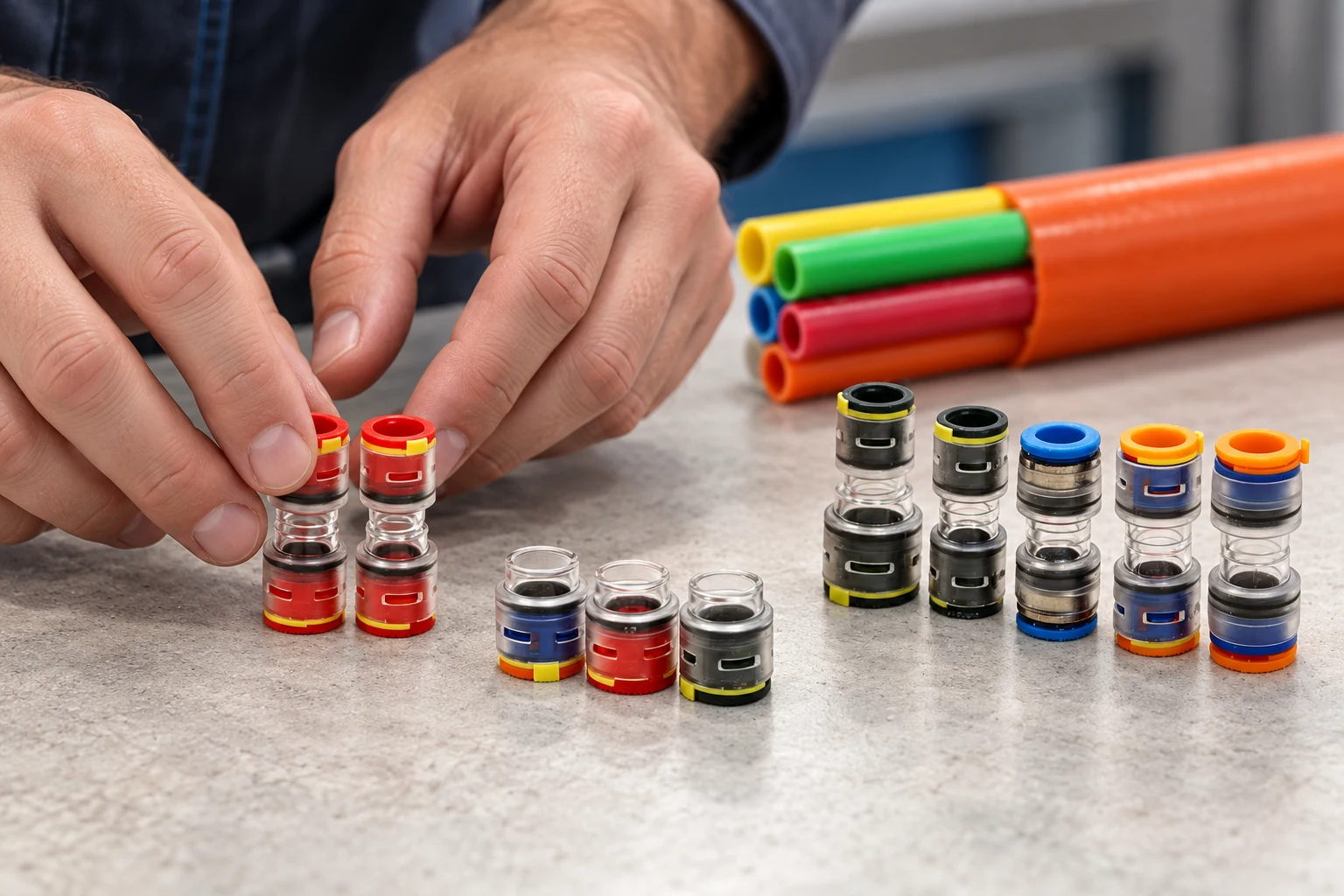
A straight coupler connects two compatible duct ends on one axis. It may extend or repair a run when the exact documentation permits that use. Insertability alone does not establish sealing, retention, bore continuity, or environmental suitability.
Other categories answer different questions: a reducer handles a defined size change, while an end stop closes an unused duct. Gas- or water-blocking functions must never be inferred from an ordinary coupler. This end-stop product example shows why “fitting,” “cap,” “joint,” and “coupler” are not reliable synonyms.
The phrase Connector microduct fiber is also search shorthand, not a specification. A purchase description should state function, duct data for both sides, route location, installation method, and approval documents. This prevents a straight union from replacing a required closure or transition.
A Straight Coupler Requires Matching Duct Interfaces
Start with the duct manufacturer’s outside diameter and tolerances, then record the inner diameter or wall construction. Ducts sharing a nominal label may differ in tolerance, stiffness, surface condition, or approved connector range. Obtain written confirmation for the exact interface.
Next examine joint geometry. The installer needs a square, undamaged end, the specified insertion depth, and a way to confirm seating. A transparent body or witness feature may support inspection but cannot prove pressure integrity; instructions and the project test procedure remain controlling.
Finally, define the installation environment: burial, handhole, building entry, and exposed cabinet conditions can differ. Verify suitability from exact product documentation. This HDPE microduct product example can start a system discussion, but it does not confirm that a chosen fitting and duct form an approved pair.
Compare Fittings by Function, Fit, and Evidence
| Faktor odluke | Generic FTTH duct-fitting category | Straight coupler category |
|---|---|---|
| Primary purpose | Covers joining, reducing, closing, branching, isolating, or transitioning functions | Joins two compatible ducts in line |
| Selection starting point | Required network function at the location | Interface data for both duct ends |
| Compatibility question | Does the exact fitting perform the required function under the specified conditions? | Does the exact model accept both ducts and preserve the required pathway? |
| Provjera instalacije | Depends on the fitting type and manufacturer instruction | Cut quality, cleanliness, insertion, retention, and specified leak or pressure check |
| Tendencija jediničnih troškova | Varies with function and documentation; no category-wide assumption is reliable | Often simple in function, but purchase price alone excludes rework risk |
| Maintenance and TCO | Driven by access, inspection, replacement process, and failure consequence | Driven by joint count, accessibility, installation control, and verified fit |
The total-cost issue is practical: an inexpensive but incorrectly specified connection can consume crew time during fault isolation and delay the next installation stage. That statement is procurement logic, not a field-performance claim about a particular model. Compare the evidence package and the cost of access or rework, not merely two unit prices.
Use Route Conditions to Build the Selection Matrix
| Project condition | Likely fitting category to investigate | Evidence to obtain before approval |
|---|---|---|
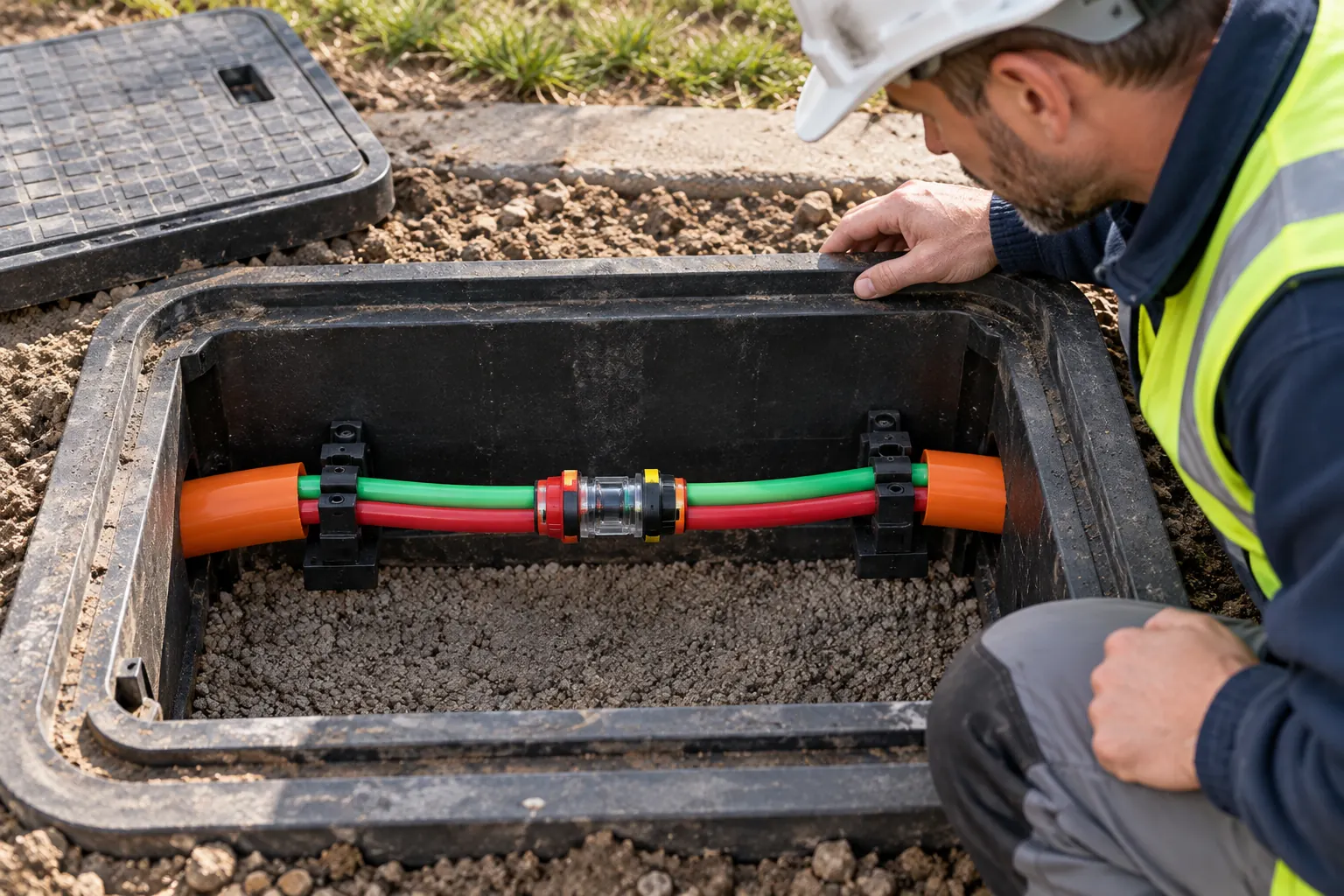
| Two like-for-like duct ends in one run | Pravi spojnik | Accepted duct dimensions, insertion instruction, environmental limits, and test conditions |
| Ducts with different outside diameters | Purpose-designed reducer or transition fitting | Approved size mapping for both sides and pathway geometry |
| Same outside diameter but different wall construction | Model confirmed by both duct and fitting documentation | Written compatibility confirmation; do not infer it from outside diameter alone |
| Unused duct awaiting future service | End closure specified for that duty | Closure instructions, environment limits, and reopening or replacement guidance |
| Building entry or another defined boundary | Boundary-control fitting identified by the network design | Project requirements and exact, substantiated product function |
Jedan HDPE telecom coupler should therefore be treated as procurement shorthand until the supplier identifies the exact model and its documented application. If a row in the matrix cannot be completed from controlled documents, pause the substitution rather than filling the gap with a generic claim.
What the Standards Cover—and What They Do Not Approve
ITU-T L.79 describes optical fiber cable elements for microduct blowing-installation applications. IEC 60794-5-20 addresses outdoor microduct fiber units, microducts, and protected microducts for blown installation. These publications define system context; citing them does not certify a fitting or create a rating.
IEC 60794-1-21 covers mechanical test methods for optical fiber cables; IEC 60794-1-22 covers environmental methods. They are not blanket approvals for surrounding components. Ask which edition, method, specimen, conditioning, and acceptance criterion apply, then request evidence for the offered model. Market rules and network-owner specifications may add requirements.
Unsupported claims can cause submittal rejection, delay, or substitution disputes. Use “tested according to” only with a traceable report, and “compliant” only after reviewing the applicable scope and evidence.
Confirm the Model and Documents Before Substitution
- Mark every fitting location on the route and name its required function before requesting prices.
- Provide the controlled duct datasheet for each side of every joint, including tolerances rather than only nominal size.
- Request the proposed model’s current datasheet, installation instructions, environmental limits, and applicable test evidence.
- Define the site inspection and acceptance record before installation begins; do not invent a pressure or temperature limit when the project documents are silent.
- Control substitutions by exact model and revision, because a generic category name cannot demonstrate equivalence.
Microduct Connector can support this review by matching a request to available product categories and documentation, while the buyer and network owner retain responsibility for project approval. The company’s guide on how to choose the right connector provides additional questions to use during supplier discussions.
Često postavljana pitanja
Why does the FTTH duct fittings leak during or after fiber blowing
Possible causes include an incompletely seated duct, a damaged or contaminated duct end, a seal problem, dimensional mismatch, or damage introduced during handling. Isolate the joint and follow the project’s safe test procedure, then compare the exact duct and fitting data instead of assuming higher blowing pressure will solve the fault.
Do you need tools or lubricant to fit the FTTH duct fittings correctly
Use only the preparation tools and installation method named by the fitting manufacturer. Do not apply lubricant unless both the fitting and duct instructions permit the specific product, because an unapproved substance can affect grip, sealing, cleanliness, or later fiber work.
How can the FTTH duct fittings join ducts with different wall thicknesses
Matching outside diameter does not establish compatibility when wall construction differs. Obtain written confirmation for the exact duct pair and fitting model; if outside diameters differ, investigate a purpose-designed reducer rather than forcing a straight coupler to serve as a transition.
What temperature range should the FTTH duct fittings withstand
The required range comes from the route’s storage, installation, and service conditions, plus the network-owner specification. Use the exact model’s documented limits and test conditions; this article does not assign a generic temperature range because products and projects differ.
How can installers visually check that the FTTH duct fittings is fully seated
Follow the stated insertion depth and use a witness mark, transparent body, or inspection feature only when the exact model provides one. A visual check should be backed by the specified retention and leak or pressure acceptance process, because appearance alone does not prove joint integrity.
When should the seals or body of the FTTH duct fittings be replaced?
Replace parts when the manufacturer’s inspection criteria require it, when damage or deformation is visible, or when the assembled joint cannot pass the specified acceptance check after correct preparation. Reuse only when the product documentation permits it; otherwise replace the fitting and investigate the duct condition that may have caused the problem.
How to Choose Between FTTH Fittings and Couplers
“Fitting” describes a broad group; a straight coupler is appropriate only for a defined, matching joint. Map every location to its actual function, confirm both duct interfaces and the route environment, then approve the exact model, revision, installation method and acceptance record together. The 12.7 mm sizing discussion illustrates why nominal labels need drawing-level checks, while the 12 mm guide shows how to document seating and leak-test decisions without assuming a generic rating.
Reference
- ITU-T L.79: Optical fibre cable elements for microduct blowing-installation application.
- IEC 60794-5-20: Outdoor microduct fibre units, microducts and protected microducts for installation by blowing.
- IEC 60794-1-21: Basic optical cable test procedures—Mechanical test methods.
- IEC 60794-1-22: Basic optical cable test procedures—Environmental test methods.
FTTH duct fittings are a category; a coupler is one defined solution within it. The right selection follows the job at each location: match both duct interfaces, choose the required function, check the route environment and approve the exact model with its installation and acceptance records. That process keeps a convenient catalogue label from deciding a connection that the duct system cannot support.


