
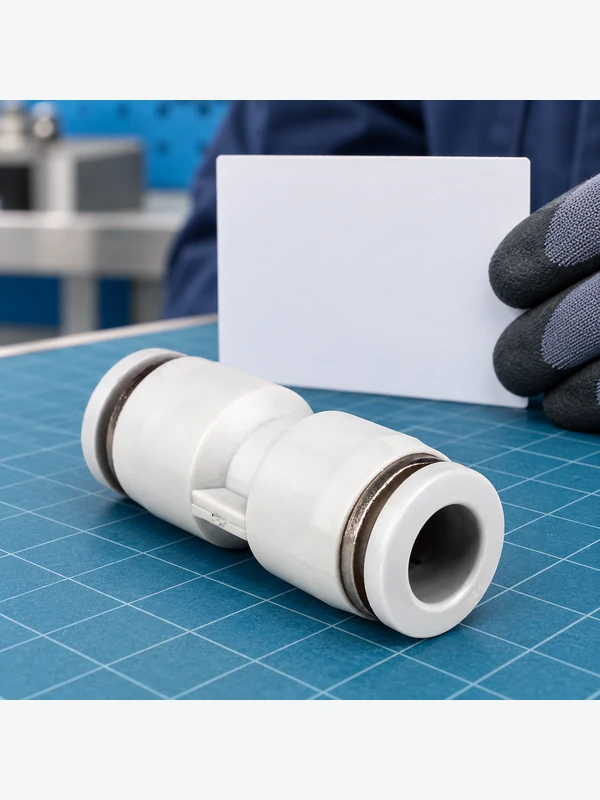
プラスチック製空気圧継手 チューブ、本体、シールおよび使用環境が一体として認証されている場合、産業用エアラインに適合させることができます。対象のチューブおよび使用条件に応じて、本体とシールの定格を確認してください。プラスチック製品と金属製品の選択肢を比較したり、複数の機械エリアにわたって交換部品を標準化したりする前に、実際の圧力、温度、動作条件、化学物質、および保守作業の可及性を明確にしてください。.
実際のチューブ外径、使用圧力と温度、空気の品質、化学物質への曝露、および必要な安全対策に応じて継手を選定してください。図面からねじ規格を確認してください。ISO 4414は空気圧システムの安全性に対応し、ISO 8573-1は空気中の汚染物質を分類します。まずチューブと稼働サイクルから始め、メーカーの耐圧・耐熱性能を確認し、保守作業の前にはシステムの圧力を解放してください。.
これらのプラスチック製空気配管用継手は、チューブ、バルブ、レギュレーター、シリンダー、および分配ポイントを接続します。多くのクリーンで中程度の負荷用途に適していますが、ポリマーは熱、洗浄剤、振動、および油に対してそれぞれ異なる挙動を示します。配管経路、ロックアウト手順、および保守点検時のアクセスとともに、空気システムの仕様書に記載してください。.
空気ラインの運転条件から始めます
接続部における通常圧力および最大圧力、温度、媒体、デューティサイクル、および近隣の作業者を記録してください。ISO 4414:2010は、エネルギー隔離や残留圧力の危険を含む空気圧システムの設計および運用を対象としていますが、個々の継手を認証するものではありません。静的なベンチ試験での評価値は、熱、繰り返しの動き、または解放後に鞭のように振れる可能性のある配管には適さない場合があります。.
ISO 8573-1:2010は、空気中の汚染物質を粒子、水分、油分によって分類するものであり、製品の認証ではありません。下流工程における空気品質の等級を指定し、潤滑剤、凝縮水、または洗浄剤が継手に到達しないかどうかを確認してください。食品包装と一般的な機械の作動では、同じ公称圧力であっても異なるリスク評価が必要になることがあります。.
チュービングと継手は、1つのインターフェースとして指定する必要があります。コレットとシールは、規定のチューブ外径および公差に基づいて設計されています。一般的な外径には、4、6、8、10、12 mmがありますが、メートル法のチューブとインチ規格のチューブは互換性がありません。公表されているチューブの範囲を使用し、直角に切断し、スクラッチがないか確認した上で、使用前に圧力の緩やかな開放と引っ張り検査を実施してください。.
環境に使用する素材を選択してください
ポリアミド(ナイロン)、PBT、アセタル、およびポリプロピレンは、剛性、水分への応答、耐薬品性、耐熱性においてそれぞれ異なるトレードオフを示します。使用する媒体と温度に対応したコンパウンドとシールの組み合わせを選択してください。ASTM D543は、プラスチックの化学薬品に対する耐性を評価するもので、材料の比較には役立ちますが、すべてのプラント用流体に対して完成品の継手が適合することを保証するものではありません。.
また、シールの評価も行いましょう。NBR、FKM、EPDMなどのエラストマーは、油、熱、洗浄用化学薬品に対する耐性が異なります。サプライヤーは、本体と シール材, なぜなら、一見互換性があるように見える樹脂製本体でも、Oリングが互換でないために早期に故障する可能性があるからです。露出部、可動部、または高温環境下にある箇所については、文書化された代替品と組み立て全体の許容範囲を比較検討してください。金属製であるだけでは、適合性は保証されません。.
| 要因 | エンジニアリングプラスチック継手 | 金属製の継手 | 調達への影響 |
|---|---|---|---|
| 重量と取り扱い | 通常は低質量 | 合金と設計によります | プラスチックは、密集したサポート付き配線を簡素化できます。. |
| 熱および機械的損傷 | Depends strongly on polymer and seal | Compare the exact body, seal and tube ratings | Compare published pressure-temperature curves, not a single pressure value. |
| Corrosion exposure | Some polymers resist many aqueous environments | Alloy and plating matter | Review the actual washdown or ambient chemistry. |
| インストール速度 | Often supports tool-light tube connection | May require threaded assembly or ferrules | Measure installation and rework time in the TCO case. |
| Maintenance risk | Sensitive to tube condition and correct release procedure | Suitability still depends on the complete combination | Set inspection criteria for either option. |
When a metal fitting is a suitable replacement
Replacing a plastic body with a metal one is reasonable when the documented plastic assembly cannot accommodate the actual environment and a specified metal alternative can. First establish why the existing connection leaks. Identify whether the failed element is the tube surface, collet, thread, body or seal. A metal adapter with the same incompatible tube or unsupported bend can reproduce the original fault, while moving the damage into a more expensive port.
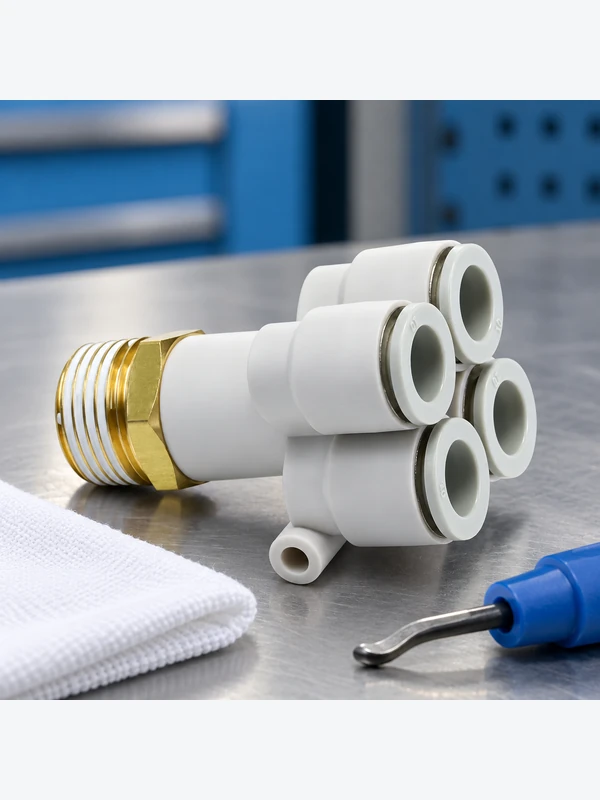
Separate a mechanical-location problem from a material problem. Impact exposure may require guarding; movement may require rerouting, support or a connection explicitly designed for that duty. Heat and cleaning chemicals require documented compatibility for the tube and elastomer as well as the body. A stainless outer shell does not automatically give the internal seal a higher temperature or chemical limit. Compare the complete rated configuration at the conditions measured at the connection.
Manufacturer catalogues illustrate why this must be model-specific. SMC’s KQ/KQ2 catalogue separately identifies permitted tubing, tube dimensions, operating fluids and component materials. Those are data for the named series, not ratings that can be transferred to an Oulu fitting or to a visually similar product. Use the same evidence categories in an enquiry for the proposed replacement and leave any undocumented field open for supplier confirmation.
For a production change, record the reason for substitution and the acceptance conditions before ordering. Keep the installed tube, mating port, operating cycle and maintenance access in the comparison. The straight-fitting fault guide can help identify the original interface problem. Approve the metal alternative only after it meets the actual requirement; do not use a successful static seal as proof that the entire moving assembly is qualified.
Include assembly, leak testing and repairs in the cost comparison
push-to-connect fittings can reduce assembly time and make panel maintenance more repeatable when technicians use compatible, undamaged tube. Unit price is only part of the cost: a leak can raise compressor run time, and an inaccessible connector extends interruption. The U.S. Department of Energy emphasizes leak management as a system-efficiency measure.
For example, 24 connections saving 6 installation minutes each reduce initial labor by 144 minutes. That benefit can disappear through repeat troubleshooting. Treat this as an example, not a performance claim; validate a representative assembly with an appropriate pressure-hold check and documented acceptance criteria.
| 応募条件 | 何を検証すべきか | Typical selection direction | 受領証拠 |
|---|---|---|---|
| Clean, fixed automation line | Tube OD, pressure, temperature, air class | Plastic may be suitable | Supplier data and installed pull/pressure check |
| Frequent machine changeover | Release access, tube wear, training | Quick-connect design with controlled procedure | Repeatability trial over the changeover cycle |
| Washdown or chemical exposure | Body and seal compatibility | Material-specific evaluation required | Compatibility evidence, such as ASTM D543 data where relevant |
| Hot, vibrating, or exposed zone | Temperature, impact, restraint, fatigue | Consider metal and additional guarding | Assembly rating and machinery risk assessment |
Approve fittings separately for each machine environment
Standardisation can simplify stores and training, but one plant can contain several different fitting environments. Divide the application into identifiable zones: a fixed control cabinet, a moving actuator area, a warmer process section and a location exposed to washdown are different approval cases. Use measured or documented operating conditions for each. Do not inherit a cabinet approval for another zone simply because both lines use the same nominal supply pressure.
構築する qualification matrix around the interfaces that matter: tube manufacturer and material, OD and tolerance, body and seal identification, port thread, installation method, temperature, maximum pressure and media exposure. Add support and release clearance. A purchase order that says only “8 mm plastic fitting” cannot communicate that complete requirement. The 空気圧部品のラインナップ can help locate candidates, but the final approval should identify the exact code and documentation revision.
Use a representative assembly and the intended チューブの準備 procedure. Agree what will be inspected before the test, which authorised operating conditions will be reproduced and how leakage or retention will be assessed. Do not invent a common endurance cycle count or proof pressure for unlike models. Where movement is involved, perform the approved cycle with the normal safeguards, and never apply a manual side load to a pressurised fitting to see whether it leaks.
Retain the result with the zone approval and define what triggers review. A different cleaner, hotter process, replacement tube family, changed routing or new port design can invalidate the original comparison. Track repeat repairs and the actual time needed for access and retesting. These observations support a local total-cost comparison without claiming a universal percentage saving or service life. Review ワンタッチ式の取り付け作業 when training technicians, while keeping installation limits tied to the supplied product.
Check safety rules alongside the supplier’s fitting ratings
For U.S. workplaces, OSHA 29 CFR 1910.147 governs hazardous-energy control and 29 CFR 1910.169 addresses air receivers; neither certifies every fitting. ISO 4414 defines pneumatic-system safety expectations, and ISO 8573-1 air-purity classes. These sources guide specification scope; the maker’s pressure-temperature limits, material declarations, and instructions establish item suitability.
Unsupported claims create practical commercial risk: an overstated pressure, food-contact, chemical-resistance, or “ISO certified” statement can lead to rejected submittals, unsafe substitution, warranty disputes, or rework. Apply the destination market’s rules and the equipment’s intended use before making claims in procurement documents. A standard test method demonstrates how a property was evaluated; it does not automatically approve a product or system.
What to confirm before ordering plastic fittings
- Map every connection: tube OD, thread standard, orientation, minimum bend clearance, and service access.
- Define normal and maximum pressure and temperature at the point of use, including compressor start-stop and ambient conditions.
- Specify air cleanliness using the process need, then review body and seal compatibility with oil, water, cleaners, and nearby chemicals.
- Request current drawings, pressure-temperature ratings, material information, and installation instructions; validate a representative assembly before rollout.
- Document lockout, depressurization, inspection, and replacement criteria in the maintenance plan.
ANMASPC / Microduct Connector can support buyers who need to align connector configuration with tubing, routing, and documentation requirements. Review the available 製品ラインナップ alongside the machine specification, rather than approving substitutions from photographs alone.
よくある質問
What are plastic pneumatic fittings used for?
They connect tubes and pneumatic components in equipment such as control panels, automation cells, and air-preparation assemblies. Their suitability depends on the pressure-temperature rating, media, tube compatibility, and physical exposure at that location.
プッシュ・ツー・コネクト継手は信頼性がありますか?
They can be reliable when the fitting, tube, and installation method are matched. Use the correct OD and tube material, make a square cut, fully insert the tube, and confirm the connection with the supplier’s recommended check before commissioning.
What is the best plastic for pneumatic fittings?
There is no universal best material. Choose the body and seal combination that the manufacturer rates for the temperature, pressure, lubricant, moisture, and chemicals in the real application; comparison data should identify the tested material and conditions.
How do you choose pneumatic tubing size?
Select pneumatic tubing OD to match the fitting and select bore based on required flow, allowable pressure drop, route length, and actuator demand. Confirm both metric versus inch sizing and the supplier’s tube-tolerance limits; do not force a near-match into a collet.
Can plastic fittings handle compressed air?
Yes, many are designed for it, but only within their published operating envelope. Check the compressed air quality, maximum pressure, temperature, and potential mechanical loading, then follow the system’s energy-isolation procedure during service.
When should metal fittings be used instead?
Consider metal where the assembly sees higher heat, mechanical impact, vibration, difficult chemical conditions, or a duty outside the plastic fitting’s documented limits. The decision should be based on complete-system risk and the manufacturer’s assembly data, not a general assumption that one material always outperforms another.
Is a plastic pneumatic fitting automatically unsuitable for a production machine?
No. Suitability depends on the exact body and seal, tube, pressure, temperature, medium, vibration and installation environment. Approve the complete combination from the supplier’s documented limits and a representative test.
How should a buyer compare two plastic fitting materials?
Compare the approved temperature and pressure range, chemical and media compatibility, UV or environmental exposure, tube retention, thread design, replacement policy and evidence supplied for the exact model. Do not choose from colour or body shape alone.
Will a stainless body fix a leak caused by the wrong tube OD?
No. The tube must match the fitting’s approved OD, tolerance, material and surface condition. Changing the body material does not correct an incompatible tube or damaged sealing zone. Identify the failed interface before selecting a replacement.
What changes should trigger a review of an approved plastic fitting?
Review the approval when the tube, seal, cleaner, medium, pressure, temperature, movement, routing or mating port changes. Check the exact assembly against the revised conditions and use the required qualification procedure. A prior approval for another machine zone is not automatic evidence of suitability.
参考文献
- SMC — KQ/KQ2 one-touch fittings catalogue (series-specific tube and assembly data)
- U.S. Department of Energy — Improving Compressed Air System Performance: Minimize Compressed Air Leaks
- ASME B1.20.1 — パイプねじ、汎用(インチ)、公式な適用範囲
要約
Identify the failure and operating conditions before choosing a plastic or metal replacement. Verify tube compatibility, thread and seal arrangement first, then compare the exact body-and-seal combinations for heat, chemicals, movement and exposure. Use metal where its documented assembly addresses the requirement, while correcting routing, support or preparation problems independently. For standardisation, qualify identifiable machine zones and retain the tube, part code, conditions and acceptance results. Review that approval after a material or process change. Keep the approval with the exact tube and fitting combination. A material change will not fix a damaged tube, incompatible thread or unsupported connection.



