
Accesorios neumáticos de plástico Puede adaptarse a una línea de aire industrial cuando el tubo, la carcasa, el sello y el entorno de funcionamiento están homologados como un conjunto integrado. Verifique las clasificaciones de la carcasa y del sello para el tubo previsto y las condiciones de servicio. Determine la presión real, la temperatura, el tipo de movimiento, los productos químicos y el acceso para el mantenimiento antes de comparar alternativas de plástico y metal o de estandarizar un repuesto en varias zonas de la máquina.
Elija los accesorios según el diámetro exterior real de la tubería, la presión y la temperatura de funcionamiento, la calidad del aire, la exposición a productos químicos y los controles de seguridad requeridos. Confirme la designación de la rosca en el plano. ISO 4414 aborda la seguridad de los sistemas neumáticos, mientras que ISO 8573-1 clasifica los contaminantes del aire. Comience con la tubería y el ciclo de trabajo, verifique la clasificación de presión y temperatura del fabricante y libere la presión del sistema antes del mantenimiento.
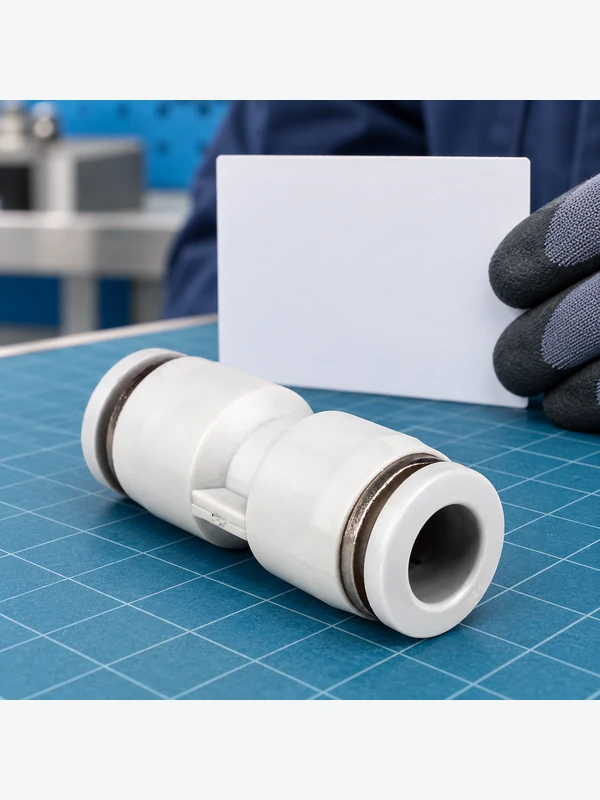
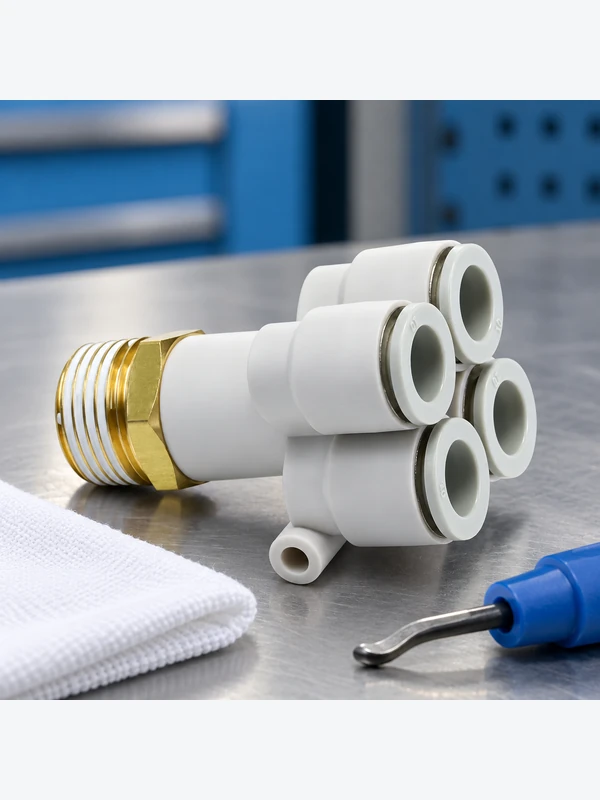
Estos accesorios neumáticos de plástico conectan tubos, válvulas, reguladores, cilindros y puntos de distribución. Son adecuados para numerosos circuitos limpios de servicio moderado, pero los polímeros responden de manera diferente al calor, a los productos de limpieza, a la vibración y a los aceites. Inclúyalos en la especificación del sistema de aire junto con el trazado de las tuberías, las prácticas de bloqueo y el acceso para el mantenimiento.
Comience con las condiciones de operación de la línea de aire.
Registre la presión normal y máxima, la temperatura en la conexión, el fluido, el ciclo de trabajo y el personal cercano. La norma ISO 4414:2010 abarca el diseño y la operación de sistemas neumáticos, incluidos los riesgos de aislamiento de energía y de presión residual; no certifica un accesorio individual. Una clasificación estática en banco puede no ser adecuada para altas temperaturas, movimientos repetidos o una línea que pueda azotarse tras su liberación.
ISO 8573-1:2010 clasifica los contaminantes del aire según partículas, agua y aceite; no es una aprobación de producto. Especifique la clase de calidad del aire del proceso aguas abajo y verifique si el lubricante, el condensado o los limpiadores pueden llegar al accesorio. El envasado de alimentos y la actuación general de máquinas pueden requerir diferentes evaluaciones de riesgo a la misma presión nominal.
El tubo y el accesorio deben especificarse como una sola interfaz. El collarín y el sello están diseñados en función de un diámetro exterior del tubo definido y su tolerancia. Los diámetros exteriores comunes incluyen 4, 6, 8, 10 y 12 mm, pero los tubos métricos y los tubos en pulgadas no son intercambiables. Utilice la gama de tubos publicada, realice un corte recto, inspeccione para detectar marcas o rayaduras y emplee una despresurización controlada junto con una prueba de tracción antes de la puesta en servicio.
Elija el material para el entorno
La poliamida (nailon), el PBT, el acetal y el polipropileno presentan diferentes compensaciones en rigidez, respuesta a la humedad, resistencia química y capacidad de temperatura. Elija el compuesto y la combinación de sello cuya clasificación cubra los medios y la temperatura reales. La norma ASTM D543 evalúa la resistencia de los plásticos a los reactivos químicos; permite comparar materiales, pero no certifica un accesorio terminado para cada fluido de planta.
También evalúe el sello. El NBR, el FKM, el EPDM y otros elastómeros presentan diferentes niveles de compatibilidad con aceites, calor y productos químicos de limpieza. Un proveedor debería poder identificar tanto el cuerpo como material de sellado, porque una carcasa de plástico aparentemente compatible aún puede fallar prematuramente debido a una junta tórica incompatible. Para puntos expuestos, móviles o sometidos a altas temperaturas, compare las alternativas documentadas y los límites del conjunto completo; la construcción metálica por sí sola no garantiza la idoneidad.
| Factor | Accesorio de plástico técnico | Accesorio metálico | Implicación de contratación |
|---|---|---|---|
| Peso y manejo | Generalmente de baja masa | Depende de la aleación y el diseño | El plástico puede simplificar el enrutamiento denso con soportes. |
| Calor y abuso mecánico | Depende en gran medida del polímero y del sello | Compara las clasificaciones exactas de la carcasa, el sello y el tubo. | Compare las curvas de presión-temperatura publicadas, no un solo valor de presión. |
| Exposición a la corrosión | Algunos polímeros son resistentes a numerosos ambientes acuosos. | Material de aleación y chapado | Revise la química real de lavado o del entorno. |
| Velocidad de instalación | A menudo admite la conexión de tubos con herramientas mínimas. | Puede requerir ensamblaje roscado o casquillos | Mida el tiempo de instalación y retrabajo en el caso del TCO. |
| Riesgo de mantenimiento | Sensible al estado del tubo y al procedimiento de liberación correcto | La idoneidad sigue dependiendo de la combinación completa. | Establezca los criterios de inspección para cualquiera de las opciones. |
Cuando una pieza metálica es un reemplazo adecuado
Reemplazar una pieza de plástico por otra de metal es razonable cuando el conjunto de plástico documentado no puede adaptarse al entorno real y existe una alternativa metálica especificada. Primero, determine por qué la conexión existente presenta fugas. Identifique si el elemento defectuoso es la superficie del tubo, el collarín, la rosca, la pieza o el sello. Un adaptador metálico que utilice el mismo tubo incompatible o una curva no soportada puede reproducir la falla original, trasladando el daño a un puerto más costoso.
Separe un problema de ubicación mecánica de un problema de material. La exposición a impactos puede requerir protección; el movimiento puede exigir un reencaminamiento, soporte o una conexión diseñada específicamente para esa función. El calor y los productos químicos de limpieza requieren documentar la compatibilidad tanto del tubo y el elastómero como del cuerpo. Una carcasa exterior de acero inoxidable no implica automáticamente que el sello interno tenga un límite superior de temperatura o de resistencia química. Compare la configuración completa clasificada en las condiciones medidas en la conexión.
Los catálogos de los fabricantes ilustran por qué esto debe ser específico para cada modelo. El catálogo KQ/KQ2 de SMC identifica por separado las tuberías permitidas, las dimensiones de los tubos, los fluidos de funcionamiento y los materiales de los componentes. Esos son datos de la serie mencionada, no valores que puedan transferirse a un accesorio de Oulu ni a un producto visualmente similar. Utilice las mismas categorías de evidencia en una consulta sobre el reemplazo propuesto y deje cualquier campo sin documentar abierto para la confirmación del proveedor.
For a production change, record the reason for substitution and the acceptance conditions before ordering. Keep the installed tube, mating port, operating cycle and maintenance access in the comparison. The straight-fitting fault guide can help identify the original interface problem. Approve the metal alternative only after it meets the actual requirement; do not use a successful static seal as proof that the entire moving assembly is qualified.
Include assembly, leak testing and repairs in the cost comparison
push-to-connect fittings can reduce assembly time and make panel maintenance more repeatable when technicians use compatible, undamaged tube. Unit price is only part of the cost: a leak can raise compressor run time, and an inaccessible connector extends interruption. The U.S. Department of Energy emphasizes leak management as a system-efficiency measure.
For example, 24 connections saving 6 installation minutes each reduce initial labor by 144 minutes. That benefit can disappear through repeat troubleshooting. Treat this as an example, not a performance claim; validate a representative assembly with an appropriate pressure-hold check and documented acceptance criteria.
| Condición de aplicación | Qué verificar | Typical selection direction | Evidencia de aceptación |
|---|---|---|---|
| Clean, fixed automation line | Tube OD, pressure, temperature, air class | Plastic may be suitable | Supplier data and installed pull/pressure check |
| Frequent machine changeover | Release access, tube wear, training | Quick-connect design with controlled procedure | Repeatability trial over the changeover cycle |
| Washdown or chemical exposure | Body and seal compatibility | Material-specific evaluation required | Compatibility evidence, such as ASTM D543 data where relevant |
| Hot, vibrating, or exposed zone | Temperature, impact, restraint, fatigue | Consider metal and additional guarding | Assembly rating and machinery risk assessment |
Approve fittings separately for each machine environment
Standardisation can simplify stores and training, but one plant can contain several different fitting environments. Divide the application into identifiable zones: a fixed control cabinet, a moving actuator area, a warmer process section and a location exposed to washdown are different approval cases. Use measured or documented operating conditions for each. Do not inherit a cabinet approval for another zone simply because both lines use the same nominal supply pressure.
Construir un qualification matrix around the interfaces that matter: tube manufacturer and material, OD and tolerance, body and seal identification, port thread, installation method, temperature, maximum pressure and media exposure. Add support and release clearance. A purchase order that says only “8 mm plastic fitting” cannot communicate that complete requirement. The Ámbito de piezas neumáticas can help locate candidates, but the final approval should identify the exact code and documentation revision.
Use a representative assembly and the intended Preparación de tubos procedure. Agree what will be inspected before the test, which authorised operating conditions will be reproduced and how leakage or retention will be assessed. Do not invent a common endurance cycle count or proof pressure for unlike models. Where movement is involved, perform the approved cycle with the normal safeguards, and never apply a manual side load to a pressurised fitting to see whether it leaks.
Retain the result with the zone approval and define what triggers review. A different cleaner, hotter process, replacement tube family, changed routing or new port design can invalidate the original comparison. Track repeat repairs and the actual time needed for access and retesting. These observations support a local total-cost comparison without claiming a universal percentage saving or service life. Review operación de ajuste con un solo toque when training technicians, while keeping installation limits tied to the supplied product.
Check safety rules alongside the supplier’s fitting ratings
For U.S. workplaces, OSHA 29 CFR 1910.147 governs hazardous-energy control and 29 CFR 1910.169 addresses air receivers; neither certifies every fitting. ISO 4414 defines pneumatic-system safety expectations, and ISO 8573-1 air-purity classes. These sources guide specification scope; the maker’s pressure-temperature limits, material declarations, and instructions establish item suitability.
Unsupported claims create practical commercial risk: an overstated pressure, food-contact, chemical-resistance, or “ISO certified” statement can lead to rejected submittals, unsafe substitution, warranty disputes, or rework. Apply the destination market’s rules and the equipment’s intended use before making claims in procurement documents. A standard test method demonstrates how a property was evaluated; it does not automatically approve a product or system.
What to confirm before ordering plastic fittings
- Map every connection: tube OD, thread standard, orientation, minimum bend clearance, and service access.
- Define normal and maximum pressure and temperature at the point of use, including compressor start-stop and ambient conditions.
- Specify air cleanliness using the process need, then review body and seal compatibility with oil, water, cleaners, and nearby chemicals.
- Request current drawings, pressure-temperature ratings, material information, and installation instructions; validate a representative assembly before rollout.
- Document lockout, depressurization, inspection, and replacement criteria in the maintenance plan.
ANMASPC / Microduct Connector can support buyers who need to align connector configuration with tubing, routing, and documentation requirements. Review the available gama de productos alongside the machine specification, rather than approving substitutions from photographs alone.
Preguntas frecuentes
What are plastic pneumatic fittings used for?
They connect tubes and pneumatic components in equipment such as control panels, automation cells, and air-preparation assemblies. Their suitability depends on the pressure-temperature rating, media, tube compatibility, and physical exposure at that location.
¿Son fiables los accesorios de conexión rápida?
They can be reliable when the fitting, tube, and installation method are matched. Use the correct OD and tube material, make a square cut, fully insert the tube, and confirm the connection with the supplier’s recommended check before commissioning.
What is the best plastic for pneumatic fittings?
There is no universal best material. Choose the body and seal combination that the manufacturer rates for the temperature, pressure, lubricant, moisture, and chemicals in the real application; comparison data should identify the tested material and conditions.
How do you choose pneumatic tubing size?
Select pneumatic tubing OD to match the fitting and select bore based on required flow, allowable pressure drop, route length, and actuator demand. Confirm both metric versus inch sizing and the supplier’s tube-tolerance limits; do not force a near-match into a collet.
Can plastic fittings handle compressed air?
Yes, many are designed for it, but only within their published operating envelope. Check the compressed air quality, maximum pressure, temperature, and potential mechanical loading, then follow the system’s energy-isolation procedure during service.
When should metal fittings be used instead?
Consider metal where the assembly sees higher heat, mechanical impact, vibration, difficult chemical conditions, or a duty outside the plastic fitting’s documented limits. The decision should be based on complete-system risk and the manufacturer’s assembly data, not a general assumption that one material always outperforms another.
Is a plastic pneumatic fitting automatically unsuitable for a production machine?
No. Suitability depends on the exact body and seal, tube, pressure, temperature, medium, vibration and installation environment. Approve the complete combination from the supplier’s documented limits and a representative test.
How should a buyer compare two plastic fitting materials?
Compare the approved temperature and pressure range, chemical and media compatibility, UV or environmental exposure, tube retention, thread design, replacement policy and evidence supplied for the exact model. Do not choose from colour or body shape alone.
Will a stainless body fix a leak caused by the wrong tube OD?
No. The tube must match the fitting’s approved OD, tolerance, material and surface condition. Changing the body material does not correct an incompatible tube or damaged sealing zone. Identify the failed interface before selecting a replacement.
What changes should trigger a review of an approved plastic fitting?
Review the approval when the tube, seal, cleaner, medium, pressure, temperature, movement, routing or mating port changes. Check the exact assembly against the revised conditions and use the required qualification procedure. A prior approval for another machine zone is not automatic evidence of suitability.
Referencias
- SMC — KQ/KQ2 one-touch fittings catalogue (series-specific tube and assembly data)
- U.S. Department of Energy — Improving Compressed Air System Performance: Minimize Compressed Air Leaks
- ASME B1.20.1 — Pipe Threads, General Purpose (Inch), official scope
Resumen
Identify the failure and operating conditions before choosing a plastic or metal replacement. Verify tube compatibility, thread and seal arrangement first, then compare the exact body-and-seal combinations for heat, chemicals, movement and exposure. Use metal where its documented assembly addresses the requirement, while correcting routing, support or preparation problems independently. For standardisation, qualify identifiable machine zones and retain the tube, part code, conditions and acceptance results. Review that approval after a material or process change. Keep the approval with the exact tube and fitting combination. A material change will not fix a damaged tube, incompatible thread or unsupported connection.



