
Cenário ilustrativo, não um caso relatado de cliente: Quando um engenheiro de controle em Shenzhen substituiu uma válvula que demorava a abrir, a nova bobina foi energizada, mas o atuador ainda travou. Uma rápida verificação da pressão revelou que o modelo pilotado selecionado não dispunha da pressão diferencial necessária ao seu mecanismo. A falha aparente parecia ser uma válvula defeituosa; a causa raiz, porém, estava na classificação e na especificação. Essa distinção constitui o ponto de partida prático para a seleção. válvula solenóide tipos.
Válvula solenóideOs s são comumente agrupados em três famílias operacionais: ação direta, semi-direto (passo a passo) e operado por piloto. A primeira questão de seleção não é “Qual válvula é mais barata?” mas “Este projeto abre de forma confiável na pressão disponível, com a abertura, fluido, tensão e posição de falha exigidas?” A ISO 4414:2010 fornece a estrutura de segurança para sistemas pneumáticos de energia fluida, enquanto o Departamento de Energia dos EUA recomenda tratar o ar comprimido como um sistema gerenciado, em vez de uma utilidade gratuita. Comece com um ponto de trabalho documentado, verifique os limites de pressão e de meios do fabricante e, em seguida, confira a instalação, o controle elétrico e o acesso para manutenção.
Quais são os três principais tipos de válvulas solenoides?
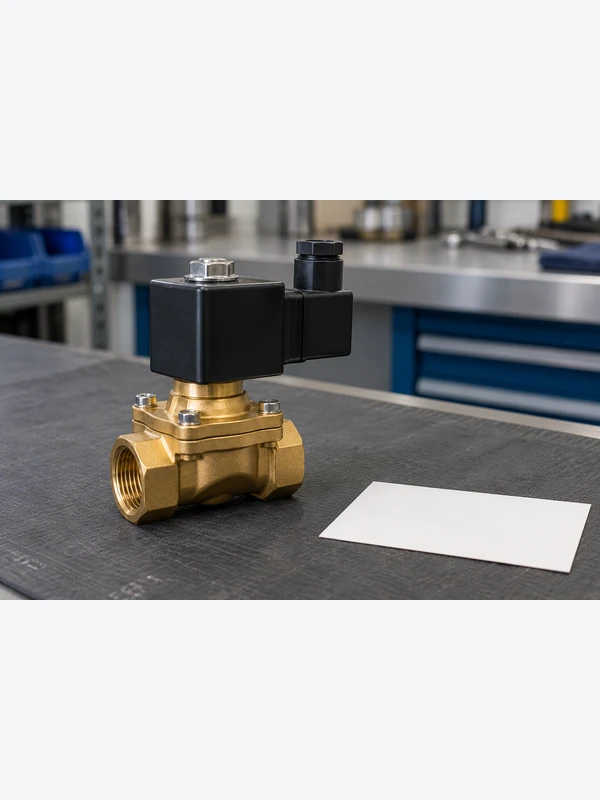
Uma válvula solenóide utiliza uma bobina energizada para mover um êmbolo, diafragma ou pistão e alterar o caminho do fluido. A família de operação determina quanto da força de abertura provém diretamente do atuador eletromagnético e quanto resulta da pressão do fluido atuando em um orifício piloto interno. As três famílias a seguir descrevem princípios de funcionamento, e não classificações ou certificações universais dos produtos.
| Tipo | Como a força de abertura é gerada | Dependência da pressão | Pergunta típica de seleção |
|---|---|---|---|
| Ação direta | A bobina eleva ou desloca diretamente o elemento de fechamento. | Pode ser adequado em locais onde há pouca ou nenhuma pressão diferencial disponível, dependendo do projeto específico. | A bobina consegue deslocar o orifício necessário contra a pressão máxima e as condições do fluido? |
| Semi-direto / passo a passo | A bobina inicia o movimento do piloto, e o elemento principal então utiliza um diferencial de pressão. | Alguns projetos podem iniciar com pressão diferencial zero; confirme os limites especificados pelo fabricante e as instruções de montagem. | A linha requer partida sem pressão, e a orientação de instalação está especificada? |
| Operado por piloto | A bobina abre uma passagem piloto; a pressão da linha move o diafragma ou o pistão principal. | Requer a pressão diferencial mínima indicada na folha de dados. | A pressão de entrada e a vazão permanecerão dentro da faixa operacional da válvula piloto? |
A descrição do produto fornecida também diferencia as construções de diafragma e pistão dentro dessas famílias. Essa é uma segunda camada de classificação: o material, o arranjo da vedação, a compatibilidade com o fluido e a tolerância à contaminação podem alterar a escolha correta, mesmo quando duas válvulas compartilham o mesmo princípio de operação.
Em que se diferencia a operação de ação direta da operação pilotada?
Em uma válvula de ação direta, a bobina energizada fornece o movimento necessário para levantar o obturador de seu assento. Quando a alimentação é desligada, uma mola ou o mecanismo de retorno especificado recoloca o obturador em sua posição original. Como o acionamento é local, essa configuração pode ser adequada para aplicações com pressão diferencial baixa ou nula, mas a força magnética disponível, o tamanho do orifício, a temperatura e o ciclo de trabalho ainda impõem limitações.
Uma válvula pilotada utiliza a pressão já presente no circuito. Ao energizar a bobina, abre-se um pequeno caminho piloto; o desequilíbrio de pressão resultante movimenta o obturador principal. Isso permite suportar um fluxo maior sem exigir que a bobina levante diretamente todo o elemento principal, mas não se pode presumir que funcione em pressão zero. Uma válvula que opera corretamente em um coletor pressurizado pode não abrir durante a comissionamento, em serviços a vácuo ou durante uma purga em baixa pressão, caso a sua pressão diferencial mínima não seja atendida.
Por que o tamanho do orifício é importante?
O orifício é a abertura controlada por onde o fluido passa. Aumentá-lo pode melhorar a capacidade de vazão, mas também aumenta a força necessária para um mecanismo de ação direta e pode alterar a pressão mínima exigida por um projeto pilotado. Não infira a capacidade apenas pelo tamanho da rosca da conexão: compare os dados do fabricante relativos ao coeficiente de vazão, à faixa de pressão, ao fluido e à temperatura para o modelo específico.
O que acontece quando as pressões de entrada e saída se tornam iguais?
Avalie uma válvula durante a partida, em fluxo estável, no fechamento e em qualquer condição de pressão igual. Um projeto com pilotagem interna pode exigir uma especificação diferencial de pressão mínimo para operar. A diferença disponível pode desaparecer quando uma tomada é acionada, um circuito é fechado ou a alimentação é reduzida. Uma simples pressão nominal de alimentação não indica se o mecanismo piloto consegue funcionar naquele ponto do ciclo.
Um projeto de ação direta movimenta seu elemento de vedação por meio do atuador, em vez de depender da pressão piloto interna da mesma forma. A página pública de produtos VZWD da Festo identifica explicitamente essa linha como de controle direto e afirma que não é necessária diferença de pressão. Esse é um exemplo documentado útil, e não uma permissão universal para usar qualquer válvula de ação direta com qualquer meio, vazão, nível de vácuo ou pressão reversa. O código exato ainda determina os limites.
Distinga entre projetos com pilotagem interna, externa e com assistência de elevação. Um piloto alimentado externamente pode ter requisitos de alimentação diferentes da linha de processo. Um projeto com assistência mecânica pode ser documentado para uma queda de pressão diferencial nula, mas o comprador deve verificar essa afirmação para o modelo específico. Classifique a válvula com base na descrição de função e no símbolo do circuito fornecidos pelo fabricante, em vez de confiar na denominação genérica de um revendedor.
Qual classificação de válvula se adequa a um circuito de automação real?
A seleção torna-se mais confiável quando a especificação é redigida como uma breve ficha técnica antes de se escolher um número de peça. Registre o meio, a pressão normal e a pressão máxima, a vazão necessária, a temperatura, a alimentação elétrica disponível, a frequência de comutação, os requisitos de resposta, a disposição das conexões e o que a máquina deve fazer em caso de perda de energia ou de ar comprimido. A ISO 4414:2010 exige considerações de segurança em nível de sistema; uma válvula não pode ser selecionada isoladamente da energia armazenada, do trajeto de escape e do atuador que ela controla.
| Dimensão do projeto | O que gravar | Why it changes the choice | Verification action |
|---|---|---|---|
| Médio | Air, water, gas, oil, steam or another specified fluid | Seal and body materials, lubrication and contamination limits differ. | Match the medium to the exact compatibility chart; do not generalize from a pneumatic listing. |
| Pressão | Minimum, normal and maximum inlet pressure; outlet pressure where relevant | Pilot-operated designs need a stated differential; direct designs have force and pressure limits. | Check both the operating range and the required minimum differential pressure. |
| Caminho do fluxo | Orifice, port arrangement and required flow rate | Orifice affects capacity, coil force and pressure drop. | Use the model data sheet and the system’s flow calculation, not port size alone. |
| Fail position | Normally closed, normally open or another defined safe state | Power loss, control logic and maintenance isolation depend on the return state. | Review the risk assessment and machine sequence under loss of power and loss of pressure. |
| Electrical duty | Coil voltage, AC/DC, connector, duty cycle and switching frequency | An incorrect coil can overheat, chatter or remain unenergized. | Check the coil label, wiring, suppression and controller output before commissioning. |
How should engineers compare the total cost of each type?
Unit price is only one line in the decision. A valve that requires a pressure differential may need a different start-up sequence; a direct-acting valve may trade a simpler pressure requirement for a smaller flow path or higher coil demand. Maintenance time, spare-part identity, access to the coil, air quality, leakage checks and unplanned downtime all belong in the total-cost discussion. The DOE compressed-air sourcebook emphasizes finding and correcting system losses, so include leakage and unnecessary energization in the operating review rather than attributing every loss to the valve body.
For a new machine, compare at least two technically valid options using the same duty point. For a replacement, preserve the existing connection and control intent only after confirming that the new valve’s pressure, flow, response and fail state are equivalent for the application. “Fits the thread” is not an engineering equivalence test.
What standards and checks should govern specification?
ISO 4414:2010 covers general rules and safety requirements for pneumatic fluid-power systems and their components. It is a system safety standard, not a blanket product certification. ISO 12100 principles are useful when the valve is part of machinery risk assessment, although the supplied reference list does not establish a certification claim for any particular component. IEC 60730-2-8:2018 addresses particular requirements for electrically operated water valves; its scope should be checked against the actual medium and application before it is cited.
Commercial documentation should state the applicable market, medium and test basis. A standard reference does not prove that a specific model is certified, and a supplier’s catalog statement does not replace a review of the final assembly. Ask for the current data sheet, wiring information, pressure limits, material details and any test or conformity documents that are relevant to the destination market.
How should startup and shutdown be included in the valve test?
Write a short sequence describing inlet pressure, outlet condition and command state before energization, during normal operation and after power removal. Include low-pressure startup and any back-pressure condition that belongs to the real process. The intended de-energized valve position should be recorded, but do not equate normally closed with a validated safe machine state: stored pressure, load movement and other circuit elements still require a separate safety assessment.
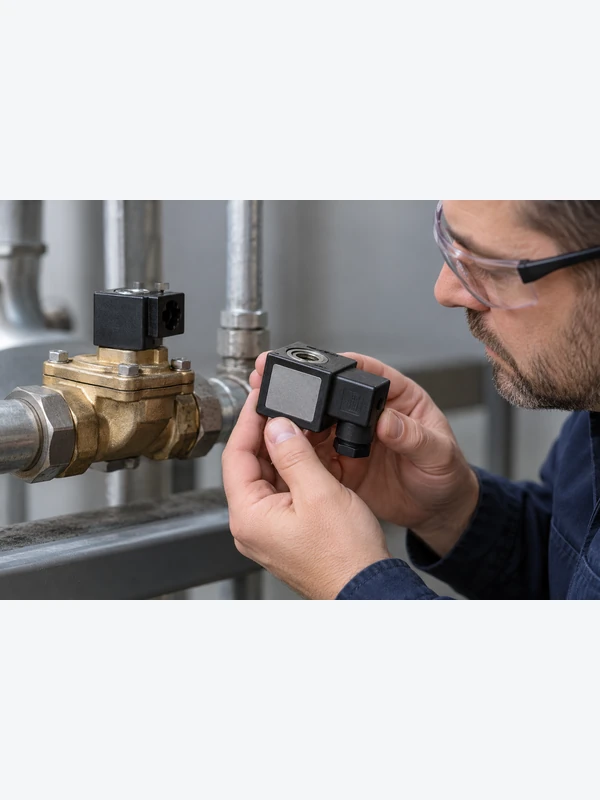
Record the full assembly reference, coil voltage and AC/DC type, electrical connector, permitted duty and installation orientation. A coil that fits mechanically is not sufficient evidence for electrical interchangeability. Check the current manufacturer documentation before replacing the coil, and do not operate a detached coil unless its instructions explicitly permit that action. Isolation must address both electrical energy and the relevant pressurized medium.
For acceptance, compare actual switching and leakage with the defined procedure and limits. If a valve works once at full supply but fails during repeated startup, record the inlet and outlet conditions rather than only replacing the coil. The pneumatic cylinder mechanics guide helps where valve behavior affects an actuator, and the guia de manutenção de conexões pneumáticas covers adjacent connection problems. Keep those diagnoses separate so a leaking port or restricted exhaust is not misclassified as a solenoid fault.
What is a practical five-step selection process?
- Define the duty point. Write medium, minimum and maximum pressure, temperature, flow, porting, voltage and switching pattern.
- Choose the operating family. Use direct-acting when the pressure and orifice duty suit direct force; consider semi-direct or pilot operation only after verifying pressure conditions.
- Confirm the fail state. Document normally open or normally closed behavior and the machine response to loss of power, air or signal.
- Check the installation. Confirm orientation, manifold spacing, exhaust routing, coil access, contamination control and service isolation.
- Validate before release. Bench-test the exact configuration at the real pressure and temperature range, then record the part number and replacement criteria.
Oulu / ANMASPC lists pneumatic fittings, hoses, cylinders, valves and related pneumatic parts. Treat that category as a sourcing starting point; request the model-specific documentation needed for the application rather than assuming that a catalog family carries one common rating. The products directory can help narrow the component family before engineering review.
Perguntas frequentes
Quais são os três principais tipos de válvulas solenoides?
The three main operating families are direct-acting, semi-direct or step-by-step, and pilot-operated. They differ in how the coil and line pressure move the closing element. Confirm the exact construction and pressure limits in the manufacturer’s data sheet.
What is the difference between direct-acting and pilot-operated solenoid valves?
Direct-acting valves use the coil to move the main closing element directly. Pilot-operated valves use the coil to open a small pilot passage, then use a pressure differential to move the main element. The latter therefore needs the stated minimum differential pressure.
Can a pilot-operated solenoid valve work at zero pressure?
Do not assume so. Some semi-direct designs can start at zero differential pressure, but a conventional pilot-operated design normally depends on pressure imbalance. Check the specific model’s minimum differential pressure and test the start condition during commissioning.
How do I choose a normally open or normally closed solenoid valve?
Choose the state that gives the required machine behavior when the coil is de-energized, then confirm it against the risk assessment and sequence of operations. Consider both loss of electrical power and loss of supply pressure; the safest state is application-specific.
What should be checked before replacing a solenoid valve coil?
Check voltage, AC or DC type, connector, power and duty cycle, coil temperature limits, suppression and the valve’s compatibility with the replacement coil. A coil that physically fits may still be electrically incorrect. Record the original part marking and compare it with the replacement documentation.
Why does a solenoid valve buzz or fail to open?
Possible causes include incorrect voltage, loose wiring, a contaminated plunger, excessive pressure, insufficient pilot differential, wrong orientation or a damaged seal. Isolate energy safely, verify the electrical supply and pressure against the data sheet, and inspect the complete circuit before replacing parts.
Does every pilot-operated valve need process pressure to open?
No single rule covers all pilot arrangements. Internally piloted, externally piloted and mechanically assisted designs can have different requirements. Check the exact model’s minimum differential and pilot-supply conditions.
Does normally closed mean the whole machine is safe after power loss?
No. It describes the valve’s specified normal state, not the safety of the complete machine. Consider trapped pressure, gravity loads, downstream volume and the validated circuit response to power removal.
Referências
- Festo, Solenoid valve VZWD: directly controlled function and no-pressure-difference requirement; manufacturer-specific example
- U.S. Department of Energy, Minimize Compressed Air Leaks: valves and connection points in the system
Resumo
A solenoid valve should be classified by both its flow function and its actuation method. Establish the medium, flow requirement and inlet-to-outlet pressure conditions through the complete cycle before choosing direct actuation, an internal pilot or another documented arrangement. Check minimum differential, reverse-pressure restrictions and the exact coil specification instead of treating port size or voltage alone as compatibility. Include startup, shutdown and the intended de-energized state in acceptance, while keeping the machine’s safety assessment separate from a normally open or normally closed label. Oulu’s pneumatic range can be reviewed against that written specification, with current model documentation obtained before approving a valve or replacement coil.



