
報告されている顧客事例ではなく、説明用のシナリオ: 深圳の制御エンジニアが開弁速度の遅いバルブを交換したところ、新しいコイルには通電したものの、アクチュエータは依然として動作不良に陥った。簡易な圧力確認の結果、選定されたパイロット作動式の設計では、その機構が要求する差圧が確保されていないことが判明した。表面上の故障は不良バルブのように見えたが、根本原因は機器の分類と仕様の不適合にあった。この違いこそが、機器選定における実践的な出発点となる。 ソレノイドバルブ 種類。.
ソレノイドバルブは一般的に3つの運用ファミリーに分類されます。 直接作用の, 、半直接作用式(段階式)およびパイロット作動式。最初の選択における問いは「どのバルブが最も安価か?」ではなく、「この設計は、利用可能な圧力、必要な開口部、流体、電圧、および故障時の位置において、確実に開くのか?」です。ISO 4414:2010は空気圧流体システムの安全基盤を提供し、一方で米国エネルギー省は、圧縮空気を無料の公益サービスとして扱うのではなく、管理されたシステムとして扱うことを推奨しています。まずは書面による動作条件を定め、メーカーの圧力および使用媒体の限界を確認した上で、設置、電気制御、および保守点検のアクセスについても検討してください。.
ソレノイドバルブの主な種類は3つあります。
電磁弁は、通電したコイルによってプランジャー、ダイアフラムまたはピストンを移動させ、流体の経路を切り替えます。その動作方式は、開弁力のうちどれだけが電磁アクチュエータ自体から直接得られるか、またどれだけが内部のパイロット経路に作用する流体圧力によって得られるかを決定します。以下に示す3つの動作方式は、製品の一般的な性能評価や認証を指すものではなく、動作原理を説明するものです。.
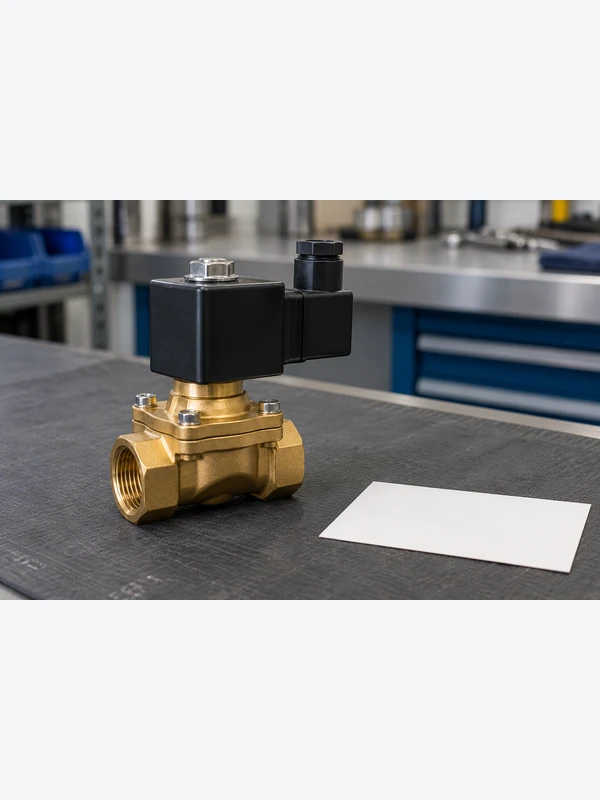
| タイプ | 開力量の発生メカニズム | 圧力依存性 | 典型的な選択問題 |
|---|---|---|---|
| 直接作用の | コイルは閉止部を直接持ち上げるか、または移動させます。. | 特定の設計条件に従えば、差圧がほとんどまたは全くない場所でも適用可能です。. | コイルは、最大圧力および流体条件において、所定の開口部を移動させることができますか? |
| 半直接的/段階的 | コイルがパイロット動作を開始し、その後、主要素は圧力差を利用して作動します。. | 一部の設計では、差圧ゼロから作動を開始できます。メーカーが提示する限界値および取り付けに関する指示を必ず確認してください。. | ラインには無圧起動が必要ですか?また、設置方向は指定されていますか? |
| パイロット作動式 | コイルがパイロット通路を開き、ライン圧によりメインダイアフラムまたはピストンが動作します。. | データシートに記載された最小差圧が必要です。. | 入口圧力と流量は、パイロットバルブの動作範囲内に収まりますか? |
提供された製品説明では、これらのシリーズ内でもダイアフラム式とピストン式の構造が区別されています。これは第二の分類基準であり、材料、シールの構成、流体との適合性、および汚染耐性によって、たとえ二つのバルブが同じ動作原理を共有していても、適切な選択は変わることがあります。.
直接作用式の動作とパイロット式の動作にはどのような違いがありますか?
直動式バルブでは、電磁コイルに通電することで、密閉部をシートから持ち上げるための動作力を供給します。電源が切断されると、スプリングまたは指定された復帰機構によって密閉部が元の位置に戻ります。作動が局所的であるため、微小な差圧や無差圧での用途に適していますが、利用可能な磁力、開口部のサイズ、温度、稼働率には依然として制限があります。.
パイロット式バルブは、回路内に既に存在する圧力を用います。コイルに通電すると小さなパイロット経路が開き、生じた圧力の不平衡によって主遮断部が移動します。これにより、コイルが主要素全体を直接持ち上げる必要なく、より大きな流量経路をサポートできますが、零圧下での動作を保証することはできません。加圧されたマニホールド上で正常に動作するバルブでも、最低差圧を満たしていない場合、試運転時や真空状態、または低圧パージ時には開弁しないことがあります。.
なぜ開口部のサイズが重要なのですか?
開口部は、流体が通過する制御された通路です。これを大きくすると流量容量は向上しますが、直動式機構に必要な力も増加し、パイロット式設計では必要最小圧力が変化する可能性があります。ポートのねじサイズだけで容量を推測しないでください。正確なモデルについては、メーカーが提示する流量係数、使用圧力範囲、対応流体および温度に関するデータを比較してください。.
入口圧力と出口圧力が等しくなると、どうなりますか?
バルブは、起動時、定常流量時、閉止時、および等圧状態のいずれにおいても評価してください。内部ピロット式の設計では、特定の 最小圧力差 動作させるためのものです。コンセントが接続されたり、回路が閉じたり、供給圧が低下したりすると、利用可能な差圧は消失する可能性があります。公称供給圧だけでは、そのサイクルの時点においてパイロット機構が動作可能かどうかを示すことはできません。.
ダイレクト作用方式では、同一の内部パイロット圧力に依存するのではなく、アクチュエータによってシール部材を直接駆動します。フェストの公開製品ページ(VZWD)では、当該シリーズがダイレクト制御であることが明示されており、圧力差は不要と記されています。これは有用な文書化された事例ですが、あらゆるダイレクト作用式バルブを任意の流体、流量、真空度、逆圧に対しても使用できるという普遍的な許可を意味するものではありません。限界は依然として、個々の型式コードによって決定されます。.
内部ピロット式、外部ピロット式、および補助リフト式の各設計を区別してください。外部供給型のピロットは、プロセスラインとは異なる供給要件を持つ場合があります。機械的補助式の設計は差圧ゼロでの動作仕様として記載されることがありますが、実際のモデルについては購入者がその記載内容を確認する必要があります。バルブの分類は、再販業者の概括的なラベルに頼るのではなく、メーカーの機能説明および回路記号に基づいて行なってください。.
Which valve classification fits a real automation circuit?
Selection becomes more reliable when the duty is written as a short data sheet before a part number is chosen. Record the medium, normal and peak pressure, required flow, temperature, available electrical supply, switching frequency, response requirement, port arrangement and what the machine should do after power or air is lost. ISO 4414:2010 calls for system-level safety consideration; a valve cannot be selected in isolation from stored energy, exhaust routing and the actuator it controls.
| Design dimension | 何を記録するか | Why it changes the choice | Verification action |
|---|---|---|---|
| ミディアム | Air, water, gas, oil, steam or another specified fluid | Seal and body materials, lubrication and contamination limits differ. | Match the medium to the exact compatibility chart; do not generalize from a pneumatic listing. |
| 圧力 | Minimum, normal and maximum inlet pressure; outlet pressure where relevant | Pilot-operated designs need a stated differential; direct designs have force and pressure limits. | Check both the operating range and the required minimum differential pressure. |
| 流れの経路 | Orifice, port arrangement and required flow rate | Orifice affects capacity, coil force and pressure drop. | Use the model data sheet and the system’s flow calculation, not port size alone. |
| Fail position | Normally closed, normally open or another defined safe state | Power loss, control logic and maintenance isolation depend on the return state. | Review the risk assessment and machine sequence under loss of power and loss of pressure. |
| Electrical duty | Coil voltage, AC/DC, connector, duty cycle and switching frequency | An incorrect coil can overheat, chatter or remain unenergized. | Check the coil label, wiring, suppression and controller output before commissioning. |
How should engineers compare the total cost of each type?
Unit price is only one line in the decision. A valve that requires a pressure differential may need a different start-up sequence; a direct-acting valve may trade a simpler pressure requirement for a smaller flow path or higher coil demand. Maintenance time, spare-part identity, access to the coil, air quality, leakage checks and unplanned downtime all belong in the total-cost discussion. The DOE compressed-air sourcebook emphasizes finding and correcting system losses, so include leakage and unnecessary energization in the operating review rather than attributing every loss to the valve body.
For a new machine, compare at least two technically valid options using the same duty point. For a replacement, preserve the existing connection and control intent only after confirming that the new valve’s pressure, flow, response and fail state are equivalent for the application. “Fits the thread” is not an engineering equivalence test.
What standards and checks should govern specification?
ISO 4414:2010 covers general rules and safety requirements for pneumatic fluid-power systems and their components. It is a system safety standard, not a blanket product certification. ISO 12100 principles are useful when the valve is part of machinery risk assessment, although the supplied reference list does not establish a certification claim for any particular component. IEC 60730-2-8:2018 addresses particular requirements for electrically operated water valves; its scope should be checked against the actual medium and application before it is cited.
Commercial documentation should state the applicable market, medium and test basis. A standard reference does not prove that a specific model is certified, and a supplier’s catalog statement does not replace a review of the final assembly. Ask for the current data sheet, wiring information, pressure limits, material details and any test or conformity documents that are relevant to the destination market.
How should startup and shutdown be included in the valve test?
Write a short sequence describing inlet pressure, outlet condition and command state before energization, during normal operation and after power removal. Include low-pressure startup and any back-pressure condition that belongs to the real process. The intended de-energized valve position should be recorded, but do not equate normally closed with a validated safe machine state: stored pressure, load movement and other circuit elements still require a separate safety assessment.
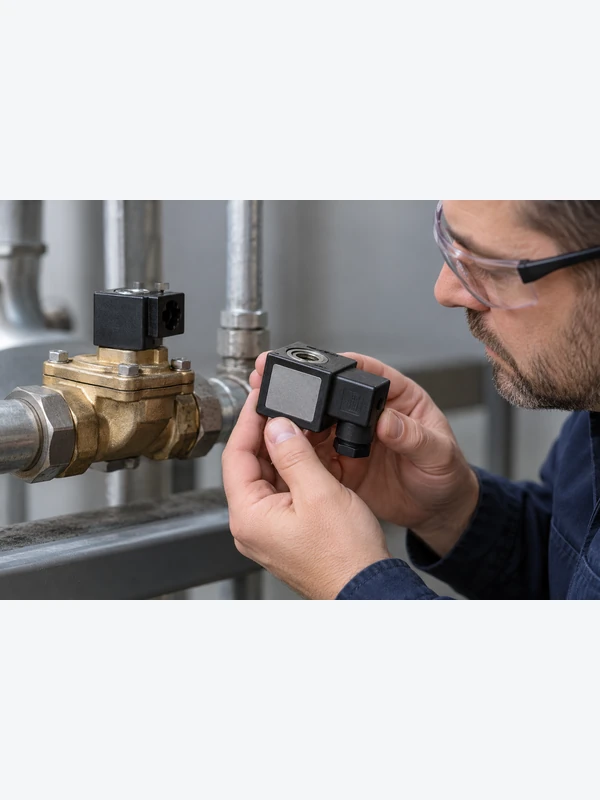
Record the full assembly reference, coil voltage and AC/DC type, electrical connector, permitted duty and installation orientation. A coil that fits mechanically is not sufficient evidence for electrical interchangeability. Check the current manufacturer documentation before replacing the coil, and do not operate a detached coil unless its instructions explicitly permit that action. Isolation must address both electrical energy and the relevant pressurized medium.
For acceptance, compare actual switching and leakage with the defined procedure and limits. If a valve works once at full supply but fails during repeated startup, record the inlet and outlet conditions rather than only replacing the coil. The pneumatic cylinder mechanics guide helps where valve behavior affects an actuator, and the 空気圧継手の保守ガイド covers adjacent connection problems. Keep those diagnoses separate so a leaking port or restricted exhaust is not misclassified as a solenoid fault.
What is a practical five-step selection process?
- Define the duty point. Write medium, minimum and maximum pressure, temperature, flow, porting, voltage and switching pattern.
- Choose the operating family. Use direct-acting when the pressure and orifice duty suit direct force; consider semi-direct or pilot operation only after verifying pressure conditions.
- Confirm the fail state. Document normally open or normally closed behavior and the machine response to loss of power, air or signal.
- Check the installation. Confirm orientation, manifold spacing, exhaust routing, coil access, contamination control and service isolation.
- Validate before release. Bench-test the exact configuration at the real pressure and temperature range, then record the part number and replacement criteria.
Oulu / ANMASPC lists pneumatic fittings, hoses, cylinders, valves and related pneumatic parts. Treat that category as a sourcing starting point; request the model-specific documentation needed for the application rather than assuming that a catalog family carries one common rating. The products directory can help narrow the component family before engineering review.
よくある質問
ソレノイドバルブの主な種類は3つあります。
The three main operating families are direct-acting, semi-direct or step-by-step, and pilot-operated. They differ in how the coil and line pressure move the closing element. Confirm the exact construction and pressure limits in the manufacturer’s data sheet.
What is the difference between direct-acting and pilot-operated solenoid valves?
Direct-acting valves use the coil to move the main closing element directly. Pilot-operated valves use the coil to open a small pilot passage, then use a pressure differential to move the main element. The latter therefore needs the stated minimum differential pressure.
Can a pilot-operated solenoid valve work at zero pressure?
Do not assume so. Some semi-direct designs can start at zero differential pressure, but a conventional pilot-operated design normally depends on pressure imbalance. Check the specific model’s minimum differential pressure and test the start condition during commissioning.
How do I choose a normally open or normally closed solenoid valve?
Choose the state that gives the required machine behavior when the coil is de-energized, then confirm it against the risk assessment and sequence of operations. Consider both loss of electrical power and loss of supply pressure; the safest state is application-specific.
What should be checked before replacing a solenoid valve coil?
Check voltage, AC or DC type, connector, power and duty cycle, coil temperature limits, suppression and the valve’s compatibility with the replacement coil. A coil that physically fits may still be electrically incorrect. Record the original part marking and compare it with the replacement documentation.
Why does a solenoid valve buzz or fail to open?
Possible causes include incorrect voltage, loose wiring, a contaminated plunger, excessive pressure, insufficient pilot differential, wrong orientation or a damaged seal. Isolate energy safely, verify the electrical supply and pressure against the data sheet, and inspect the complete circuit before replacing parts.
Does every pilot-operated valve need process pressure to open?
No single rule covers all pilot arrangements. Internally piloted, externally piloted and mechanically assisted designs can have different requirements. Check the exact model’s minimum differential and pilot-supply conditions.
Does normally closed mean the whole machine is safe after power loss?
No. It describes the valve’s specified normal state, not the safety of the complete machine. Consider trapped pressure, gravity loads, downstream volume and the validated circuit response to power removal.
参考文献
- Festo, Solenoid valve VZWD: directly controlled function and no-pressure-difference requirement; manufacturer-specific example
- U.S. Department of Energy, Minimize Compressed Air Leaks: valves and connection points in the system
要約
A solenoid valve should be classified by both its flow function and its actuation method. Establish the medium, flow requirement and inlet-to-outlet pressure conditions through the complete cycle before choosing direct actuation, an internal pilot or another documented arrangement. Check minimum differential, reverse-pressure restrictions and the exact coil specification instead of treating port size or voltage alone as compatibility. Include startup, shutdown and the intended de-energized state in acceptance, while keeping the machine’s safety assessment separate from a normally open or normally closed label. Oulu’s pneumatic range can be reviewed against that written specification, with current model documentation obtained before approving a valve or replacement coil.



