A pneumatic cylinder is an actuator that uses compressed air to move a piston and produce mechanical motion. In industrial automation it may push, lift, clamp, position or release a load. The word cylinder also appears in engine and compressor terminology, but those machines perform different jobs. This guide focuses on the pneumatic actuator and on the decisions needed to select it as part of an air-powered motion system.
How does a pneumatic cylinder produce motion?
Compressed air enters a working chamber through a controlled valve. The pressure acting on the effective piston area creates force, while the mounting and mechanical arrangement determine how that force reaches the load. The cylinder is therefore not a complete motion system by itself. Air supply, valves, tubing, flow controls, guides and the driven mechanism all influence its operation.
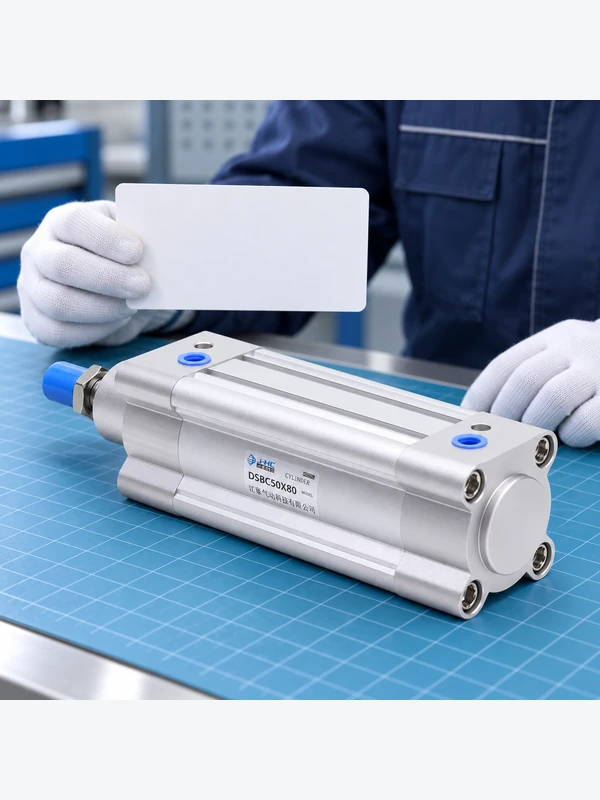
A force estimate is an initial sizing step rather than a guarantee of movement. Friction, load direction, acceleration and the pressure actually available during the cycle must also be considered. For a conventional rod cylinder, the rod occupies part of the piston area on one side, so extension and retraction should be checked separately. Use the selected manufacturer’s data and calculation method for the exact design rather than assuming equal force in both directions.
Which cylinder types suit different motion requirements?
A single-acting cylinder uses air for powered travel in one direction and a spring or external force for its return. Its return arrangement must suit the load and required cycle. A double-acting cylinder uses controlled air supply on both sides of the piston, allowing powered extension and retraction. Choosing between them begins with the motion required by the process, not simply with the number of ports visible on a catalogue picture.
Rodless actuators can be considered when their arrangement suits the available installation space and load guidance. Diaphragm and rotary or oscillating pneumatic actuators serve different motion requirements and should not be treated as interchangeable linear rod cylinders. Confirm the actual movement, mounting, stroke or angle, load and maintenance needs against the supplier’s documentation before selecting an actuator family.
What must be specified besides bore and stroke?
Describe the load, travel direction, required stroke, speed, cycle frequency and available mounting space. Identify how the moving assembly is guided and whether the actuator is expected to encounter side loads. Confirm end-position sensing, cushioning, air preparation and the access needed for inspection or seal replacement. A sensor can report a position condition to the controller, but it does not establish that the mechanical alignment or force margin is correct.
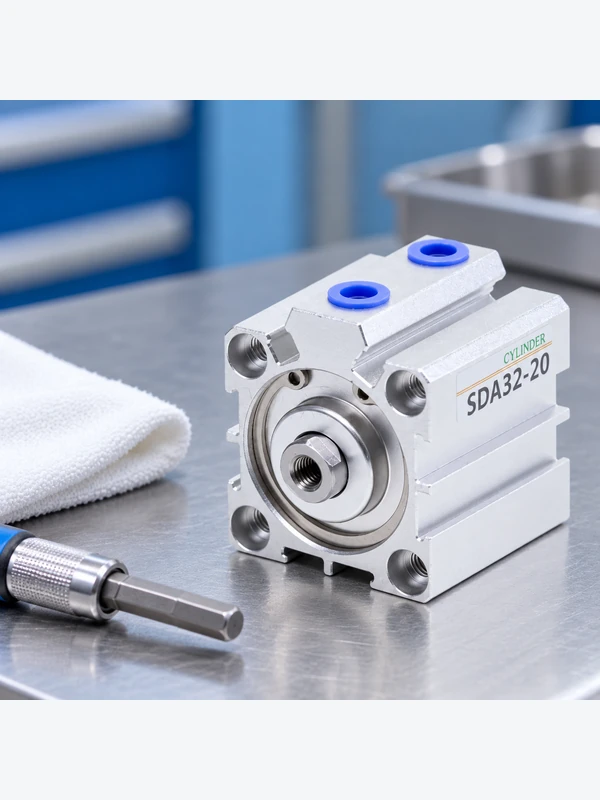
Keep the actuator specification connected to the valve and tubing schedule. A cylinder with an adequate theoretical force can still perform poorly if the supply or exhaust path restricts the required motion. Review both directions of travel and the actual operating cycle. These system checks give the commissioning team a defined basis for testing rather than leaving it to compensate for an incomplete specification by adjusting pressure or speed after installation.
How should cylinder force, stroke and air supply be sized together?
A pneumatic цилиндр needs a matched force calculation жана maintenance plan. Bore and stroke are only the starting fields; mounting, side load, cushioning, sensing, pressure, speed and contamination determine whether the actuator will run reliably.
| Design field | Verify before release |
|---|---|
| Load | Force direction, effective area, friction, acceleration and guidance. |
| Motion | Stroke, speed, cushioning, cycle rate and end-position sensing. |
| Кызмат | Air quality, temperature, washdown, seal kit and access for inspection. |
Use the basic force relationship for an initial estimate, then confirm the exact manufacturer’s force table and mounting limits. The pneumatic parts range can be matched after the valve, tube and sensor requirements are known.
A cylinder is not sized by bore and stroke alone. The useful design question is whether the actuator can deliver the required force and speed through the complete mechanism, including guidance, friction, acceleration, cushioning and the available air pressure. Public manufacturer guidance describes cylinders as compressed-air devices that generate linear motion; ISO 15552 provides dimensional requirements for its scope, while ISO 4414 addresses system safety. Neither source is a universal force or service-life guarantee.
| Design input | Why it changes the selection | Evidence to keep |
|---|---|---|
| Load direction | Side load and guide friction can consume the force margin | Mechanism drawing and load case |
| Stroke and speed | High speed increases impact and air demand | Cycle profile and cushion setting |
| Pressure | Effective force follows available pressure and area | Measured point-of-use pressure |
| Чөйрө | Heat, washdown, dust and chemicals affect seals | Material and maintenance limits |
For an initial estimate, force is pressure multiplied by effective piston area, then reduced for friction, return springs, side load and the project margin. The final choice must use the manufacturer’s force table and mounting limits. If a correctly sized cylinder stalls, check alignment, guide friction, flow controls, valve switching and point-of-use pressure before increasing system pressure. A cycle counter can identify drift, but it does not replace inspection of rod, seal, fittings and end cushioning.
Include the sensor, valve and tube interface in the same release sheet. The site’s pneumatic parts range is relevant only after bore, stroke, load and environment are fixed. For recurring leaks at tube ends, connect the review to the fitting maintenance workflow rather than changing the cylinder first.
What should commissioning verify before the cylinder enters production?
Commissioning should show that the cylinder reaches both end positions at the planned load and speed, that cushioning prevents damaging impact, and that sensors report the intended state. Check the point-of-use pressure during motion rather than relying only on the compressor gauge. Record unusual noise, rod alignment, tube movement and valve response. These observations help separate a cylinder-size issue from a guide, flow-control or fitting problem. After release, keep a baseline cycle time and inspection interval so later drift can be identified.
What should a cylinder fault record tell the maintenance team?
Describe the failed motion before ordering a replacement actuator. A cylinder that stops partway through a stroke presents a different diagnostic problem from one that reaches the end slowly or fails to confirm its position. Record the direction of movement, load condition, commanded valve state and available observations from the air supply and sensors. Avoid treating a position signal as direct evidence of force or treating a bore-size calculation as proof that the installed circuit can deliver the required flow.
Ал cylinder maintenance record should connect the actuator part number with its mounting, guidance, valve, tubing, speed control and end-position settings. Compare the current installation with the commissioning baseline. If guides bind or the load has changed, replacing the same cylinder may reproduce the problem. If a larger bore is proposed, review the associated air demand, mounting loads and motion controls rather than approving the change from force alone.
After corrective work, repeat the agreed checks for both travel directions and the relevant operating load. Record any adjustment to cushioning or sensing so that a later crew can distinguish a mechanical change from a control change. Keep the selected manufacturer’s limits and maintenance instructions with the machine documents. Standards references help identify the applicable cylinder family, while the actual part and complete motion circuit determine what must be checked on that machine.
Көп берилүүчү суроолор
Why can a correctly sized cylinder still stall?
Side load, guide friction, low supply pressure, flow restriction, valve switching or a binding mechanism can remove the expected margin.
What does a cycle counter add?
It helps expose drift or missed strokes earlier, but it does not replace alignment checks, leak inspection or the supplier’s maintenance instructions.
Which standard should be quoted?
Use the standard applicable to the cylinder family and project; ISO 15552 is a dimensional reference for its scope, not a universal seal or pressure rating.
What does a pneumatic cylinder do?
It converts compressed-air energy into controlled linear motion through a piston and rod assembly.
How is cylinder force estimated?
Use pressure multiplied by effective piston area, then account for friction, return-spring effects, side loads and the project safety factor.
When should a single-acting cylinder be selected?
Choose it when the process needs powered motion in one direction and a spring or external force can provide the return, subject to the load and cycle requirements.
Why are sensors added to cylinders?
Sensors can confirm end position or cycle state for the controller. They do not correct poor alignment, excessive side load or an undersized actuator.
How do cushioning and speed relate?
Cushioning controls end-of-stroke impact. Set it with the actual load and speed; excessive cushioning can slow the cycle.
What should be included in a cylinder quotation?
Include bore, stroke, mounting, rod and thread details, pressure, speed, load, sensor requirement, environment and expected cycle rate.
Does a larger bore always improve the cycle?
No. It can increase force while also increasing air consumption, inertia and machine impact. Verify the complete cycle.
Деректер
- ISO 15552:2018 – official cylinder dimensional reference.
- ISO 4414:2010 – official pneumatic system safety reference.
- SMC pneumatic-cylinder application context
Summary
Select a cylinder from the actual load and motion, not from bore alone. Confirm force, mounting, guidance, speed, cushioning, sensing and environment, then commission it under the real load. A small record of cycle count, leaks and end-position signals makes maintenance more useful and avoids promising a force or life value that belongs to another model.