
Инженер по техническому обслуживанию может дважды заменить протекающий пневмопровод, прежде чем обнаружит, что фитинг был выбран исключительно по размеру резьбы. Наружный диаметр трубки, резьба патрубка, рабочая среда, а также предельные значения давления и температуры должны соответствовать друг другу; даже если фитинг с прямым подключением физически подходит, он всё равно может оказаться неподходящим для данной системы. Этот справочник даёт ответ на вопрос: где… пневмофитинги Рассматриваются используемые фитинги, их функции в системе и способы их выбора без предположения, что один тип фитинга подходит для любой системы. Основное внимание уделяется обычным промышленным и коммерческим системам сжатого воздуха, а не утверждению о том, что один фитинг пригоден для любого оборудования, рабочей среды или регламентированного применения.
Пневматические фитинги соединяют, разветвляют, ориентируют, регулируют или заканчивают трубопроводы, чтобы сжатый воздух мог поступать к клапанам, цилиндрам, приводам, инструментам и приборам. Перед заказом укажите четыре параметра: наружный диаметр трубы, резьбу порта, рабочую среду и диапазон давления/температуры. ISO 1219-1 определяет обозначения, используемые для чтения условных обозначений гидравлических и пневматических схем; он не сертифицирует конкретный фитинг. На следующем практическом этапе необходимо сравнить чертеж подключения оборудования производителя с данными производителей фитингов и труб, а затем проверить контрольную сборку на герметичность и правильность посадки.
Где используются пневматические фитинги в рабочей системе?
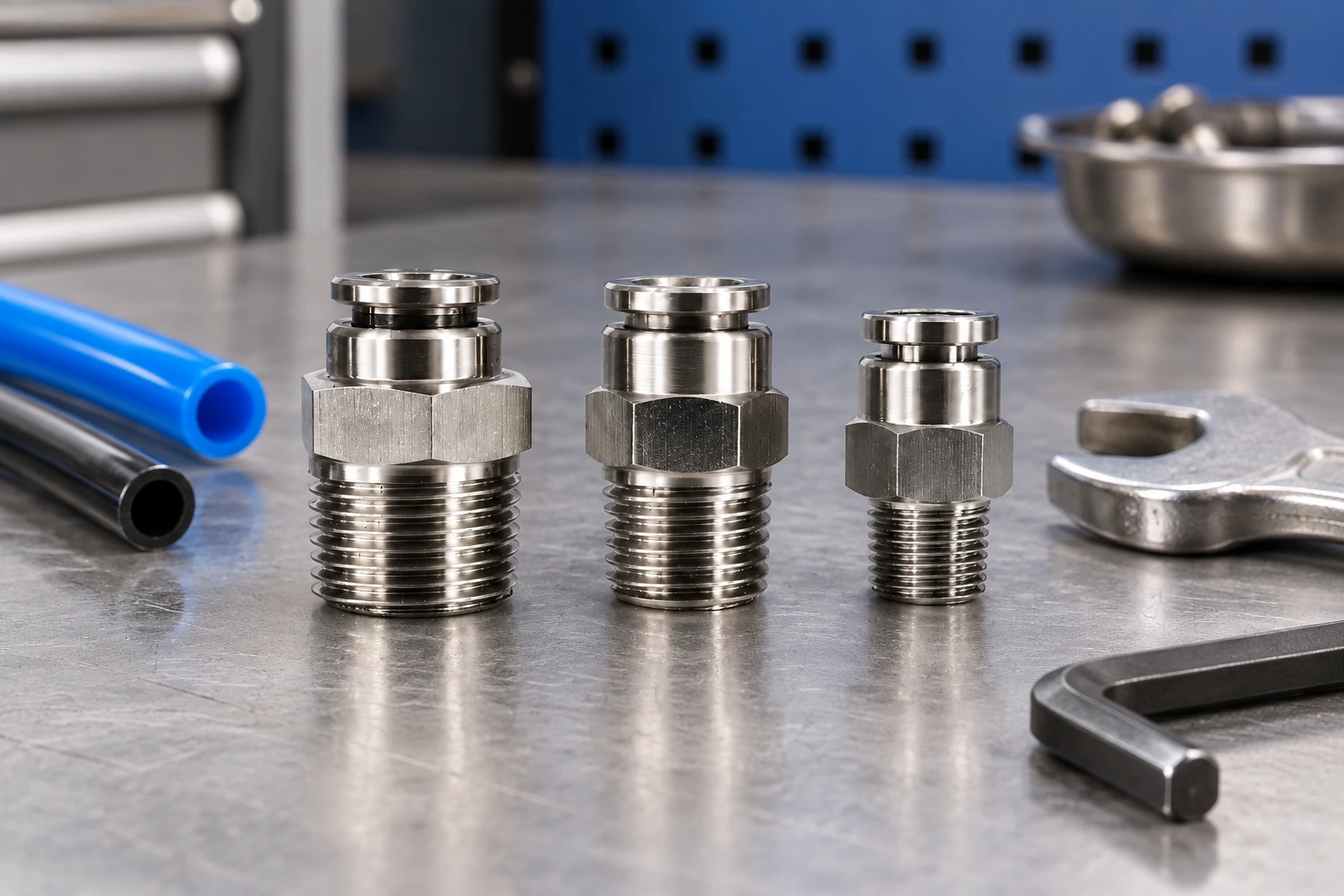
Фитинги устанавливаются везде, где пневматическая магистраль изменяет своё направление или соединяется с другим компонентом. Прямой фитинг «пуш‑ин» соединяет трубку с клапаном или цилиндром; угловой фитинг поворачивает магистраль там, где пространство корпуса ограничено; тройник или коллектор разделяет подачу на несколько ответвлений; проходной фитинг проходит через перегородку; а заглушка или шумоглушитель закрывает неиспользуемый порт. В производственной ячейке одна и та же магистраль может выполнять несколько этих функций, поэтому фитинг является частью конструкции системы, а не декоративным аксессуаром.
Типичные области применения включают автоматизацию машин, оборудование для захвата и перемещения деталей, упаковку, сборочные приспособления, пневмоинструменты для цехов, измерительную технику и панели технического обслуживания. Одного лишь указания области применения недостаточно для определения пригодности. Масляный туман, водяной пар, вакуум, химически агрессивные среды, экспозиция на открытом воздухе или экстремальные температуры могут повлиять на выбор материалов и уплотнений. По этой причине каталоги компаний SMC и Festo классифицируют соединительную технологию по типу трубки, резьбы, функциональности и условиям эксплуатации.Документация по фитингам и трубкам SMC; Документация по соединительной технологии Festo).
Какие функции соединения выполняют пневматические фитинги?
Как фитинг соединяет трубку с компонентом?
Трубный фитинг типа «труба‑порт» обеспечивает механическое крепление и герметизацию между гибкой трубкой и резьбовым элементом, таким как клапан, цилиндр, регулятор или манометр. В конструкции с прямым введением зажимная муфта удерживает трубку, а внутреннее уплотнение обжимается вокруг её наружной поверхности. Трубка должна быть отрезана под прямым углом, зачищена от заусенцев и полностью вставлена до указанной производителем глубины; если трубка упирается в посадочное место неровно, возможна утечка даже при соблюдении номинального наружного диаметра.
Каким образом отводы, тройники и коллекторы управляют маршрутизацией?
Направляющие фитинги предотвращают изгиб трубопровода с радиусом, меньшим рекомендованного, и снижают нагрузку на патрубки. Тройники и коллекторы распределяют поток рабочей среды, а переходники обеспечивают стыковку двух заданных размеров. размер трубыs. Схема прокладки по‑прежнему влияет на перепад давления и удобство обслуживания: компактный отвод может улучшить зазоры, но добавление лишних поворотов увеличивает количество соединений, которые необходимо проверять. Форма фитинга не изменяет допустимое рабочее давление всей системы; ограничивающим параметром остается значение самого низкорейтингового компонента.
Когда применяются запорные, перегородочные и вытяжные фитинги?
Запорные или обратные функции изолируют ответвление или ограничивают обратный поток, если конструкция изделия явно предусматривает такую функцию. Перегородочные фитинги поддерживают трубку через панель, а выпускные фитинги или глушители обеспечивают отвод из клапана. Это функциональные выборы, а не взаимозаменяемые названия: нельзя предполагать, что обычный соединитель обеспечивает изоляцию, контроль потока или снижение шума. Сверяйте условный обозначение и описание детали с документацией схемы; ISO 1219-1 полезен для интерпретации этой схемы.
Как пневматические фитинги обеспечивают надёжное соединение?
Надёжное соединение обеспечивает удержание, герметичность и правильную нагрузку. Удержание осуществляется за счёт зажимного механизма фитинга; герметичность — благодаря эластомеру или специально разработанному уплотнительному элементу; нагрузка включает глубину вставки трубопровода, степень завинчивания резьбы и защиту от вибрации. Резьбовой герметик, если его применение допускается, должен наноситься только в тех местах, где это разрешено производителем фитинга, поскольку избыточный материал может попасть внутрь клапана или нарушить расчётную степень завинчивания резьбы.
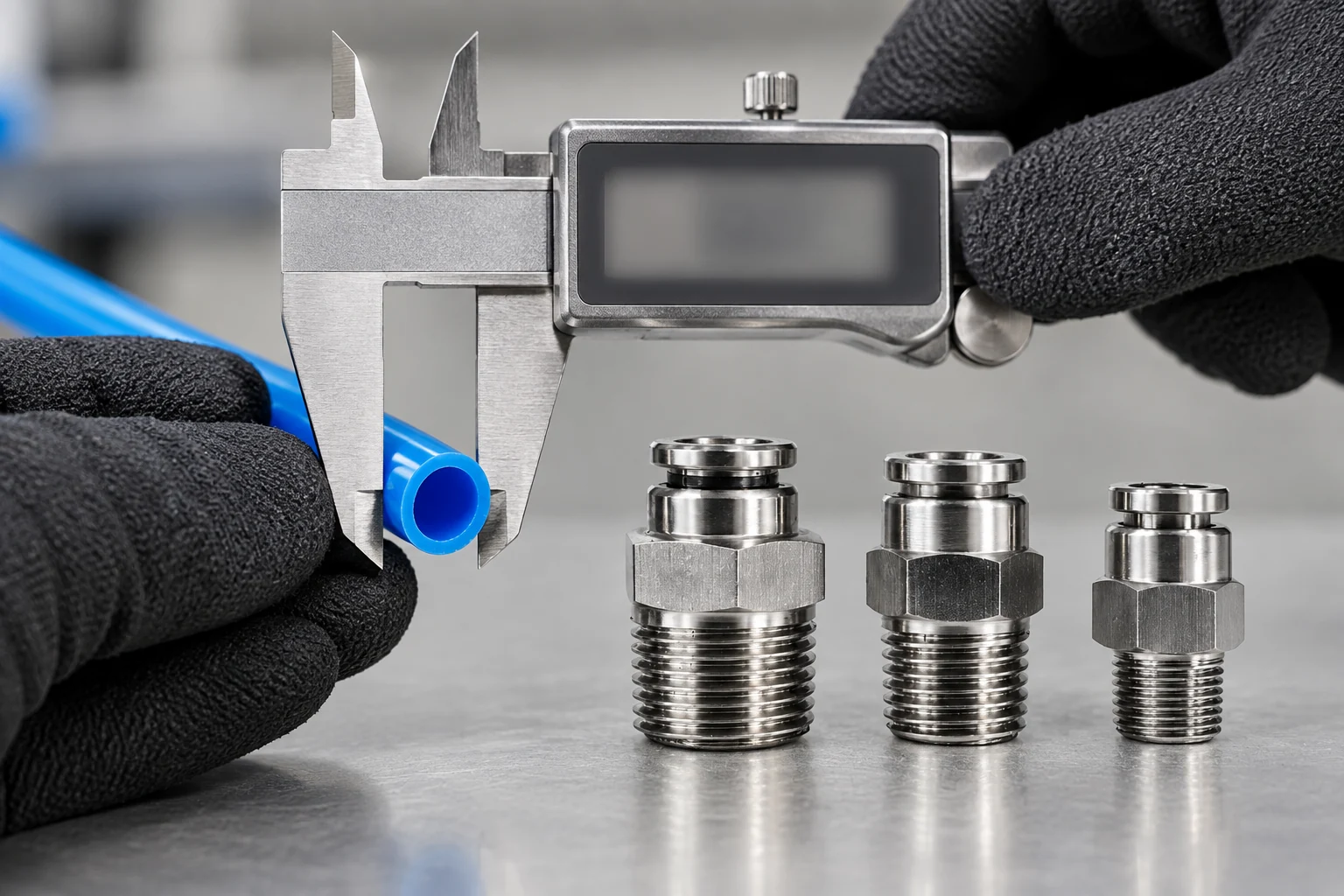
При новом монтаже проверьте наружный диаметр трубы с помощью соответствующего калибра или штангенциркуля, убедитесь, что стандарт резьбы и её тип (наружная/внутренняя) совпадают, а также что рабочая среда допускается материалами уплотнения и корпуса. После завершения соединения постепенно повышайте давление и применяйте утверждённый на объекте метод проверки на герметичность. Видимые пузыри, падение давления или слышимый утечка — это повод отключить контур и устранить неплотность в соединении, а не компенсировать её повышением подачи давления.
Какие типы пневматических фитингов подходят для распространённых применений?
| Тип соединения | Основная функция | Где это обычно используется | Фокус проверки |
|---|---|---|---|
| Прямой защёлкивающийся | Соединение трубки с резьбовым патрубком | Клапаны, цилиндры, регуляторы, компактные коллекторы | Наружный диаметр трубы, резьба патрубка, материал уплотнения, предельные значения давления и температуры |
| Локоть или поворотный локоть | Изменить направление и снизить нагрузку на трассировку | Плотные машинные панели и движущиеся линии приводов | Зазор, радиус изгиба, пределы поворота, виброподдержка |
| Чай, крестовина или коллектор | Разветвить один источник питания на несколько линий | Крепления, захваты, сенсорные схемы, распределительные блоки | Требование к потоку ветви, количество портов, стандарт общего резьбового соединения |
| Редуктор | Переход между указанными размерами труб | Замена услуг и сборки смешанных размеров | Оба наружных диаметра труб, направление потока, зазор и опора |
| Переборка | Пропустите трубку через панель или корпус. | Шкафы управления и защищённые секции машин | Толщина панели, доступ к гайке-стопору, уплотнение и снятие натяжения кабеля |
| Вилка, заглушка или глушитель | Закрыть порт или управлять вытяжкой | Неиспользуемые порты клапанов и управляемые выпускные отверстия | Функция, поток выхлопных газов, загрязнение и доступ для технического обслуживания |
Эта таблица представляет собой рамочную схему выбора, а не гарантию совместимости. Одна и та же серия может использовать несколько стандартов резьбы или вариантов уплотнений, а такое наименование, как “быстросъемный”, указывает на способ соединения, а не на универсальные эксплуатационные характеристики. Руководство по выбору пластиковых пневматических фитингов содержит более подробное сравнение материалов и областей применения.
Какие изменения происходят, когда трубопровод движется вместе с машиной?
Фитинг в стационарном шкафу и соединение на подвижной сборке могут иметь одинаковый номинальный диаметр трубы, но различаться по эксплуатационным требованиям. Определите места изгибов трубы, точки её опоры и наличие скручивания в месте патрубка при полном ходе. Статический номинальное рабочее давление does not establish suitability for repeated bending, vibration or rotation. The specification should describe the motion and require confirmation for that duty from the selected component manufacturer.
Separate three functions: a fitting body that can be oriented for installation, a tube that flexes during machine motion, and a joint designed for continuous rotation. They are not interchangeable descriptions. Keep bending away from the release sleeve, provide the required service loop and check that guarding or another mechanism cannot strike the tube. If the layout cannot keep side load off a standard port, revise the routing or select a purpose-designed connection after engineering review.
Assess the real assembly during a controlled trial: tube movement, clearance, leakage, abrasion and access to the release mechanism. State the observation conditions and stopping criteria rather than choosing an arbitrary cycle count and calling it a lifetime test. The Руководство по монтажу пневматического трубного соединителя can help organize preparation and support checks, but the manufacturer’s dynamic-application data must govern the particular moving connection.
How should buyers match fittings to an application?
| Application question | Connection function to consider | Evidence to collect before purchase |
|---|---|---|
| Does a cylinder need a compact tube route? | Straight, elbow, or swivel elbow | Cylinder port thread, tube OD, bend radius, moving clearance |
| Does one supply feed several actuators? | Чай, крестовина или коллектор | Branch count, simultaneous demand, port thread and tube size |
| Must a tube cross a panel? | Bulkhead fitting | Panel thickness, access on both sides, seal and strain-relief requirements |
| Is a line being converted to another tube size? | Редуктор | Both measured ODs, manufacturer-approved transition, support near the joint |
| Is an unused valve port being closed? | Plug or cap | Port thread, pressure/temperature envelope, future maintenance plan |
| Does exhaust need controlled outlet flow? | Silencer or exhaust fitting | Valve exhaust port, flow requirement, contamination and service conditions |
What must be checked before a pneumatic fitting is approved?
- Measure the tube OD. Nominal labels are not a substitute for the actual outside diameter. Push-in collets and seals are designed around the specified OD and tolerance.
- Identify the thread. Record thread standard, size, gender, and sealing method from the component drawing; do not infer a thread from appearance.
- Name the medium. Clean dry air, lubricated air, vacuum, inert gas, and other media can require different body or seal materials. Confirm chemical compatibility in the product documentation.
- Confirm pressure and temperature. Use the fitting maker’s published limits for the actual temperature, duty cycle, and environment. Never transfer a rating from a different tube, seal, or fitting family.
- Plan installation and maintenance. Leave access for insertion, release, leak inspection, and replacement. Keep tubes supported so vibration is not carried directly into the port.
These checks are especially important when replacing a fitting with a visually similar part. The KQ2 quick-connect coupling guide can help explain a specific quick-connection family, but its details should not be generalized to unrelated series.
Which standards and documents help verify a fitting choice?
ISO 1219-1:2012 defines graphical symbols and circuit diagrams for fluid power, so it helps a team agree on what a connection is intended to do. It is not a product approval or a pressure test certificate. For the actual fitting, the controlling documents are the manufacturer’s current datasheet, installation instructions, material compatibility statement, and any application-specific regulation or site standard. SMC and Festo catalogs are useful primary product references because they show how tube sizes, threads, fitting functions, and environmental notes are presented; they do not make another manufacturer’s part interchangeable.
Where a machine falls under a local pressure, machinery, food-contact, or hazardous-location rule, the machine builder or responsible engineer must identify the applicable requirement. A generic “industrial use” statement is not evidence of compliance. Keep the selected part number, revision, and verification record with the machine file so a future replacement can be checked against the same boundary conditions.
How can a leak be traced to the right interface?
Mark whether leakage is at the tube seal, threaded port, body or another nearby component. A fitting beside a noisy exhaust may be blamed without being the source. Use the plant’s approved detection procedure and examine the circuit in its relevant operating state. A branch may seal while idle yet show a problem when tubing moves or downstream demand increases. Record that state so the maintenance team can reproduce the observation.
The U.S. Department of Energy’s Minimize Compressed Air Leaks identifies couplings, hoses, fittings, quick disconnects and point-of-use equipment among common leak locations. It also explains that lowering air demand does not automatically produce the maximum electrical saving without appropriate compressor-control response. A repair record should therefore distinguish a local seal correction from a measured system-energy improvement. Do not attach a generic energy-saving percentage to an individual fitting.
Where repeated reconnection leaves grip marks, inspect both the tube end and fitting condition. Follow the supplier’s reuse rules; replace parts with damaged sleeves, bodies or sealing surfaces and investigate the recurring load or contamination. The Руководство по техническому обслуживанию пневматических фитингов provides related inspection questions for service teams. Keeping failed parts identified by machine zone and lot can reveal a shared routing or assembly issue before another replacement is fitted.
How should pneumatic fittings be maintained after installation?
Maintenance starts with visual inspection for tube scoring, cracked bodies, damaged threads, movement at the port, or contamination around the seal. Isolate and depressurize the branch before releasing a push-in tube; pulling a live line can create a sudden hose movement and damage the collet. Re-cut a damaged tube squarely and replace a fitting when the seal or gripping elements show wear. Avoid reusing a part if the maker’s instructions require replacement after removal.
Record recurring leaks by location and operating condition. A pattern may point to routing strain, unsupported vibration, wrong tube OD, chemical attack, or a pressure and temperature mismatch rather than a random fitting defect. The common pneumatic fitting issues guide provides a practical inspection sequence; site lockout and depressurization procedures remain mandatory.
Часто задаваемые вопросы
Are pneumatic fittings and pneumatic couplings the same thing?
The terms overlap, but usage varies by catalog. “Fitting” often covers tube-to-port connectors, elbows, tees, reducers, and plugs, while “coupling” may describe a connector designed to join or disconnect two lines or components. Check the manufacturer’s part definition and drawing rather than treating the terms as proof of function.
Can I use any push-in fitting with the same tube size?
No. The tube OD is necessary but not sufficient: thread, seal material, medium, pressure, temperature, and fitting series also have to match. Use the tube and fitting manufacturer’s compatibility data and verify a sample connection before releasing a production order.
What is the most common cause of a push-in fitting leak?
Common causes include an incorrect tube OD, an angled or damaged tube cut, incomplete insertion, seal damage, side loading, or a mismatched thread at the component. Isolate the line, inspect the joint, and correct the underlying condition rather than simply tightening an unrelated part.
Do pneumatic fittings work with vacuum as well as compressed air?
Some do, but vacuum service must be stated in the product documentation. Vacuum can change how a seal is loaded and can draw contamination through a poor joint. Confirm the permitted vacuum range, tube material, and connection direction for the selected series.
How do I choose between plastic, brass, and stainless-steel fittings?
Start with the medium, temperature, pressure, corrosion exposure, weight, and installation environment. Plastic may suit a lightweight clean-air circuit, while metal may be selected for mechanical or environmental demands; neither choice is automatically correct without the manufacturer’s data and the application’s requirements.
When should a pneumatic fitting be replaced instead of repaired?
Replace it when the body, thread, collet, seal, or tube contact surface is damaged, when leakage returns after the verified installation checks, or when the service conditions have changed beyond its documentation. If the root cause is unknown, stop the branch and review OD, thread, medium, pressure, temperature, and routing before installing another part.
Can a normal push-in fitting be used on a moving axis?
Only within its documented application limits. Describe the tube motion, support, vibration and environment to the supplier. A body that swivels for alignment is not proof of suitability for continuous rotation or repeated tube articulation.
Does repairing one air leak prove that electricity use has fallen?
No. It can reduce local air loss, but electrical consumption also depends on compressor controls and operating demand. Verify air use and electrical use at defined boundaries before reporting a measured energy saving.
Ссылки
- SMC, KQ2 one-touch fitting catalogue: tube retention, sealing and connection configurations
- Министерство энергетики США, Сократите утечки сжатого воздуха, Информационный лист 3
Краткое содержание
Pneumatic fittings connect, route and adapt an air circuit, but their suitability depends on the complete application. Match tube dimensions and material, port thread, medium and operating conditions before considering the connection shape. Then check movement, support and access throughout the machine cycle. A push-in connection should never be assumed to provide automatic shutoff, continuous rotation or a universal reuse allowance. When a leak occurs, identify the interface and operating state before replacing parts, and separate a local repair from an unmeasured energy-saving claim. Oulu’s Ассортимент пневматических компонентов can support a documented selection process when the exact connection requirements and model-specific limits are provided for review.



