
یک مهندس نگهداری ممکن است قبل از اینکه بفهمد اتصال تنها بر اساس اندازه خراش انتخاب شده، خط هوای نشتکننده را دو بار تعویض کند. قطر بیرونی لوله (OD)، خراش منفذ، ماده کاربردی، و محدودههای فشار و دما همه باید با هم سازگار باشند؛ حتی یک اتصال پرس-در-جایی که از نظر فیزیکی جفت میشود، میتواند اتصال نادرست برای مدار باشد. این راهنمای پاسخ به این سؤال میدهد که اتصالات پنوماتیک از آنها استفاده میشود، وظایف اتصال آنها چیست و چگونه باید آنها را انتخاب کرد بدون این فرض که یک اتصال برای هر سیستم مناسب باشد. این متن روی سیستمهای عادی فشردههوای صنعتی و تجاری تمرکز دارد، نه اینکه ادعا شود یک اتصال برای هر ماشین، مایع یا کاربرد کنترلشده مناسب است.
لوازم هوایی برای اتصال، شاخهدهی، جهتدهی، کنترل یا پایان دادن به لولهکشی استفاده میشوند تا هوا فشرده بتواند به شیرها، سیلندرها، عملگها، ابزارها و دستگاهها برسد. قبل از سفارش، چهار مورد را مشخص کنید: قطر خارجی لوله، درپوش سر روزنه، میانه و دامنه فشار/دمایی. ISO 1219-1 نمادهای مورد استفاده برای خواندن نمادهای مدار قدرت مایع را تعیین میکند؛ اما لوازم خاصی را تأیید نمیکند. مرحله بعدی عملی این است که طراحی اتصال سازنده تجهیزات را با دادههای سازنده لوازم و لوله مقایسه کنید، سپس یک مجموعه آزمایشی را برای نشستن و نشتی معاینه کنید.
در یک سیستم کاری، اتصالات فشارهوایی در کجا استفاده میشوند؟
لوازم به هر جا که یک مدار هوای فشرده از یک قطعه یا جهت به قطعه یا جهت دیگر تغییر میکند، نصب میشود. یک لولهکشی مستقیم برای وصل کردن لوله به شیر یا سیلندر استفاده میشود؛ یک زانو در جاهایی که فضای کابینت محدود است، جهت خط را عوض میکند؛ یک سهراهی یا منشعب تأمین را به بیش از یک شاخه تقسیم میکند؛ یک لولهکشی پانلی از داخل یک پنل عبور میکند؛ و یک سرپوش یا خفّاف صدایی، یک سوراخ استفادهنشده را بسته میشود. در یک سلول تولیدی، یک مدار میتواند چندین از این عملکردها را در خود داشته باشد، بنابراین لوازم بخشی از طراحی سیستم هستند و نه یک اکسسوری دکوراتیو.
زیرمجموعههای معمول کاربرد شامل اتوماسیون ماشینآلات، تجهیزات جمعآوری و قرار دادن، بستهبندی، ابزارهای سرگرمی، ابزارهای هوایی کارگاهی، دستگاههای اندازهگیری و پنلهای نگهداری است. تنها برچسب کاربردی، مناسب بودن را ثابت نمیکند. مه روغنی، بخار آب، خلاء، مواد شیمیایی تخریبکننده، قرار گرفتن در محیط باز یا دماهای غیرعادی میتوانند انتخاب ماده و نوع جوانج را تغییر دهند. به همین دلیل، کاتالوگهای SMC و Festo فناوری اتصال را بر اساس لوله، سرب، عملکرد و محیط جدا میکنند (مستندات اتصالات و لولههای SMC; مستندات فناوری اتصال Festo).
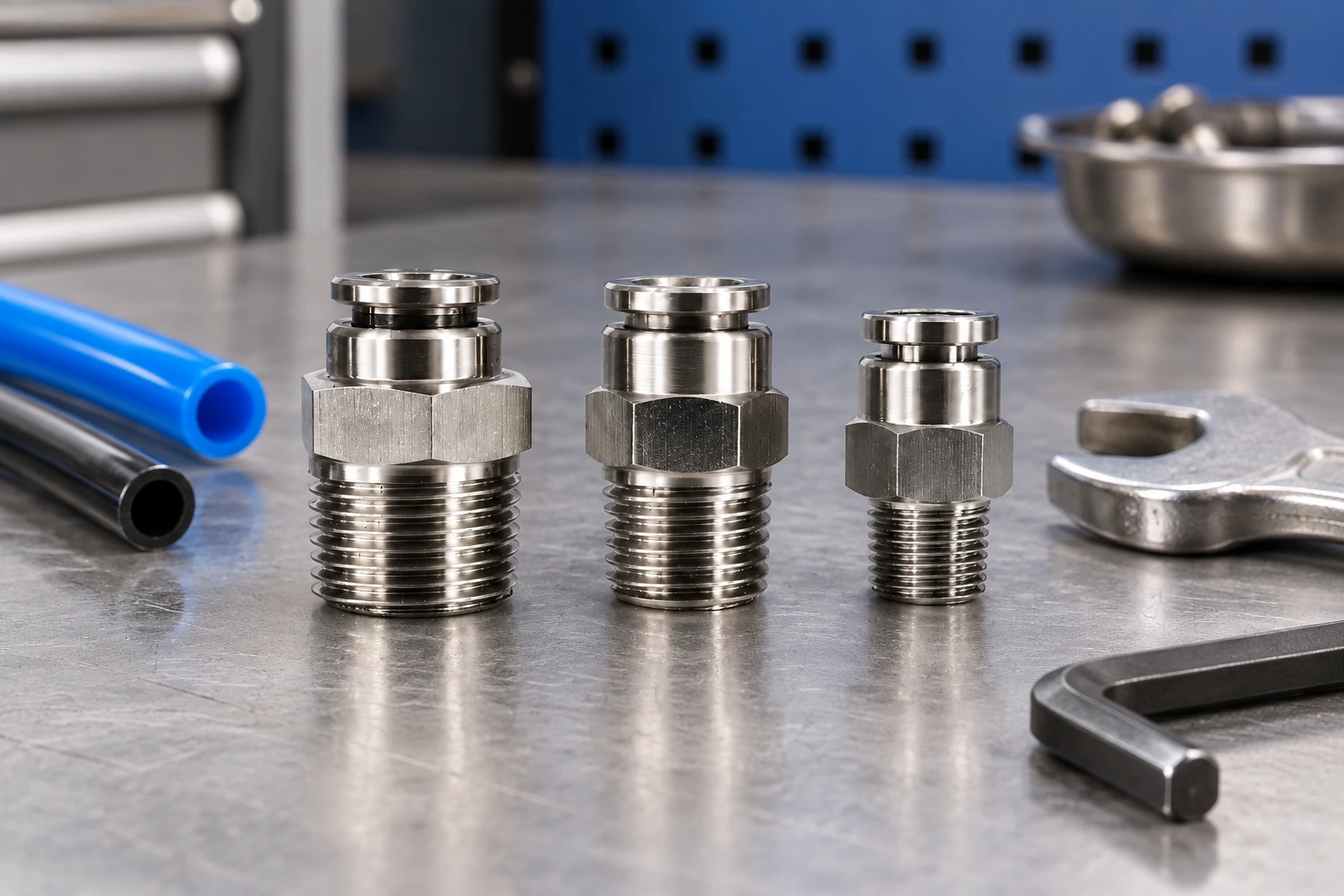
افزههای فشارهوایی چه وظایف اتصالی انجام میدهند؟
یک اتصال چگونه لوله را به یک قطعه وصل میکند؟
یک اتصال لوله به منفذ، گرفت مکانیکی و جلوهگری بین لولههای انعطافپذیر و یک قطعه دارای سربند مانند شیر، سیلندر، رگولاتور یا کالیبر فشار فراهم میکند. در طراحی پشتهای، کلت لوله را نگه میدارد در حالی که یک جلوهگر داخلی دور سطح خارجی آن بسته میشود. لوله باید به صورت عمود بریده، حفرهزدایی شده و تا عمق تعیینشده توسط سازنده کاملاً وارد شود؛ لولهای که به طور نامساوی به پایین میرسد حتی در صورت درست بودن قطر خارجی اسمی نیز ممکن است نشت کند.
چگونه آرم، تیها و منافذ، مسیریابی را مدیریت میکنند؟
لوازم جهتیابی مانع از خم شدن لوله در زیر شعاع توصیهشده آن میشوند و میتوانند فشار وارده بر منفذ را کاهش دهند. سهراهها و توزیعکنندهها تأمین را توزیع میکنند، در حالی که کاهندهها انتقال بین دو مقادیر مشخص را انجام میدهند. اندازه لولهس. مسیریابی همچنان بر کاهش فشار و دسترسی به خدمات تأثیر میگذارد: یک زاویهمنهایی کوچک میتواند به افزایش فاصله کمک کند، اما اضافه کردن چرخشهای غیرضروری باعث ایجاد جوشهای بیشتری میشود که باید معاینه شوند. شکل یک اتصال، رتبه فشار کل مدار را تغییر نمیدهد؛ پایینترین رتبه قطعه، همچنان مرجع محدودکننده است.
ابزارهای قطع جریان، پیچهای فلنش و اتصالات خروجی کجا مفید هستند؟
عملکردهای قطع یا بازرسی، یک شاخه را عایق میکنند یا جریان معکوس را محدود میکنند، زمانی که طراحی محصول به صراحت آن عملکرد را فراهم میکند. اتصالات پارچین، لوله را از طریق یک پنل حمایت میکنند، و اتصالات خروجی یا سایلنسورها، خروجی یک شیر را مدیریت میکنند. اینها انتخابهای عملکردی هستند، نه نامهای قابل جایگزین: نباید فرض کرد که یک اتصال ساده، عایقسازی، کنترل جریان یا کاهش سر و صدا را فراهم میکند. نماد و توضیحات قطعه را با مستندات مدار مقایسه کنید؛ ISO 1219-1 برای تفسیر آن نمودار مفید است.
چگونه اتصالات هوایی یک اتصال قابل اعتماد ایجاد میکنند؟
یک اتصال قابل اعتماد، نگهداری، محکمسازی و بارگذاری صحیح را با هم ترکیب میکند. نگهداری از طریق مکانیزم گرفتن اتصال حاصل میشود؛ محکمسازی از طریق یک الاستومر یا سطح تماس طراحی شده حاصل میشود؛ و بارگذاری شامل عمق ورود لوله، تعامل خراشها و مقاومت در برابر ارتعاشات است. اگر استفاده از روغن خراش مجاز باشد، تنها در جاهایی که سازنده اتصال اجازه داده است باید استفاده شود، زیرا مواد اضافی میتواند وارد یک شیر شود یا تعامل خواستهشده خراشها را تغییر دهد.
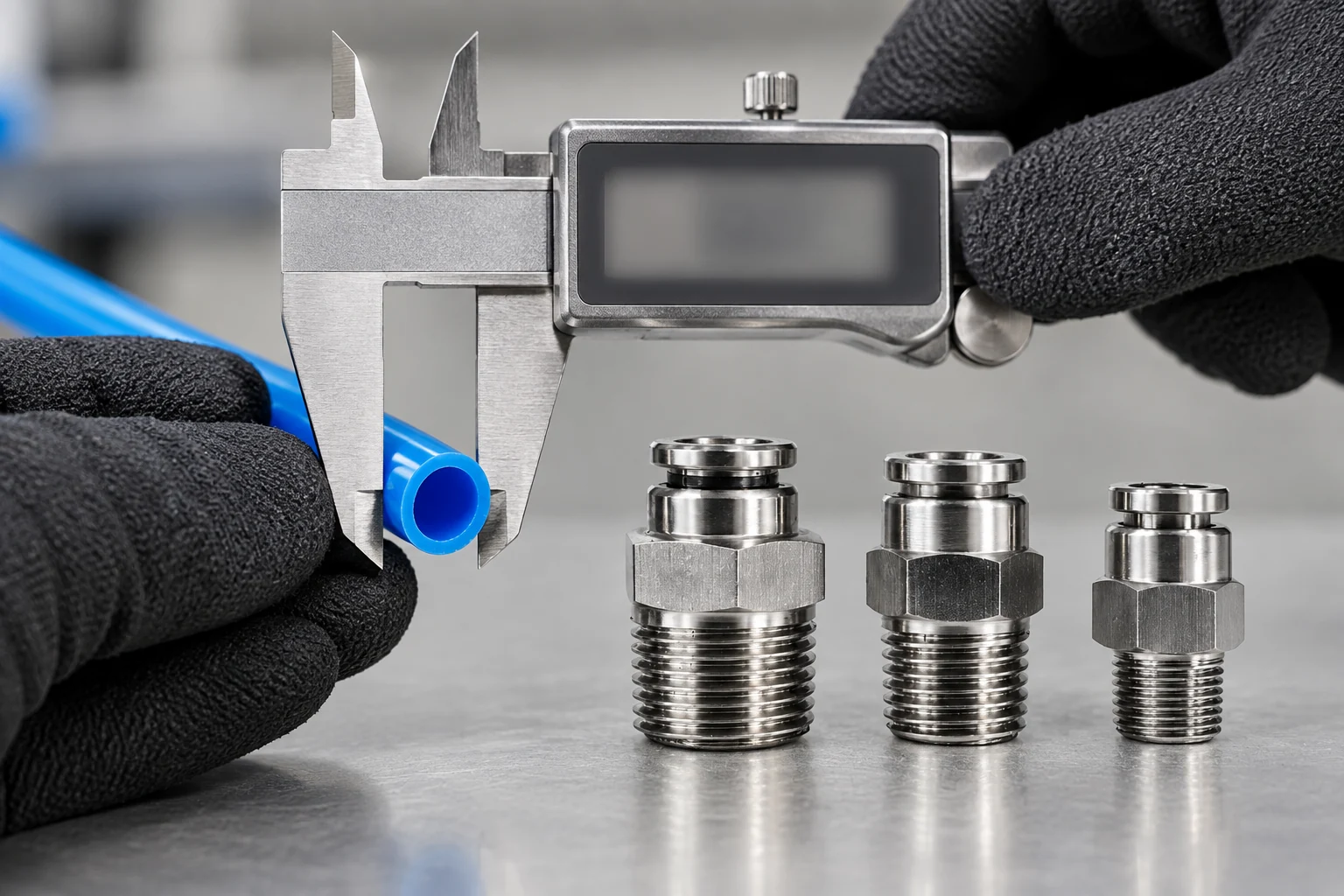
در مورد یک نصب جدید، قطر خارجی لوله را با یک سایزگیر یا کالیپر مناسب بررسی کنید، مطمئن شوید که استاندارد و نوع سربند (مذکر یا مؤنث) مطابقت دارد، و از اینکه محیط با مواد پیمانکار و بدنه سازگار است، اطمینان حاصل کنید. پس از اتمام اتصال، فشار را به تدریج افزایش دهید و از روش بررسی نشتی مورد تأیید محل استفاده کنید. ظهور حباب قابل مشاهده، کاهش فشار یا شنیدن صدای نشت، دلیلی است برای جدا کردن مدار و اصلاح اتصال، نه اینکه با افزایش فشار تأمین، آن را جبران کنید.
کدام انواع اتصالات هوای فشرده برای کاربردهای رایج مناسب هستند؟
| نوع اتصال | وظیفه اصلی | جایی که معمولاً استفاده میشود | تمرکز بر احراز صحت |
|---|---|---|---|
| ورود مستقیم با فشار دادن | اتصال لوله به پورت فرفرهای | شیرها، سیلندرها، رگولاتورها، مانیفولدهای کوچک | قطر خارجی لوله، سر رشته منفذ، ماده پیمانکار، محدودههای فشار و دما |
| آرنج یا آرنج چرخشی | جهت را تغییر دهید و فشار روی مسیریابی را کاهش دهید | پنلهای متراکم دستگاه و خطوط سوئیچهای متحرک | Clearance, bend radius, swivel limits, vibration support |
| Tee, cross, or manifold | Branch one supply into multiple lines | Fixtures, grippers, sensor circuits, distribution blocks | Branch flow demand, port count, common thread standard |
| کاهشدهنده | انتقال بین اندازههای لوله مشخص شده | Service replacements and mixed-size assemblies | Both tube ODs, direction of flow, space and support |
| Bulkhead | Pass a tube through a panel or enclosure | Control cabinets and guarded machine sections | Panel thickness, locknut access, sealing and strain relief |
| Plug, cap, or silencer | Close a port or manage exhaust | Unused valve ports and controlled exhaust outlets | Function, exhaust flow, contamination and maintenance access |
This table is a selection framework, not a compatibility guarantee. A fitting family may use several thread standards or seal options, and a product name such as “quick” describes the connection method rather than an unrestricted operating envelope. The guide to choosing plastic pneumatic fittings gives a deeper material and application comparison.
What changes when tubing moves with the machine?
A fitting in a stationary cabinet and a connection on a moving assembly may have the same nominal tube size but different service demands. Identify where the tube bends, where it is supported and whether it twists at the port during the full movement. A static working-pressure rating does not establish suitability for repeated bending, vibration or rotation. The specification should describe the motion and require confirmation for that duty from the selected component manufacturer.
Separate three functions: a fitting body that can be oriented for installation, a tube that flexes during machine motion, and a joint designed for continuous rotation. They are not interchangeable descriptions. Keep bending away from the release sleeve, provide the required service loop and check that guarding or another mechanism cannot strike the tube. If the layout cannot keep side load off a standard port, revise the routing or select a purpose-designed connection after engineering review.
Assess the real assembly during a controlled trial: tube movement, clearance, leakage, abrasion and access to the release mechanism. State the observation conditions and stopping criteria rather than choosing an arbitrary cycle count and calling it a lifetime test. The راهنمای نصب اتصال لولههای هوایی فشرده can help organize preparation and support checks, but the manufacturer’s dynamic-application data must govern the particular moving connection.
How should buyers match fittings to an application?
| Application question | Connection function to consider | Evidence to collect before purchase |
|---|---|---|
| Does a cylinder need a compact tube route? | Straight, elbow, or swivel elbow | Cylinder port thread, tube OD, bend radius, moving clearance |
| Does one supply feed several actuators? | Tee, cross, or manifold | Branch count, simultaneous demand, port thread and tube size |
| Must a tube cross a panel? | Bulkhead fitting | Panel thickness, access on both sides, seal and strain-relief requirements |
| Is a line being converted to another tube size? | کاهشدهنده | Both measured ODs, manufacturer-approved transition, support near the joint |
| Is an unused valve port being closed? | Plug or cap | Port thread, pressure/temperature envelope, future maintenance plan |
| Does exhaust need controlled outlet flow? | Silencer or exhaust fitting | Valve exhaust port, flow requirement, contamination and service conditions |
What must be checked before a pneumatic fitting is approved?
- Measure the tube OD. Nominal labels are not a substitute for the actual outside diameter. Push-in collets and seals are designed around the specified OD and tolerance.
- Identify the thread. Record thread standard, size, gender, and sealing method from the component drawing; do not infer a thread from appearance.
- Name the medium. Clean dry air, lubricated air, vacuum, inert gas, and other media can require different body or seal materials. Confirm chemical compatibility in the product documentation.
- Confirm pressure and temperature. Use the fitting maker’s published limits for the actual temperature, duty cycle, and environment. Never transfer a rating from a different tube, seal, or fitting family.
- Plan installation and maintenance. Leave access for insertion, release, leak inspection, and replacement. Keep tubes supported so vibration is not carried directly into the port.
These checks are especially important when replacing a fitting with a visually similar part. The KQ2 quick-connect coupling guide can help explain a specific quick-connection family, but its details should not be generalized to unrelated series.
Which standards and documents help verify a fitting choice?
ISO 1219-1:2012 defines graphical symbols and circuit diagrams for fluid power, so it helps a team agree on what a connection is intended to do. It is not a product approval or a pressure test certificate. For the actual fitting, the controlling documents are the manufacturer’s current datasheet, installation instructions, material compatibility statement, and any application-specific regulation or site standard. SMC and Festo catalogs are useful primary product references because they show how tube sizes, threads, fitting functions, and environmental notes are presented; they do not make another manufacturer’s part interchangeable.
Where a machine falls under a local pressure, machinery, food-contact, or hazardous-location rule, the machine builder or responsible engineer must identify the applicable requirement. A generic “industrial use” statement is not evidence of compliance. Keep the selected part number, revision, and verification record with the machine file so a future replacement can be checked against the same boundary conditions.
How can a leak be traced to the right interface?
Mark whether leakage is at the tube seal, threaded port, body or another nearby component. A fitting beside a noisy exhaust may be blamed without being the source. Use the plant’s approved detection procedure and examine the circuit in its relevant operating state. A branch may seal while idle yet show a problem when tubing moves or downstream demand increases. Record that state so the maintenance team can reproduce the observation.
The U.S. Department of Energy’s Minimize Compressed Air Leaks identifies couplings, hoses, fittings, quick disconnects and point-of-use equipment among common leak locations. It also explains that lowering air demand does not automatically produce the maximum electrical saving without appropriate compressor-control response. A repair record should therefore distinguish a local seal correction from a measured system-energy improvement. Do not attach a generic energy-saving percentage to an individual fitting.
Where repeated reconnection leaves grip marks, inspect both the tube end and fitting condition. Follow the supplier’s reuse rules; replace parts with damaged sleeves, bodies or sealing surfaces and investigate the recurring load or contamination. The راهنمای نگهداری اتصالات پنوماتیک provides related inspection questions for service teams. Keeping failed parts identified by machine zone and lot can reveal a shared routing or assembly issue before another replacement is fitted.
How should pneumatic fittings be maintained after installation?
Maintenance starts with visual inspection for tube scoring, cracked bodies, damaged threads, movement at the port, or contamination around the seal. Isolate and depressurize the branch before releasing a push-in tube; pulling a live line can create a sudden hose movement and damage the collet. Re-cut a damaged tube squarely and replace a fitting when the seal or gripping elements show wear. Avoid reusing a part if the maker’s instructions require replacement after removal.
Record recurring leaks by location and operating condition. A pattern may point to routing strain, unsupported vibration, wrong tube OD, chemical attack, or a pressure and temperature mismatch rather than a random fitting defect. The common pneumatic fitting issues guide provides a practical inspection sequence; site lockout and depressurization procedures remain mandatory.
سوالات متداول
Are pneumatic fittings and pneumatic couplings the same thing?
The terms overlap, but usage varies by catalog. “Fitting” often covers tube-to-port connectors, elbows, tees, reducers, and plugs, while “coupling” may describe a connector designed to join or disconnect two lines or components. Check the manufacturer’s part definition and drawing rather than treating the terms as proof of function.
Can I use any push-in fitting with the same tube size?
No. The tube OD is necessary but not sufficient: thread, seal material, medium, pressure, temperature, and fitting series also have to match. Use the tube and fitting manufacturer’s compatibility data and verify a sample connection before releasing a production order.
What is the most common cause of a push-in fitting leak?
Common causes include an incorrect tube OD, an angled or damaged tube cut, incomplete insertion, seal damage, side loading, or a mismatched thread at the component. Isolate the line, inspect the joint, and correct the underlying condition rather than simply tightening an unrelated part.
Do pneumatic fittings work with vacuum as well as compressed air?
Some do, but vacuum service must be stated in the product documentation. Vacuum can change how a seal is loaded and can draw contamination through a poor joint. Confirm the permitted vacuum range, tube material, and connection direction for the selected series.
How do I choose between plastic, brass, and stainless-steel fittings?
Start with the medium, temperature, pressure, corrosion exposure, weight, and installation environment. Plastic may suit a lightweight clean-air circuit, while metal may be selected for mechanical or environmental demands; neither choice is automatically correct without the manufacturer’s data and the application’s requirements.
When should a pneumatic fitting be replaced instead of repaired?
Replace it when the body, thread, collet, seal, or tube contact surface is damaged, when leakage returns after the verified installation checks, or when the service conditions have changed beyond its documentation. If the root cause is unknown, stop the branch and review OD, thread, medium, pressure, temperature, and routing before installing another part.
Can a normal push-in fitting be used on a moving axis?
Only within its documented application limits. Describe the tube motion, support, vibration and environment to the supplier. A body that swivels for alignment is not proof of suitability for continuous rotation or repeated tube articulation.
Does repairing one air leak prove that electricity use has fallen?
No. It can reduce local air loss, but electrical consumption also depends on compressor controls and operating demand. Verify air use and electrical use at defined boundaries before reporting a measured energy saving.
مراجع
- SMC, KQ2 one-touch fitting catalogue: tube retention, sealing and connection configurations
- وزارت انرژی ایالات متحده، کاهش نشت هوای فشرده، بروشور راهنمایی 3
خلاصه
Pneumatic fittings connect, route and adapt an air circuit, but their suitability depends on the complete application. Match tube dimensions and material, port thread, medium and operating conditions before considering the connection shape. Then check movement, support and access throughout the machine cycle. A push-in connection should never be assumed to provide automatic shutoff, continuous rotation or a universal reuse allowance. When a leak occurs, identify the interface and operating state before replacing parts, and separate a local repair from an unmeasured energy-saving claim. Oulu’s رشته محصولات پنیومیتی can support a documented selection process when the exact connection requirements and model-specific limits are provided for review.



