
A maintenance engineer may replace a leaking air line twice before discovering that the fitting was selected by thread size alone. The tube outside diameter (OD), port thread, working medium, and pressure and temperature limits all have to agree; a push-in fitting that fits physically can still be the wrong connection for the circuit. This guide answers where pneumatic fittings are used, what their connection functions are, and how to choose them without assuming that one fitting suits every system. It focuses on ordinary industrial and commercial compressed-air systems, not on a claim that one fitting is suitable for every machine, fluid, or regulated application.
Кыскача мазмун: Pneumatic fittings connect, branch, orient, control, or terminate tubing so compressed air can reach valves, cylinders, actuators, tools, and instruments. Specify four items before ordering: tube OD, port thread, medium, and pressure/temperature envelope. ISO 1219-1 provides the notation used to read fluid-power circuit symbols; it does not certify a particular fitting. The practical next step is to compare the equipment maker’s connection drawing with the fitting and tube manufacturer’s data, then inspect a test assembly for seating and leakage.
Where are pneumatic fittings used in a working system?
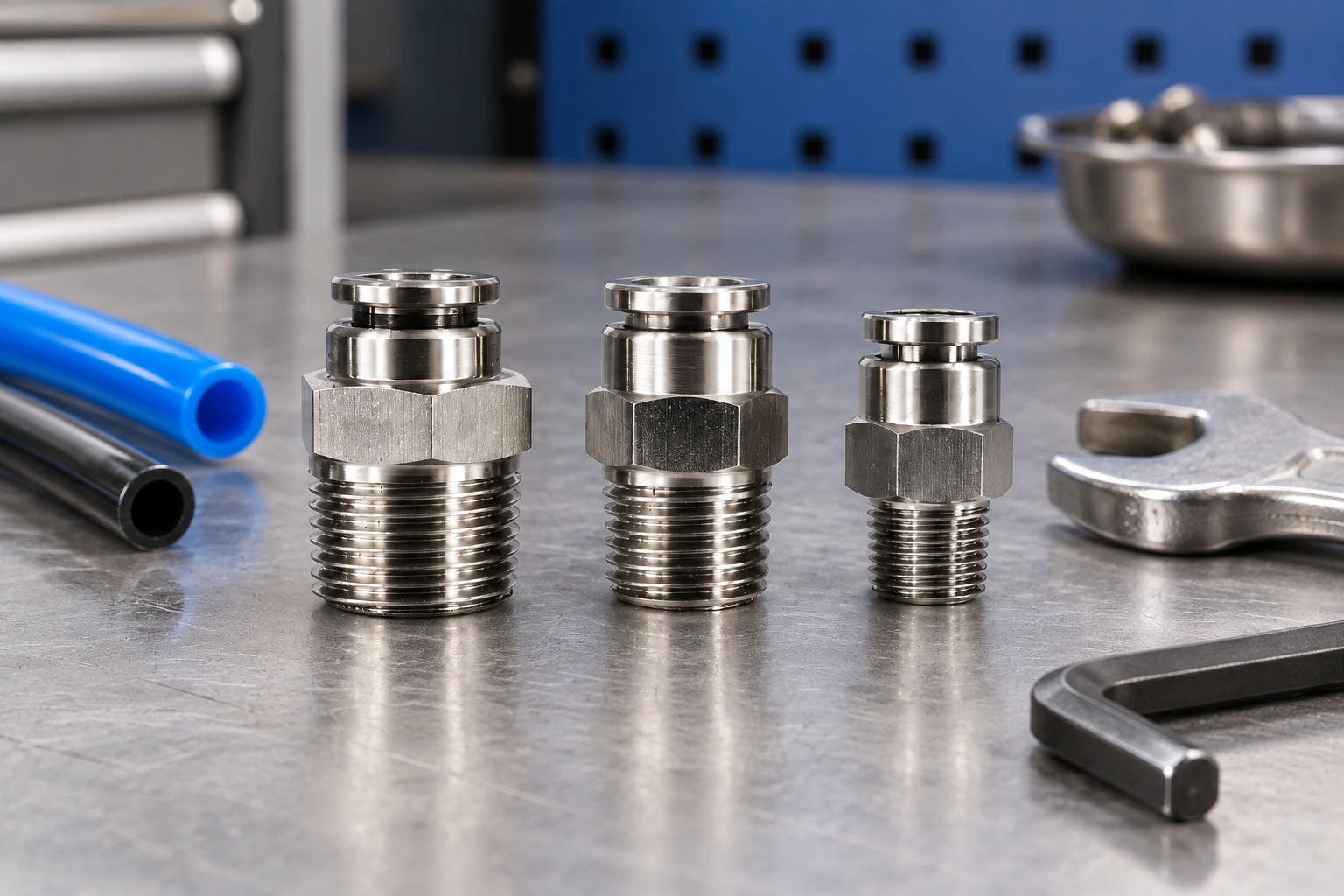
Fittings appear anywhere a pneumatic circuit changes from one component or direction to another. A straight push-in fitting joins a tube to a valve or cylinder; an elbow turns the line where cabinet space is limited; a tee or manifold divides supply to more than one branch; a bulkhead fitting passes through a panel; and a plug or silencer closes an unused port. In a production cell, the same circuit can contain several of these functions, so the fitting is part of the system layout rather than a cosmetic accessory.
Typical application fields include machine automation, pick-and-place equipment, packaging, assembly fixtures, workshop air tools, instrumentation, and maintenance panels. The application label alone does not establish suitability. Oil mist, water vapor, vacuum, chemically aggressive media, outdoor exposure, or unusual temperature can change the material and seal choice. Catalogs from SMC and Festo separate connection technology by tube, thread, function, and environment for this reason (SMC fittings and tubing documentation; Festo connection-technology documentation).
What connection functions do pneumatic fittings perform?
How does a fitting connect tubing to a component?
A tube-to-port fitting provides the mechanical grip and seal between flexible tubing and a threaded component such as a valve, cylinder, regulator, or gauge. In a push-in design, the collet retains the tube while an internal seal closes around its outside surface. The tube must be cut square, deburred, and fully inserted to the manufacturer’s depth; a tube that bottoms unevenly can leak even when the nominal OD is correct.
How do elbows, tees, and manifolds manage routing?
Directional fittings keep a tube from bending below its recommended radius and can reduce strain at a port. Tees and manifolds distribute supply, while reducers transition between two specified tube sizes. Routing still affects pressure drop and service access: a compact elbow may help clearance, but adding unnecessary turns adds joints that must be inspected. A fitting’s shape does not change the pressure rating of the complete circuit; the lowest-rated component remains the limiting reference.
When are shut-off, bulkhead, and exhaust fittings useful?
Shut-off or check functions isolate a branch or restrict reverse flow when the product design explicitly provides that function. Bulkhead fittings support a tube through a panel, and exhaust fittings or silencers manage the outlet of a valve. These are functional choices, not interchangeable names: a plain connector should not be assumed to provide isolation, flow control, or noise reduction. Confirm the symbol and part description against the circuit documentation; ISO 1219-1 is useful for interpreting that diagram.
How do pneumatic fittings create a reliable connection?
A reliable joint combines retention, sealing, and correct loading. Retention comes from the fitting’s gripping mechanism; sealing comes from an elastomer or engineered interface; loading includes the tube’s insertion depth, thread engagement, and support against vibration. Thread sealant, if permitted, must be applied only where the fitting maker allows it, because excess material can enter a valve or alter the intended thread engagement.
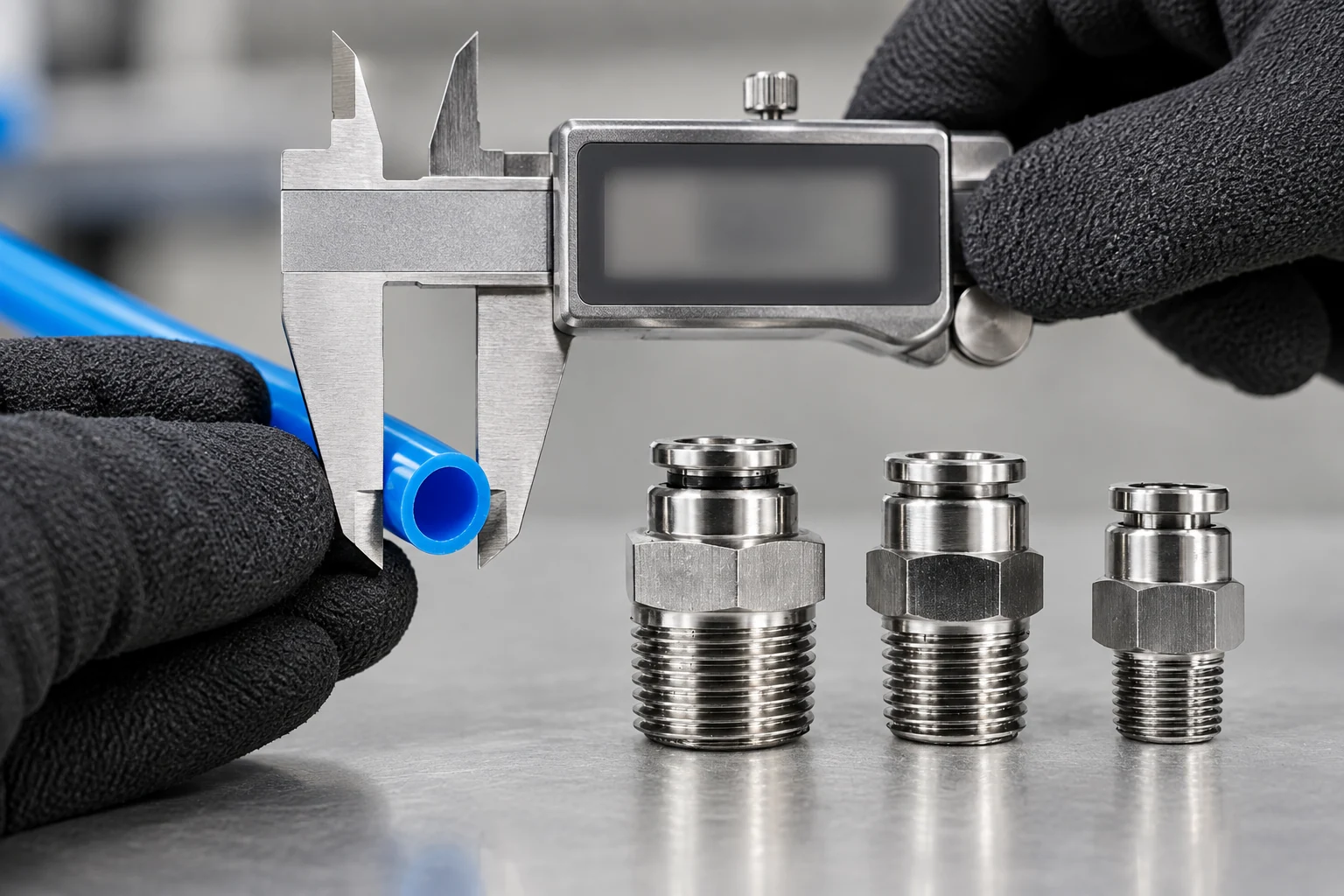
For a new installation, verify the tube OD with a suitable gauge or caliper, check that the thread standard and gender match, and confirm that the medium is permitted by the seal and body materials. Pressurize progressively after the connection is complete and use the site-approved leak-check method. A visible bubble, pressure decay, or audible leak is a reason to isolate the circuit and correct the joint, not to compensate by raising supply pressure.
Which pneumatic fitting types fit common applications?
| Fitting type | Primary function | Where it is commonly used | Verification focus |
|---|---|---|---|
| Straight push-in | Tube-to-threaded-port connection | Valves, cylinders, regulators, compact manifolds | Tube OD, port thread, seal material, pressure and temperature limits |
| Elbow or swivel elbow | Change direction and reduce routing strain | Dense machine panels and moving actuator lines | Clearance, bend radius, swivel limits, vibration support |
| Tee, cross, or manifold | Branch one supply into multiple lines | Fixtures, grippers, sensor circuits, distribution blocks | Branch flow demand, port count, common thread standard |
| Кемиткич | Transition between specified tube sizes | Service replacements and mixed-size assemblies | Both tube ODs, direction of flow, space and support |
| Bulkhead | Pass a tube through a panel or enclosure | Control cabinets and guarded machine sections | Panel thickness, locknut access, sealing and strain relief |
| Plug, cap, or silencer | Close a port or manage exhaust | Unused valve ports and controlled exhaust outlets | Function, exhaust flow, contamination and maintenance access |
This table is a selection framework, not a compatibility guarantee. A fitting family may use several thread standards or seal options, and a product name such as “quick” describes the connection method rather than an unrestricted operating envelope. The guide to choosing plastic pneumatic fittings gives a deeper material and application comparison.
How should buyers match fittings to an application?
| Application question | Connection function to consider | Evidence to collect before purchase |
|---|---|---|
| Does a cylinder need a compact tube route? | Straight, elbow, or swivel elbow | Cylinder port thread, tube OD, bend radius, moving clearance |
| Does one supply feed several actuators? | Tee, cross, or manifold | Branch count, simultaneous demand, port thread and tube size |
| Must a tube cross a panel? | Bulkhead fitting | Panel thickness, access on both sides, seal and strain-relief requirements |
| Is a line being converted to another tube size? | Кемиткич | Both measured ODs, manufacturer-approved transition, support near the joint |
| Is an unused valve port being closed? | Plug or cap | Port thread, pressure/temperature envelope, future maintenance plan |
| Does exhaust need controlled outlet flow? | Silencer or exhaust fitting | Valve exhaust port, flow requirement, contamination and service conditions |
What must be checked before a pneumatic fitting is approved?
- Measure the tube OD. Nominal labels are not a substitute for the actual outside diameter. Push-in collets and seals are designed around the specified OD and tolerance.
- Identify the thread. Record thread standard, size, gender, and sealing method from the component drawing; do not infer a thread from appearance.
- Name the medium. Clean dry air, lubricated air, vacuum, inert gas, and other media can require different body or seal materials. Confirm chemical compatibility in the product documentation.
- Confirm pressure and temperature. Use the fitting maker’s published limits for the actual temperature, duty cycle, and environment. Never transfer a rating from a different tube, seal, or fitting family.
- Plan installation and maintenance. Leave access for insertion, release, leak inspection, and replacement. Keep tubes supported so vibration is not carried directly into the port.
These checks are especially important when replacing a fitting with a visually similar part. The KQ2 quick-connect coupling guide can help explain a specific quick-connection family, but its details should not be generalized to unrelated series.
Which standards and documents help verify a fitting choice?
ISO 1219-1:2012 defines graphical symbols and circuit diagrams for fluid power, so it helps a team agree on what a connection is intended to do. It is not a product approval or a pressure test certificate. For the actual fitting, the controlling documents are the manufacturer’s current datasheet, installation instructions, material compatibility statement, and any application-specific regulation or site standard. SMC and Festo catalogs are useful primary product references because they show how tube sizes, threads, fitting functions, and environmental notes are presented; they do not make another manufacturer’s part interchangeable.
Where a machine falls under a local pressure, machinery, food-contact, or hazardous-location rule, the machine builder or responsible engineer must identify the applicable requirement. A generic “industrial use” statement is not evidence of compliance. Keep the selected part number, revision, and verification record with the machine file so a future replacement can be checked against the same boundary conditions.
How should pneumatic fittings be maintained after installation?
Maintenance starts with visual inspection for tube scoring, cracked bodies, damaged threads, movement at the port, or contamination around the seal. Isolate and depressurize the branch before releasing a push-in tube; pulling a live line can create a sudden hose movement and damage the collet. Re-cut a damaged tube squarely and replace a fitting when the seal or gripping elements show wear. Avoid reusing a part if the maker’s instructions require replacement after removal.
Record recurring leaks by location and operating condition. A pattern may point to routing strain, unsupported vibration, wrong tube OD, chemical attack, or a pressure and temperature mismatch rather than a random fitting defect. The common pneumatic fitting issues guide provides a practical inspection sequence; site lockout and depressurization procedures remain mandatory.
Frequently asked questions about pneumatic fittings
Are pneumatic fittings and pneumatic couplings the same thing?
The terms overlap, but usage varies by catalog. “Fitting” often covers tube-to-port connectors, elbows, tees, reducers, and plugs, while “coupling” may describe a connector designed to join or disconnect two lines or components. Check the manufacturer’s part definition and drawing rather than treating the terms as proof of function.
Can I use any push-in fitting with the same tube size?
No. The tube OD is necessary but not sufficient: thread, seal material, medium, pressure, temperature, and fitting series also have to match. Use the tube and fitting manufacturer’s compatibility data and verify a sample connection before releasing a production order.
What is the most common cause of a push-in fitting leak?
Common causes include an incorrect tube OD, an angled or damaged tube cut, incomplete insertion, seal damage, side loading, or a mismatched thread at the component. Isolate the line, inspect the joint, and correct the underlying condition rather than simply tightening an unrelated part.
Do pneumatic fittings work with vacuum as well as compressed air?
Some do, but vacuum service must be stated in the product documentation. Vacuum can change how a seal is loaded and can draw contamination through a poor joint. Confirm the permitted vacuum range, tube material, and connection direction for the selected series.
How do I choose between plastic, brass, and stainless-steel fittings?
Start with the medium, temperature, pressure, corrosion exposure, weight, and installation environment. Plastic may suit a lightweight clean-air circuit, while metal may be selected for mechanical or environmental demands; neither choice is automatically correct without the manufacturer’s data and the application’s requirements.
When should a pneumatic fitting be replaced instead of repaired?
Replace it when the body, thread, collet, seal, or tube contact surface is damaged, when leakage returns after the verified installation checks, or when the service conditions have changed beyond its documentation. If the root cause is unknown, stop the branch and review OD, thread, medium, pressure, temperature, and routing before installing another part.
Деректер
- ISO 1219-1:2012, Fluid power systems and components – Graphical symbols and circuit diagrams.
- SMC, Fittings and Tubing product documentation.
- Festo, Pneumatic connection technology documentation.
The dependable choice is not the fitting that merely threads in; it is the one whose tube OD, thread, medium, pressure, temperature, and routing have all been verified for the same service. After those checks, ANMASPC/Oulu can help buyers compare a documented pneumatic fitting range for their connection layout. Review the pneumatic fittings range and contact the team with the tube OD, thread, medium, pressure, temperature, and application details so the selection can be checked against the relevant product data.


