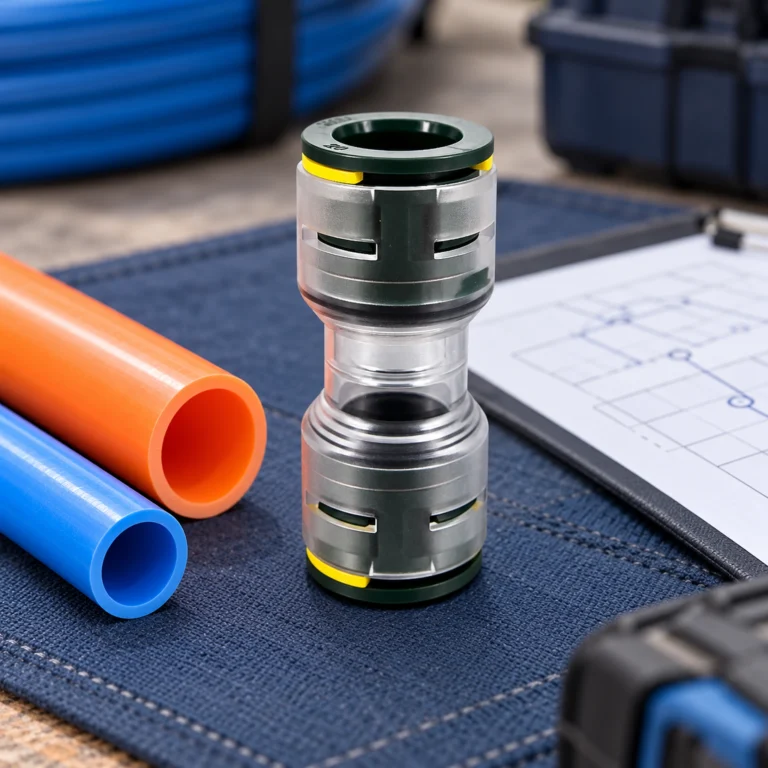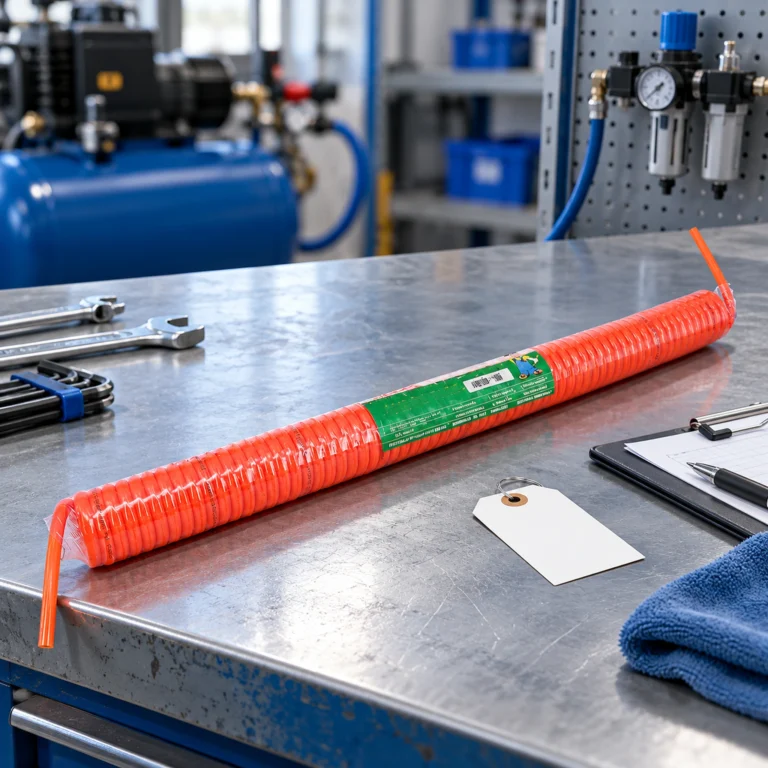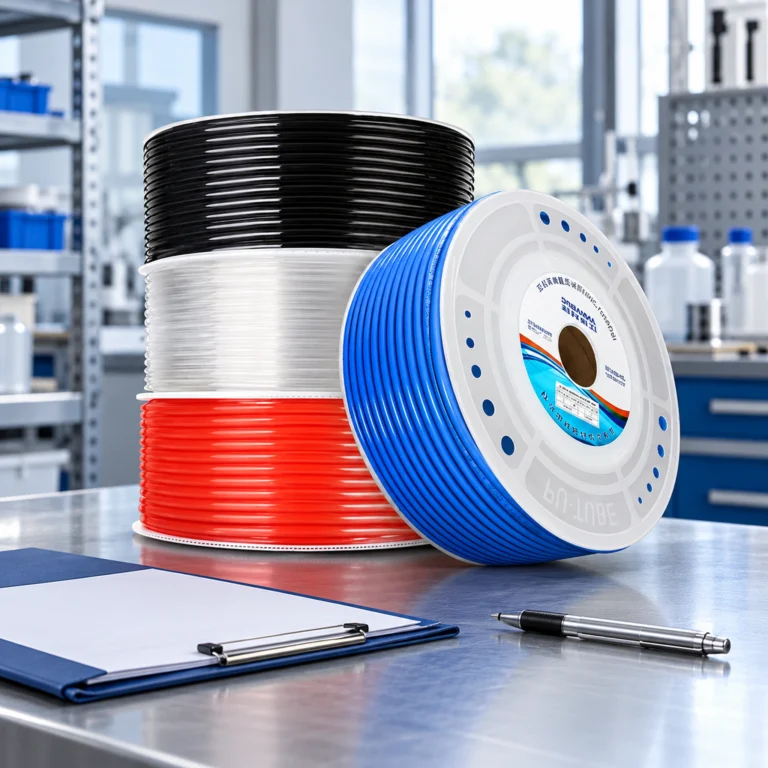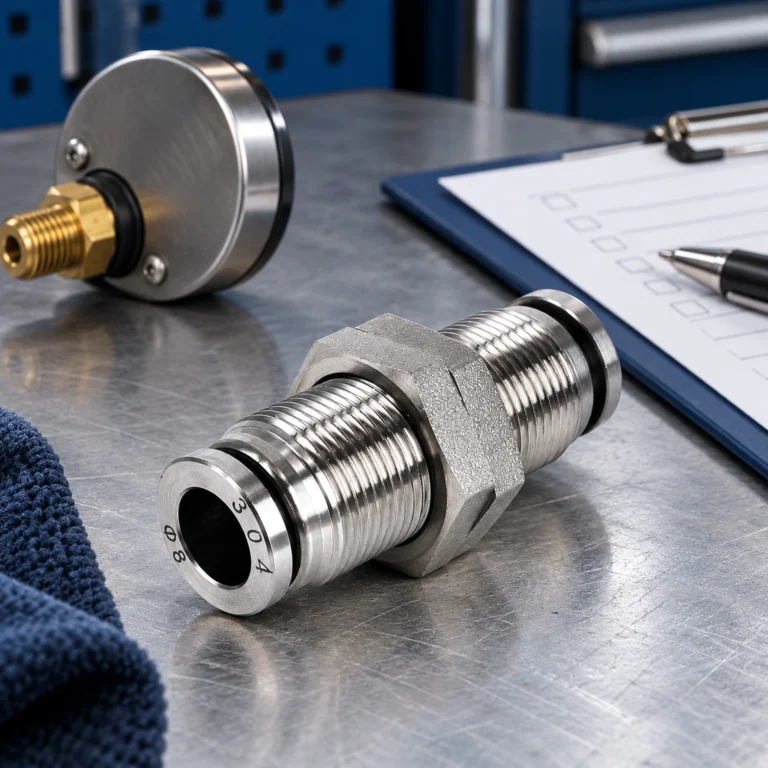
A pneumatic tube that leaks only when an actuator moves is giving a different clue from a line that leaks continuously at a threaded port. Replacing both with the same spare hose can hide the cause for a short period while leaving the routing, temperature or connector mismatch unchanged. Flexible polyurethane tubing is convenient around machinery, but flexibility does not remove its minimum bend radius or make it suitable for every oil, cleaner and pressure cycle. This guide separates tube-side leaks, wall damage, kinks and flow restrictions so maintenance teams can inspect the right location, correct the underlying condition and approve a replacement without guessing from colour or nominal size.
Start by locating the symptom and isolating the pneumatic energy before disturbing the line. A PU pneumatic hose can leak because its OD or material is unsuitable for the fitting, its end is damaged, it is incompletely inserted, or heat and chemical exposure have changed its condition. Kinks usually require a routing correction, not just another connector. Match the exact hose’s pressure-temperature rating and minimum bend radius, support the first bend beyond the fitting, and verify the route through the full machine movement. Use a controlled leak and functional check after reassembly.
Where does the leak occur, and when does it appear?
Observe the connection with guards and operating procedures respected. A leak at the push-in entry points attention toward the tube end, insertion, side load or seal. A leak at the equipment thread requires a separate thread and sealing assessment. A damaged wall away from the fitting suggests abrasion, heat, chemical attack or excessive bending. Mark the location before shutdown so the investigation does not lose its original reference.
Compare stationary and moving conditions using approved inspection methods. A hose can seal at rest yet pull sideways when a cylinder reaches the end of travel. Check every intended machine position rather than the easiest position for the technician. Do not reach into moving equipment to feel for an air jet. The pneumatic leak troubleshooting guide explains why a thread leak and a tube-entry leak need different remedies.
| Ажиглагдсан шинж тэмдэг | Conditions worth checking | Corrective direction |
|---|---|---|
| Leak at tube entry | OD, end condition, insertion and side load | Prepare approved tubing and correct the route |
| Leak at threaded port | Thread designation and sealing surface | Repair the specified port connection |
| Wall wear or pinhole | Panel edges, rubbing, heat and chemicals | Replace damaged tubing and remove the exposure |
| Flow falls during motion | Flattening, stretching or a pinched loop | Change bend geometry and support |
How should tube size and insertion be checked?
For a push-in fitting, identify tube outside diameter in the correct unit system. The inside diameter controls part of the flow capacity but does not define the sealing interface. Record both dimensions and the tube formulation. A 1/4-inch OD is 6.35 mm, not 6 mm; the separate metric and inch tables in SMC’s TU/TIUB catalogue make this distinction explicit. Match the tube’s permitted tolerance and material to the fitting’s current instructions.
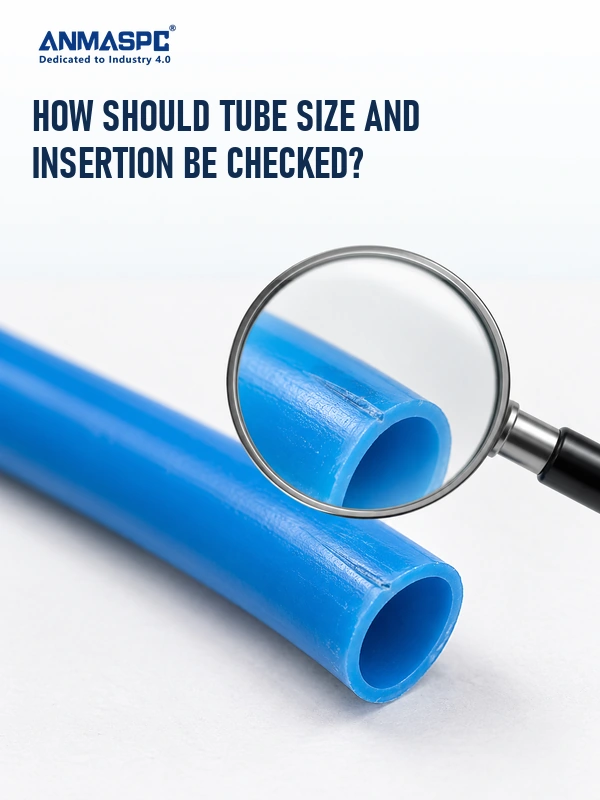
Cut square with an appropriate tube cutter and inspect the end for scoring, a slanted cut, flattening or residue. Insert using the exact manufacturer’s method and depth, then make its prescribed retention check while depressurized. A soft tube can buckle during insertion, creating a false impression that it reached the internal stop. SMC’s KQG2 instructions specifically warn about this with polyurethane in that grease-free series. The warning explains a possible assembly failure; it does not authorize adding lubricant to another fitting.
Do not repeatedly reinstall a deformed end. Remove the damaged section only if the remaining approved hose length still permits the intended route. Otherwise replace the length. If a correctly prepared tube continues leaking, assess the retaining and sealing components according to the connector manufacturer’s repair policy.
What bend radius prevents kinks in a moving route?
Тэр minimum bend radius belongs to the exact tube size and series, at the specified test condition. It is not a universal multiple that can safely be applied to every PU tube. Determine whether the drawing expresses radius or diameter, whether the value is static or dynamic, and whether the stated temperature matches the installation. Repeated-motion use needs the supplier’s explicit dynamic guidance.
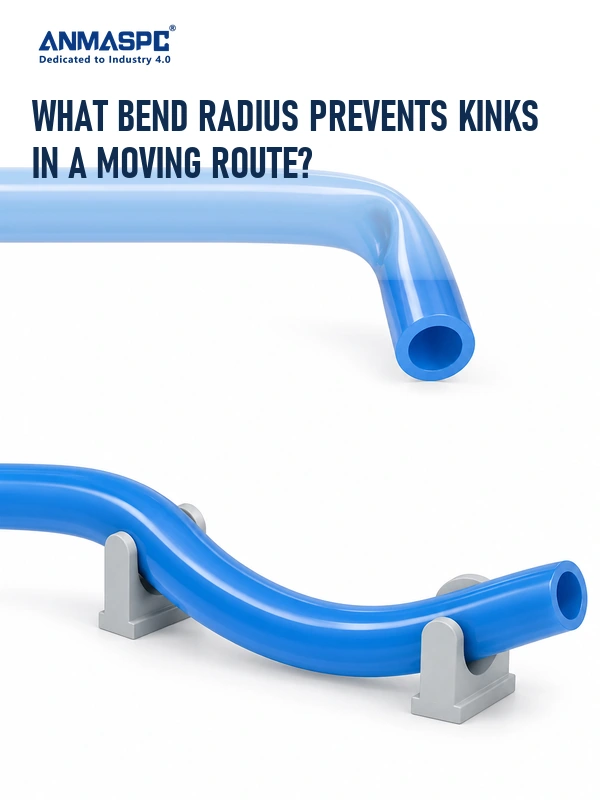
For a concrete example, SMC lists a 20 mm minimum bending radius for TU0805 tubing, while its TU0604 value is 15 mm. Those figures belong to the named catalogue sizes. They show why a value for one OD should not be copied to another. A warm, cyclic route may need a different qualification from the catalogue’s minimum static bend. Avoid treating the tightest bend that survives one installation as a proven production route.
Leave an appropriate straight entry into the fitting and support tubing without crushing it. Keep a moving service loop free from sharp edges, pinch points and adjacent hot surfaces. Check the fully extended and retracted positions, guarding clearance and access for removal. If a guide or elbow is introduced, qualify its friction and flow effects rather than adding it solely to make the installation look tidy.
Why does the hose soften or leak near a warm machine?
A room-temperature pressure figure does not describe every installation. The TU/TIUB example in the SMC catalogue states 0.8 MPa maximum operating pressure at 20°C and directs users to temperature-dependent information. It also distinguishes its air and water temperature conditions. These are series-specific values; they do not establish the limits of an Oulu hose, a reinforced hose or another PU formulation.
Measure or establish the relevant local conditions: the tube near a motor, the medium inside it, pressure transients and possible heating during startup. Compare tube and fitting limits under those same conditions. A regulator setting alone may not characterize every transient. Never use a proof or burst pressure as the continuous working limit, and do not increase pressure to overcome a flow restriction without resolving the restriction.
When choosing between materials, use the PU and PA hose comparison as an introduction to routing and selection. Final approval still needs the exact supplier data, including dimensional compatibility and temperature behaviour.
Can oil, water or cleaning chemicals damage the hose?
“Polyurethane” describes a material family, not a complete compatibility statement. Formulation, chemical identity, concentration, temperature and exposure duration all matter. Distinguish an oil carried inside compressed air from a cleaner sprayed on the outside. Include both in the specification. Swelling, tackiness, cracking, discolouration or a persistent change in dimensions should prompt investigation rather than a tighter clamp.
The SMC TU document provides a useful contrast: its general TU/TIUB section permits specified air/water conditions, while its hard-polyurethane TUH section warns against water because of hydrolysis. Therefore neither “all PU tubing is water-safe” nor “PU can never carry water” is an adequate selection rule. Obtain written applicability for the named part and actual service. A chemical chart is an initial screening tool, not evidence that a complete moving assembly will remain functional.
| Replacement requirement | Баримтыг хүсэлтлэх | What to avoid assuming |
|---|---|---|
| Pressure and heat | Exact-size operating curve and transient restrictions | Burst pressure is an operating rating |
| Repeated movement | Dynamic bend and application approval | A static minimum proves cyclic life |
| Oil, water or cleaner | Formulation-specific compatibility at actual conditions | Material name or colour proves suitability |
| Food or clean-air area | Required regulatory declaration and cleanliness scope | A transparent or stainless assembly is certified |
How can pressure loss be separated from a leak?
A long or undersized line can starve an actuator without leaking externally. Evaluate length, inside diameter, the number of restrictions, simultaneous demand, flow-control settings and upstream filtration. Pressure should be compared during the same operating event. Resting pressure can recover between cycles and conceal a restriction that appears only when several devices operate together.
A kink is particularly important because its restriction changes as the tube moves or warms. If a temporary reroute removes the symptom under an approved test procedure, document the route and support as part of the repair. Do not leave an unguarded temporary bypass as the permanent solution. When reviewing Oulu’s polyurethane PU tube listing, request the exact OD/ID combination, working conditions and bend requirements; product photographs establish appearance, not a flow guarantee.
What should be verified before the machine returns to service?
Hose replacement should follow the machine’s energy-control procedure. Isolate the affected section only where its design and procedure permit safe isolation, release trapped pressure, and verify the safe state. A closed valve does not by itself prove every trapped volume is depressurized. Preserve the tube and connector codes so the maintenance record identifies the combination actually installed.
After assembly, use the agreed leak-test method within the approved operating range and run the representative cycle with guards restored. Confirm that the route remains free from tension, abrasion and pinching. Record the fault location and corrective action, not just “hose replaced.” Include compatible spares and support hardware in the pneumatic maintenance plan. That prevents the next replacement from recreating the original fault.
Олонтаа асуугддаг асуултууд
Can the hose or fitting be replaced without shutting down the whole line?
Only if the machine has a designed, documented means of safely isolating the affected section, relieving trapped energy and preventing unexpected movement. Otherwise use the required wider shutdown. Never disconnect a pressurized push-in tube.
What certifications matter when a PU pneumatic hose is used near food or clean air?
Specify the actual jurisdiction, contact type and air-quality requirement. Request declarations and cleanliness information for the exact tube, fitting and seals. Being near food differs from direct food contact; a general industrial listing proves neither.
What tube size and bend radius should be used with a PU pneumatic hose?
Match the fitting’s accepted OD, material and tolerance, then select ID for the flow requirement. Obtain the exact tube’s minimum radius and any dynamic restrictions. Do not transfer a radius between different diameters or formulations.
How do you prevent abrasion and kinks when routing a PU pneumatic hose?
Use suitable supports, clearance from edges and an adequate bend through every machine position. Avoid over-tight clamps, twisting and a sharp bend immediately at the connector. Inspect the route after representative motion rather than only at rest.
What pressure and temperature limits apply to a PU pneumatic hose?
The current datasheet for the exact part determines them. Compare its temperature-dependent working limit with the connector and equipment limits, including transients. A published burst value cannot replace an operating rating.
Which connector thread fits a PU pneumatic hose without leaking?
The tube normally matches the connector’s tube socket; the thread matches the equipment port. Identify these independently. Specify OD and tube material on one end, and thread standard, size and seal arrangement on the other.
Дүрийн баримжаа
- SMC: TU/TIUB and TUH polyurethane tubing catalogue — size-specific bends, temperature-dependent pressure and different water limitations.
- SMC: KQG2 catalogue, specific product precautions — soft-tube insertion, tubing deformation and mechanical-load restrictions.
- SMC: KQ2 one-touch fittings catalogue — connection and tube-selection context.
Summary
A lasting PU hose repair starts with the fault location and operating condition. Verify tube dimensions and end preparation for an entry leak, investigate the sealing design for a thread leak, and change the route when motion causes a kink or side load. Check the exact tube’s pressure-temperature data and chemical suitability before selecting a replacement; neither colour nor a generic PU description supplies that evidence. Return the machine to service only after safe isolation, controlled assembly and a representative leak and movement check. Oulu’s hose range offers a starting point for sourcing, while the approved tube code, connector combination and supported route should remain together in the maintenance specification.