
Un tubo pneumatico che presenta perdite solo durante il movimento dell’attuatore fornisce indicazioni diverse rispetto a una linea che perde in modo continuo da un raccordo filettato. Sostituire entrambi con lo stesso tubo di ricambio può mascherare la causa per un breve periodo, lasciando inalterati l’andamento della tubazione, la temperatura o il disallineamento dei connettori. I tubi flessibili in poliuretano sono comodi nelle vicinanze delle macchine, ma la flessibilità non elimina il loro raggio di curvatura minimo né li rende adatti a ogni tipo di olio, detergente e ciclo di pressione. Questa guida distingue tra perdite sul lato del tubo, danni alla parete, pieghe e restrizioni al flusso, consentendo ai team di manutenzione di ispezionare l’area corretta, correggere la condizione sottostante e approvare la sostituzione senza basarsi esclusivamente sul colore o sulla dimensione nominale.
Inizia individuando il sintomo e isolando l’energia pneumatica prima di intervenire sulla linea. A Tubo pneumatico in PU Può verificarsi una perdita perché il diametro esterno o il materiale non sono adatti al raccordo, l’estremità è danneggiata, è stato inserito in modo incompleto oppure l’esposizione a calore e sostanze chimiche ne ha alterato le condizioni. Le piegature spesso richiedono una correzione del percorso, non semplicemente un altro raccordo. Verificare che la tubazione corrisponda esattamente alla classe di pressione e temperatura e al raggio di curvatura minimo; sostenere la prima curva immediatamente dopo il raccordo e controllare il percorso durante l’intero range di movimento della macchina. Effettuare un controllo delle perdite controllate e delle funzionalità dopo il rimontaggio.
Dove si verifica la perdita e quando compare?
Osservare il collegamento e rispettare le procedure operative. Una perdita nei punti di inserimento a pressione richiede attenzione verso l’estremità del tubo, l’inserimento, il carico laterale o la tenuta. Una perdita nella filettatura dell’apparecchiatura richiede una valutazione separata della filettatura e della tenuta. Una parete danneggiata lontano dal raccordo suggerisce abrasione, calore, aggressione chimica o piegature eccessive. Segnare la posizione prima dello spegnimento in modo che l’indagine non perda il riferimento originale.
Confronta le condizioni di riposo e di movimento utilizzando metodi di ispezione approvati. Un tubo flessibile può essere ermetico a riposo ma spostarsi lateralmente quando un cilindro raggiunge la fine della corsa. Verifica ogni posizione prevista della macchina, anziché quella più comoda per il tecnico. Non inserire le mani in apparecchiature in movimento per individuare un getto d’aria. Il Guida alla risoluzione dei problemi di perdite pneumatiche spiega perché una perdita di thread e una perdita all’ingresso del tubo richiedono soluzioni diverse.
| Sintomo osservato | Condizioni da verificare | Direzione correttiva |
|---|---|---|
| Fuga all'ingresso del tubo | OD, condizione di fine, inserimento e carico laterale | Preparare il tubo approvato e correggere il percorso. |
| Fuga al porto filettato | Designazione del filetto e superficie di tenuta | Ripara la connessione della porta specificata |
| Usura della parete o foro a spillo | Bordi del pannello, sfregamento, calore e sostanze chimiche | Replace damaged tubing and remove the exposure |
| Flow falls during motion | Flattening, stretching or a pinched loop | Change bend geometry and support |
How should tube size and insertion be checked?
For a push-in fitting, identify diametro esterno del tubo in the correct unit system. The inside diameter controls part of the flow capacity but does not define the sealing interface. Record both dimensions and the tube formulation. A 1/4-inch OD is 6.35 mm, not 6 mm; the separate metric and inch tables in SMC’s TU/TIUB catalogue make this distinction explicit. Match the tube’s permitted tolerance and material to the fitting’s current instructions.
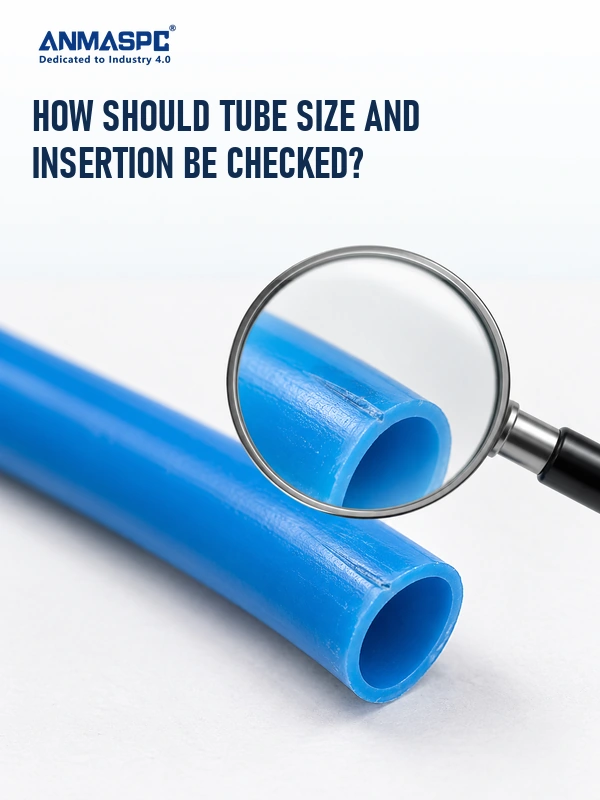
Cut square with an appropriate tube cutter and inspect the end for scoring, a slanted cut, flattening or residue. Insert using the exact manufacturer’s method and depth, then make its prescribed retention check while depressurized. A soft tube can buckle during insertion, creating a false impression that it reached the internal stop. SMC’s KQG2 instructions specifically warn about this with polyurethane in that grease-free series. The warning explains a possible assembly failure; it does not authorize adding lubricant to another fitting.
Do not repeatedly reinstall a deformed end. Remove the damaged section only if the remaining approved hose length still permits the intended route. Otherwise replace the length. If a correctly prepared tube continues leaking, assess the retaining and sealing components according to the connector manufacturer’s repair policy.
What bend radius prevents kinks in a moving route?
Il minimum bend radius belongs to the exact tube size and series, at the specified test condition. It is not a universal multiple that can safely be applied to every PU tube. Determine whether the drawing expresses radius or diameter, whether the value is static or dynamic, and whether the stated temperature matches the installation. Repeated-motion use needs the supplier’s explicit dynamic guidance.
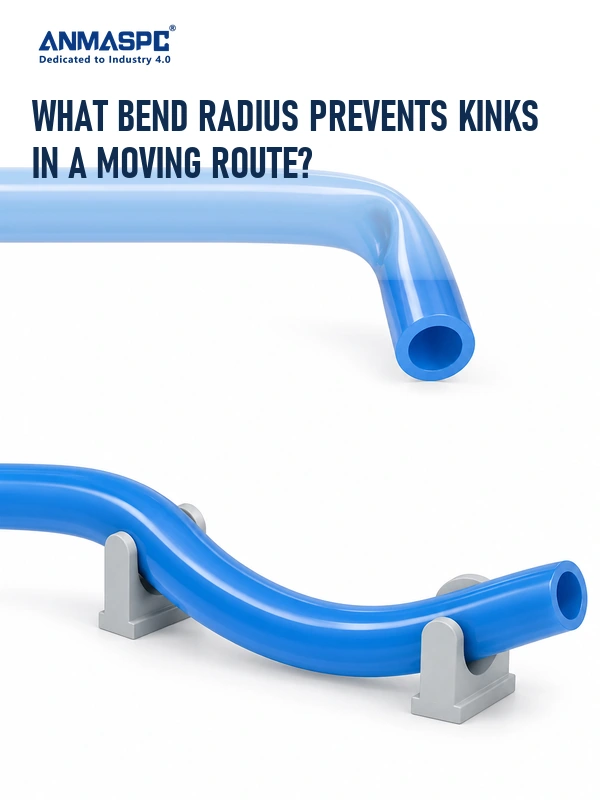
For a concrete example, SMC lists a 20 mm minimum bending radius for TU0805 tubing, while its TU0604 value is 15 mm. Those figures belong to the named catalogue sizes. They show why a value for one OD should not be copied to another. A warm, cyclic route may need a different qualification from the catalogue’s minimum static bend. Avoid treating the tightest bend that survives one installation as a proven production route.
Leave an appropriate straight entry into the fitting and support tubing without crushing it. Keep a moving service loop free from sharp edges, pinch points and adjacent hot surfaces. Check the fully extended and retracted positions, guarding clearance and access for removal. If a guide or elbow is introduced, qualify its friction and flow effects rather than adding it solely to make the installation look tidy.
Why does the hose soften or leak near a warm machine?
A room-temperature pressure figure does not describe every installation. The TU/TIUB example in the SMC catalogue states 0.8 MPa maximum operating pressure at 20°C and directs users to temperature-dependent information. It also distinguishes its air and water temperature conditions. These are series-specific values; they do not establish the limits of an Oulu hose, a reinforced hose or another PU formulation.
Measure or establish the relevant local conditions: the tube near a motor, the medium inside it, pressure transients and possible heating during startup. Compare tube and fitting limits under those same conditions. A regulator setting alone may not characterize every transient. Never use a proof or burst pressure as the continuous working limit, and do not increase pressure to overcome a flow restriction without resolving the restriction.
When choosing between materials, use the PU and PA hose comparison as an introduction to routing and selection. Final approval still needs the exact supplier data, including dimensional compatibility and temperature behaviour.
Can oil, water or cleaning chemicals damage the hose?
“Polyurethane” describes a material family, not a complete compatibility statement. Formulation, chemical identity, concentration, temperature and exposure duration all matter. Distinguish an oil carried inside compressed air from a cleaner sprayed on the outside. Include both in the specification. Swelling, tackiness, cracking, discolouration or a persistent change in dimensions should prompt investigation rather than a tighter clamp.
The SMC TU document provides a useful contrast: its general TU/TIUB section permits specified air/water conditions, while its hard-polyurethane TUH section warns against water because of hydrolysis. Therefore neither “all PU tubing is water-safe” nor “PU can never carry water” is an adequate selection rule. Obtain written applicability for the named part and actual service. A chemical chart is an initial screening tool, not evidence that a complete moving assembly will remain functional.
| Replacement requirement | Prove da richiedere | What to avoid assuming |
|---|---|---|
| Pressure and heat | Exact-size operating curve and transient restrictions | Burst pressure is an operating rating |
| Repeated movement | Dynamic bend and application approval | A static minimum proves cyclic life |
| Oil, water or cleaner | Formulation-specific compatibility at actual conditions | Material name or colour proves suitability |
| Food or clean-air area | Required regulatory declaration and cleanliness scope | A transparent or stainless assembly is certified |
How can pressure loss be separated from a leak?
A long or undersized line can starve an actuator without leaking externally. Evaluate length, inside diameter, the number of restrictions, simultaneous demand, flow-control settings and upstream filtration. Pressure should be compared during the same operating event. Resting pressure can recover between cycles and conceal a restriction that appears only when several devices operate together.
A kink is particularly important because its restriction changes as the tube moves or warms. If a temporary reroute removes the symptom under an approved test procedure, document the route and support as part of the repair. Do not leave an unguarded temporary bypass as the permanent solution. When reviewing Oulu’s polyurethane PU tube listing, request the exact OD/ID combination, working conditions and bend requirements; product photographs establish appearance, not a flow guarantee.
What should be verified before the machine returns to service?
Hose replacement should follow the machine’s energy-control procedure. Isolate the affected section only where its design and procedure permit safe isolation, release trapped pressure, and verify the safe state. A closed valve does not by itself prove every trapped volume is depressurized. Preserve the tube and connector codes so the maintenance record identifies the combination actually installed.
After assembly, use the agreed leak-test method within the approved operating range and run the representative cycle with guards restored. Confirm that the route remains free from tension, abrasion and pinching. Record the fault location and corrective action, not just “hose replaced.” Include compatible spares and support hardware in the pneumatic maintenance plan. That prevents the next replacement from recreating the original fault.
Domande frequenti
Can the hose or fitting be replaced without shutting down the whole line?
Only if the machine has a designed, documented means of safely isolating the affected section, relieving trapped energy and preventing unexpected movement. Otherwise use the required wider shutdown. Never disconnect a pressurized push-in tube.
What certifications matter when a PU pneumatic hose is used near food or clean air?
Specify the actual jurisdiction, contact type and air-quality requirement. Request declarations and cleanliness information for the exact tube, fitting and seals. Being near food differs from direct food contact; a general industrial listing proves neither.
What tube size and bend radius should be used with a PU pneumatic hose?
Match the fitting’s accepted OD, material and tolerance, then select ID for the flow requirement. Obtain the exact tube’s minimum radius and any dynamic restrictions. Do not transfer a radius between different diameters or formulations.
How do you prevent abrasion and kinks when routing a PU pneumatic hose?
Use suitable supports, clearance from edges and an adequate bend through every machine position. Avoid over-tight clamps, twisting and a sharp bend immediately at the connector. Inspect the route after representative motion rather than only at rest.
What pressure and temperature limits apply to a PU pneumatic hose?
The current datasheet for the exact part determines them. Compare its temperature-dependent working limit with the connector and equipment limits, including transients. A published burst value cannot replace an operating rating.
Which connector thread fits a PU pneumatic hose without leaking?
The tube normally matches the connector’s tube socket; the thread matches the equipment port. Identify these independently. Specify OD and tube material on one end, and thread standard, size and seal arrangement on the other.
Riferimenti
- SMC: TU/TIUB and TUH polyurethane tubing catalogue — size-specific bends, temperature-dependent pressure and different water limitations.
- SMC: KQG2 catalogue, specific product precautions — soft-tube insertion, tubing deformation and mechanical-load restrictions.
- SMC: KQ2 one-touch fittings catalogue — connection and tube-selection context.
Riepilogo
A lasting PU hose repair starts with the fault location and operating condition. Verify tube dimensions and end preparation for an entry leak, investigate the sealing design for a thread leak, and change the route when motion causes a kink or side load. Check the exact tube’s pressure-temperature data and chemical suitability before selecting a replacement; neither colour nor a generic PU description supplies that evidence. Return the machine to service only after safe isolation, controlled assembly and a representative leak and movement check. Oulu’s hose range offers a starting point for sourcing, while the approved tube code, connector combination and supported route should remain together in the maintenance specification.



