
アクチュエータが動作したときにのみ漏れる空気配管は、ねじ込みポートから常に漏れている配管とは異なる手がかりを示します。両者を同じ予備ホースに交換しても、配管経路や温度条件、コネクタの不整合といった根本原因はそのまま残ったままになり、一時的には問題が見過ごされてしまうことがあります。機械周りでは柔軟なポリウレタンチューブが便利ですが、柔軟性があるからといって最小曲げ半径がなくなるわけではなく、あらゆる油種や洗浄剤、圧力サイクルに対応できるわけでもありません。本ガイドでは、チューブ側の漏れ、壁面損傷、屈曲、流量制限などを明確に区分し、保守チームが適切な箇所を点検して根本原因を是正し、色や公称サイズだけで判断することなく正しい交換品を選定できるようにしています。.
まず、症状の原因箇所を特定し、配管に手を加える前に空気圧エネルギーを遮断してください。A PU空気ホース ホースは、外径や材質が継手に適していない、端部が損傷している、完全に挿入されていない、または熱や化学薬品の影響で状態が変化しているために漏れを起こすことがあります。屈曲(キンク)は通常、別の継手を取り付けるだけでは解決せず、配管経路の見直しが必要です。使用するホースの耐圧・耐温度性能および最小曲げ半径を正確に適合させ、継手から次の曲げ箇所までを確実に支持し、機械の全動作範囲にわたって経路を確認してください。再組み立て後には、制御された漏れ試験と機能試験を実施してください。.
漏れはどこで発生し、いつ現れますか?
ガードとの接続状態および運用手順の遵守状況を確認してください。プッシュイン接続部におけるリークは、チューブ端部、挿入部、側面荷重、またはシールに起因している可能性があります。機器のねじ部でのリークについては、別途ねじおよびシールの評価が必要です。継手から離れた箇所で管壁が損傷している場合は、摩耗、熱、化学薬品による腐食、または過度の曲げが原因と考えられます。調査で元の参照点を見失わないよう、停止前にその位置を記録しておいてください。.
承認された検査手法を用いて、静止状態と稼働状態を比較してください。ホースは静止時には密閉されているにもかかわらず、シリンダーが行程の端に達した際に横方向に引き出されることがあります。技術者が最も作業しやすい位置だけでなく、機械の想定されるあらゆる位置を確認してください。空気噴流を感じ取るために、動いている装置の中に手を入れてはなりません。 空気漏れのトラブルシューティングガイド スレッドリークとチューブエントリーリークが異なる対処法を必要とする理由を説明します。.
| 確認された症状 | 確認すべき条件 | 修正方向 |
|---|---|---|
| チューブ入口の漏れ | OD、終端条件、挿入および側面荷重 | 承認済みのチューブを準備し、経路を修正してください。 |
| ねじ込みポートからの漏れ | ねじの呼び名およびシール面 | 指定されたポート接続を修復する |
| 壁の摩耗またはピンホール | パネルの縁、擦れ、熱、化学薬品 | 損傷したチューブを交換し、露出部分を取り除いてください。 |
| 動作中に流量が低下します | 平坦化、伸長、またはつぶれたループ | 曲げ形状とサポートを変更 |
チューブのサイズと挿入状態はどのように確認すべきですか?
プッシュイン継手の場合、特定してください チューブ外径 正しい単位系で記載してください。内径は流量能力の一部を制御しますが、シール面を定義するものではありません。両方の寸法とチューブの材質を記録してください。1/4-inchの外径は6.35 mmであり、6 mmではありません。 SMCのTU/TIUBカタログ この区別を明示してください。チューブの許容公差と材質を、継手の現行指示書に適合させてください。.
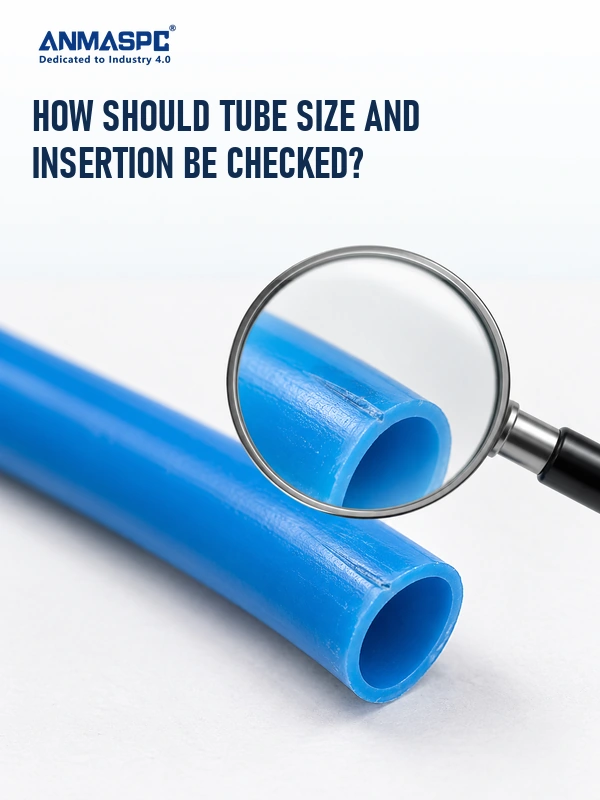
適切なチューブカッターで正方形に切断し、端面にスコアリング、斜めの切り口、潰れ、または残留物がないか確認してください。メーカーが指定する正確な方法と挿入深さで取り付けた後、減圧状態で所定の保持確認を行ってください。軟質チューブは挿入時にたわむことがあり、内部ストップに到達したという誤った印象を与える可能性があります。SMCのKQG2の取扱説明書では、グリースフリー仕様のポリウレタンについてこの点を特に警告しています。この警告は、組み立て不良の可能性を説明するものであり、他の継手に潤滑剤を追加することを許可するものではありません。.
変形した端部を繰り返し取り付け直さないでください。残った許容ホース長が依然として想定される配管経路を確保できる場合に限り、損傷部分を取り除いてください。そうでない場合は、該当する長さのホースを交換してください。適切に準備されたチューブから漏れが継続する場合は、コネクタ製造元の修理方針に従って、保持部品およびシール部品を点検・評価してください。.
移動経路でひっかかりを防ぐための最小曲げ半径はどれですか?
ザ 最小曲げ半径 指定された試験条件において、該当するチューブサイズおよびシリーズに固有のものです。すべてのPUチューブに安全に適用できる汎用的な倍率ではありません。図面が半径を示しているか直径を示しているか、数値が静的か動的か、また記載されている温度が設置時の条件と一致しているかを確認してください。繰り返し動作での使用には、サプライヤーからの明確な動的使用に関する指示が必要です。.
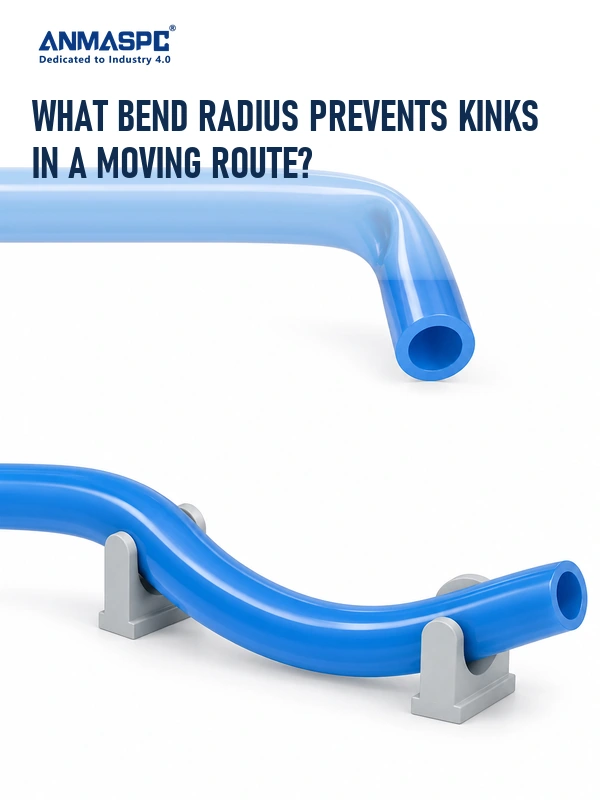
For a concrete example, SMC lists a 20 mm minimum bending radius for TU0805 tubing, while its TU0604 value is 15 mm. Those figures belong to the named catalogue sizes. They show why a value for one OD should not be copied to another. A warm, cyclic route may need a different qualification from the catalogue’s minimum static bend. Avoid treating the tightest bend that survives one installation as a proven production route.
Leave an appropriate straight entry into the fitting and support tubing without crushing it. Keep a moving service loop free from sharp edges, pinch points and adjacent hot surfaces. Check the fully extended and retracted positions, guarding clearance and access for removal. If a guide or elbow is introduced, qualify its friction and flow effects rather than adding it solely to make the installation look tidy.
Why does the hose soften or leak near a warm machine?
A room-temperature pressure figure does not describe every installation. The TU/TIUB example in the SMC catalogue states 0.8 MPa maximum operating pressure at 20°C and directs users to temperature-dependent information. It also distinguishes its air and water temperature conditions. These are series-specific values; they do not establish the limits of an Oulu hose, a reinforced hose or another PU formulation.
Measure or establish the relevant local conditions: the tube near a motor, the medium inside it, pressure transients and possible heating during startup. Compare tube and fitting limits under those same conditions. A regulator setting alone may not characterize every transient. Never use a proof or burst pressure as the continuous working limit, and do not increase pressure to overcome a flow restriction without resolving the restriction.
When choosing between materials, use the PU and PA hose comparison as an introduction to routing and selection. Final approval still needs the exact supplier data, including dimensional compatibility and temperature behaviour.
Can oil, water or cleaning chemicals damage the hose?
“Polyurethane” describes a material family, not a complete compatibility statement. Formulation, chemical identity, concentration, temperature and exposure duration all matter. Distinguish an oil carried inside compressed air from a cleaner sprayed on the outside. Include both in the specification. Swelling, tackiness, cracking, discolouration or a persistent change in dimensions should prompt investigation rather than a tighter clamp.
The SMC TU document provides a useful contrast: its general TU/TIUB section permits specified air/water conditions, while its hard-polyurethane TUH section warns against water because of hydrolysis. Therefore neither “all PU tubing is water-safe” nor “PU can never carry water” is an adequate selection rule. Obtain written applicability for the named part and actual service. A chemical chart is an initial screening tool, not evidence that a complete moving assembly will remain functional.
| Replacement requirement | 要求する証拠 | What to avoid assuming |
|---|---|---|
| Pressure and heat | Exact-size operating curve and transient restrictions | Burst pressure is an operating rating |
| Repeated movement | Dynamic bend and application approval | A static minimum proves cyclic life |
| Oil, water or cleaner | Formulation-specific compatibility at actual conditions | Material name or colour proves suitability |
| Food or clean-air area | Required regulatory declaration and cleanliness scope | A transparent or stainless assembly is certified |
How can pressure loss be separated from a leak?
A long or undersized line can starve an actuator without leaking externally. Evaluate length, inside diameter, the number of restrictions, simultaneous demand, flow-control settings and upstream filtration. Pressure should be compared during the same operating event. Resting pressure can recover between cycles and conceal a restriction that appears only when several devices operate together.
A kink is particularly important because its restriction changes as the tube moves or warms. If a temporary reroute removes the symptom under an approved test procedure, document the route and support as part of the repair. Do not leave an unguarded temporary bypass as the permanent solution. When reviewing Oulu’s polyurethane PU tube listing, request the exact OD/ID combination, working conditions and bend requirements; product photographs establish appearance, not a flow guarantee.
What should be verified before the machine returns to service?
Hose replacement should follow the machine’s energy-control procedure. Isolate the affected section only where its design and procedure permit safe isolation, release trapped pressure, and verify the safe state. A closed valve does not by itself prove every trapped volume is depressurized. Preserve the tube and connector codes so the maintenance record identifies the combination actually installed.
After assembly, use the agreed leak-test method within the approved operating range and run the representative cycle with guards restored. Confirm that the route remains free from tension, abrasion and pinching. Record the fault location and corrective action, not just “hose replaced.” Include compatible spares and support hardware in the pneumatic maintenance plan. That prevents the next replacement from recreating the original fault.
よくある質問
Can the hose or fitting be replaced without shutting down the whole line?
Only if the machine has a designed, documented means of safely isolating the affected section, relieving trapped energy and preventing unexpected movement. Otherwise use the required wider shutdown. Never disconnect a pressurized push-in tube.
What certifications matter when a PU pneumatic hose is used near food or clean air?
Specify the actual jurisdiction, contact type and air-quality requirement. Request declarations and cleanliness information for the exact tube, fitting and seals. Being near food differs from direct food contact; a general industrial listing proves neither.
What tube size and bend radius should be used with a PU pneumatic hose?
Match the fitting’s accepted OD, material and tolerance, then select ID for the flow requirement. Obtain the exact tube’s minimum radius and any dynamic restrictions. Do not transfer a radius between different diameters or formulations.
How do you prevent abrasion and kinks when routing a PU pneumatic hose?
Use suitable supports, clearance from edges and an adequate bend through every machine position. Avoid over-tight clamps, twisting and a sharp bend immediately at the connector. Inspect the route after representative motion rather than only at rest.
What pressure and temperature limits apply to a PU pneumatic hose?
The current datasheet for the exact part determines them. Compare its temperature-dependent working limit with the connector and equipment limits, including transients. A published burst value cannot replace an operating rating.
Which connector thread fits a PU pneumatic hose without leaking?
The tube normally matches the connector’s tube socket; the thread matches the equipment port. Identify these independently. Specify OD and tube material on one end, and thread standard, size and seal arrangement on the other.
参考文献
- SMC: TU/TIUB and TUH polyurethane tubing catalogue — size-specific bends, temperature-dependent pressure and different water limitations.
- SMC: KQG2 catalogue, specific product precautions — soft-tube insertion, tubing deformation and mechanical-load restrictions.
- SMC: KQ2 ワンタッチ継手カタログ — connection and tube-selection context.
要約
A lasting PU hose repair starts with the fault location and operating condition. Verify tube dimensions and end preparation for an entry leak, investigate the sealing design for a thread leak, and change the route when motion causes a kink or side load. Check the exact tube’s pressure-temperature data and chemical suitability before selecting a replacement; neither colour nor a generic PU description supplies that evidence. Return the machine to service only after safe isolation, controlled assembly and a representative leak and movement check. Oulu’s hose range offers a starting point for sourcing, while the approved tube code, connector combination and supported route should remain together in the maintenance specification.



