
「光コネクタ」という用語は、2つの非常に異なる部品を指すことがあります。1つはSCやLCコネクタのように光ファイバーを位置合わせするコネクタであり、もう1つはファイバーケーブルを包むマイクロダクト内の物理的な接続部です。本ガイドでは、後者の部品について説明します。A マイクロダクトコネクタ ダクトに接続し、ケーブル敷設経路を支持しますが、光信号の接続や分配は行いません。.
まず機能で選択し、次にダクト外径、内部通路、記載された動作条件、設置環境を考慮してください。外径が一致するだけでは完全な仕様とは言えません。また、見慣れた色や透明な本体、あるいは「光ファイバーカプラ」という語が含まれている製品リストだけでも十分ではありません。.
光コネクタが必要ですか、それともマイクロダクトカプラーが必要ですか?
光ファイバ機器用コネクタのご要望は、正確な見積もりを出すには範囲が広すぎます。プロジェクトで必要なのが光ケーブルの端末処理、ダクト間接続、空ダクト用シール、それとも既設ケーブル周辺のシールかを明記してください。特定できない部品を交換する場合は、経路図または既存部品の写真を添付してください。.
ダクト継手については、両端のダクトと設置場所を記述してください。継手が同一サイズのダクトを接続する場合は、ストレートカプラーが適切な場合があります。外径が異なる場合は、レデューサーを使用し、各端について個別に仕様を定める必要があります。いずれの部品も、ケーブル周囲の環状空間を密閉できるとは想定しないでください。.
この区別により、誤解を招く比較を防ぎます。光スプリッターは光学性能の基準で評価されます。マイクロダクト用継手には、寸法、空気圧、機械的特性に関する証拠が必要です。同じキーワードでこれらを比較しても購入者の役には立たず、適切でない問題解決に至る部品を注文してしまう可能性があります。.
コネクタを選定する際、ダクトの外径と内径の両方が重要な理由
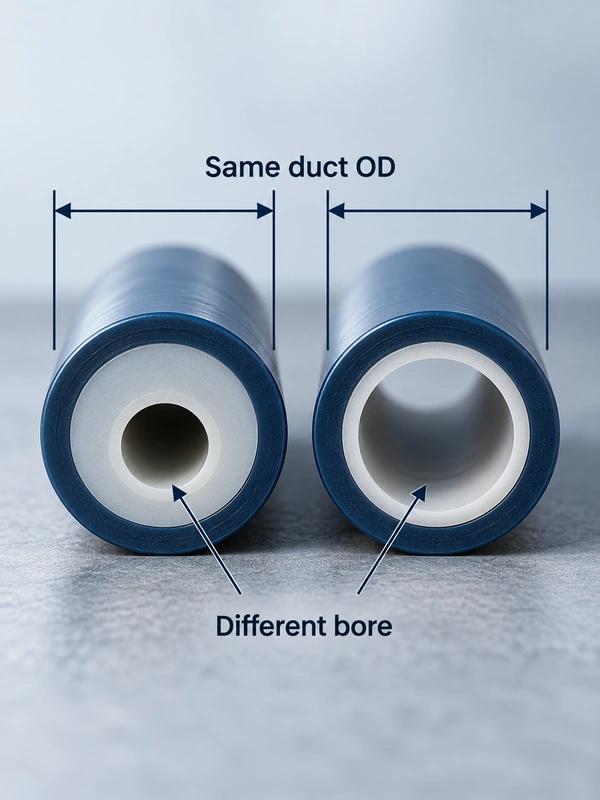
ダクト外径 適合するプッシュインコネクタが通常保持およびシールする面を示します。内径は利用可能な通路のサイズを示します。損傷のないサンプルを測定し、メーカーが指定する寸法(可能な場合は公差も含む)を記録してください。ダクト端部が潰れていると、誤った測定値が得られる可能性があります。.
当サイトのストレートカップラー製品群には、公称外径は同一だが内径が異なる複数のダクトが掲載されています。これにより、両寸法を必ずこの順序で併記する必要があることが示されています。 7 mm マイクロダクトコネクタガイド その規模の家族にとって有用な出発点を提供しますが、プロジェクトには依然として正確なダクト構造とケーブルに関する情報が必要です。.
| 寸法または条件 | What it controls | What to send the supplier |
|---|---|---|
| Duct OD at each end | Grip and outside seal interface | Nominal value, tolerance and duct identification |
| Duct ID at each end | Cable passage through the route | Actual bore designation and wall construction |
| Cable outside diameter | Clearance and gas-block selection | Cable manufacturer’s dimensional range |
| Connector internal passage | Possible local restriction | Drawing or confirmed minimum passage |
| 圧力と温度 | Permitted installation conditions | Approved operating envelope for the assembly |
Do not measure only the visible collar opening and call it the connector bore. Hidden shoulders or a reducer transition may determine the limiting passage. Obtain a drawing or written confirmation rather than probing a sealed product in a way that could damage its internal components.
Will the fiber cable fit through every duct and connector?
A cable must pass through every duct section, joint and transition. A generous bore at the starting chamber does not compensate for a smaller downstream section. Record reducer locations and verify the minimum route passage against the cable and installation-system requirements. There is no universal cable-to-duct ratio that can be applied without those requirements.
Consider a hypothetical replacement where the existing duct and new duct share the same outside diameter but have different wall thicknesses. The connector may accept both ends mechanically, while the cable encounters a narrower passage beyond the joint. The purchasing decision must therefore separate physical fit from route suitability.
Bends, unsupported joints and damaged duct ends also affect passage. A pressure-tight joint can still contain an obstruction. Plan the route’s permitted continuity or passage check separately from its leak test, using the network owner’s procedure and appropriately rated equipment.
When to use a straight coupler, end stop or gas block
A straight coupler joins compatible ducts. An end stop closes an unused duct. A gas block provides a seal around the installed fibre unit or cable within its stated size range. Emtelle’s gas-block documentation explicitly distinguishes the tube joint from the low-pressure seal of the space around the fibre unit.
ザ gas-block microduct connector guide explains when this additional cable seal is required. For an empty branch awaiting a later connection, an appropriately sized マイクロダクトエンドキャップ serves a different purpose. Do not try to pass a cable through an ordinary end stop and assume the altered part remains sealed.
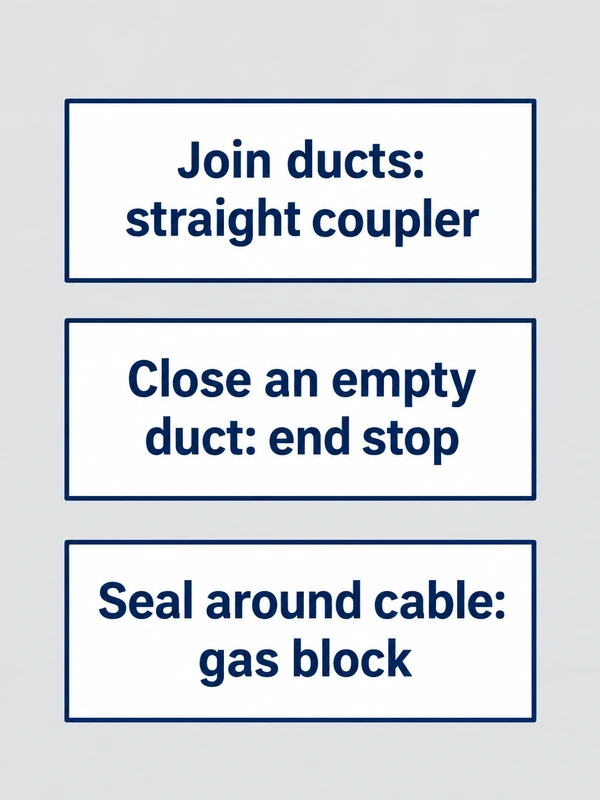
| Required job | 候補コンポーネント | Separate question to resolve |
|---|---|---|
| Join equal duct sizes | ストレートカプラー | Are both bores and duct materials approved? |
| 異なるダクトサイズを接続する | Reducer coupler | Can the cable pass the smaller section? |
| 空のダクトを閉じる | 終点 | What pressure and environmental conditions apply? |
| Seal around installed cable | Gas or water block | Does its cable seal cover the actual cable diameter? |
A locking clip or cover may protect a release mechanism, but it does not create a cable seal. Document the component’s role in the route so that future maintenance staff do not remove a sealing device under the assumption that it is only a protective accessory.
Which pressure rating applies to the microduct connector?
Blowing pressure, working pressure, proof pressure and burst pressure describe different conditions. A gas-seal rating is another separate property. Emtelle’s published gas-block datasheet illustrates this distinction by listing gas sealing separately from its pressure information for fibre installation. Those values apply to its named products, not to every similarly shaped connector.
Ask for a current model-specific datasheet covering the proposed temperature, duct material and test conditions. When a catalogue contains inconsistent pressure figures, obtain clarification before ordering or testing. Choosing the larger number because it appears in a headline is not a defensible engineering decision.
Hexatronic’s MPB30601+ page also separates construction, application and test information. Its specified external-cover configuration is relevant to direct burial. These are useful examples of the evidence to request, but another manufacturer’s results do not establish the capability of an ANMASPC product.
Do microduct connectors need BSP or NPT thread seals?
Ordinary push-in microduct joints do not need BSP or NPT thread sealant at the duct entry. They depend on the approved duct size, end condition, insertion and internal sealing design. Adding tape around the duct can interfere with seating and does not turn an incompatible tube into a compatible one.
A blowing head or test adapter may include a threaded connection elsewhere in the setup. Identify that interface separately. Confirm the thread standard, sealing arrangement and tightening instruction from the equipment manufacturer. Keep sealant debris out of the cable passage and never mix thread types simply because they start to screw together.
What to inspect and record after installing a microduct connector
Prepare the duct with the specified cutting tool, keeping its end square, round and clean. Follow the connector’s insertion and retention instructions. Support the route so it does not pull sideways on the fitting, and install required covers or locks. Before touching a pressurized joint, isolate the system and verify that stored pressure has been released.
Record the installed connector, duct sizes on both sides, cable details where relevant, location and acceptance results. These details matter when an upgrade adds a larger cable or changes a duct section. The existing connector may remain serviceable, but compatibility needs to be reassessed against the new route conditions.
よくある質問
How do I install a microduct connector without damaging the tube?
Use the approved cutter, inspect the end for scratches and ovality, and insert it according to the connector instructions. Protect clean ends from grit. If a damaged section is removed, confirm the remaining length still allows an aligned, supported joint.
Can a microduct connector be disconnected and reused?
Only if its manufacturer permits reuse and the body, grip and seals remain acceptable. Release pressure first. Inspect the duct contact area and follow any requirement to cut back or replace the tube; do not assume a previously used end is undamaged.
Which seal should be used on a threaded microduct test adapter?
First establish whether there actually is a threaded side. A typical push-in duct joint has none. For a separate threaded adapter, follow its specified thread and sealing system; instructions for an optical connector or another fitting family do not apply.
What should I measure before ordering a replacement microduct connector?
Record duct OD and ID on both sides, cable diameter when relevant, connector identification and installation environment. Include tolerances and pressure-temperature requirements. A photograph helps identify the part but cannot replace a dimensional specification.
Why might a duct release under vibration?
Possible causes include incomplete insertion, an unsuitable diameter, damaged retention components, accidental collet operation or route tension. Isolate and inspect before assigning the cause. A locking accessory cannot compensate for a fundamentally incompatible or damaged joint.
Is a plastic, brass or stainless steel fitting suitable for this microduct?
Select the documented assembly for the route and medium. Material labels alone do not establish cable passage, retention, pressure suitability or environmental durability. A general pneumatic metal fitting is not automatically a substitute for a purpose-designed microduct coupler.
参考文献
- Hexatronic, MPB30601+ microduct connectors and end stops: component functions, construction and application conditions.
- Emtelle, Gas Block Connector: sealing between tube, connector and fibre cable.
- Emtelle, Gas Block Connectors datasheet, Issue 5: distinct tube and fibre-unit interfaces and model-specific performance information.
要約
Order a duct connector by its job and the complete route specification. Confirm both duct diameters, cable clearance, pressure conditions and exposure, then verify installation and testing requirements. Keeping optical terminations, duct joints and cable seals distinct prevents the most basic selection mistake before installation begins.
For sourcing, submit those details with an enquiry for the straight microduct coupler family. Request the exact size drawing and applicable test documentation rather than relying on the family photograph or a general catalogue description.



