
Coventry’de, yalnızca ikinci bir makine çalıştığında yavaşlayan bir pnömatik silindiri inceleyen bir teknisyeni hayal edin. Regülatör manometresi çalışma döngüleri arasında normal görünüyor; bu nedenle teknisyen, birkaç çelik boru bağlantısını değiştirmeye hazırlanıyor. Bu varsayımsal durumda, kayıp ipucu eşzamanlı yük talebi: yerel bağlantı elemanları sağlam olabilirken, ortak besleme hattı çalışma sırasında basınç düşüşü yaşayabiliyor.
Düşük hava akışını, aynı çalışma durumunda belirlenmiş noktalardaki basınçları karşılaştırarak ve ardından değişimin görüldüğü bölgede inceleme yaparak sorun giderin. Yedeklemeden önce boru iç çapını, yolu, filtreleri, vanaları, egzoz sistemini ve sızıntıları kontrol edin. çelik boru bağlantı elemanları. Normal rölanti basınç değeri, basıncın oluşabileceğini gösterir; ancak makine hareket ederken hattın gerekli debiyi sağlayabileceğini kanıtlamaz.
Bir bileşeni değiştirmeden önce semptomu tanımlayın.
Sorunun yavaş uzama, yavaş geri çekilme, düşük kuvvet, tutarsız döngü süresi veya gecikmeli tepki olup olmadığını kaydedin. Bu belirtiler birbirinin üzerine düşebilir, ancak mutlaka aynı nedenle ortaya çıkmazlar. Arızanın ne zaman başladığını ve nelerin değiştiğini not edin: yeni boru hattı, daha uzun hat, filtre değişimi, regülatör ayarı veya başka bir yerdeki artan yük. Spesifik bir önce-sonra açıklaması soruşturmayı daraltır.
Makinenin gereken çalışma koşullarını ve mevcut yükü kontrol edin. Daha ağır bir iş parçası veya mekanik direnç, hava beslemesiyle ilgili bir sorun gibi görünebilir. Belirti yalnızca tek bir hareket yönünde ortaya çıkıyorsa, egzoz yolu, valf çalışması veya mekanik yüklenme dikkat gerektirebilir. Her yavaş hareketin, değiştirilmesi kolay olduğu için en yakın bağlantı elemanından kaynaklandığını varsaymayın.
Gözlemi, müdahale gerektiren işlemlerden ayrı tutun. Basınç ölçümleri, onaylanmış bir prosedür kapsamında uygun şekilde kurulmuş test noktaları ve cihazlar gerektirir. Boru hattını çıkarmadan, bağlantı elemanlarını gevşetmeden veya ölçüm donanımı eklemekten önce, depolanmış basıncı izole edin ve boşaltın. Enerji kontrol planına hapsedilmiş bölümler ile aktüatör hareketleri de dahil edilmelidir. Sıkıştırma yoluyla açılan bir kelepçe, tasarlanmış bir havalandırma düzeninin güvenli bir alternatifi değildir.
Makine döngüsünün aynı anındaki basıncı karşılaştırın
İnceleme altındaki bölgenin yuvarak ve aşağı akışında, uygun test noktaları kullanarak gözlemleri kaydedin. Bu gözlemleri aynı tekrarlanabilir talep olayı sırasında karşılaştırın. Her iki ölçüm de farklı zamanlarda yapıldığında, makine yükündeki normal değişiklikler yanıltıcı bir basınç farkına yol açabilir. Olaya uygun tepki süresi ve aralığa sahip cihazlar kullanın; yavaş tepki veren göstergeler kısa süreli basınç düşüşlerini kaçırabilir.
Yüke bağlı basınç düşüşü Bu, tekil ve durağan bir okumadan daha bilgilendiricidir. Akış durduğunda, basınç bir daralma üzerinde eşitlenebilir. Talep yeniden başladığında ise aynı daralma, akışı sınırlayabilir ve aşağı akımda basınç düşüşüne yol açabilir. Gözlemi başka bir teknisyenin tekrarlayabilmesi için besleme ayarını, çalışma döngüsünü, eşzamanlı talebi ve ölçüm noktalarını kaydedin.
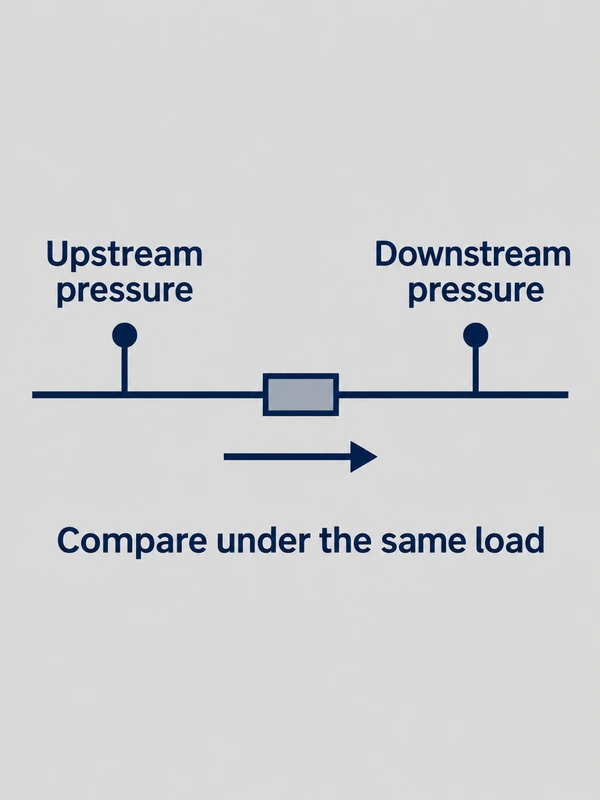
Bir kesit üzerindeki basınç farkı, nerede inceleme yapılması gerektiğini belirler; arızalı parçayı tek başına tespit etmez. Söz konusu kesitte bir boru, dirsek, valf, filtre ve adaptör dizisi bulunabilir. Her bağlantıyı birden eleştirerek reddetmek yerine, kontrollü adımlarla sorunu daha da sınırlayın. Pnömatik hortum bağlantı parçası sorun giderme kılavuzu Sızıntı ve boru durumu için pratik kontroller ekler.
| Talep sırasında gözlem | Ne önerdiğini | Sonraki inceleme |
|---|---|---|
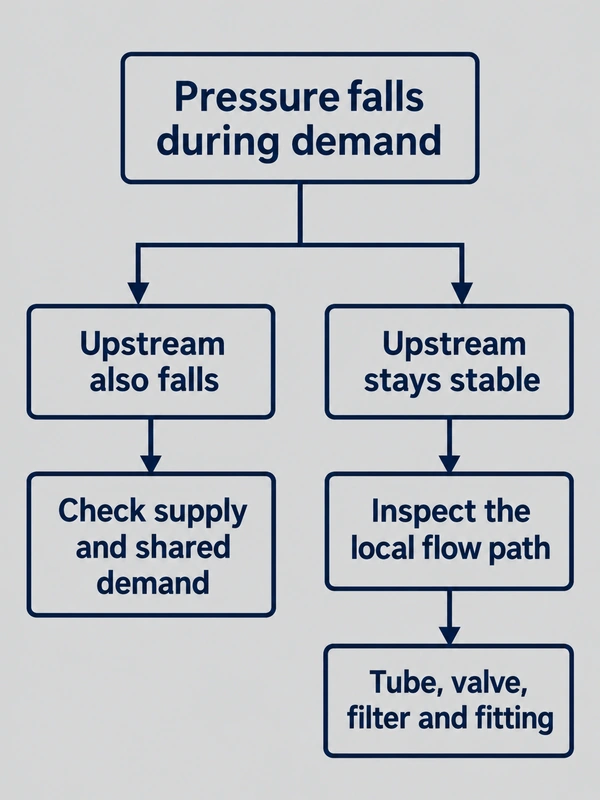
| Yukarı akım ve aşağı akımın ikisi de dahil olur. | Tedarik veya ortak talep sınırlaması söz konusu olabilir. | Yukarı akış ekipmanlarını ve eşzamanlı kullanıcıları kontrol edin. |
| Yukarı akış stabil kalır; aşağı akış düşer. | Yerel yol kısıtlayıcı olabilir. | Boru, valf, filtre ve bağlantı elemanlarını içeren bölümü daraltın. |
| Okumalar normal görünüyor; hareket hâlâ yavaş. | Ölçüm konumu veya başka bir makine kaynaklı neden söz konusu olabilir. | Check exhaust, valve operation and mechanical load |
| Problem appears only after warming | Conditions differ from the cold test | Repeat observation at the relevant temperature |
Use the pressure pattern to narrow the fault
If upstream pressure also falls, inspect the shared supply and its controls before modifying the branch. A regulator that is suitable for one demand may behave differently when several users operate together. Filter loading, distribution restrictions and compressor control behaviour can also matter. Keep the machine’s approved limits in view instead of increasing the set pressure until the symptom becomes less obvious.
If upstream remains stable, inspect the local path from that point to the load. Check for an undersized tube bore, a crushed bend, a partially closed valve, an unexpected reducer or a restricted filter. Review recent substitutions: a replacement tube with the same outside diameter can have a different inside diameter. A connector with the same end sizes can also have a different internal flow characteristic.
Compare manufacturer flow data only when the test conditions and definitions are compatible. External hex size, metal weight and port appearance do not establish equivalent flow capacity. If documentation is missing, request it or use a controlled application test. Avoid publishing an invented flow rating based on the connector’s nominal thread size.
DOE’s compressed-air leak guidance explains that leaks can contribute to pressure fluctuation and increased supply demand. Include a leak survey where appropriate, but do not assume leakage is the only cause. A line can be leak-free and still restrictive, while a leaking system may also contain undersized tubing. Correct each demonstrated problem and verify the combined result.
Inspect the tube route and the connector interfaces
Tube bore and routing often explain why a replacement behaves differently. Trace the full route, including sections hidden by guards or cable bundles. Look for flattened bends, abrasion, heat exposure and supports that pinch the tube. Observe moving sections throughout the cycle because a bend can close only at one position and recover when the machine stops.
Use the exact tube manufacturer’s bend limits and operating envelope. Polyurethane and nylon are not interchangeable merely because they fit the same nominal socket. Material, tolerance, wall thickness and exposure affect suitability. SMC’s TU catalogue demonstrates that pressure and bending information is tied to product series and stated conditions, rather than to the generic word tubing.
Identify both connector ends independently. On a bulkhead union, external threads may secure the fitting to a panel while the fluid connections are push-in sockets. Those mounting threads should not be mistaken for BSP or NPT ports. The push-in and threaded fitting comparison helps separate the interface functions before ordering a substitute.
The Oulu straight bulkhead union is a useful example of why appearance needs a drawing. Its mounting form and tube entries can be identified from the listing, but a photograph cannot establish its flow coefficient or complete working limit. Match the actual tube, panel arrangement and approved variant before using it to replace a component in the investigated section.
Replace only the parts that fail a defined check
After isolation, inspect removed tubes and connectors for contamination, damaged sealing surfaces and abnormal collar operation. Follow the manufacturer’s cleaning and service instructions. Do not drill a passage, remove a check mechanism or enlarge an opening to improve flow. Such changes alter the component and can invalidate its intended function and operating limits.
Change one identified restriction or faulty component at a time where the diagnostic plan allows. Repeat the same measurement and machine cycle after the change. If several parts must be replaced together for a safe repair, record that limitation: the result confirms the repaired section, not the independent contribution of each part. This distinction prevents an uncertain diagnosis becoming a permanent purchasing rule.
| Öğe | Kayıt | Practical value |
|---|---|---|
| Operating event | Cycle step, load and other air users | Makes the symptom repeatable |
| Measurement | Locations, instruments and simultaneous readings | Separates supply and local-path behaviour |
| Component change | Old and new codes, tube OD and ID | Reveals unintended substitutions |
| Doğrulama | Leak check and performance under the same load | Shows whether the repair solved the reported problem |
The cost of replacing every fitting includes installation labour, new leak opportunities and uncertainty about what actually worked. A measured investigation may take longer than changing the first accessible connector, but it produces a reusable diagnosis. Retain successful pressure observations as a baseline for future maintenance, without treating one operating test as a lifetime performance guarantee.
Sıkça sorulan sorular
Can a tube or connector be replaced without stopping the entire line?
Only if the installation has an approved isolation arrangement that safely separates the affected circuit. Verify depressurization and trapped energy before disconnecting it. Whether other equipment can continue running depends on the system design and procedure, not on the connector being push-in.
Which certifications matter near food or clean-air equipment?
Define the actual contact, cleanliness and destination-market requirements before requesting documentation. A stainless body does not establish food-contact or cleanroom suitability for the whole assembly. Confirm the tube, seal and supplied condition as well as the fitting.
What tube size and bend radius should a connector use?
Match the socket to the approved tube outside diameter, units and material, then choose the bore for the required flow. Use the exact tube series bend limit and its stated conditions. Do not infer the radius from the connector’s body size.
How do you prevent abrasion and kinks near a connector?
Provide supported routing, adequate bend clearance and room for the full machine movement. Keep tubing away from sharp edges and avoid clamps that distort it. Check the entry remains aligned and that the release collar cannot be pressed accidentally during operation.
What pressure and temperature limits apply?
The complete tube, fitting, seal and port combination must suit the actual duty. Check temperature-dependent limits and pressure transients in the product documentation. A proof-pressure value or stainless body description is not enough to approve continuous service.
Which thread fits a steel tube connector without leaking?
First determine whether the connector actually has a fluid-port thread or only a mounting thread. For a threaded port, match the exact standard, nominal size and sealing method. Some unions have two push-in sockets and therefore no threaded fluid connection to match.
Kaynakça
- U.S. DOE: Minimize Compressed Air Leaks
- SMC: KQG2 fitting dimensions, operating limits and precautions
- SMC: Tubing dimensions and operating precautions
Özet
Low airflow is best traced under the load that produces it. Compare upstream and downstream pressure, narrow the affected path and check the tube, valves and supply before replacing sound connectors. For Oulu bulkhead connector enquiries, include the tube dimensions, interface drawing and observed operating conditions. Those details support a justified replacement and a repair that can be verified against the original symptom.



