
Представьте, что техник в Ковентри исследует пневмоцилиндр, который замедляется только при запуске второй машины. Манометр регулятора во время перерывов между циклами показывает нормальные значения, поэтому техник готовится заменить несколько стальных трубных соединений. В этом гипотетическом случае ключевым упущенным фактором является одновременная нагрузка: местные фитинги могут быть исправны, в то время как общая система питания недостаточно снабжает их в процессе работы.
Устраните низкий воздушный поток, сравнив давление в заданных точках во время одного и того же рабочего цикла, а затем проверив участок, где наблюдается изменение. Перед заменой проверьте диаметр трубки, её прокладку, фильтры, клапаны, выпуск и наличие утечек. соединители для стальных труб. Нормальное значение давления на холостом ходу подтверждает, что давление может повышаться; это не означает, что магистраль способна обеспечить требуемый расход при движении машины.
Определите симптом перед заменой компонента.
Запишите, проявляется ли проблема в медленном выдвижении, медленном втягивании, слабом усилии, непостоянном времени цикла или задержке отклика. Эти симптомы могут пересекаться, но не обязательно имеют одну и ту же причину. Отметьте, когда возникла неисправность и что изменилось: установлена новая трубка, увеличена длина магистрали, заменён фильтр, отрегулирован редуктор или возросло потребление в другом месте. Чёткое описание ситуации «до» и «после» поможет сузить круг поиска.
Проверьте требуемые рабочие условия машины и фактическую нагрузку. Увеличенная масса заготовки или механическое сопротивление могут маскироваться под проблему с подачей воздуха. Если симптом проявляется только в одном направлении движения, стоит обратить внимание на систему отвода отработанного воздуха, работу клапана или механическую нагрузку. Не следует автоматически предполагать, что замедленное движение вызвано ближайшим соединителем лишь потому, что его легко заменить.
Соблюдайте разделение наблюдения и вмешательства в работу. Для измерения давления необходимы соответствующие установленные контрольные точки и приборы, а также утверждённая процедура. Перед демонтажем трубопроводов, ослаблением соединений или установкой измерительного оборудования необходимо изолировать систему и сбросить накопленное давление. В план управления энергетическими ресурсами следует включать замкнутые участки и движущиеся элементы привода. Съёмный выпускной хомут не является безопасной заменой специально предусмотренной системы вентиляции.
Сравните давление в один и тот же момент цикла работы машины.
Разместите измерительные точки выше и ниже исследуемого участка, используя подходящие контрольные точки. Сравните показания в ходе одного и того же повторяемого рабочего цикла. Если оба замера выполняются в разное время, естественные колебания нагрузки оборудования могут привести к появлению ложной разницы давления. Используйте приборы с временем отклика и диапазоном, соответствующими характеру события; медленно реагирующий индикатор может не зафиксировать кратковременное падение давления.
Перепад давления под нагрузкой является более информативным, чем одиночное статичное измерение. Когда поток прекращается, давление может выравниваться по обе стороны сужения. При возобновлении потребления то же самое сужение может ограничивать подачу и вызывать падение давления в下游ной части системы. Запишите настройки подачи, рабочий цикл, текущую величину потребления и места измерений, чтобы другой техник мог повторить наблюдение.
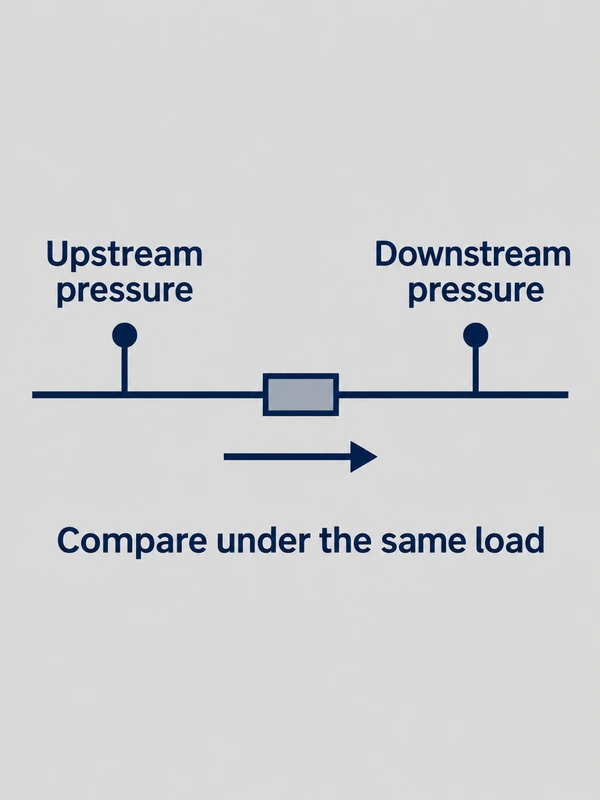
Перепад давления на определённом участке указывает, где следует провести проверку, но не позволяет однозначно определить неисправный элемент. Этот участок может включать трубопровод, отвод, клапан, фильтр и набор переходников. Ограничивайте круг поиска поэтапно, а не исключайте сразу все соединители. Руководство по устранению неполадок пневматических шланговых соединений добавляет практические проверки на утечку и состояние трубопроводов.
| Наблюдение во время спроса | Что это подразумевает | Следующее расследование |
|---|---|---|
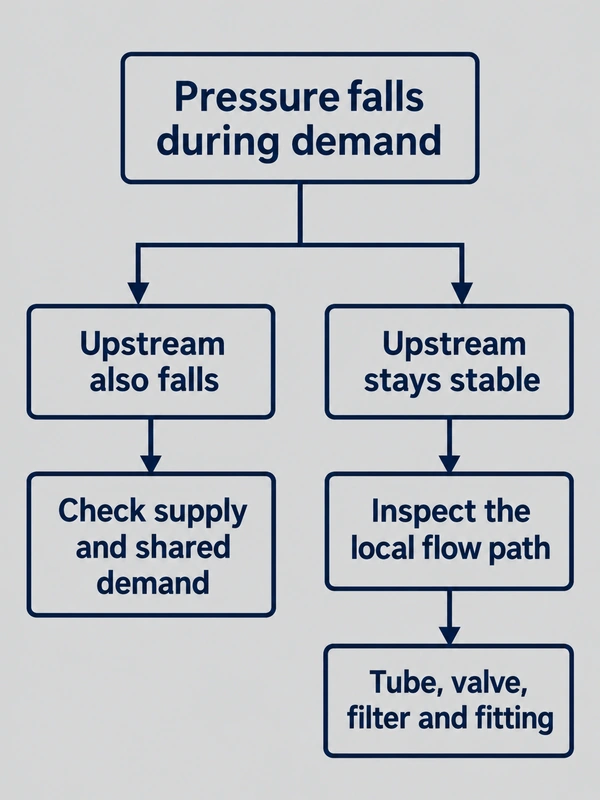
| И верхний, и нижний поток оба падают. | Может быть задействовано ограничение поставки или совместного спроса. | Check upstream equipment and concurrent users |
| Upstream stays stable; downstream falls | The local path may be restrictive | Narrow the section containing tube, valve, filter and fitting |
| Readings look normal; motion remains slow | Measurement location or another machine cause may be involved | Check exhaust, valve operation and mechanical load |
| Problem appears only after warming | Conditions differ from the cold test | Repeat observation at the relevant temperature |
Use the pressure pattern to narrow the fault
If upstream pressure also falls, inspect the shared supply and its controls before modifying the branch. A regulator that is suitable for one demand may behave differently when several users operate together. Filter loading, distribution restrictions and compressor control behaviour can also matter. Keep the machine’s approved limits in view instead of increasing the set pressure until the symptom becomes less obvious.
If upstream remains stable, inspect the local path from that point to the load. Check for an undersized tube bore, a crushed bend, a partially closed valve, an unexpected reducer or a restricted filter. Review recent substitutions: a replacement tube with the same outside diameter can have a different inside diameter. A connector with the same end sizes can also have a different internal flow characteristic.
Compare manufacturer flow data only when the test conditions and definitions are compatible. External hex size, metal weight and port appearance do not establish equivalent flow capacity. If documentation is missing, request it or use a controlled application test. Avoid publishing an invented flow rating based on the connector’s nominal thread size.
DOE’s compressed-air leak guidance explains that leaks can contribute to pressure fluctuation and increased supply demand. Include a leak survey where appropriate, but do not assume leakage is the only cause. A line can be leak-free and still restrictive, while a leaking system may also contain undersized tubing. Correct each demonstrated problem and verify the combined result.
Inspect the tube route and the connector interfaces
Tube bore and routing often explain why a replacement behaves differently. Trace the full route, including sections hidden by guards or cable bundles. Look for flattened bends, abrasion, heat exposure and supports that pinch the tube. Observe moving sections throughout the cycle because a bend can close only at one position and recover when the machine stops.
Use the exact tube manufacturer’s bend limits and operating envelope. Polyurethane and nylon are not interchangeable merely because they fit the same nominal socket. Material, tolerance, wall thickness and exposure affect suitability. SMC’s TU catalogue demonstrates that pressure and bending information is tied to product series and stated conditions, rather than to the generic word tubing.
Identify both connector ends independently. On a bulkhead union, external threads may secure the fitting to a panel while the fluid connections are push-in sockets. Those mounting threads should not be mistaken for BSP or NPT ports. The push-in and threaded fitting comparison helps separate the interface functions before ordering a substitute.
The Oulu straight bulkhead union is a useful example of why appearance needs a drawing. Its mounting form and tube entries can be identified from the listing, but a photograph cannot establish its flow coefficient or complete working limit. Match the actual tube, panel arrangement and approved variant before using it to replace a component in the investigated section.
Replace only the parts that fail a defined check
After isolation, inspect removed tubes and connectors for contamination, damaged sealing surfaces and abnormal collar operation. Follow the manufacturer’s cleaning and service instructions. Do not drill a passage, remove a check mechanism or enlarge an opening to improve flow. Such changes alter the component and can invalidate its intended function and operating limits.
Change one identified restriction or faulty component at a time where the diagnostic plan allows. Repeat the same measurement and machine cycle after the change. If several parts must be replaced together for a safe repair, record that limitation: the result confirms the repaired section, not the independent contribution of each part. This distinction prevents an uncertain diagnosis becoming a permanent purchasing rule.
| Предмет | Запись | Practical value |
|---|---|---|
| Operating event | Cycle step, load and other air users | Makes the symptom repeatable |
| Measurement | Locations, instruments and simultaneous readings | Separates supply and local-path behaviour |
| Component change | Old and new codes, tube OD and ID | Reveals unintended substitutions |
| Проверка | Leak check and performance under the same load | Shows whether the repair solved the reported problem |
The cost of replacing every fitting includes installation labour, new leak opportunities and uncertainty about what actually worked. A measured investigation may take longer than changing the first accessible connector, but it produces a reusable diagnosis. Retain successful pressure observations as a baseline for future maintenance, without treating one operating test as a lifetime performance guarantee.
Часто задаваемые вопросы
Can a tube or connector be replaced without stopping the entire line?
Only if the installation has an approved isolation arrangement that safely separates the affected circuit. Verify depressurization and trapped energy before disconnecting it. Whether other equipment can continue running depends on the system design and procedure, not on the connector being push-in.
Which certifications matter near food or clean-air equipment?
Define the actual contact, cleanliness and destination-market requirements before requesting documentation. A stainless body does not establish food-contact or cleanroom suitability for the whole assembly. Confirm the tube, seal and supplied condition as well as the fitting.
What tube size and bend radius should a connector use?
Match the socket to the approved tube outside diameter, units and material, then choose the bore for the required flow. Use the exact tube series bend limit and its stated conditions. Do not infer the radius from the connector’s body size.
How do you prevent abrasion and kinks near a connector?
Provide supported routing, adequate bend clearance and room for the full machine movement. Keep tubing away from sharp edges and avoid clamps that distort it. Check the entry remains aligned and that the release collar cannot be pressed accidentally during operation.
What pressure and temperature limits apply?
The complete tube, fitting, seal and port combination must suit the actual duty. Check temperature-dependent limits and pressure transients in the product documentation. A proof-pressure value or stainless body description is not enough to approve continuous service.
Which thread fits a steel tube connector without leaking?
First determine whether the connector actually has a fluid-port thread or only a mounting thread. For a threaded port, match the exact standard, nominal size and sealing method. Some unions have two push-in sockets and therefore no threaded fluid connection to match.
Ссылки
- U.S. DOE: Minimize Compressed Air Leaks
- SMC: KQG2 fitting dimensions, operating limits and precautions
- SMC: Tubing dimensions and operating precautions
Краткое содержание
Low airflow is best traced under the load that produces it. Compare upstream and downstream pressure, narrow the affected path and check the tube, valves and supply before replacing sound connectors. For Oulu bulkhead connector enquiries, include the tube dimensions, interface drawing and observed operating conditions. Those details support a justified replacement and a repair that can be verified against the original symptom.



