
코벤트리의 한 기술자가 두 번째 기계가 가동될 때만 속도가 느려지는 공압 실린더를 점검하고 있다고 상상해 보세요. 사이클 간에는 레귤레이터 게이지가 정상으로 보이므로, 기술자는 여러 개의 강관 커넥터를 교체할 준비를 합니다. 이 가상의 사례에서, 동시 수요가 바로 놓친 단서입니다: 현장의 배관 부속품은 이상이 없을 수 있지만, 공용 공급이 가동 중에 저하되고 있을 수 있습니다.
동일한 운전 조건에서 정의된 지점들의 압력을 비교하여 저풍량 문제를 진단한 다음, 압력 변화가 나타나는 부위를 점검하십시오. 교체하기 전에 튜브 내경, 배관 경로, 필터, 밸브, 배기구 및 누설 여부를 확인하십시오. 강관 연결구. 정상적인 공회전 압력 측정값은 압력이 상승할 수 있음을 보여줄 뿐, 기계가 작동 중일 때 해당 배관이 요구되는 유량을 제공할 수 있음을 입증하지는 않습니다.
부품을 교체하기 전에 증상을 정의하십시오.
문제가 느린 확장, 느린 축소, 약한 힘, 일관되지 않은 사이클 시간 또는 지연된 응답인지 기록하십시오. 이러한 증상들은 겹칠 수 있지만 반드시 동일한 원인을 가진 것은 아닙니다. 고장이 언제 시작되었는지와 무엇이 변경되었는지 메모하십시오: 새로운 튜브 사용, 경로 연장, 필터 교체, 레귤레이터 조정 또는 다른 곳에서의 수요 증가 등입니다. 구체적인 전후 상황 설명은 문제 파악 범위를 좁혀줍니다.
기계의 요구되는 작동 조건과 실제 부하를 확인하십시오. 더 무거운 공작물이나 기계적 저항이 공기 공급 문제로 오인될 수 있습니다. 증상이 한 방향으로만 나타난다면, 배기 경로, 밸브 작동 또는 기계적 하중에 주의를 기울여야 합니다. 교체가 쉽다는 이유만으로 모든 느린 동작을 가장 가까운 커넥터 때문이라고 단정하지 마십시오.
관찰 작업은 침입형 작업과 분리하십시오. 압력 측정을 위해서는 승인된 절차에 따라 적절히 설치된 시험 포인트와 계측기가 필요합니다. 배관을 제거하거나 커넥터를 풀거나 측정 장비를 추가하기 전에 저장된 압력을 격리하고 방출하십시오. 에너지 제어 계획에는 갇힌 구간과 액추에이터의 움직임도 포함해야 합니다. 푸시-인 방식의 해제 링은 설계된 배기 장치를 대체할 수 있는 안전한 방법이 아닙니다.
기계 주기의 동일한 시점에서 압력을 비교합니다.
조사 대상 구간의 상류와 하류에 적절한 측정 지점을 설치하여 관측값을 기록하십시오. 동일한 반복 가능한 작동 조건에서 이를 비교하십시오. 두 측정값을 서로 다른 시점에 취할 경우, 기계 부하의 정상적인 변화로 인해 오해를 불러일으킬 수 있는 압력 차이가 발생할 수 있습니다. 해당 현상에 적합한 응답 속도와 측정 범위를 갖춘 계측기를 사용하십시오; 응답 속도가 느린 계측기는 짧은 시간 동안 발생하는 압력 강하를 놓칠 수 있습니다.
부하 하 압력 강하 단독의 정적인 측정값보다는 훨씬 더 많은 정보를 제공합니다. 유량이 멈추면, 장애물 양쪽의 압력이 평형을 이룰 수 있습니다. 소비가 재개되면 같은 장애물이 공급량을 제한하여 하류 쪽에서 압력 강하를 유발할 수 있습니다. 다른 기술자가 해당 관찰을 재현할 수 있도록 공급 설정, 작동 주기, 동시 소비량 및 측정 위치를 기록해 두십시오.
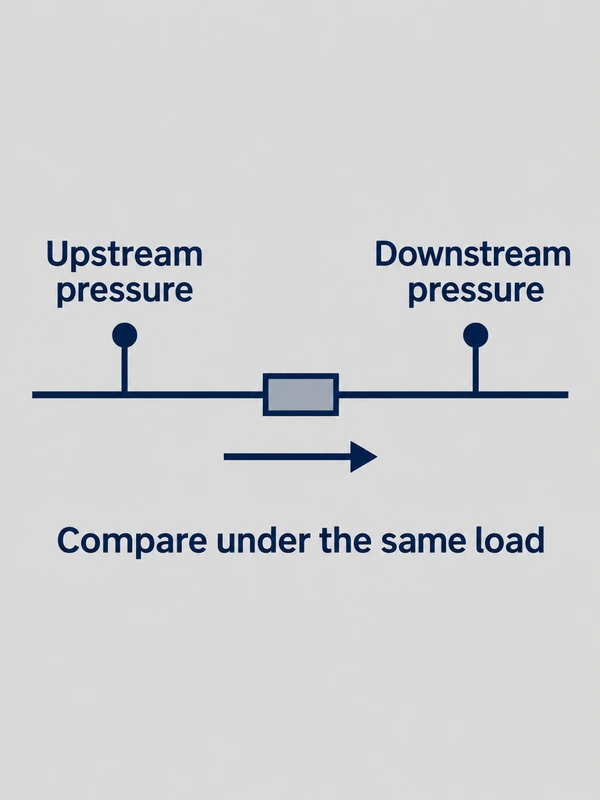
특정 구간에서 발생하는 압력 차이는 조사해야 할 위치를 알려주지만, 고장 부품을 단독으로 특정하지는 않습니다. 해당 구간에는 튜브, 엘보, 밸브, 필터 및 어댑터가 겹쳐 설치되어 있을 수 있습니다. 모든 연결부를 한꺼번에 교체하기보다는, 통제된 단계를 거쳐 점차 범위를 좁혀 나가십시오. 공압 호스 커넥터 문제 해결 가이드 누설 및 튜브 상태에 대한 실용적인 점검을 추가합니다.
| 수요 중 관찰 | What it suggests | Next investigation |
|---|---|---|
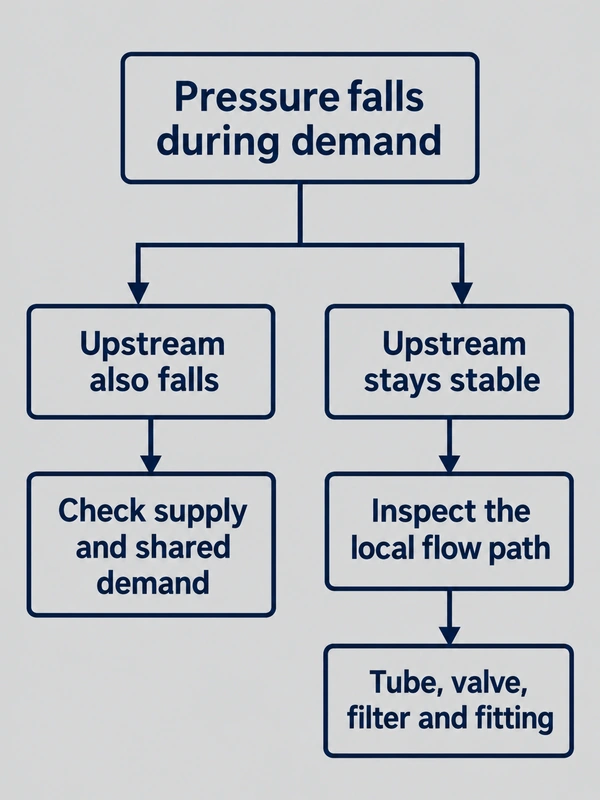
| Upstream and downstream both fall | Supply or shared-demand limitation may be involved | Check upstream equipment and concurrent users |
| Upstream stays stable; downstream falls | The local path may be restrictive | Narrow the section containing tube, valve, filter and fitting |
| Readings look normal; motion remains slow | Measurement location or another machine cause may be involved | Check exhaust, valve operation and mechanical load |
| Problem appears only after warming | Conditions differ from the cold test | Repeat observation at the relevant temperature |
Use the pressure pattern to narrow the fault
If upstream pressure also falls, inspect the shared supply and its controls before modifying the branch. A regulator that is suitable for one demand may behave differently when several users operate together. Filter loading, distribution restrictions and compressor control behaviour can also matter. Keep the machine’s approved limits in view instead of increasing the set pressure until the symptom becomes less obvious.
If upstream remains stable, inspect the local path from that point to the load. Check for an undersized tube bore, a crushed bend, a partially closed valve, an unexpected reducer or a restricted filter. Review recent substitutions: a replacement tube with the same outside diameter can have a different inside diameter. A connector with the same end sizes can also have a different internal flow characteristic.
Compare manufacturer flow data only when the test conditions and definitions are compatible. External hex size, metal weight and port appearance do not establish equivalent flow capacity. If documentation is missing, request it or use a controlled application test. Avoid publishing an invented flow rating based on the connector’s nominal thread size.
DOE’s compressed-air leak guidance explains that leaks can contribute to pressure fluctuation and increased supply demand. Include a leak survey where appropriate, but do not assume leakage is the only cause. A line can be leak-free and still restrictive, while a leaking system may also contain undersized tubing. Correct each demonstrated problem and verify the combined result.
Inspect the tube route and the connector interfaces
Tube bore and routing often explain why a replacement behaves differently. Trace the full route, including sections hidden by guards or cable bundles. Look for flattened bends, abrasion, heat exposure and supports that pinch the tube. Observe moving sections throughout the cycle because a bend can close only at one position and recover when the machine stops.
Use the exact tube manufacturer’s bend limits and operating envelope. Polyurethane and nylon are not interchangeable merely because they fit the same nominal socket. Material, tolerance, wall thickness and exposure affect suitability. SMC’s TU catalogue demonstrates that pressure and bending information is tied to product series and stated conditions, rather than to the generic word tubing.
Identify both connector ends independently. On a bulkhead union, external threads may secure the fitting to a panel while the fluid connections are push-in sockets. Those mounting threads should not be mistaken for BSP or NPT ports. The push-in and threaded fitting comparison helps separate the interface functions before ordering a substitute.
The Oulu straight bulkhead union is a useful example of why appearance needs a drawing. Its mounting form and tube entries can be identified from the listing, but a photograph cannot establish its flow coefficient or complete working limit. Match the actual tube, panel arrangement and approved variant before using it to replace a component in the investigated section.
Replace only the parts that fail a defined check
After isolation, inspect removed tubes and connectors for contamination, damaged sealing surfaces and abnormal collar operation. Follow the manufacturer’s cleaning and service instructions. Do not drill a passage, remove a check mechanism or enlarge an opening to improve flow. Such changes alter the component and can invalidate its intended function and operating limits.
Change one identified restriction or faulty component at a time where the diagnostic plan allows. Repeat the same measurement and machine cycle after the change. If several parts must be replaced together for a safe repair, record that limitation: the result confirms the repaired section, not the independent contribution of each part. This distinction prevents an uncertain diagnosis becoming a permanent purchasing rule.
| 아이템 | 기록 | Practical value |
|---|---|---|
| Operating event | Cycle step, load and other air users | Makes the symptom repeatable |
| Measurement | Locations, instruments and simultaneous readings | Separates supply and local-path behaviour |
| Component change | Old and new codes, tube OD and ID | Reveals unintended substitutions |
| 확인 | Leak check and performance under the same load | Shows whether the repair solved the reported problem |
The cost of replacing every fitting includes installation labour, new leak opportunities and uncertainty about what actually worked. A measured investigation may take longer than changing the first accessible connector, but it produces a reusable diagnosis. Retain successful pressure observations as a baseline for future maintenance, without treating one operating test as a lifetime performance guarantee.
자주 묻는 질문
Can a tube or connector be replaced without stopping the entire line?
Only if the installation has an approved isolation arrangement that safely separates the affected circuit. Verify depressurization and trapped energy before disconnecting it. Whether other equipment can continue running depends on the system design and procedure, not on the connector being push-in.
Which certifications matter near food or clean-air equipment?
Define the actual contact, cleanliness and destination-market requirements before requesting documentation. A stainless body does not establish food-contact or cleanroom suitability for the whole assembly. Confirm the tube, seal and supplied condition as well as the fitting.
What tube size and bend radius should a connector use?
Match the socket to the approved tube outside diameter, units and material, then choose the bore for the required flow. Use the exact tube series bend limit and its stated conditions. Do not infer the radius from the connector’s body size.
How do you prevent abrasion and kinks near a connector?
Provide supported routing, adequate bend clearance and room for the full machine movement. Keep tubing away from sharp edges and avoid clamps that distort it. Check the entry remains aligned and that the release collar cannot be pressed accidentally during operation.
What pressure and temperature limits apply?
The complete tube, fitting, seal and port combination must suit the actual duty. Check temperature-dependent limits and pressure transients in the product documentation. A proof-pressure value or stainless body description is not enough to approve continuous service.
Which thread fits a steel tube connector without leaking?
First determine whether the connector actually has a fluid-port thread or only a mounting thread. For a threaded port, match the exact standard, nominal size and sealing method. Some unions have two push-in sockets and therefore no threaded fluid connection to match.
참고문헌
- U.S. DOE: Minimize Compressed Air Leaks
- SMC: KQG2 fitting dimensions, operating limits and precautions
- SMC: Tubing dimensions and operating precautions
요약
Low airflow is best traced under the load that produces it. Compare upstream and downstream pressure, narrow the affected path and check the tube, valves and supply before replacing sound connectors. For Oulu bulkhead connector enquiries, include the tube dimensions, interface drawing and observed operating conditions. Those details support a justified replacement and a repair that can be verified against the original symptom.



