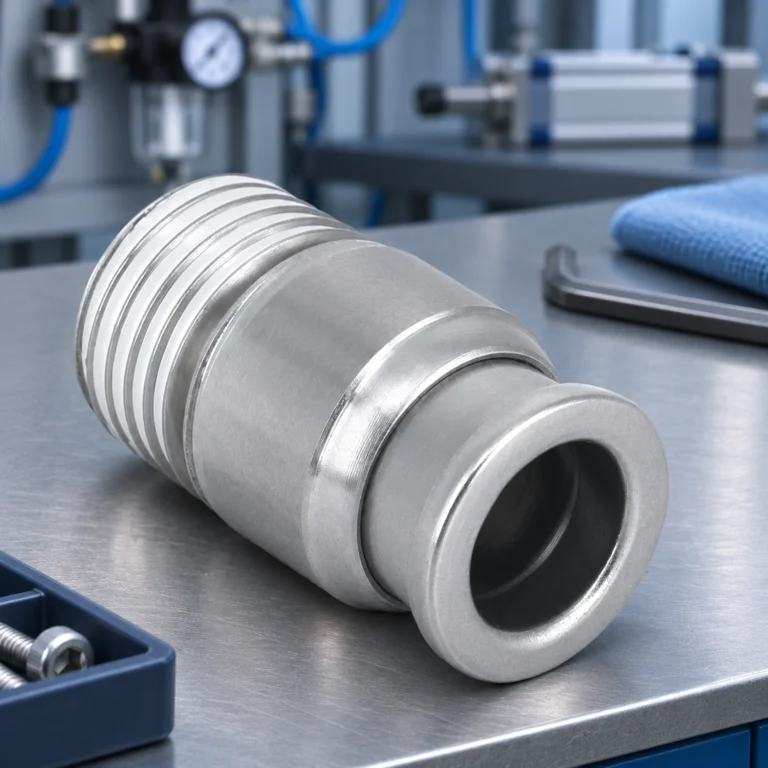
“1/4-inch fitting” can mean a fitting for 1/4-inch outside-diameter tubing, a fitting with a nominal 1/4-inch pipe thread, or a component that has both. These are different specifications. Before ordering, identify which end the size describes and whether the application uses air, water or another fluid. A familiar-looking connector is not enough to establish compatibility.
This buying guide explains 1/4-inch push-to-connect fittings for pneumatic tube connections. It covers size descriptions, common shapes, valves, unused ports and incoming inspection. The central rule is straightforward: specify every connection interface and the actual operating conditions, rather than let “quarter inch” stand in for a complete part description.
Read both connection sizes in a fitting description
A tube socket marked for 1/4-inch OD is intended for the corresponding approved tube size. One quarter of an inch equals 6.35 mm. That does not make a 6 mm tube an acceptable substitute. The sealing and gripping interface is designed around a specified tube range, including dimensional tolerances and material requirements.
A 1/4 NPT threaded end uses a nominal pipe-thread designation. Its actual thread outside diameter is not 6.35 mm. “MNPT” means male NPT, so a description such as “1/4-inch MNPT x 1/4-inch OD” identifies a male threaded port connection at one end and a quarter-inch tube socket at the other.
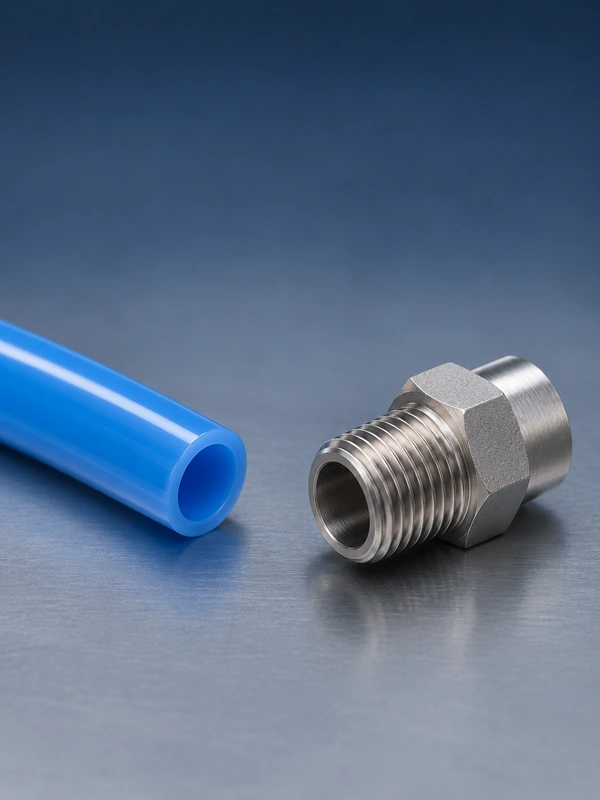
Keep thread standards explicit. A nominal size without “NPT,” “R,” “G” or another applicable designation leaves uncertainty. Do not infer compatibility because a thread starts into a port or because two fittings have similar hexagon sizes. Use the equipment drawing and the selected fitting’s specification.
| Açıklama | Meaning | Additional detail required |
|---|---|---|
| 1/4-inch OD tube | Nominal outside diameter of 6.35 mm | Material, tolerance, wall and operating limits |
| 1/4 NPT | Nominal NPT pipe-thread size | Gender and prescribed sealing method |
| 1/4 MNPT x 1/4 OD | Male thread plus tube socket | Approved tubing and complete product rating |
| 1/4-inch union | Usually a tube-to-tube connection | Both ends and the manufacturer’s naming convention |
| 1/4-inch valve | Incomplete valve description | Connection interfaces, function and operating conditions |
The pneumatic fitting size and thread guide provides a broader explanation of these independent interfaces. Carry the same distinction into quotations, packaging labels and maintenance records so that a correct initial selection is not lost during replacement.
Choose the fitting shape from the air-line route
A straight union joins compatible tube ends. A threaded straight fitting connects tubing to a port. An elbow changes the departure direction; a tee adds a third branch. Choose the shape that keeps tubing away from moving parts and allows the release collar to be reached without dismantling unrelated equipment.
A tee is appropriate when a third connection is required, not merely when a tube needs to turn a corner. An elbow serves that direction change without adding an unused branch. If a tee is used, specify the size and type of all three connections and how any future branch will be safely closed until required.
A bulkhead union can provide a defined connection through a panel. Confirm the panel thickness and mounting dimensions from the product drawing. A bulkhead shape alone does not establish a particular tube size, pressure rating or environmental seal. The photograph of a product family should not be used to infer that the displayed unit is the quarter-inch version.
Check the complete tube specification before buying
İçin 1/4-inch push-to-connect air line fittings, identify the tube material as well as OD. The SMC KQ2 catalogue provides examples for specified nylon, soft nylon and polyurethane tubing. Its approvals and operating values apply to those products, not automatically to another brand with a similar appearance.
Record the tube’s inside diameter or wall specification where flow and route design require it. Two tubes with the same outside diameter can have different bores. A connection can be dimensionally correct at the socket while the tube is unsuitable for the required flow, pressure, temperature or environmental exposure.
Do not select an entire line by fitting size alone. Check the consuming device, route length, valves, restrictions and required response. Increasing a fitting’s external size will not necessarily remove a restriction elsewhere, and reducing tube size for convenience can affect performance. Use the relevant engineering data rather than assume a universal quarter-inch flow capacity.
| Order field | Ne kaydedilecek | Neden önemli olduğu |
|---|---|---|
| Boru ucu | 1/4-inch OD with approved tube model | Defines the grip and seal interface |
| Thread end, if present | Standard, nominal size and gender | Defines the equipment connection |
| Tube wall or ID | Actual tubing specification | Supports flow and mechanical assessment |
| Fluid and conditions | Air quality, pressure, temperature and exposure | Checks seals and tubing suitability |
| Mounting and access | Panel details, orientation and clearance | Supports assembly and maintenance |
Specify the valve function as carefully as its size
A push-to-connect valve may provide shut-off, flow adjustment or another documented function. These are not interchangeable. A valve used to adjust a branch is not automatically suitable as the machine’s safety isolation device. The required function, flow direction and any venting behavior must be established from the specific product information.
Closing a valve may leave compressed air trapped downstream. Before removing tubing or a fitting, follow the equipment’s isolation procedure and relieve and verify residual pressure. Check valves, actuators and other components can create trapped sections, so a single closed handle is not proof that the whole line is safe to disconnect.
For a purchasing request, state whether the valve must simply stop flow or also provide an approved exhaust function. Confirm the connection sizes on all relevant ports and any mounting requirement. Avoid assuming a particular internal flow path from the valve’s external body or handle shape.
Specify how unused ports will be closed
An unused push-in socket normally requires a plug approved for that socket and service. An open tube end requires a suitable tube cap or another documented closure arrangement. These parts are not the same, even when a catalogue groups them together under accessories. Specify exactly what is open.
A shipping dust cover may only protect a component during storage and must not be assumed to retain operating pressure. Likewise, a makeshift inserted object is not an approved plug. Request the correct closure part number and installation instructions, including its compatibility with the operating fluid and conditions.
Document temporary closures in the line schedule. When a later branch is added, personnel need to know whether the port is merely reserved, isolated or still connected to a pressurized supply. Make the system safe before removing a closure, and check the completed connection after commissioning.
Do not substitute a water fitting without confirming air service
Some push-in products list both air and water under defined conditions, while others are intended for a narrower service. The presence of a quarter-inch tube socket does not establish air compatibility. Seal materials, temperature limits, pressure conditions and installation requirements still need verification.
For potable water, additional application-specific approvals may matter; an air fitting does not acquire them because it accepts water tubing. Conversely, a water-system approval is not a blanket pneumatic approval. Ask for the actual product documentation and evaluate it against the application rather than treating “push fit” as a universal standard.
Also distinguish the tube itself. A quarter-inch tube sold for another service may use a different material or dimensional tolerance from the one approved by the pneumatic fitting manufacturer. Confirm the complete tube-and-fitting combination before assembly, not after a leak appears.
Inspect the delivered parts and record the first installation
Compare delivered part numbers and connection markings with the order. Keep metric and inch stock separate, and label incomplete packages immediately. A loose connector in a mixed bin is difficult to identify reliably by appearance, particularly when the difference is between 6 mm and 6.35 mm tubing.
Prepare a square, clean tube end and follow the selected fitting’s insertion instructions. There is no universal insertion depth for every quarter-inch fitting. Check routing and retention, then perform the machine’s controlled commissioning and leak checks. If a threaded joint leaks, use the fitting leak-check guide to distinguish it from a tube-socket problem.
The Department of Energy recommends an ongoing approach to compressed-air leaks: identify, repair and follow up. Record the fault location and corrected part combination. This helps prevent a maintenance team from repeatedly replacing a good fitting when the actual cause is damaged tubing, incorrect thread selection or side loading.
For a hypothetical spare-parts order, separate quarter-inch tube unions from quarter-inch NPT adapters rather than list both as “1/4 connectors.” Add the installed part numbers and quantities. That small documentation change makes receiving inspection and later repairs much less dependent on individual memory.
Sıkça sorulan sorular
Does 1/4-inch refer to tube OD or pipe thread size?
It can refer to either, so the description must say which. A 1/4-inch OD tube is nominally 6.35 mm outside diameter. A 1/4 NPT designation describes a nominal pipe thread and does not mean a 6.35 mm thread outside diameter.
What does 1/4-inch MNPT x 1/4-inch OD mean?
It describes a male NPT threaded connection of nominal 1/4-inch size and a socket for approved 1/4-inch OD tubing. Confirm the product drawing, tube material and operating limits. The two size references describe separate interfaces on the same fitting.
How do I choose a 1/4-inch push-to-connect air line fitting?
Specify the actual tube model and OD, the required shape, any thread interface, and the operating fluid, pressure and temperature. Check routing and access as well. Use the selected product’s compatibility and installation information rather than match a photograph.
When should I choose a 1/4-inch tee instead of an elbow?
Choose a tee when the circuit needs a third connection. Choose an elbow when the line simply needs to change direction. Verify every port’s size and ensure the physical layout permits tube removal and does not force sharp bends.
What is a 1/4-inch push-to-connect valve used for?
Its use depends on its documented function, such as shut-off or flow adjustment. Size alone does not define venting, directionality or isolation suitability. Confirm the exact valve specification and follow the equipment’s procedure for relieving trapped pressure before maintenance.
Can a 1/4-inch water line fitting be substituted in a compressed-air system?
Only if the exact fitting and tube combination is explicitly suitable for the compressed-air conditions. A matching nominal size does not prove this. Check fluid approval, temperature, pressure, seal compatibility and installation requirements before considering substitution.
How do I close an unused 1/4-inch tube connection?
First distinguish an unused fitting socket from an open tube. Use the approved plug or tube cap for that interface and operating service. Do not use shipping covers or improvised closures, and make the line safe before installing or removing the part.
Kaynakça
- SMC: KQ2 One-Touch Fittings Catalogue — inch tube interfaces, thread options and accessories.
- SMC: TU Polyurethane Tubing Catalogue — distinct metric and inch tube dimensions.
- US Department of Energy: Minimize Compressed Air Leaks — connection inspection and repair follow-up.
Özet
Order 1/4-inch tube fittings by complete interface descriptions: tube OD, thread standard, shape and approved operating conditions. Confirm valves and closures by function, and keep inch and metric spares separate. If the line crosses a panel, review the PM double bulkhead union as a product family and request confirmation of the required quarter-inch version and mounting dimensions before purchase.