
Oulu’daki bir bakım mühendisi, bir paketleme hattındaki düz bağlantı parçasını değiştirdiğinde, yeni parça görünüşte doğru şekilde yerine oturmuştu; ancak birkaç dakika içinde hafif bir fısıltı, pnömatik silindiri yavaşlatan bir basınç düşüşüne dönüştü. Görünürdeki arıza, kötü bir bağlantı gibi görünüyordu, ancak sorunun kaynağı, ekibin borunun dış çapını ölçüp, kontrol etmesiyle ortaya çıktı. konu mühürleyin ve adı üstünde benzer bir konektörün yanlış arayüz için seçildiğini tespit edin.
Hızlı cevap: Bir pnömatik düz bağlantı parçası Sadece tüp veya hortum boyutu, diş şekli, sızdırmazlık yöntemi, malzeme, akışkan ve çalışma basıncı değerleri tamamlayıcı düzeneğe uyduğunda güvenilirdir. ISO 4414, pnömatik sistemler için güvenlik ilkelerini ele alırken, ISO 8573-1 ise bireysel bağlantı parçalarını onaylamak yerine sıkıştırılmış hava kirleticilerini sınıflandırır. Sipariş vermeden önce eşleşen arayüzleri belirtin, ardından temsil edici bir düzeneği öngörülen koşullar altında test edin; bu, daha az sızıntı ve daha tekrarlanabilir bakım için pratik yoldur.
İlgili okumalar: hava hortumu bağlantı parçası tedarik kılavuzu.
Düz bağlantı parçaları, boruyu bağlantı yuvasına, boruyu boruya veya hortumu ekipmana bağlayarak doğrusal bir hat üzerinde iki noktayı birleştirir. Basit görünümü, aslında karmaşık bir tercihin ardında gizlenebilmektedir. Bir kontrol devresi, kompakt bir “bas-kaynak” gövdeye ve hassas biçimde kesilmiş polimer boruya ihtiyaç duyarken, bir kompresör bağlantısı ise ayrı bir contaya sahip dişli metal bir adaptöre gerekebilir. Her iki durumda da, bağlantı parçası basıncın sınırları içinde yer alan bir bileşendir; değiştirilebilir bir tüketim malzemesi değildir.
Düz bağlantı elemanı seçmeden önce bağlantı tipini belirleyin.
Öncelikle, gereken düz bağlantıyı belirleyin. Bir itmeyle bağlanan bağlantı elemanı, belirli bir boru dış çapını (OD) sıkma mandalı ile kavrar ve boru yüzeyinde sızdırmazlık sağlar. Dişli düz bağlantı elemanı, erkek veya dişi bağlantı noktasını birleştirir ve dişler üzerinde, yapıştırılmış conta üzerinde veya yüzeyde sızdırmazlık sağlayabilir. Hortum pensesi tipi bağlantı elemanı, hortum iç çapına (ID) göre boyutlandırılır ve uygun bir kelepçe veya kıvırma sistemiyle çalışır. Bu arayüzler, görünüşe dayanarak birbirleriyle değiştirilmemelidir.
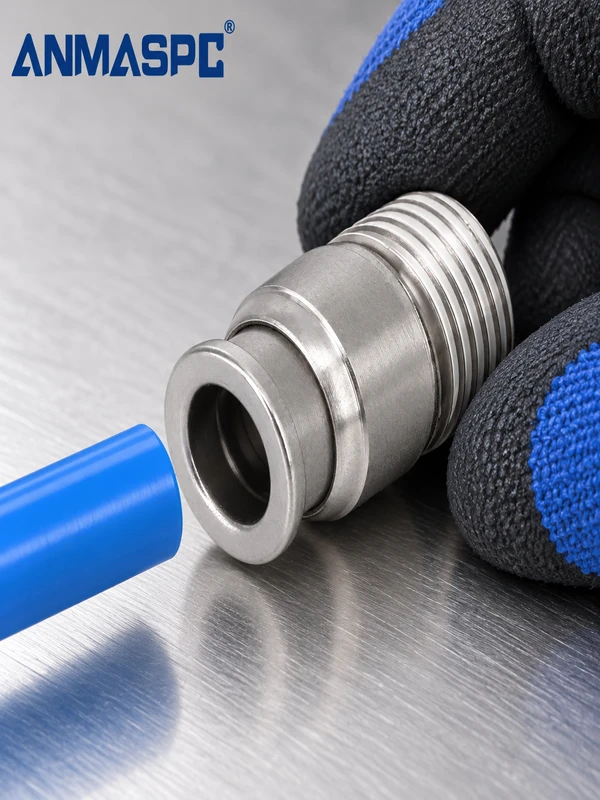
Tam diş tanımını kaydedin, sadece kesirli bir etiket değil. BSPP/G, BSPT/R, NPT ve metrik dişler şekil ve sızdırmazlık yaklaşımı bakımından farklılık gösterir. ISO 7-1 basınca dayanıklı dişli bağlantıları kapsarken, ISO 228-1 ise başka yerlerde sızdırmazlık sağlayan dişleri kapsamaktadır; her iki standart da bitmiş bir montajın her görev için uygun olduğunu kanıtlamaz.
Boru için, gerçek dış çapı teyit edin ve düzgün, dik bir kesim yapın. Eski bağlantı noktalarında belirsizlik varsa, yaklaşık bir uyuma zorlamak yerine diş ölçer ve ekipman dokümantasyonunu kullanın.
Doğrudan bağlantı elemanlarını uygulamaya göre karşılaştırın
| Tasarım | Tipik kullanım | Önemli uyumluluk kontrolü | Bakım etkisi |
|---|---|---|---|
| Basmaya bağlı düz bağlantı | Polimer borulu kontrol hatları | Boru dış çapı, malzeme, tolerans ve kesim kalitesi | Yeniden montaj öncesinde kelepçe, O-halka ve boru ucunu kontrol edin. |
| Dişli düz adaptör | Vana, manifold ve ekipman bağlantı noktaları | Tam diş profili ve sızdırmazlık geometrisi | Hasarlı dişler, contanın durumu ve titreşimden kaynaklanan gevşeme olup olmadığını kontrol edin. |
| Hortum ucu düz bağlantı parçası | Esnek hava hortumu tertibatları | Hortum ID, pabuç profili ve tutma yöntemi | Hortumda sürünme, kelepçe durumu ve aşınmayı inceleyin. |
| Boru-boruya bağlantı | Hat içi boru uzatması | Both tube ODs and materials | Keep the joint accessible for leakage checks |
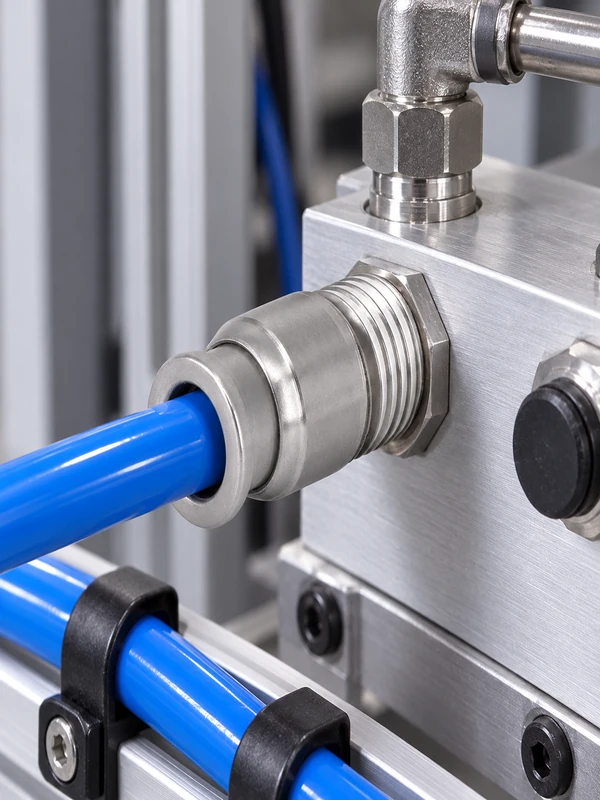
Unit price is only one cost driver. An illustrative comparison should include diagnostic time, lost air, and the spare-stock burden of several similar thread families. Standardising approved sizes and connection series can reduce those hidden costs. For flexible lines, PU and PA air hose differences can affect the assembly choice.
Record the details that maintenance needs
| Şartname alanı | Ne belirtilmeli | Desteklediği karar |
|---|---|---|
| Arayüz | Tube OD or hose ID; thread standard, gender, and sealing method | Correct mating and replacement control |
| Operating conditions | Normal pressure, possible transients, temperature, and duty cycle | Rating review for every component in the assembly |
| Ortam ve çevre | Dry or lubricated air, moisture, cleaning agents, corrosion exposure | Body and elastomer suitability review |
| Akış gereksinimi | Required tool or actuator flow, line length, and allowed pressure drop | Passage-size and performance check |
| Doğrulama planı | Part number, drawing revision, assembly instruction, and leak-test method | Repeatable incoming and field inspection |
Set the assembly limit at the lowest-rated component: fitting, tube or hose, clamp, port, valve, and accessory all count. Ask the supplier for current product data stating the intended medium, working-pressure range, temperature range, material, and assembly instructions. A general statement such as “high pressure” is not enough without those conditions and the specific part number.
Body material follows service conditions. Brass, plated steel, stainless steel, and polymers each have viable uses; confirm the exact grade, coating, and sızdırmazlık malzemesi. This overview of stainless-steel joints and fittings provides useful terminology. Ordinary compressed-air use does not establish suitability for oxygen, breathing air, food contact, or hazardous gases.
Use safety and air-quality standards for the right purpose
ISO 4414:2010 provides safety requirements for pneumatic systems and components; it helps assess stored energy and isolation, but does not certify a fitting. ISO 8573-1 defines compressed-air contaminant classes; it can inform a process specification but is not a fitting-material certification.
In the United States, OSHA 29 CFR 1910.242(b) sets conditions for compressed-air cleaning, including pressure reduced to less than 30 psi, chip guarding, and personal protective equipment. This is not a universal design pressure. Local law, intended use, and equipment instructions remain controlling. Isolate and depressurise before disconnection.
Check the complete assembly before approval
- Map each fitting between the air preparation unit and point of use, including adapters and seal components.
- Approve one written specification for each tube size and thread family; include a photo only as a supporting identifier, never as the specification.
- Assemble and leak-test a representative sample under documented operating conditions before a multi-line rollout.
- Keep replacement parts by approved part number and train technicians to verify the interface before installation.
For actuator installations, confirm port information from the equipment drawing; this guide to pneumatic cylinders is useful context. Oulu can discuss fitting configurations when the buyer supplies tube, port, pressure, media, and environment details.
İlgili okumalar: yüksek basınçlı hava hortumu kullanım kılavuzu.
Treat “straight” as a shape, not a rating
A straight fitting describes the path through the connection; it does not define the thread, material, pressure class or flow by itself. Current selection questions focus on push-in versus threaded or barbed forms, tube OD, pressure drop, vacuum use and access for maintenance. Freeze those variables before comparing catalogues.
| Form | Best starting point | Checks before approval |
|---|---|---|
| Push-in straight | Plastik borulu kontrol devreleri | Tube OD, cut, seal, bend support and release clearance |
| Threaded straight | Port transitions and rigid manifolds | BSP/NPT/metric form, seal and torque |
| Barbed straight | Esnek hortum tertibatları | Hose ID, retention method and service movement |
| Bulkhead or union | Panel or line-through installations | Panel thickness, locknut access and alignment |
Cross-check a straight choice against one-touch operating limits, the fitting-family comparison ve Pnömatik parçalar yelpazesi.
How should buyers compare flow data instead of fitting shape?
A straight body only describes the route geometry. Flow behavior depends on the effective passage, tube length, port transition, pressure ratio and the test method used by the supplier. ISO 6358-1 is a reference for determining flow-rate characteristics with compressible fluids; it does not turn every catalogue value into a directly comparable number. Ask whether the published result is for the complete fitting or only a test component, and retain the stated inlet pressure, downstream pressure and temperature.
For a maintenance standard, record both the interface and the operating observation. A fitting that passes a static leak check may still restrict an actuator during a high-demand stroke, while a fitting with a generous bore can still fail if the tube is undersized or side-loaded. Compare pressure at the supply and point of use under the same cycle, then identify whether the dominant loss is the fitting, tube, valve, filter or an air leak. This evidence is more useful than ranking fittings by outside shape.
| Evidence item | Question to ask | Decision use |
|---|---|---|
| Flow test | What pressure, temperature and medium were used? | Compare only results with compatible conditions |
| Arayüz | Which tube OD, thread and seal are approved? | Prevent a mechanically similar substitution |
| Field reading | Where does pressure fall during the cycle? | Separate a fitting restriction from a system loss |
Sıkça sorulan sorular
What is a pneumatic straight fitting?
A pnömatik düz bağlantı parçası makes an in-line connection between tubes, hoses, ports, or components in a compressed-air system. Its design may be push-to-connect, threaded, barbed, or tube-to-tube; suitability depends on the mating interface and operating conditions.
How do I select a pneumatic fitting for tubing?
Confirm the tubing’s OD, material, tolerance, and surface condition, then match the manufacturer’s stated range. Cut it squarely and test retention and leakage; do not select from nominal size alone.
What is the difference between push-to-connect and threaded fittings?
Push-to-connect fittings retain specified tubing with an internal collet and seal, enabling quick installation. Threaded fittings join ports or adapters and require the correct thread form, sealing method, and installation torque.
How do I stop air leaks at pneumatic fittings?
Depressurise safely, then inspect thread pairing, seals, tube ends, contamination, and hose retention. Replace damaged parts and follow the specified sealing method; excessive torque or sealant can damage threads and conceal the cause.
Can pneumatic fittings be used with vacuum?
Some can, but confirm vacuum service for the specific fitting, tube, seal, and pressure range. Vacuum can expose leakage paths or tube-collapse issues not evident under positive pressure, so request guidance and validate the assembly.
Which fitting material is best for compressed air?
There is no universal best material. Brass, steel, stainless steel, and engineered polymers can each suit pressure, temperature, corrosion, media, and mechanical demands; verify product data and elastomer compatibility.
İlgili okumalar: Oulu Connector company information.
Kaynakça
- ISO 4414:2010 – pneumatic system safety.
- ISO 6358-1 – flow-rate characteristics.
- ISO 7-1 – pressure-tight threaded joints.
- UK HSE INDG261 – pressure-system precautions.
Özet
A pneumatic straight fitting should be approved as part of a measured pressure boundary. First identify the tube or hose interface and thread form, then review effective passage, seal material, pressure, temperature and access for maintenance. ISO 4414 supplies system-safety context, and ISO 6358-1 supplies a flow-characteristics reference; neither is a universal product rating. Compare pressure at the point of use under the actual cycle, because a fitting can pass a static check and still restrict a demanding actuator. Keep the approved part number, drawing revision and test result with the spare. Oulu’s pneumatic parts range can be reviewed after those conditions are documented.



