
Quando um engenheiro de manutenção em Oulu substituiu um conector reto em uma linha de embalagem, a nova peça parecia estar corretamente encaixada; em questão de minutos, um leve assobio transformou-se em uma queda de pressão que retardou o movimento de um cilindro pneumático. A falha visível parecia ser causada por um mau encaixe, mas a situação inverteu-se quando a equipe mediu o diâmetro externo do tubo e verificou o tópico vedação e constatou que um conector aparentemente semelhante havia sido selecionado para a interface inadequada.
Resposta rápida: Um pneumático encaixe reto é confiável apenas quando o tamanho do tubo ou da mangueira, a forma da rosca, o método de vedação, o material, o fluido e a pressão de trabalho nominal correspondem ao conjunto completo. A ISO 4414 aborda os princípios de segurança para sistemas pneumáticos, enquanto a ISO 8573-1 classifica os contaminantes do ar comprimido, em vez de aprovar conexões individuais. Especifique as interfaces de acoplamento antes de efetuar o pedido e, em seguida, teste um conjunto representativo nas condições previstas; este é o caminho prático para reduzir vazamentos e garantir uma manutenção mais repetível.
Leitura relacionada: Guia de fornecimento de conexões para mangueiras de ar.
Os acessórios retos conectam dois pontos em linha: tubo a orifício, tubo a tubo ou mangueira a equipamento. Sua forma simples pode ocultar uma decisão complexa. Um circuito de controle pode exigir um corpo compacto de conexão por encaixe e um tubo de polímero cortado com precisão; já uma conexão de compressor pode, ao invés disso, necessitar de um adaptador metálico rosqueado com vedação separada. Em ambos os casos, o acessório é um elemento da barreira de pressão, e não um produto intercambiável.
Identifique o tipo de conexão antes de escolher um acessório reto.
Primeiro, identifique a conexão reta necessária. Um encaixe de pressão segura um determinado diâmetro externo (DE) do tubo por meio de uma bucha e forma vedação na superfície do tubo. Uma conexão reta rosqueada une uma conexão macho ou fêmea e pode vedar nas roscas, em uma junta colada ou em uma face. Um encaixe tipo “hose-barb” é dimensionado com base no diâmetro interno (DI) da mangueira e depende de um sistema adequado de abraçadeira ou crimpagem. Essas interfaces não devem ser substituídas apenas pela aparência.
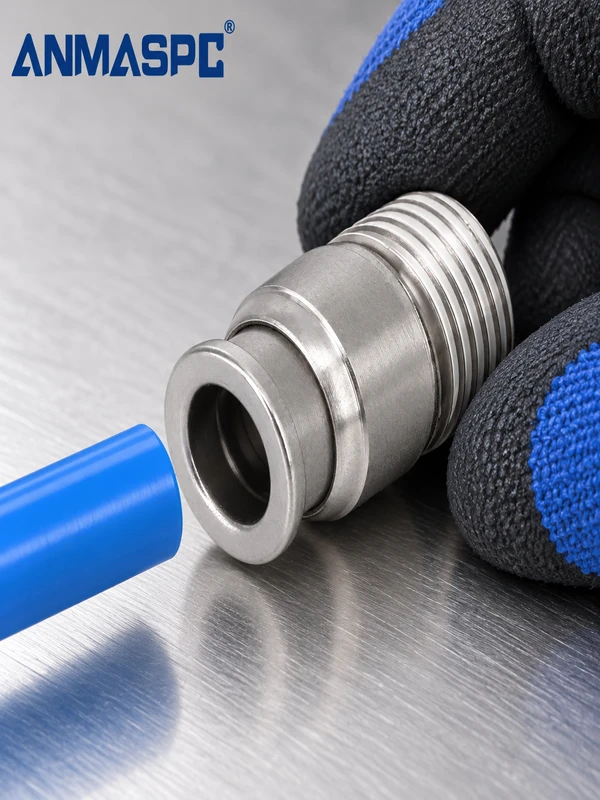
Registre a designação completa da rosca, não apenas uma etiqueta fracionária. As roscas BSPP/G, BSPT/R, NPT e métricas diferem na forma e no método de vedação. A ISO 7-1 trata de uniões roscadas estanques à pressão, enquanto a ISO 228-1 abrange roscas que vedam em outros locais; nenhuma dessas normas comprova que uma montagem finalizada seja adequada para todas as aplicações.
Para tubos, confirme o diâmetro externo real e faça um corte reto e limpo. Para conexões antigas de origem incerta, utilize um medidor de roscas e a documentação do equipamento, em vez de forçar uma correspondência aproximada.
Compare acessórios retos por aplicação
| Design | Utilização típica | Verificação de compatibilidade principal | Implicação de manutenção |
|---|---|---|---|
| Conexão rápida reta | Linhas de controle em tubo de polímero | Diâmetro externo do tubo, material, tolerância e qualidade de corte | Inspeccione o mandril, o anel O e a extremidade do tubo antes da remontagem. |
| Adaptador reto rosqueado | Válvulas, coletores e portas de equipamentos | Forma exata da rosca e geometria de vedação | Verifique se há roscas danificadas, condição da vedação e folga causada por vibração. |
| Conexão retilínea para mangueira | Conjuntos flexíveis de mangueiras de ar | Diâmetro interno da mangueira, perfil do bico e método de retenção | Inspect hose creep, clamp condition, and abrasion |
| Tube-to-tube union | In-line tube extension | Both tube ODs and materials | Keep the joint accessible for leakage checks |
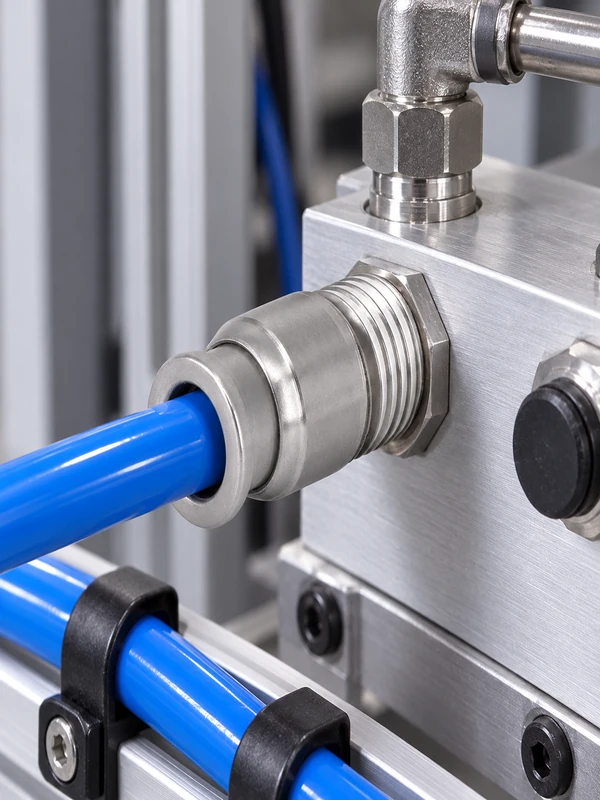
Unit price is only one cost driver. An illustrative comparison should include diagnostic time, lost air, and the spare-stock burden of several similar thread families. Standardising approved sizes and connection series can reduce those hidden costs. For flexible lines, PU and PA air hose differences can affect the assembly choice.
Record the details that maintenance needs
| Campo de especificação | O que declarar | Decision it supports |
|---|---|---|
| Interface | Tube OD or hose ID; thread standard, gender, and sealing method | Correct mating and replacement control |
| Operating conditions | Normal pressure, possible transients, temperature, and duty cycle | Rating review for every component in the assembly |
| Meio e ambiente | Dry or lubricated air, moisture, cleaning agents, corrosion exposure | Body and elastomer suitability review |
| Requisito de fluxo | Required tool or actuator flow, line length, and allowed pressure drop | Passage-size and performance check |
| Plano de verificação | Part number, drawing revision, assembly instruction, and leak-test method | Repeatable incoming and field inspection |
Set the assembly limit at the lowest-rated component: fitting, tube or hose, clamp, port, valve, and accessory all count. Ask the supplier for current product data stating the intended medium, working-pressure range, temperature range, material, and assembly instructions. A general statement such as “high pressure” is not enough without those conditions and the specific part number.
Body material follows service conditions. Brass, plated steel, stainless steel, and polymers each have viable uses; confirm the exact grade, coating, and material de vedação. This overview of stainless-steel joints and fittings provides useful terminology. Ordinary compressed-air use does not establish suitability for oxygen, breathing air, food contact, or hazardous gases.
Use safety and air-quality standards for the right purpose
ISO 4414:2010 provides safety requirements for pneumatic systems and components; it helps assess stored energy and isolation, but does not certify a fitting. ISO 8573-1 defines compressed-air contaminant classes; it can inform a process specification but is not a fitting-material certification.
In the United States, OSHA 29 CFR 1910.242(b) sets conditions for compressed-air cleaning, including pressure reduced to less than 30 psi, chip guarding, and personal protective equipment. This is not a universal design pressure. Local law, intended use, and equipment instructions remain controlling. Isolate and depressurise before disconnection.
Check the complete assembly before approval
- Map each fitting between the air preparation unit and point of use, including adapters and seal components.
- Approve one written specification for each tube size and thread family; include a photo only as a supporting identifier, never as the specification.
- Assemble and leak-test a representative sample under documented operating conditions before a multi-line rollout.
- Keep replacement parts by approved part number and train technicians to verify the interface before installation.
For actuator installations, confirm port information from the equipment drawing; this guide to pneumatic cylinders is useful context. Oulu can discuss fitting configurations when the buyer supplies tube, port, pressure, media, and environment details.
Leitura relacionada: Guia de aplicação de mangueiras de ar de alta pressão.
Treat “straight” as a shape, not a rating
A straight fitting describes the path through the connection; it does not define the thread, material, pressure class or flow by itself. Current selection questions focus on push-in versus threaded or barbed forms, tube OD, pressure drop, vacuum use and access for maintenance. Freeze those variables before comparing catalogues.
| Form | Best starting point | Checks before approval |
|---|---|---|
| Push-in straight | Circuitos de controle em tubo plástico | Tube OD, cut, seal, bend support and release clearance |
| Threaded straight | Port transitions and rigid manifolds | BSP/NPT/metric form, seal and torque |
| Barbed straight | Conjuntos de tubos flexíveis | Hose ID, retention method and service movement |
| Bulkhead or union | Panel or line-through installations | Panel thickness, locknut access and alignment |
Cross-check a straight choice against one-touch operating limits, the fitting-family comparison e o Área de peças pneumáticas.
How should buyers compare flow data instead of fitting shape?
A straight body only describes the route geometry. Flow behavior depends on the effective passage, tube length, port transition, pressure ratio and the test method used by the supplier. ISO 6358-1 is a reference for determining flow-rate characteristics with compressible fluids; it does not turn every catalogue value into a directly comparable number. Ask whether the published result is for the complete fitting or only a test component, and retain the stated inlet pressure, downstream pressure and temperature.
For a maintenance standard, record both the interface and the operating observation. A fitting that passes a static leak check may still restrict an actuator during a high-demand stroke, while a fitting with a generous bore can still fail if the tube is undersized or side-loaded. Compare pressure at the supply and point of use under the same cycle, then identify whether the dominant loss is the fitting, tube, valve, filter or an air leak. This evidence is more useful than ranking fittings by outside shape.
| Evidence item | Question to ask | Decision use |
|---|---|---|
| Flow test | What pressure, temperature and medium were used? | Compare only results with compatible conditions |
| Interface | Which tube OD, thread and seal are approved? | Prevent a mechanically similar substitution |
| Field reading | Where does pressure fall during the cycle? | Separate a fitting restriction from a system loss |
Perguntas frequentes
What is a pneumatic straight fitting?
A conexão reta pneumática makes an in-line connection between tubes, hoses, ports, or components in a compressed-air system. Its design may be push-to-connect, threaded, barbed, or tube-to-tube; suitability depends on the mating interface and operating conditions.
How do I select a pneumatic fitting for tubing?
Confirm the tubing’s OD, material, tolerance, and surface condition, then match the manufacturer’s stated range. Cut it squarely and test retention and leakage; do not select from nominal size alone.
What is the difference between push-to-connect and threaded fittings?
Push-to-connect fittings retain specified tubing with an internal collet and seal, enabling quick installation. Threaded fittings join ports or adapters and require the correct thread form, sealing method, and installation torque.
How do I stop air leaks at pneumatic fittings?
Depressurise safely, then inspect thread pairing, seals, tube ends, contamination, and hose retention. Replace damaged parts and follow the specified sealing method; excessive torque or sealant can damage threads and conceal the cause.
Can pneumatic fittings be used with vacuum?
Some can, but confirm vacuum service for the specific fitting, tube, seal, and pressure range. Vacuum can expose leakage paths or tube-collapse issues not evident under positive pressure, so request guidance and validate the assembly.
Which fitting material is best for compressed air?
There is no universal best material. Brass, steel, stainless steel, and engineered polymers can each suit pressure, temperature, corrosion, media, and mechanical demands; verify product data and elastomer compatibility.
Leitura relacionada: Informações da empresa Oulu Connector.
Referências
- ISO 4414:2010 – segurança do sistema pneumático.
- ISO 6358-1 – características de vazão.
- ISO 7-1 – juntas roscadas estanques à pressão.
- UK HSE INDG261 – precauções para sistemas de pressão.
Resumo
A pneumatic straight fitting should be approved as part of a measured pressure boundary. First identify the tube or hose interface and thread form, then review effective passage, seal material, pressure, temperature and access for maintenance. ISO 4414 supplies system-safety context, and ISO 6358-1 supplies a flow-characteristics reference; neither is a universal product rating. Compare pressure at the point of use under the actual cycle, because a fitting can pass a static check and still restrict a demanding actuator. Keep the approved part number, drawing revision and test result with the spare. Oulu’s pneumatic parts range can be reviewed after those conditions are documented.



