
A conector de bloco de gás É necessário abordar tanto o trajeto ao redor do cabo quanto a junta entre os dutos. Um acoplador reto pode fixar firmemente as extremidades dos dutos, mantendo livre o espaço ao redor do cabo. Quando o projeto da rede exigir o controle da migração de gases ou água através desse espaço, selecione um componente de vedação projetado especificamente para esse fim, com interfaces adequadas para os dutos e para o cabo.
A instalação começa pela definição do trajeto, e não pelo aperto de um anel. Determine onde o vedante deve ser instalado, qual produto é aprovado, quando ele deve ser ativado e como a instalação concluída será verificada. A pressão de sopro e a pressão de vedação contra gases são propriedades distintas; um valor publicado para uma delas não deve ser utilizado como classificação para a outra.
Onde um bloco de gás deve ser instalado para impedir a migração pelo duto?
Desenhe o trajeto do duto através da câmara, do armário ou da entrada do edifício. Identifique se a preocupação diz respeito ao movimento ao longo de um duto vazio, em torno de um cabo instalado, através de uma parede danificada do duto ou ao redor da parte externa do duto em uma passagem pela estrutura do edifício. Esses são caminhos distintos e podem exigir medidas de vedação diferentes.
A Emtelle descreve seu conector de bloqueio de gás como proporcionando uma vedação em linha entre o conector, o tubo e o cabo de fibra óptica. Isso explica a função do componente, mas não comprova resistência ao fogo nem aprovação para serviços em ambientes com gases perigosos. Uma vedação de entrada de cabos não é automaticamente um dispositivo de contenção de fogo, tampouco corrige uma câmara ou uma penetração na parede que esteja vazando.
Confirme a localização exigida com o proprietário da rede ou com o projetista do edifício antes de instalar o componente em um local de difícil acesso. Uma vedação instalada em local pouco prático pode deixar o perímetro previsto desprotegido. Por outro lado, uma conexão enterrada que necessite ser ativada posteriormente pode gerar serviços de escavação evitáveis.
Como fazer a correspondência entre o conector do bloco de gás e o diâmetro do duto e do cabo
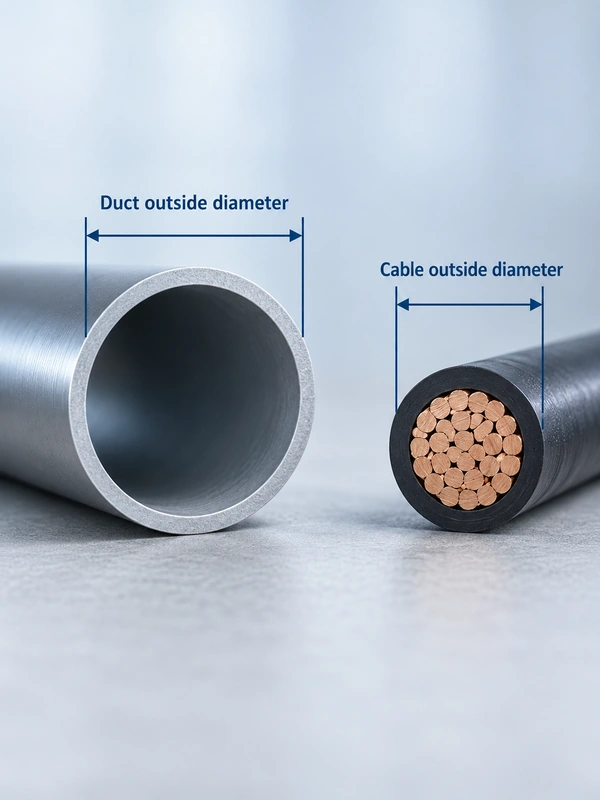
O lado do duto requer o diâmetro externo, o material e as condições aprovados. O lado do cabo requer o diâmetro real da bainha e a faixa permitida da vedação. A contagem de fibras não é um identificador confiável. diâmetro do cabo: dois cabos com o mesmo número de fibras podem ter construções e dimensões externas diferentes.
Registre o diâmetro do cabo na documentação do cabo e compare-o com a variante do produto fornecida. O 14 mm gas-block connector guide is useful for understanding the family, but a duct-size label alone does not identify the suitable cable seal. Keep the duct designation and cable range together on the order and installation record.
| Interface | Required information | Erro comum de seleção |
|---|---|---|
| Duct entry | Outside diameter, material and approved tolerance | Selecting by a similar-looking tube |
| Cable seal | Actual sheath diameter and permitted seal range | Selecting by fibre count alone |
| Route boundary | Seal location and migration requirement | Installing wherever access is easiest |
| Condição de operação | Separate blowing and sealed-state limits | Using blowing pressure as a gas-seal rating |
For a hypothetical upgrade, suppose a replacement cable is smaller than the original but uses the same duct. The duct connection may remain dimensionally correct while the existing cable seal is no longer suitable. Reassess both interfaces rather than assuming that unchanged ductwork makes the whole assembly reusable.
When should the gas block seal be tightened around the cable?
Some gas-block designs allow cable installation through an open assembly and require the cable seal to be activated afterwards. The site’s FZA14/12 7–10 product description specifies this type of sequence: pass the cable through the open connector, then operate the sealing ring. That is a product-specific instruction, not a universal rule for every gas block.
Keep the current installation instructions available at the work position. Confirm the required open state before cable installation and the final sealed state afterwards. Do not improvise torque, ring travel or tightening force. If the instructions are incomplete, obtain the missing detail from the supplier before operating the seal.
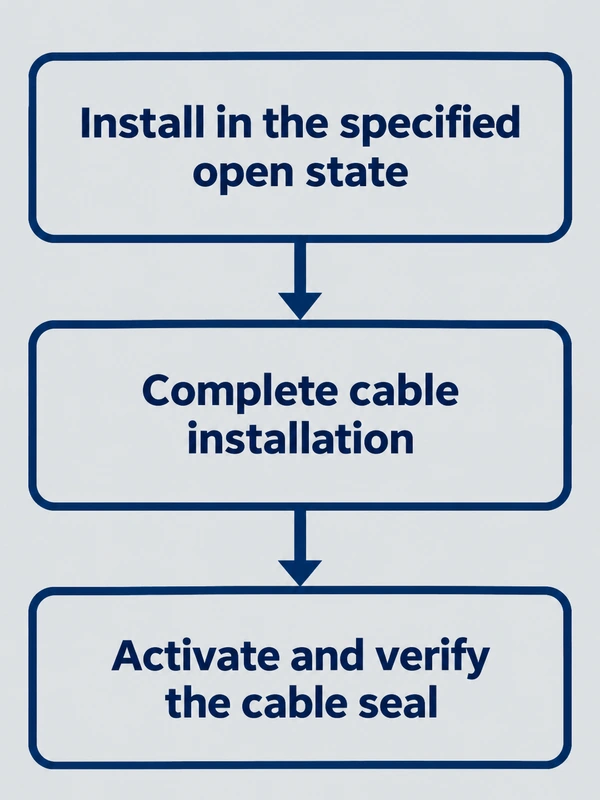
Premature activation can obstruct the cable path or load the sheath. Forgetting activation leaves the intended sealing task unfinished. Assign responsibility for the final step and include it on the acceptance record, especially when different crews install the duct and cable.
How to prepare the duct end and cable sheath for a gas block
Cut duct using the specified tool, preserving roundness and a square end. Keep grit away from the sealing surface and connector entrance. Follow the product’s insertion-depth and retention checks. Do not assume that a clear housing proves the seal is correctly compressed; transparency is an inspection aid, not a performance test.
Inspect the cable sheath at the intended sealing position. Dirt, severe scuffing or deformation can undermine the interface. Use only approved cleaning methods and lubricants. A seal designed for a smooth round cable should not be forced around an unsupported shape or a bundle of separate cables without documented approval.
Route supports must prevent the cable or duct from continuously pulling sideways on the connector. Leave the specified bend radius and maintenance access. The seal should not carry suspended cable weight or compensate for a duct route that is too short to align correctly.
Why blowing pressure and gas-sealing pressure are different
Gas-sealing pressure concerns the closed interface around the cable or fibre unit. Blowing pressure concerns cable installation conditions. Emtelle’s Issue 5 gas-block datasheet explicitly lists gas sealing separately from pressure information for fibre blowing. This distinction is more useful than copying a single headline pressure into a purchase specification.
The FZA14/12 7–10 listing mentions a blowing-pressure capability, but that statement does not establish an equal sealed-state gas rating. Request the exact sealed-state test conditions and the applicable cable and duct combination. If a project requires water resistance, ask for the water-test conditions separately rather than treating the word gas-tight as a complete water specification.
The discussion of water-block microduct connectors helps frame that requirement. Neither gas nor water sealing should be inferred from body colour, transparency or the apparent thickness of a tightening ring.
| Documented property | Question it answers | O que não estabelece |
|---|---|---|
| Open-state blowing limit | Conditions permitted during cable installation | Closed cable-seal pressure |
| Gas-seal test | Performance at the stated cable and test conditions | Fire resistance or every gas application |
| Water-seal test | Performance under the stated water exposure | Unlimited immersion or a dry building penetration |
| Environmental limits | Approved temperature and exposure | Suitability for every outdoor location |
Can the gas block be used outdoors and reopened for maintenance?
Describe the actual environment: indoor entry, sheltered cabinet, flooded chamber, exposed wall or direct burial. Ask for model-specific temperature, UV and mechanical evidence where relevant. An indoor sealing component should not be moved into an exposed route simply because its dimensions fit.
Hexatronic’s connector documentation provides an example of application-specific protection: its described direct-buried configuration uses an external cover. That requirement belongs to that family, but the procurement lesson applies broadly. State the complete approved configuration, including any cover, support or housing, rather than purchasing the bare connector by name alone.
Where an existing cable cannot conveniently be withdrawn, a divisible gas-water block may be worth assessing. Confirm the exact variant’s installation method and service limits. A split design solves an access problem only when its cable range, location and sealing requirements also match.
What to check before handing over a gas-block installation
Record product identification, duct size, cable sheath diameter, installation location and the person completing seal activation. Include the manufacturer’s required inspection or test result. If a test involves pressure, use the approved procedure and isolate the assembly before any adjustment.
Set inspection triggers around network work, cable replacement, flooding, visible movement or suspected damage. Avoid inventing a universal annual interval without reference to the operator’s maintenance policy. A seal disturbed by an upgrade needs reassessment even if its scheduled inspection is months away.
Perguntas frequentes
How does a gas block prevent moisture migration?
An appropriate design seals the relevant interfaces around the duct and cable, interrupting that path. Performance depends on the exact assembly and test conditions. It does not automatically seal a cracked duct wall, chamber lid or the outside of a building penetration.
Does a transparent gas-block body help confirm correct installation?
It can help inspect visible seating or contamination where the design permits. It cannot prove the required compression, hidden seal condition or leakage performance. Use the specified installation checks and acceptance procedure in addition to visual observation.
How do you check a gas block’s outdoor temperature and UV limits?
The conditions at the actual location, including exposure during storage and installation. Request documented limits for the exact variant and protective configuration. Do not transfer outdoor claims from another connector family or infer UV resistance from colour.
How often should a gas-water block be inspected?
Follow the operator’s plan and manufacturer guidance, with additional checks after cable work, flooding, movement or damage. Accessibility and consequence of failure affect the interval. Record what was checked so a later inspection can identify changes.
Which contaminants can a gas block exclude?
Only claim the documented sealing function under its specified conditions. A gas or water seal is not automatically a chemical barrier, filter or hazardous-area protection device. Confirm compatibility with expected substances rather than relying on the product name.
Should a gas block be sealed before or after fiber installation?
Follow the actual design. Some open-through products, including the described FZA model, are sealed after cable installation. Other products use different procedures. Confirm the sequence before work and record that the final activation step was completed.
Referências
- Emtelle, Gas Block Connector: the tube-to-cable sealing function.
- Emtelle, Gas Block Connectors, Issue 5: separate tube dimensions, fibre-unit ranges and sealing performance.
- Hexatronic, MPB30601+ connectors: application-specific external protection for duct joints.
Resumo
A completed gas-block installation needs the correct boundary location, compatible duct and cable interfaces, the product’s activation sequence and a documented acceptance result. Keep blowing limits separate from sealing limits, and preserve access for future work. The final record should make it clear which path is sealed and under what conditions.
For this installation type, review the FZA14/12 7–10 straight microduct gas-block connector with the supplier and request the exact duct/cable pairing, activation instructions and sealed-state evidence. Those details make the quotation usable for installation and acceptance.



