
A gas block connector must address the path around the cable as well as the joint between ducts. A straight coupler can hold the duct ends securely while leaving the cable’s surrounding space open. Where the network design requires control of gas or water migration through that space, select a purpose-designed sealing component with the correct duct and cable interfaces.
Installation begins with the route requirement, not with tightening a ring. Establish where the seal belongs, which product is approved, when it should be activated and how the completed installation will be checked. Blowing pressure and gas-sealing pressure are different properties; a value published for one must not be used as the rating for the other.
Where should a gas block be installed to stop migration through the duct?
Draw the duct route through the chamber, cabinet or building entry. Identify whether the concern is movement along an empty duct, around an installed cable, through a damaged duct wall or around the outside of the duct at a building penetration. These are different paths and may need different sealing measures.
Emtelle describes its gas-block connector as providing an in-line seal between connector, tube and fibre cable. That explains the component’s role, but it does not establish fire resistance or approval for hazardous-gas service. A cable-entry seal is not automatically a firestop, and it does not repair a leaking chamber or wall penetration.
Confirm the required location with the network owner or building designer before placing the component where it cannot be accessed. A conveniently located seal may leave the intended boundary unprotected. Conversely, a buried connection that needs later activation can create avoidable excavation work.
How to match a gas block connector to duct and cable diameter
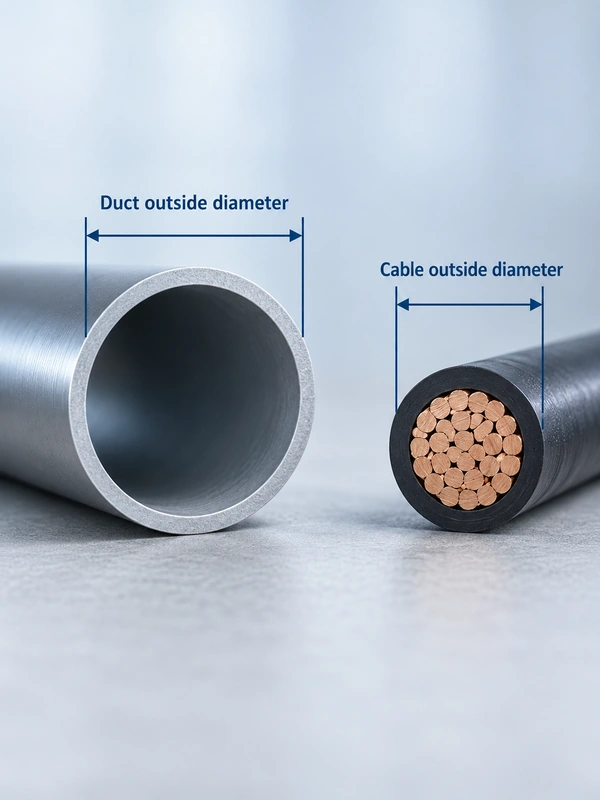
The duct side needs the approved outside diameter, material and condition. The cable side needs the actual sheath diameter and the seal’s permitted range. Fibre count does not reliably identify cable diameter: two cables with the same fibre count can have different constructions and outside dimensions.
Record cable diameter from the cable documentation and check it against the supplied product variant. The 14 mm gas-block connector guide is useful for understanding the family, but a duct-size label alone does not identify the suitable cable seal. Keep the duct designation and cable range together on the order and installation record.
| Interface | Required information | Common selection error |
|---|---|---|
| Duct entry | Outside diameter, material and approved tolerance | Selecting by a similar-looking tube |
| Cable seal | Actual sheath diameter and permitted seal range | Selecting by fibre count alone |
| Route boundary | Seal location and migration requirement | Installing wherever access is easiest |
| Operating condition | Separate blowing and sealed-state limits | Using blowing pressure as a gas-seal rating |
For a hypothetical upgrade, suppose a replacement cable is smaller than the original but uses the same duct. The duct connection may remain dimensionally correct while the existing cable seal is no longer suitable. Reassess both interfaces rather than assuming that unchanged ductwork makes the whole assembly reusable.
When should the gas block seal be tightened around the cable?
Some gas-block designs allow cable installation through an open assembly and require the cable seal to be activated afterwards. The site’s FZA14/12 7–10 product description specifies this type of sequence: pass the cable through the open connector, then operate the sealing ring. That is a product-specific instruction, not a universal rule for every gas block.
Keep the current installation instructions available at the work position. Confirm the required open state before cable installation and the final sealed state afterwards. Do not improvise torque, ring travel or tightening force. If the instructions are incomplete, obtain the missing detail from the supplier before operating the seal.
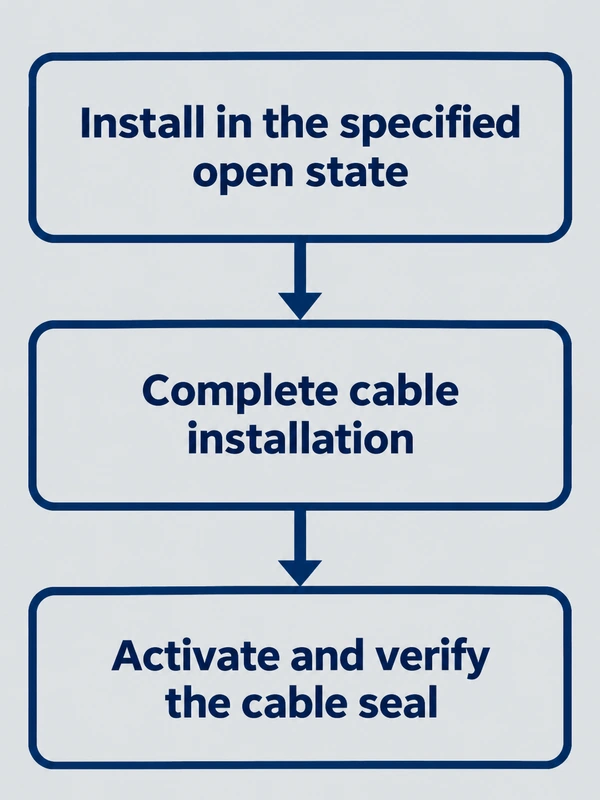
Premature activation can obstruct the cable path or load the sheath. Forgetting activation leaves the intended sealing task unfinished. Assign responsibility for the final step and include it on the acceptance record, especially when different crews install the duct and cable.
How to prepare the duct end and cable sheath for a gas block
Cut duct using the specified tool, preserving roundness and a square end. Keep grit away from the sealing surface and connector entrance. Follow the product’s insertion-depth and retention checks. Do not assume that a clear housing proves the seal is correctly compressed; transparency is an inspection aid, not a performance test.
Inspect the cable sheath at the intended sealing position. Dirt, severe scuffing or deformation can undermine the interface. Use only approved cleaning methods and lubricants. A seal designed for a smooth round cable should not be forced around an unsupported shape or a bundle of separate cables without documented approval.
Route supports must prevent the cable or duct from continuously pulling sideways on the connector. Leave the specified bend radius and maintenance access. The seal should not carry suspended cable weight or compensate for a duct route that is too short to align correctly.
Why blowing pressure and gas-sealing pressure are different
Gas-sealing pressure concerns the closed interface around the cable or fibre unit. Blowing pressure concerns cable installation conditions. Emtelle’s Issue 5 gas-block datasheet explicitly lists gas sealing separately from pressure information for fibre blowing. This distinction is more useful than copying a single headline pressure into a purchase specification.
The FZA14/12 7–10 listing mentions a blowing-pressure capability, but that statement does not establish an equal sealed-state gas rating. Request the exact sealed-state test conditions and the applicable cable and duct combination. If a project requires water resistance, ask for the water-test conditions separately rather than treating the word gas-tight as a complete water specification.
The discussion of water-block microduct connectors helps frame that requirement. Neither gas nor water sealing should be inferred from body colour, transparency or the apparent thickness of a tightening ring.
| Documented property | Question it answers | What it does not establish |
|---|---|---|
| Open-state blowing limit | Conditions permitted during cable installation | Closed cable-seal pressure |
| Gas-seal test | Performance at the stated cable and test conditions | Fire resistance or every gas application |
| Water-seal test | Performance under the stated water exposure | Unlimited immersion or a dry building penetration |
| Environmental limits | Approved temperature and exposure | Suitability for every outdoor location |
Can the gas block be used outdoors and reopened for maintenance?
Describe the actual environment: indoor entry, sheltered cabinet, flooded chamber, exposed wall or direct burial. Ask for model-specific temperature, UV and mechanical evidence where relevant. An indoor sealing component should not be moved into an exposed route simply because its dimensions fit.
Hexatronic’s connector documentation provides an example of application-specific protection: its described direct-buried configuration uses an external cover. That requirement belongs to that family, but the procurement lesson applies broadly. State the complete approved configuration, including any cover, support or housing, rather than purchasing the bare connector by name alone.
Where an existing cable cannot conveniently be withdrawn, a divisible gas-water block may be worth assessing. Confirm the exact variant’s installation method and service limits. A split design solves an access problem only when its cable range, location and sealing requirements also match.
What to check before handing over a gas-block installation
Record product identification, duct size, cable sheath diameter, installation location and the person completing seal activation. Include the manufacturer’s required inspection or test result. If a test involves pressure, use the approved procedure and isolate the assembly before any adjustment.
Set inspection triggers around network work, cable replacement, flooding, visible movement or suspected damage. Avoid inventing a universal annual interval without reference to the operator’s maintenance policy. A seal disturbed by an upgrade needs reassessment even if its scheduled inspection is months away.
Олонтаа асуугддаг асуултууд
How does a gas block prevent moisture migration?
An appropriate design seals the relevant interfaces around the duct and cable, interrupting that path. Performance depends on the exact assembly and test conditions. It does not automatically seal a cracked duct wall, chamber lid or the outside of a building penetration.
Does a transparent gas-block body help confirm correct installation?
It can help inspect visible seating or contamination where the design permits. It cannot prove the required compression, hidden seal condition or leakage performance. Use the specified installation checks and acceptance procedure in addition to visual observation.
How do you check a gas block’s outdoor temperature and UV limits?
The conditions at the actual location, including exposure during storage and installation. Request documented limits for the exact variant and protective configuration. Do not transfer outdoor claims from another connector family or infer UV resistance from colour.
How often should a gas-water block be inspected?
Follow the operator’s plan and manufacturer guidance, with additional checks after cable work, flooding, movement or damage. Accessibility and consequence of failure affect the interval. Record what was checked so a later inspection can identify changes.
Which contaminants can a gas block exclude?
Only claim the documented sealing function under its specified conditions. A gas or water seal is not automatically a chemical barrier, filter or hazardous-area protection device. Confirm compatibility with expected substances rather than relying on the product name.
Should a gas block be sealed before or after fiber installation?
Follow the actual design. Some open-through products, including the described FZA model, are sealed after cable installation. Other products use different procedures. Confirm the sequence before work and record that the final activation step was completed.
Дүрийн баримжаа
- Emtelle, Gas Block Connector: the tube-to-cable sealing function.
- Emtelle, Gas Block Connectors, Issue 5: separate tube dimensions, fibre-unit ranges and sealing performance.
- Hexatronic, MPB30601+ connectors: application-specific external protection for duct joints.
Summary
A completed gas-block installation needs the correct boundary location, compatible duct and cable interfaces, the product’s activation sequence and a documented acceptance result. Keep blowing limits separate from sealing limits, and preserve access for future work. The final record should make it clear which path is sealed and under what conditions.
For this installation type, review the FZA14/12 7–10 straight microduct gas-block connector with the supplier and request the exact duct/cable pairing, activation instructions and sealed-state evidence. Those details make the quotation usable for installation and acceptance.



