
FTTX is not a single product or a promise that every customer receives the same fiber route. It is a family of access architectures in which the final destination of the fiber changes: home, building, curb or node. That distinction matters because the remaining copper or in-building segment, civil work, power and maintenance plan can determine the outcome as much as the optical cable. This revised guide explains what FTTX actually changes, how to compare architectures, and where microduct connectors fit in a controlled deployment.
The short answer: FTTX moves optical fiber through some or all of the local loop, but the “X” determines the remaining segment and the engineering boundary. FTTH reaches the premises; FTTB reaches a building; FTTC and FTTN stop earlier. Select the architecture from route economics, endpoint access, capacity, serviceability and local requirements, then validate the complete duct-and-connector assembly before cable installation.
How does FTTX differ from a conventional copper access loop?
Optical fiber carries information as light and is less affected by electromagnetic interference than metallic access media. However, “fiber is faster” is not a complete project specification. The service delivered to a user depends on the access electronics, optical budget, remaining local segment, split architecture, power, route condition and customer equipment.
| Architecture | Where fiber stops | What remains to plan |
|---|---|---|
| Үйгө чейин оптикалык тармак | Home or premises | Drop route, entry, ONT/ONU and in-building distribution |
| FTTB | Building communications room | Riser, floor distribution, power and building access |
| FTTC | Curb-side cabinet | Cabinet power, backhaul and the final local segment |
| FTTN | Neighborhood node | Node location, feeder capacity and remaining access plant |
Which project conditions favor each FTTX option?
| Абал | Architecture to investigate | Evidence required |
|---|---|---|
| New single-family development | FTTH with accessible drops and spare pathways | Parcel plan, entry route and service boundary |
| Existing apartment block | FTTB or FTTH depending on riser access | Riser survey, fire/local-code review and endpoint plan |
| Long rural route | Compare deeper fiber with staged node deployment | Section lengths, access points and repair logistics |
| Mixed legacy network | Phased upgrade with measured transitions | Actual duct/cable data and acceptance criteria |
For a staged optical route, the HDPE microduct range should be specified with outside diameter, inside diameter, wall, route condition and identification method. A fitting is not interchangeable merely because the printed size looks similar.
Where do microduct connectors affect FTTX reliability?
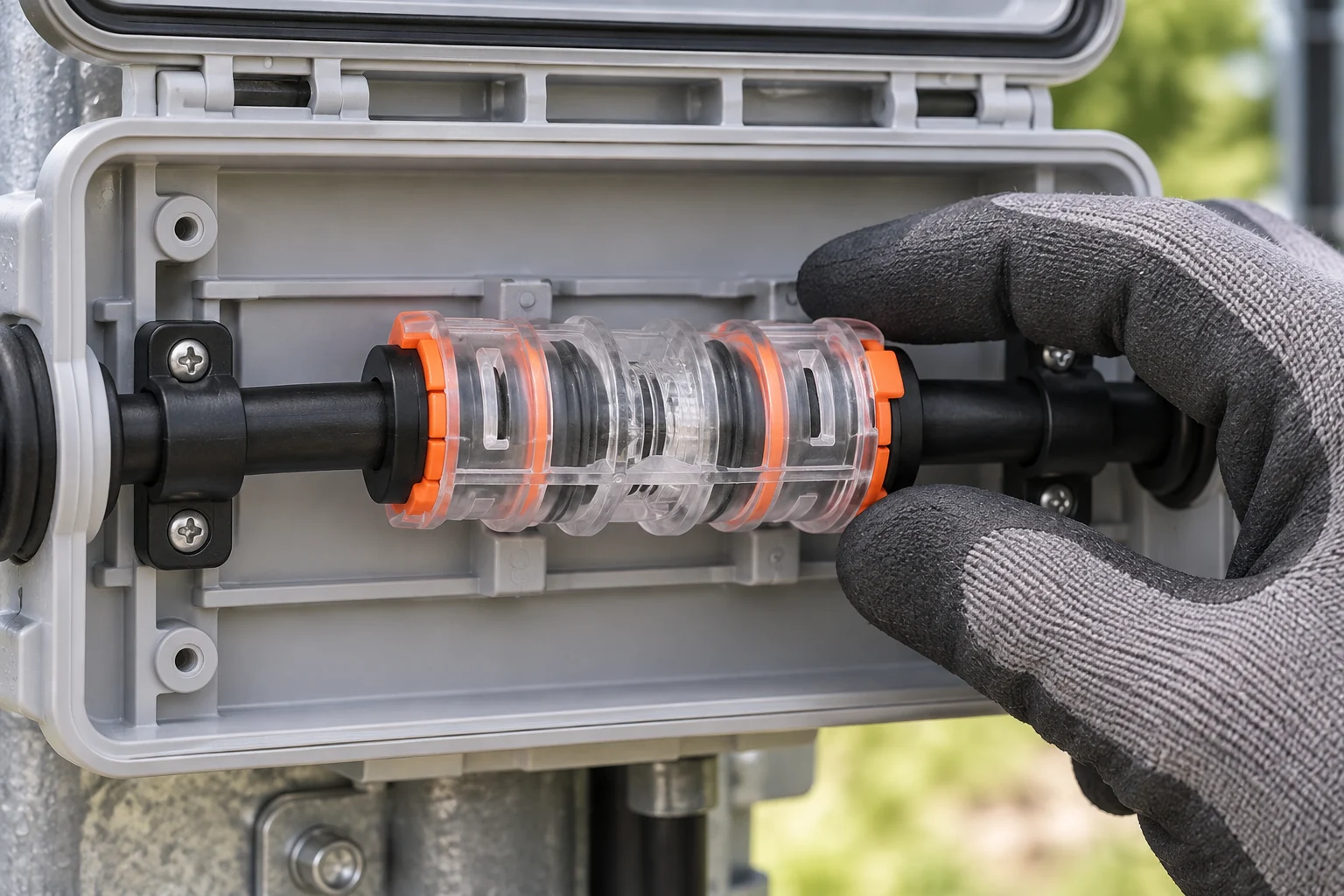
Connectors join equal-size ducts, transition between sizes, close spare pathways or control gas and water migration where a purpose-designed closure is required. Their effect is local but important: an incomplete insertion, damaged seal or wrong transition can reduce the usable air path and delay blowing. Select from the product catalogue by measured OD and function, then inspect the assembled joint before it is buried or enclosed.
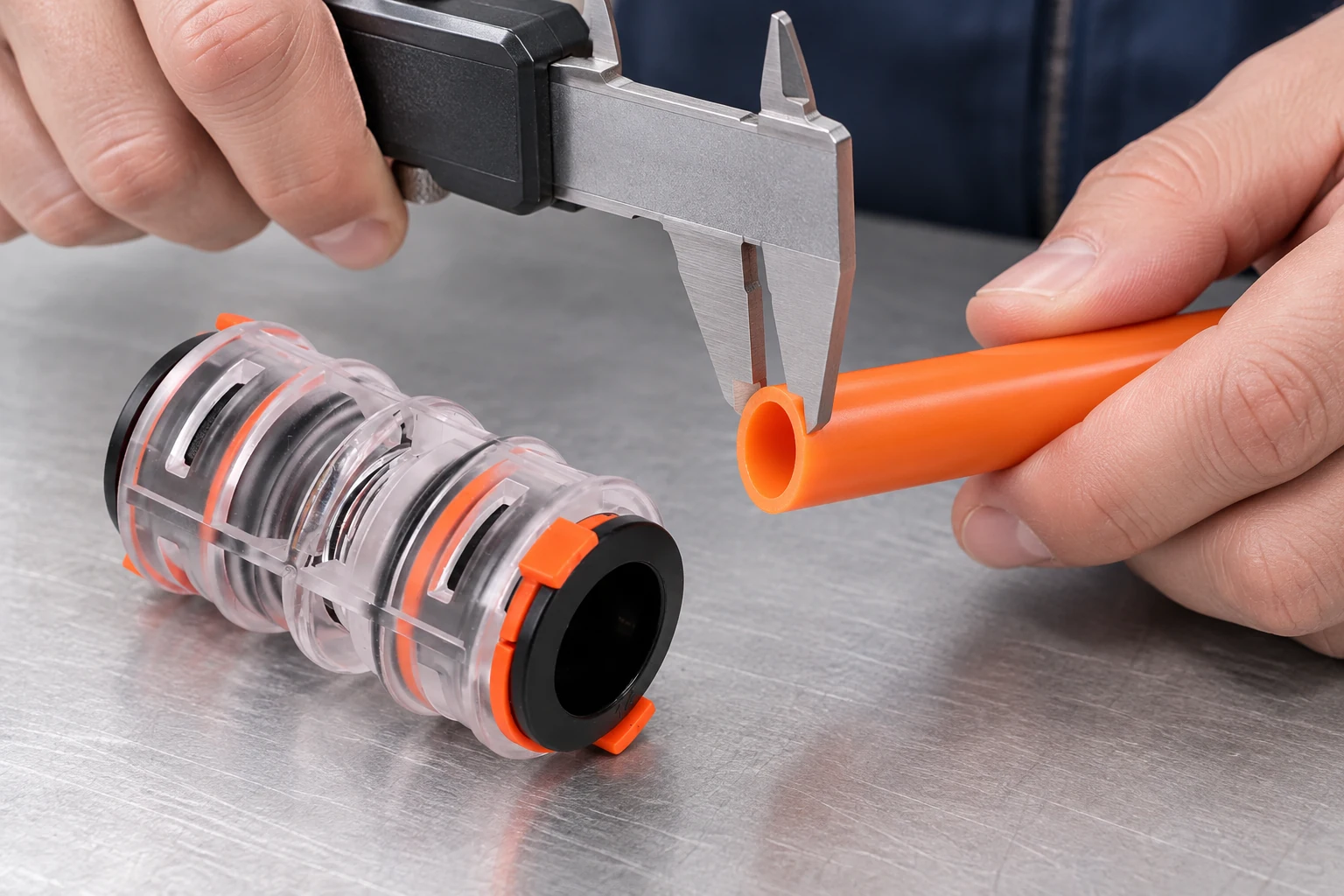
At a minimum, cut the duct square, clean the sealing area, mark insertion depth, seat the duct without side load and record the part number and location. Apply the project pressure or leakage procedure to a representative section. IEC 60794-5-20 and ITU-T L.1700 provide useful reference scopes, but they do not replace a network owner’s method statement.
What should be included in an FTTX acceptance record?
Record the route section, duct and cable identifiers, connector SKU, measured dimensions, insertion check, pressure-test setup, stabilization time, start and end readings, temperature and any corrective work. If a reading changes, isolate temporary caps, gauges and shorter sections before concluding that a buried connector has failed. This record is valuable for future expansions because it distinguishes a route limitation from an equipment limitation.
Why must duct acceptance and optical acceptance be separate?
A duct pressure or continuity check cannot establish the optical loss of a fibre that has not yet been installed. Conversely, a passing optical test does not document the condition of every spare duct. Use separate acceptance packages for the pathway and the optical link, connected by the same route identifiers. This is a recommended handover structure; exact procedures and limits belong in the project specification.
For optical acceptance testing, distinguish overall insertion loss from individual-event characterization. Fluke Networks’ OTDR guide explains that an optical loss test set measures total insertion loss, whereas an OTDR characterizes events such as connectors, splices and bends. Set the relevant fibre type, wavelengths, test directions and instrument settings for the actual network. Do not apply one blanket loss limit or enterprise-cabling test tier to every PON route.
Which records should connect civil work, cable installation and service handover?
Use a common section identifier across the duct acceptance record, cable-laying record and optical report. The pathway package should identify the installed duct, accessible joints, transitions and agreed preparation checks. The laying package should identify the actual cable and machine configuration, settings and interventions. The optical package should identify tested fibres, endpoints, test methods, results and corrective work. Include as-built changes instead of leaving the original design drawing as the only route record.
Where room-level distribution follows FTTH, that is another handover boundary rather than a substitute for the outside access network. The FTTR versus FTTH guide explains the difference. Specify which team owns each boundary and who closes outstanding defects. A network is ready for its agreed service only when the required checks are complete, not merely because the ducts are buried or the cable has reached the far chamber.
Which questions do FTTX buyers ask before deployment?
Does FTTX always mean FTTH?
No. FTTX is the family term; FTTH is only the architecture whose fiber reaches the home or premises.
Does fiber eliminate all access bottlenecks?
No. Split ratios, electronics, remaining copper, optical budget, route condition and customer equipment can still limit service.
Why reserve spare microducts?
Accessible spare pathways can support later cable placement without repeating civil work, but only when they are sealed, labeled and recorded.
How should a connector size be chosen?
Measure the actual duct outside diameter and compare it with the connector’s approved range and function. Do not rely on nominal labels alone.
Can a standards reference replace a field test?
No. The standard’s scope and test method must be matched to the exact component and project; the assembled route still needs acceptance evidence.
What equipment is needed for air-blown fiber?
Use a cable blowing machine whose approved cable, duct, control and safety envelope matches the route. Confirm the combination before mobilization.
Can OTDR testing replace every insertion-loss measurement?
Not automatically. Fluke’s guide distinguishes event characterization from total insertion-loss verification. Follow the specified acceptance method and use the required instruments; do not approve a link from a trace alone when the contract requires a separate loss measurement.
Should duct preparation and optical tests use the same pass criteria?
No. They assess different systems. Define pathway criteria before blowing and optical criteria for the installed link, then connect both sets of results through route and fibre identifiers.
References and conclusion
- ITU-T L.1700, outside-plant optical-fiber network requirements
- IEC standards portal (verify the applicable 60794-5 edition)
- European Commission, State of the Digital Decade 2025
Conclusion: FTTX is best understood as a set of endpoint choices, not as a generic speed label. Start with the service boundary and route conditions, decide where fiber should stop, and then verify the remaining segment, power, access and maintenance plan. For air-blown sections, measure the duct, match each connector to its function and prove the assembled path before cable insertion. Skipping those checks can turn an apparently modern architecture into a difficult repair route. Oulu / ANMASPC supports documented sourcing for микродукт туташтыргычтары, HDPE pathways and blowing equipment through the product catalogue.


