
브리스톨의 포장 라인 기술자가 외경이 동일한 더 유연한 공기 튜브로 딱딱한 튜브를 교체한다고 상상해 보세요. 배관 작업은 더 쉬워지지만, 고속 생산 주기 중 실린더 속도가 느려집니다. 이 가상 사례에서 새 튜브는 내경이 더 작고 경로가 더 깁니다. 재질 변경으로 취급 편의성은 개선되었지만, 동일한 공기 유량을 보장하지는 않습니다.
폴리우레탄과 나일론 중에서 선택하기 금속 호스 피팅 네 가지 별도의 검사가 필요합니다: 피팅의 승인된 튜브 규격, 유로, 경로 및 노출 조건입니다. 본 문서는 호환되는 튜브 피팅과 함께 사용되는 공압용 튜브에 관한 것입니다. 주름진 금속 호스, 압착식 유압 호스 또는 일반적인 바브 연결부는 각각 다른 선택 방법이 필요하므로 본 문서에서는 다루지 않습니다.
경로 주변의 재질과 노출을 선택하세요.
폴리우레탄 튜브 유연성과 손쉬운 배관이 중요한 경우에는 종종 폴리우레탄이, 치수 안정성과 보다 단단한 튜브가 필요한 경우에는 종종 나일론이 고려됩니다. 이는 선택 경향일 뿐, 절대적인 순위는 아닙니다. 폴리머의 조성, 벽 두께, 온도 및 제조사의 제조 방식에 따라 비교 결과는 달라질 수 있습니다. 소재 명칭만으로는 작동 압력, 내구 수명 또는 내화학성을 정확히 파악할 수 없습니다.
가용한 이동 범위와 공간부터 검토하십시오. 움직이는 조립체의 짧은 연결부는 보호 캐비닛 내부의 고정된 배관 루트와는 다른 요구 사항을 수반할 수 있습니다. 이동 범위의 양 끝, 가드 주변 및 고온 표면 근처의 경로를 확인하세요. 그런 다음, 손으로 가장 쉽게 구부러지는 샘플을 무작위로 선택하지 말고, 정적 및 동적 굽힘 요구 사항을 포함한 정확한 시리즈 데이터를 비교하여 결정하십시오.
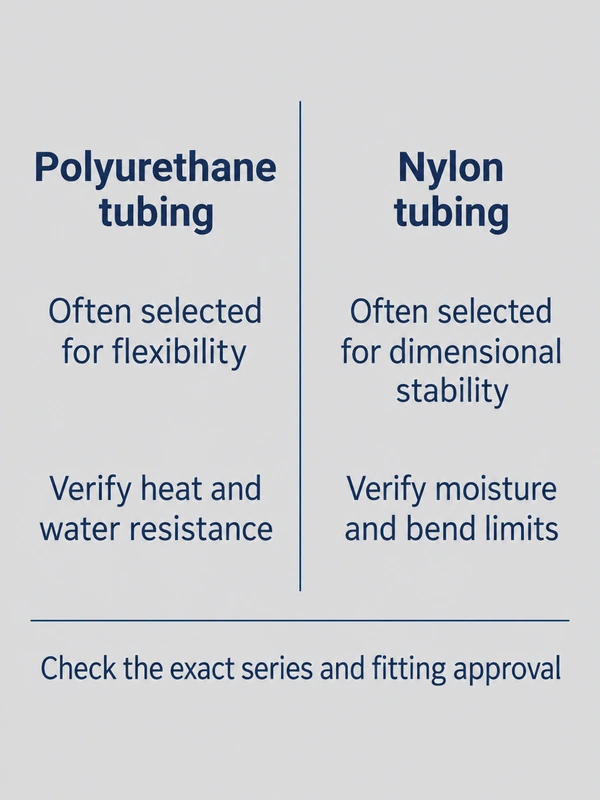
다음으로 내부 유체와 외부 환경을 나열합니다. 압축공기에는 수분과 윤활유가 포함될 수 있으며, 외부에서는 세제나 절삭유에 노출될 수 있습니다. SMC의 TU 문서는 정확한 등급이 얼마나 중요한지를 보여줍니다. 해당 문서의 TU/TIUB 및 TUH 섹션에는 각각 다른 수분 제한 기준이 명시되어 있습니다. 한 제조사의 폴리우레탄 라인업 내에서도 이러한 차이가 존재하므로, 모든 PU 튜브가 물에 적합하다고 일반화할 수는 없습니다.
그 PU 및 PA 공기 호스 비교 재료 선택에 대한 추가적인 배경 정보를 제공합니다. 구매 결정을 내릴 때는 이러한 일반적인 차이점을 실제 튜브 코드, 승인된 피팅 시리즈 및 적용 분야에 관한 구체적인 질문으로 전환하십시오. 색상, 연성 및 공급업체의 일반적인 설명만으로는 고분자 재료의 성분 조합이나 사용 한계를 파악하기에 충분하지 않습니다.
| 선택형 질문 | 폴리우레탄 후보 | 나일론 후보 |
|---|---|---|
| 해당 경로를 무리 없이 이동할 수 있나요? | 유연성 및 최소 굽힘 데이터를 확인하세요 | 강성 및 필요한 굽힘 여유를 확인하십시오. |
| 해당 부품에 맞을까요? | 외경 공차 및 승인된 등급을 확인하십시오. | 외경 공차 및 승인된 등급을 확인하십시오. |
| 작동 온도에서는 어떤 일이 발생하나요? | 시리즈의 압력-온도 한계를 사용하십시오. | 시리즈의 압력-온도 한계를 사용하십시오. |
| Is fluid exposure acceptable? | Check hydrolysis and chemical restrictions | Check moisture and chemical restrictions |
| Will it deliver the required air? | Compare actual bore and installed route | Compare actual bore and installed route |
Match outside diameter for sealing and inside diameter for flow
The fitting grips and seals against a specified 튜브 외경. The inside diameter determines the available flow area along the tube. Two tubes can therefore fit the same nominal socket while presenting different flow paths. Confirm that the fitting approves the material and dimensional tolerance as well as the nominal outside diameter; matching one number does not complete the compatibility check.
As an illustrative geometry example, compare two tubes with an 8 mm outside diameter and respective bores of 5 mm and 6 mm. Their bore areas are about 19.6 mm² and 28.3 mm², calculated from πd²/4. The larger bore has 44% more area. This is a mathematical comparison, not a claim that a particular product delivers 44% more air; actual delivery depends on the complete system and test conditions.
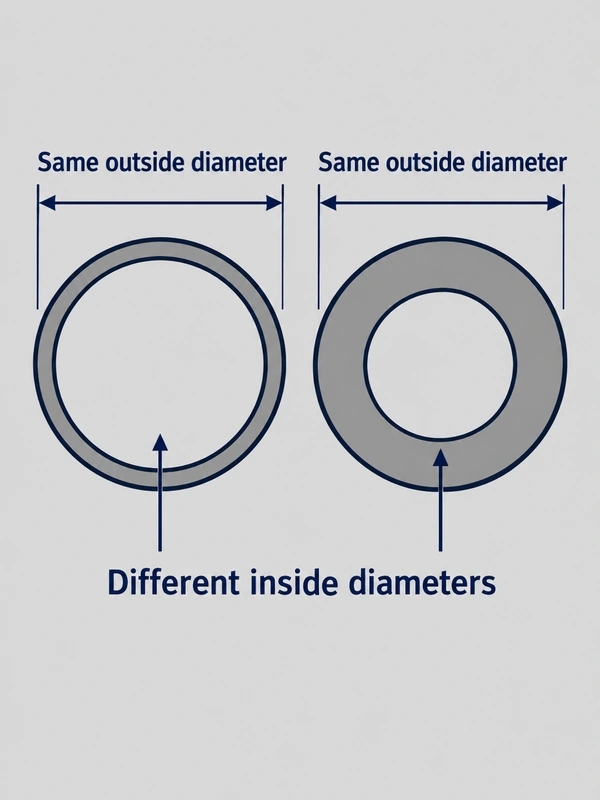
Record both diameters on the spare-parts list. A description such as blue 8 mm tube omits the bore, polymer and grade, making an apparently harmless substitution possible. Also keep inch and metric sizes distinct. The SMC TU catalogue lists separate metric and inch families, illustrating why a near visual match is not evidence of interchangeability.
Changing bore may also change wall thickness, stiffness and the permissible working envelope. Do not select a thinner wall solely to improve airflow. Compare the manufacturer’s pressure and temperature data and check whether the fitting requires any additional support. If flow data for the assembly is unavailable, a controlled machine trial is more informative than judging from the tube colour or the fitting’s external size.
Check the hot operating condition, not only room temperature
Pressure ratings need a stated temperature. SMC lists a maximum operating pressure of 0.8 MPa at 20°C for its specified TU/TIUB range and directs users to its characteristics for other temperatures. Those are SMC product values, not ratings for Oulu tubing or all polyurethane products. Their value here is to demonstrate why an isolated pressure number is incomplete.
Consider the local environment around the tube. Air inside a warm enclosure, proximity to motors and cleaning cycles may expose the line to conditions different from the workshop average. Check both fluid and ambient limits, and distinguish burst pressure from allowed continuous operation. A metal hose adapter can remain mechanically intact while its connected polymer tube or seal becomes unsuitable.
The same caution applies to bend radius. A room-temperature value does not automatically describe hot service or repeated movement. Use the manufacturer’s definition and test conditions. Avoid routing at the smallest published radius merely because it fits the layout; allowance for installation tolerances and machine movement can prevent flattening and side load at the connection.
Trace low flow through the complete installed line
If a machine slows after a tube change, compare the old and new tube specifications before replacing the metal couplings. Check bore, length, sharp bends, pinched sections and any newly added adapters. Observe pressure under the same machine load, because an idle gauge can look normal even when a restrictive path cannot supply the required air during a fast stroke.
Look beyond the inlet line. A regulator, filter, valve, exhaust restriction or shared demand can produce similar symptoms. Change one factor at a time and retain the operating conditions with the result. The PU hose leak and kink troubleshooting guide is useful when a softer replacement changes the route or introduces an intermittent restriction.
Maintenance cost includes repeat leaks, access time and lost production, not only the price per metre. A flexible tube that needs frequent replacement in the actual chemical environment may be a poor choice; a stiffer tube that cannot be routed without side load can be equally unsuitable. Compare expected service tasks using evidence from the intended installation rather than a general claim that one polymer lasts longer.
| 기록 | Before replacement | After replacement |
|---|---|---|
| 정체성 | Original code, material, OD and ID | New code and confirmed fitting approval |
| 루트 | Length, bends and movement | Changed length, supports and clearance |
| Duty | 압력, 온도 및 매체 | Same conditions used for verification |
| 성능 | Machine symptom and load | Cycle behaviour, pressure and leak check |
Confirm documentation for clean-air or food-related duties
Being near a food machine does not automatically mean the tube contacts food, and being made from a familiar polymer does not establish food-contact compliance. Define whether the duty involves direct contact, process air, washdown or merely an external location. Request documentation covering the actual tube grade and intended destination-market use where those requirements apply.
Likewise, clean compressed air is a system requirement involving the supply, filtration, tubing and downstream equipment. A fitting photograph cannot demonstrate a cleanliness class. Ask about supplied cleanliness, packaging and any required preparation. For Oulu nylon pneumatic tubing, confirm the exact size and series information rather than assigning a certification or pressure rating from a general comparison article.
자주 묻는 질문
How often should tubing and metal fittings be inspected?
Set the interval from the machine duty, movement, environment and observed failure history. Inspect after changes in routing, chemicals or operating conditions as well as at planned maintenance. A universal calendar interval cannot account for both a protected fixed line and a frequently moving exposed tube.
What is the main difference between polyurethane and nylon tubing?
PU is often selected for flexibility, while nylon is often selected for dimensional stability. The exact grade and wall dimensions determine the useful limits. Compare approved pressure, temperature, bend and media data before deciding which material suits the installation.
How do you troubleshoot low flow through a hose-fitting assembly?
Compare tube bore, route length and restrictions, then measure pressure under a repeatable operating load. Include regulators, filters, valves and shared demand in the investigation. A metal connector should be replaced only when evidence points to damage, incorrect sizing or a local restriction.
What bend radius prevents premature tube failure?
Use the exact tube manufacturer’s minimum radius and its stated conditions, then allow for movement and installation variation. There is no single radius for all PU and nylon tubing. Check that bends remain clear of the fitting entry and do not flatten during operation.
Can a tube be changed without shutting down the whole line?
Only where an approved local isolation arrangement makes the affected circuit safe without exposing connected equipment or people. Verify depressurization and trapped energy before disconnection. Continued operation elsewhere is a system-design question, not an inherent feature of a push-in fitting.
Which certifications matter near food or clean-air equipment?
Requirements depend on actual contact, air-quality needs, cleaning exposure and destination market. Obtain documents for the exact tube and fitting, including any seals, rather than relying on the polymer name. A general industrial listing does not establish food-contact or cleanroom suitability.
참고문헌
- SMC: TU, TIUB and TUH tubing specifications and precautions
- SMC: KQG2 approved tubing and operating precautions
- U.S. DOE: Compressed-air leak management
요약
Choose the tube that fits the route, exposure and operating envelope, then confirm its outside diameter and material with the fitting series. Preserve the required bore so a convenient substitution does not create an airflow problem. Compare Oulu PU tube options with the nylon candidate using a complete specification and request confirmation of the selected size, medium and temperature before ordering.



