
Imaginez un technicien de ligne d’emballage à Bristol remplaçant un tuyau d’air rigide par un tuyau plus souple de même diamètre extérieur. Le câblage devient ainsi plus facile, mais le vérin ralentit pendant un cycle de production rapide. Dans cet exemple hypothétique, le nouveau tuyau présente un alésage plus petit et suit un trajet plus long. Ce changement de matériau a facilité la manipulation, sans pour autant garantir le même débit d’air.
Choisir entre le polyuréthane et le nylon pour raccords de tuyaux métalliques requiert quatre vérifications distinctes : la spécification de tube approuvée pour le raccord, le passage d’écoulement, l’itinéraire et les conditions d’exposition. Cet article concerne les tubes pneumatiques utilisés avec des raccords de tuyauterie compatibles. Il ne couvre pas les flexibles métalliques ondulés, les flexibles hydrauliques sertis ni les raccords à barbelure génériques, qui nécessitent chacun une méthode de sélection différente.
Choisissez le matériau autour de l’itinéraire et l’exposition.
Tuyau en polyuréthane On privilégie souvent le caoutchouc lorsque la flexibilité et la facilité de câblage sont importantes, tandis que le nylon est souvent choisi lorsque la stabilité dimensionnelle et une gaine plus rigide sont nécessaires. Il s’agit d’orientations de sélection, et non de classements universels. La formulation du polymère, l’épaisseur de paroi, la température et la conception du fabricant peuvent modifier ces comparaisons. Le seul nom d’un matériau ne permet pas de déterminer la pression de service, la durée de vie en mouvement ni la résistance chimique.
Commencez par évaluer le mouvement et l’espace disponible. Une liaison courte sur un ensemble mobile peut imposer des contraintes différentes au tube par rapport à une installation fixe à l’intérieur d’un coffret protégé. Vérifiez le parcours aux deux extrémités de la course, autour des protections et à proximité des surfaces chaudes. Ensuite, comparez les données techniques précises de la série, y compris les exigences de flexion statique et dynamique, plutôt que de choisir simplement l’échantillon qui se plie le plus facilement à la main.
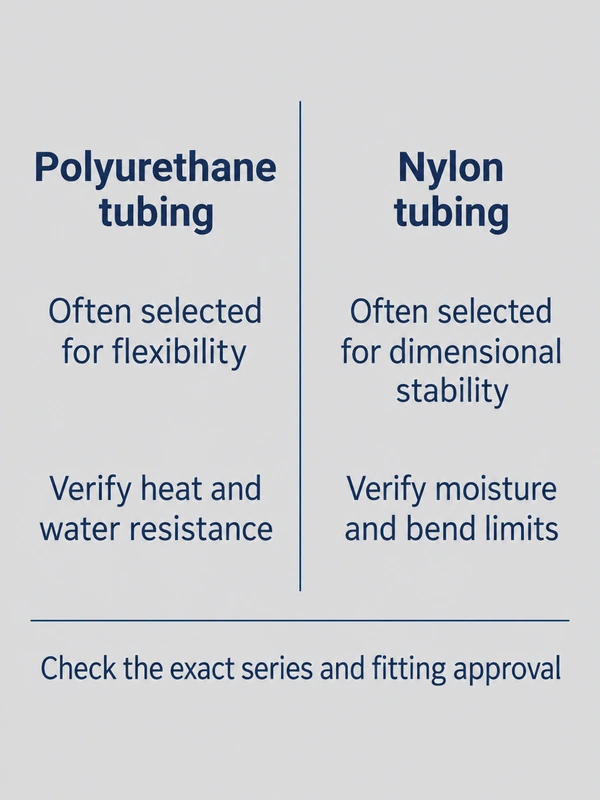
Ensuite, indiquez le fluide interne et les agents externes auxquels le composant est exposé. L’air comprimé peut contenir de l’humidité et des traces de lubrifiant, tandis que l’environnement extérieur peut être en contact avec des détergents ou des fluides de coupe. La documentation TU de SMC illustre l’importance du choix précis de la qualité : ses sections TU/TIUB et TUH imposent des limites différentes en matière de teneur en eau. Cette différence au sein de la gamme de polyuréthane d’un même fabricant exclut toute généralisation selon laquelle tous les tubes en PU seraient adaptés à l’eau.
Le Comparaison des flexibles d’air en PU et en PA fournit des informations complémentaires sur le choix du matériau. Pour une décision d’achat, transformez ces différences générales en questions précises concernant le code exact du tube, la série de raccords approuvée et l’application. La couleur, la souplesse et la description générique d’un fournisseur ne suffisent pas à identifier une formulation polymère ni une limite d’utilisation.
| Question de sélection | Candidat en polyuréthane | Candidat en nylon |
|---|---|---|
| Le trajet peut-il être effectué sans effort ? | Vérifiez les données de flexibilité et de rayon de courbure minimal. | Vérifiez la rigidité et l'espace de dégagement de pliage requis. |
| Cela conviendra-t-il au raccord ? | Confirmer la tolérance d’OD et la nuance approuvée | Confirmer la tolérance d’OD et la nuance approuvée |
| Que se passe-t-il à la température de fonctionnement ? | Utilisez les limites de pression-température de la série. | Utilisez les limites de pression-température de la série. |
| L’exposition aux fluides est-elle acceptable ? | Vérifier l’hydrolyse et les restrictions chimiques | Vérifiez les restrictions relatives à l’humidité et aux produits chimiques |
| Fournira-t-il l’air requis ? | Comparer le diamètre réel et le parcours installé | Comparer le diamètre réel et le parcours installé |
Correspondance du diamètre extérieur pour l’étanchéité et du diamètre intérieur pour le débit.
L’embout s’ajuste et assure l’étanchéité selon une spécification définie. diamètre extérieur du tube. Le diamètre intérieur détermine la section de passage disponible le long du tube. Ainsi, deux tubes peuvent correspondre à la même raccordement nominale tout en offrant des passages de fluide différents. Vérifiez que le raccord accepte bien le matériau et les tolérances dimensionnelles, ainsi que le diamètre extérieur nominal ; la seule correspondance d’un seul chiffre ne suffit pas à garantir la compatibilité.
À titre d’exemple de géométrie descriptive, comparons deux tubes ayant un diamètre extérieur de 8 mm et des alésages respectifs de 5 mm et 6 mm. Leurs surfaces d’alésage sont d’environ 19.6 mm² et 28.3 mm², calculées selon la formule πd²/4. L’alésage le plus grand présente une surface supérieure de 44 %. Il s’agit d’une comparaison mathématique et non d’une affirmation selon laquelle un produit particulier délivre 44 % d’air en plus ; la délivrance réelle dépend du système complet et des conditions d’essai.
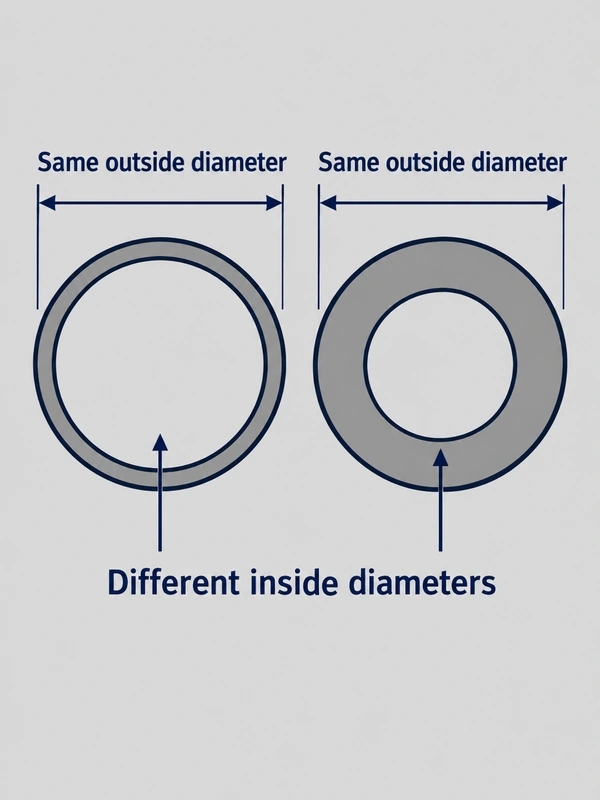
Record both diameters on the spare-parts list. A description such as blue 8 mm tube omits the bore, polymer and grade, making an apparently harmless substitution possible. Also keep inch and metric sizes distinct. The SMC TU catalogue lists separate metric and inch families, illustrating why a near visual match is not evidence of interchangeability.
Changing bore may also change wall thickness, stiffness and the permissible working envelope. Do not select a thinner wall solely to improve airflow. Compare the manufacturer’s pressure and temperature data and check whether the fitting requires any additional support. If flow data for the assembly is unavailable, a controlled machine trial is more informative than judging from the tube colour or the fitting’s external size.
Check the hot operating condition, not only room temperature
Pressure ratings need a stated temperature. SMC lists a maximum operating pressure of 0.8 MPa at 20°C for its specified TU/TIUB range and directs users to its characteristics for other temperatures. Those are SMC product values, not ratings for Oulu tubing or all polyurethane products. Their value here is to demonstrate why an isolated pressure number is incomplete.
Consider the local environment around the tube. Air inside a warm enclosure, proximity to motors and cleaning cycles may expose the line to conditions different from the workshop average. Check both fluid and ambient limits, and distinguish burst pressure from allowed continuous operation. A metal hose adapter can remain mechanically intact while its connected polymer tube or seal becomes unsuitable.
The same caution applies to bend radius. A room-temperature value does not automatically describe hot service or repeated movement. Use the manufacturer’s definition and test conditions. Avoid routing at the smallest published radius merely because it fits the layout; allowance for installation tolerances and machine movement can prevent flattening and side load at the connection.
Trace low flow through the complete installed line
If a machine slows after a tube change, compare the old and new tube specifications before replacing the metal couplings. Check bore, length, sharp bends, pinched sections and any newly added adapters. Observe pressure under the same machine load, because an idle gauge can look normal even when a restrictive path cannot supply the required air during a fast stroke.
Look beyond the inlet line. A regulator, filter, valve, exhaust restriction or shared demand can produce similar symptoms. Change one factor at a time and retain the operating conditions with the result. The PU hose leak and kink troubleshooting guide is useful when a softer replacement changes the route or introduces an intermittent restriction.
Maintenance cost includes repeat leaks, access time and lost production, not only the price per metre. A flexible tube that needs frequent replacement in the actual chemical environment may be a poor choice; a stiffer tube that cannot be routed without side load can be equally unsuitable. Compare expected service tasks using evidence from the intended installation rather than a general claim that one polymer lasts longer.
| Enregistrement | Before replacement | After replacement |
|---|---|---|
| Identité | Original code, material, OD and ID | New code and confirmed fitting approval |
| Route | Length, bends and movement | Changed length, supports and clearance |
| Duty | Pression, température et milieu | Same conditions used for verification |
| Performance | Machine symptom and load | Cycle behaviour, pressure and leak check |
Confirm documentation for clean-air or food-related duties
Being near a food machine does not automatically mean the tube contacts food, and being made from a familiar polymer does not establish food-contact compliance. Define whether the duty involves direct contact, process air, washdown or merely an external location. Request documentation covering the actual tube grade and intended destination-market use where those requirements apply.
Likewise, clean compressed air is a system requirement involving the supply, filtration, tubing and downstream equipment. A fitting photograph cannot demonstrate a cleanliness class. Ask about supplied cleanliness, packaging and any required preparation. For Oulu nylon pneumatic tubing, confirm the exact size and series information rather than assigning a certification or pressure rating from a general comparison article.
Foire aux questions
How often should tubing and metal fittings be inspected?
Set the interval from the machine duty, movement, environment and observed failure history. Inspect after changes in routing, chemicals or operating conditions as well as at planned maintenance. A universal calendar interval cannot account for both a protected fixed line and a frequently moving exposed tube.
What is the main difference between polyurethane and nylon tubing?
PU is often selected for flexibility, while nylon is often selected for dimensional stability. The exact grade and wall dimensions determine the useful limits. Compare approved pressure, temperature, bend and media data before deciding which material suits the installation.
How do you troubleshoot low flow through a hose-fitting assembly?
Compare tube bore, route length and restrictions, then measure pressure under a repeatable operating load. Include regulators, filters, valves and shared demand in the investigation. A metal connector should be replaced only when evidence points to damage, incorrect sizing or a local restriction.
What bend radius prevents premature tube failure?
Use the exact tube manufacturer’s minimum radius and its stated conditions, then allow for movement and installation variation. There is no single radius for all PU and nylon tubing. Check that bends remain clear of the fitting entry and do not flatten during operation.
Can a tube be changed without shutting down the whole line?
Only where an approved local isolation arrangement makes the affected circuit safe without exposing connected equipment or people. Verify depressurization and trapped energy before disconnection. Continued operation elsewhere is a system-design question, not an inherent feature of a push-in fitting.
Which certifications matter near food or clean-air equipment?
Requirements depend on actual contact, air-quality needs, cleaning exposure and destination market. Obtain documents for the exact tube and fitting, including any seals, rather than relying on the polymer name. A general industrial listing does not establish food-contact or cleanroom suitability.
Références
- SMC: TU, TIUB and TUH tubing specifications and precautions
- SMC: KQG2 approved tubing and operating precautions
- U.S. DOE: Compressed-air leak management
Résumé
Choose the tube that fits the route, exposure and operating envelope, then confirm its outside diameter and material with the fitting series. Preserve the required bore so a convenient substitution does not create an airflow problem. Compare Oulu PU tube options with the nylon candidate using a complete specification and request confirmation of the selected size, medium and temperature before ordering.



