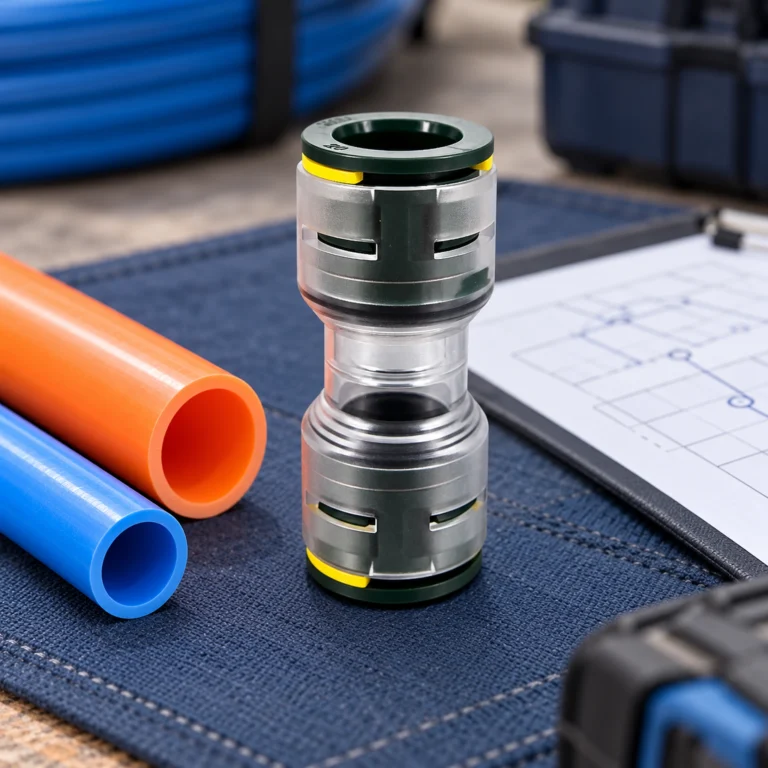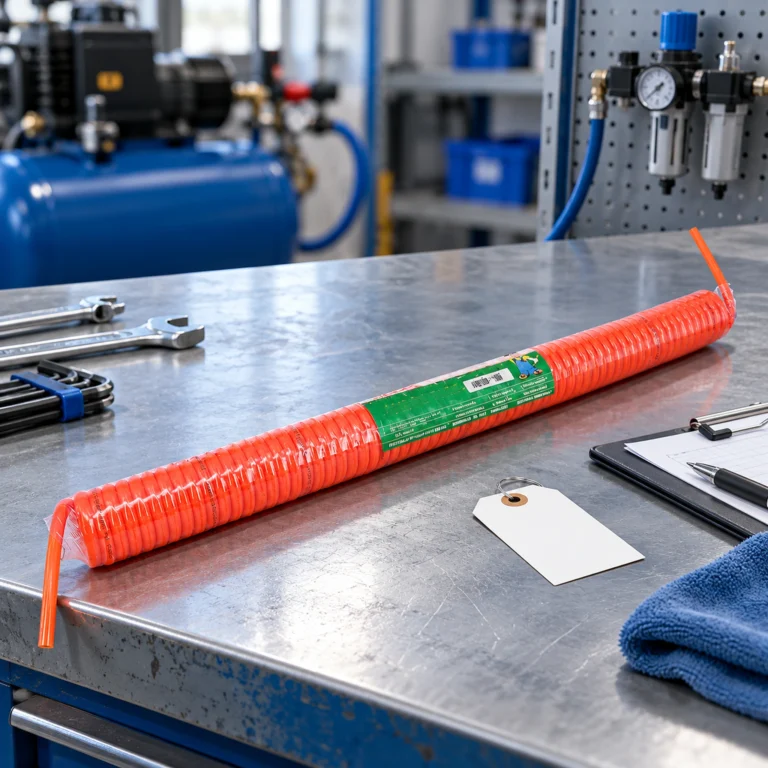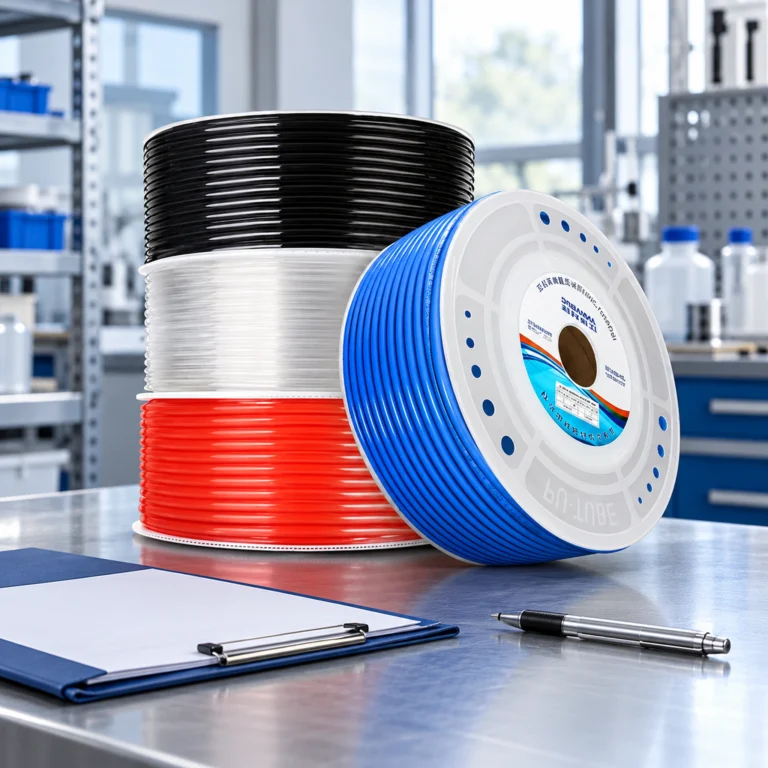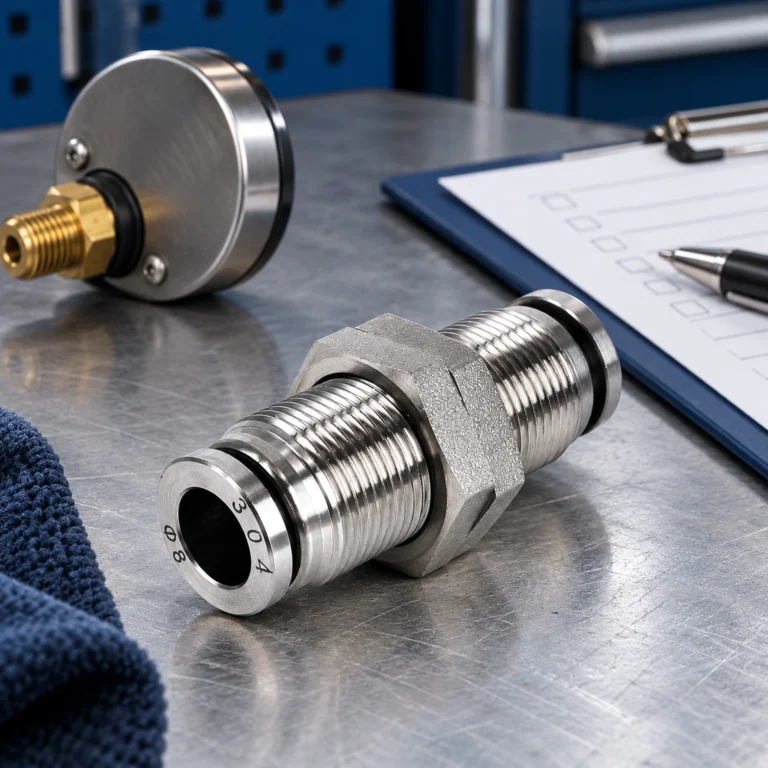
Imagine a packaging-line technician in Bristol replacing a stiff air tube with a more flexible one of the same outside diameter. Routing becomes easier, but the cylinder slows during a fast production cycle. In this hypothetical example, the new tube has a smaller bore and follows a longer path. The material change helped handling without guaranteeing the same airflow.
Choosing between polyurethane and nylon for metal hose fittings requires four separate checks: the fitting’s approved tube specification, the flow passage, the route and the exposure conditions. This article concerns pneumatic tubing used with compatible tube fittings. It does not cover corrugated metal hose, crimped hydraulic hose or a generic barb connection, each of which requires a different selection method.
Choose the material around the route and the exposure
Polyurethane tubing is often considered when flexibility and easy routing matter, while nylon is often considered when dimensional stability and a firmer tube are useful. These are selection tendencies, not universal rankings. Polymer formulation, wall thickness, temperature and the manufacturer’s construction can change the comparison. A material name alone cannot establish working pressure, movement life or chemical resistance.
Start with the movement and space available. A short connection on a moving assembly may place different demands on the tube from a fixed run inside a protected cabinet. Check the route at both ends of travel, around guards and near hot surfaces. Then compare the exact series data, including any static and dynamic bend requirements, rather than choosing whichever sample bends most easily by hand.
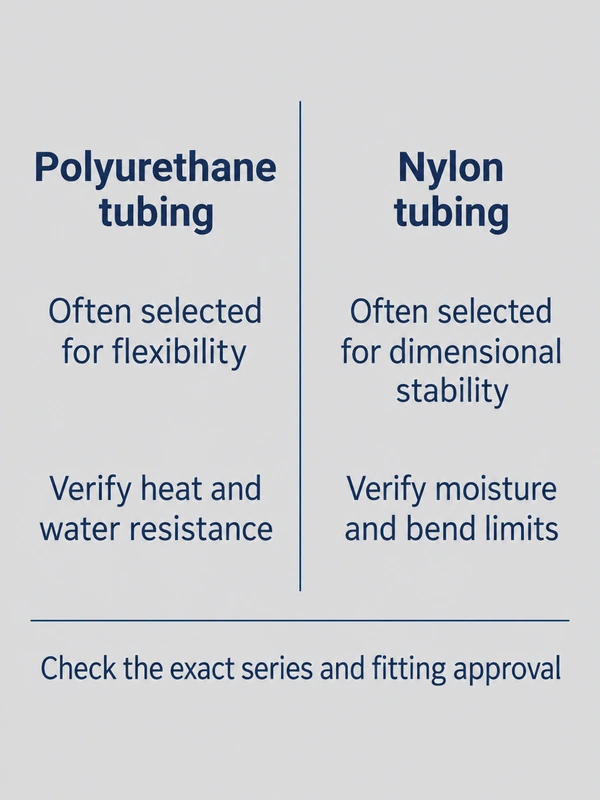
Next list the internal fluid and external exposure. Compressed air can contain moisture and lubricant carryover, while the outside may encounter detergent or cutting fluid. SMC’s TU documentation demonstrates how important the exact grade is: its TU/TIUB and TUH sections contain different water restrictions. That difference within one manufacturer’s polyurethane range rules out a blanket statement that every PU tube is suitable for water.
The PU and PA air-hose comparison gives additional background on the material choice. For a purchasing decision, turn those general differences into specific questions about the actual tube code, approved fitting series and application. Colour, softness and a supplier’s generic description are not enough to identify a polymer formulation or an operating limit.
| Pitanje za odabir | Polyurethane candidate | Nylon candidate |
|---|---|---|
| Can the route be made without strain? | Check flexibility and minimum bend data | Check stiffness and required bend clearance |
| Will it suit the fitting? | Confirm OD tolerance and approved grade | Confirm OD tolerance and approved grade |
| What happens at operating temperature? | Use the series pressure-temperature limits | Use the series pressure-temperature limits |
| Is fluid exposure acceptable? | Check hydrolysis and chemical restrictions | Check moisture and chemical restrictions |
| Will it deliver the required air? | Compare actual bore and installed route | Compare actual bore and installed route |
Match outside diameter for sealing and inside diameter for flow
The fitting grips and seals against a specified tube outside diameter. The inside diameter determines the available flow area along the tube. Two tubes can therefore fit the same nominal socket while presenting different flow paths. Confirm that the fitting approves the material and dimensional tolerance as well as the nominal outside diameter; matching one number does not complete the compatibility check.
As an illustrative geometry example, compare two tubes with an 8 mm outside diameter and respective bores of 5 mm and 6 mm. Their bore areas are about 19.6 mm² and 28.3 mm², calculated from πd²/4. The larger bore has 44% more area. This is a mathematical comparison, not a claim that a particular product delivers 44% more air; actual delivery depends on the complete system and test conditions.
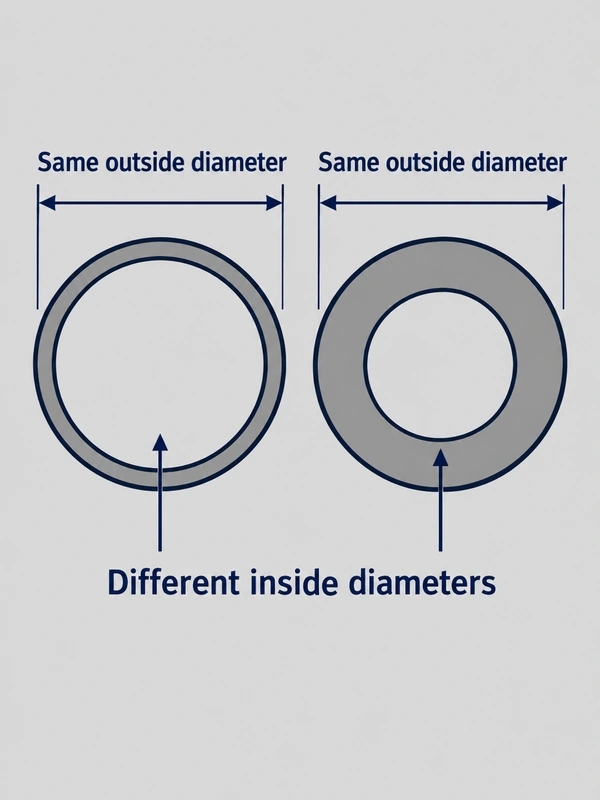
Record both diameters on the spare-parts list. A description such as blue 8 mm tube omits the bore, polymer and grade, making an apparently harmless substitution possible. Also keep inch and metric sizes distinct. The SMC TU catalogue lists separate metric and inch families, illustrating why a near visual match is not evidence of interchangeability.
Changing bore may also change wall thickness, stiffness and the permissible working envelope. Do not select a thinner wall solely to improve airflow. Compare the manufacturer’s pressure and temperature data and check whether the fitting requires any additional support. If flow data for the assembly is unavailable, a controlled machine trial is more informative than judging from the tube colour or the fitting’s external size.
Check the hot operating condition, not only room temperature
Pressure ratings need a stated temperature. SMC lists a maximum operating pressure of 0.8 MPa at 20°C for its specified TU/TIUB range and directs users to its characteristics for other temperatures. Those are SMC product values, not ratings for Oulu tubing or all polyurethane products. Their value here is to demonstrate why an isolated pressure number is incomplete.
Consider the local environment around the tube. Air inside a warm enclosure, proximity to motors and cleaning cycles may expose the line to conditions different from the workshop average. Check both fluid and ambient limits, and distinguish burst pressure from allowed continuous operation. A metal hose adapter can remain mechanically intact while its connected polymer tube or seal becomes unsuitable.
The same caution applies to bend radius. A room-temperature value does not automatically describe hot service or repeated movement. Use the manufacturer’s definition and test conditions. Avoid routing at the smallest published radius merely because it fits the layout; allowance for installation tolerances and machine movement can prevent flattening and side load at the connection.
Trace low flow through the complete installed line
If a machine slows after a tube change, compare the old and new tube specifications before replacing the metal couplings. Check bore, length, sharp bends, pinched sections and any newly added adapters. Observe pressure under the same machine load, because an idle gauge can look normal even when a restrictive path cannot supply the required air during a fast stroke.
Look beyond the inlet line. A regulator, filter, valve, exhaust restriction or shared demand can produce similar symptoms. Change one factor at a time and retain the operating conditions with the result. The PU hose leak and kink troubleshooting guide is useful when a softer replacement changes the route or introduces an intermittent restriction.
Maintenance cost includes repeat leaks, access time and lost production, not only the price per metre. A flexible tube that needs frequent replacement in the actual chemical environment may be a poor choice; a stiffer tube that cannot be routed without side load can be equally unsuitable. Compare expected service tasks using evidence from the intended installation rather than a general claim that one polymer lasts longer.
| Record | Before replacement | After replacement |
|---|---|---|
| Identity | Original code, material, OD and ID | New code and confirmed fitting approval |
| Route | Length, bends and movement | Changed length, supports and clearance |
| Duty | Pressure, temperature and medium | Same conditions used for verification |
| Performanse | Machine symptom and load | Cycle behaviour, pressure and leak check |
Confirm documentation for clean-air or food-related duties
Being near a food machine does not automatically mean the tube contacts food, and being made from a familiar polymer does not establish food-contact compliance. Define whether the duty involves direct contact, process air, washdown or merely an external location. Request documentation covering the actual tube grade and intended destination-market use where those requirements apply.
Likewise, clean compressed air is a system requirement involving the supply, filtration, tubing and downstream equipment. A fitting photograph cannot demonstrate a cleanliness class. Ask about supplied cleanliness, packaging and any required preparation. For Oulu nylon pneumatic tubing, confirm the exact size and series information rather than assigning a certification or pressure rating from a general comparison article.
Često postavljana pitanja
How often should tubing and metal fittings be inspected?
Set the interval from the machine duty, movement, environment and observed failure history. Inspect after changes in routing, chemicals or operating conditions as well as at planned maintenance. A universal calendar interval cannot account for both a protected fixed line and a frequently moving exposed tube.
What is the main difference between polyurethane and nylon tubing?
PU is often selected for flexibility, while nylon is often selected for dimensional stability. The exact grade and wall dimensions determine the useful limits. Compare approved pressure, temperature, bend and media data before deciding which material suits the installation.
How do you troubleshoot low flow through a hose-fitting assembly?
Compare tube bore, route length and restrictions, then measure pressure under a repeatable operating load. Include regulators, filters, valves and shared demand in the investigation. A metal connector should be replaced only when evidence points to damage, incorrect sizing or a local restriction.
What bend radius prevents premature tube failure?
Use the exact tube manufacturer’s minimum radius and its stated conditions, then allow for movement and installation variation. There is no single radius for all PU and nylon tubing. Check that bends remain clear of the fitting entry and do not flatten during operation.
Can a tube be changed without shutting down the whole line?
Only where an approved local isolation arrangement makes the affected circuit safe without exposing connected equipment or people. Verify depressurization and trapped energy before disconnection. Continued operation elsewhere is a system-design question, not an inherent feature of a push-in fitting.
Which certifications matter near food or clean-air equipment?
Requirements depend on actual contact, air-quality needs, cleaning exposure and destination market. Obtain documents for the exact tube and fitting, including any seals, rather than relying on the polymer name. A general industrial listing does not establish food-contact or cleanroom suitability.
Reference
- SMC: TU, TIUB and TUH tubing specifications and precautions
- SMC: KQG2 approved tubing and operating precautions
- U.S. DOE: Compressed-air leak management
Summary
Choose the tube that fits the route, exposure and operating envelope, then confirm its outside diameter and material with the fitting series. Preserve the required bore so a convenient substitution does not create an airflow problem. Compare Oulu PU tube options with the nylon candidate using a complete specification and request confirmation of the selected size, medium and temperature before ordering.