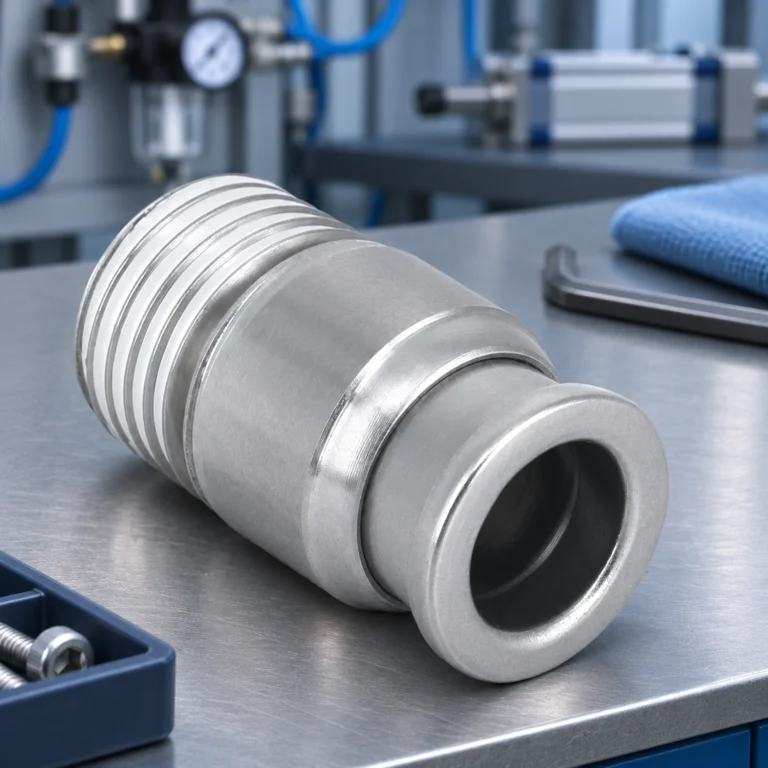
A push-in fitting is compatible with a tube only when the connection size, material, dimensional tolerance and operating conditions agree. A tube that enters the socket is not necessarily approved for it. Likewise, a threaded end that starts into a port is not proof of the correct thread. These are separate interfaces and should be specified separately.
Buyers searching for push-to-connect tube fittings often encounter descriptions that mix tube sizes, pipe threads and body materials. This guide explains how to read those descriptions, qualify a tube-and-fitting combination and write a purchase specification that does not depend on assumptions. It uses manufacturer catalogues as examples, without extending their approvals to unrelated products.
Treat tube outside diameter and pipe thread as separate specifications
The tube end of a push-in fitting is normally specified by the tube’s outside diameter, or OD. The tube passes through a gripping and sealing interface designed for a defined dimensional range. Inside diameter, or ID, matters for the flow passage but does not replace the OD needed to select the socket.
The threaded end has its own designation: thread standard, nominal size and gender. NPT, R and G are examples of different designations encountered in pneumatic catalogues. They must not be treated as interchangeable simply because the quoted size is similar. The equipment port and the fitting need an explicitly compatible thread and sealing arrangement.
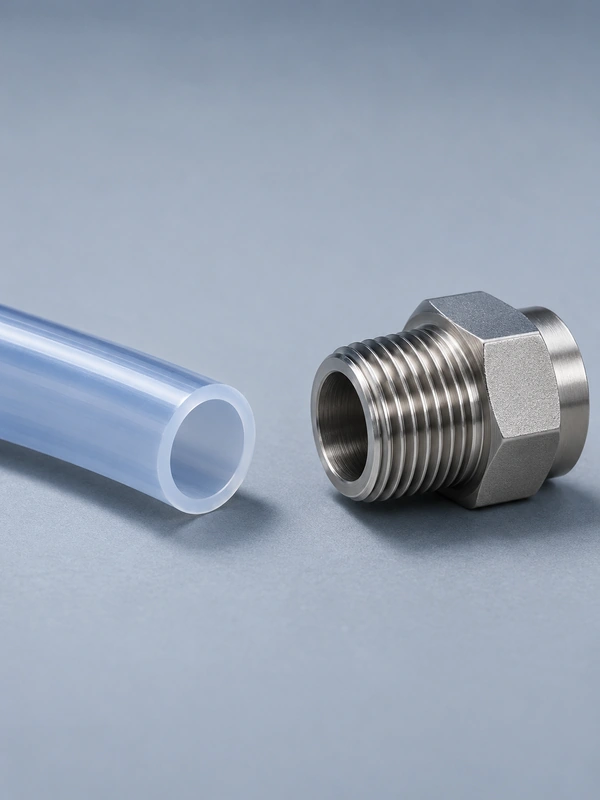
For example, “1/4-inch tube OD” describes a nominal outside diameter of 6.35 mm. “1/4 NPT” describes a nominal pipe-thread size, not a thread outside diameter of 6.35 mm. A complete description can legitimately contain both, but each refers to a different end of the component.
| Term on the order | Šta opisuje | Šta ne utvrđuje |
|---|---|---|
| Tube OD | Outside dimension matched to the socket | Inside diameter or thread size |
| Tube ID | Internal opening | Correct push-in socket size |
| Nominal pipe thread | Thread designation for the port interface | Measured tube diameter |
| Materijal tijela | Material of the specified fitting body | Approved tube material or seal chemistry |
| Operating rating | Conditions defined for the selected product | Approval for all fluids and temperatures |
When a supplier description says push-to-connect pipe fittings, ask whether it means a tube-to-threaded-port adapter or another connection system. The phrase pneumatic push-fit pipe fittings can carry the same ambiguity. Commercial wording is not always precise. A drawing that identifies both ends avoids a purchase dispute about what “pipe size” was intended to mean.
Confirm tube material and dimensional tolerance together
Material approval is specific to the fitting design. The cited SMC KQ2 catalogue lists nylon, soft nylon and polyurethane for the relevant series. That is useful evidence for those products, not a universal list for every push-in connection. Tube hardness and surface behavior can affect how the gripping and sealing elements work.
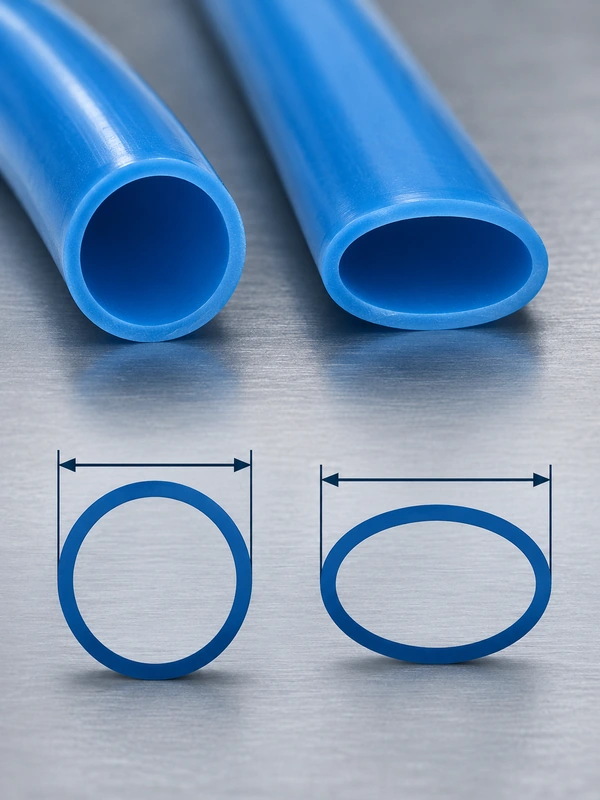
Nominal diameter is also only part of the dimensional requirement. Tube tolerance, roundness and surface condition matter. An oval, flattened or deeply scratched end can behave differently from a sound sample of the same nominal size. Check the supplier’s allowable dimensions rather than assume that a nominal marking guarantees the condition of a damaged end.
Upoređivanje polyurethane and nylon pneumatic tubing helps frame material questions, but the final choice still needs the actual tubing model and operating conditions. Avoid blanket statements that one material is always better. Flexibility, environmental exposure and the required performance must be considered together.
Include the fluid and temperature range in the specification. A tube and fitting may both be acceptable at one condition but unsuitable at another. The complete system must stay within all applicable limits. Do not use a proof-test value as a continuous operating rating or transfer a rating from one manufacturer’s catalogue to another supplier’s part.
Do not assume a metal fitting accepts steel tubing
A metal fitting body does not tell you what its tube socket can grip. Steel tubing has a different surface and mechanical behavior from the plastic tubes listed for many pneumatic push-in products. Some connection systems are designed for metal tubing, but their compatibility must be documented for the particular series and tube specification.
If an application requires steel tubing, provide its exact material, outside diameter, wall thickness and surface condition to the fitting supplier. Request the approved connection method and preparation requirements. Do not force it into a plastic-tube socket or rely on a brief pressure check as proof of long-term suitability.
The same caution applies to a product described as heavy duty. Ask what duty is meant: repeated movement, temperature, corrosion exposure, impact, pressure cycling or another condition. A thick-looking body or a stainless material description does not answer those questions. Define the actual requirement and obtain matching evidence.
Prepare and inspect the tube before assembly
Use a suitable cutter to produce a square end without crushing the tube. Keep dirt and cutting debris away from the insertion region. Inspect for scratches, flattened areas and previous gripping damage. Follow the manufacturer’s instructions on any permissible trimming or further preparation; do not add heat, lubricant or a chamfer without approval.
Check the free tube length and route before insertion. The line should approach the socket without a forced sideways bend and should not be pulled tight when a panel closes. A correctly matched connection can still leak if the installation continuously loads it in a way it was not designed to accommodate.
For a threaded adapter, install the port connection with the specified sealing and tightening method. The guide to pneumatic fitting sizes, threads and pressure explains the independent checks at that interface. Tube preparation and thread sealing are separate tasks; correcting one does not compensate for an error in the other.
Verify seating using the selected model’s instructions
Push the prepared tube straight to the required seated position. Use the specified insertion depth or marking method where provided. Do not borrow a depth from a different socket size or another brand. The gripping mechanism may engage before the tube reaches the correct final position, so initial resistance to withdrawal is not the only check.
Perform the manufacturer’s retention check and the equipment’s controlled leak test. Make sure the release collar has working clearance and is not pressed by nearby objects. Record the tube and fitting part numbers used in the assembly so later replacements can reproduce a confirmed combination.
| Provjerite prije objavljivanja | Acceptable evidence | Razlog za zaustavljanje |
|---|---|---|
| Tube identity | Marking and supplier data agree with the order | Unknown material or mixed inch/metric stock |
| Krajnji uvjet | Square, clean, undamaged preparation | Ovality, deep scratches or contamination |
| Seating | Model-specific insertion procedure completed | Unexplained resistance or uncertain depth |
| Port joint | Thread and sealing method confirmed | Cross-threading or unidentified thread |
| Operating check | Approved commissioning and leak-check record | Leakage, tube movement or abnormal loading |
If removal is necessary, isolate the equipment and relieve and verify trapped pressure before operating the release mechanism. Closing a valve does not by itself prove that every downstream section is depressurized. Use the machine’s procedure and inspect the removed tube before considering reuse.
Make compatibility visible in the purchase order
A useful purchase line identifies the fitting function, tube OD and material, threaded interface where present, operating fluid and conditions, and any mounting constraints. Attach the relevant drawing or part number. Where a quotation offers an alternative, request an explicit comparison against those requirements rather than accept “equivalent” without details.
For a bulkhead connection, add panel thickness, mounting-hole requirements and access on both sides. A bulkhead fitting provides a mounting arrangement but is not automatically an environmental seal or strain relief. Confirm any such functions separately. The exact product drawing determines whether the proposed mounting is practical.
As a hypothetical purchasing example, an order for “6 mm stainless fitting” leaves the thread, tube material, mounting and fluid unspecified. Expanding it into a connection schedule gives the supplier a clear basis for selection. It also makes incoming inspection possible because the receiving team knows what to compare with the delivered part.
After installation, retain the verified combination in the maintenance bill of materials. The Department of Energy’s guidance treats compressed-air leak reduction as continuing maintenance. A precise replacement specification supports that process by preventing repeated substitutions that introduce new fit or sealing problems.
Često postavljana pitanja
How are push-to-connect tube fitting sizes specified?
The tube socket is generally specified by tube outside diameter, with the unit stated clearly. A threaded end is specified separately by thread standard, nominal size and gender. Confirm the manufacturer’s drawing because a commercial description may omit one of these details.
What is the difference between the tube end and the threaded end of a fitting?
The tube end grips and seals an approved tube. The threaded end connects the fitting to a compatible equipment port using the specified sealing arrangement. Their size designations describe different interfaces, even when both happen to contain the same nominal number.
Can a push-to-connect fitting be used with steel tubing?
Only when that fitting series explicitly approves the steel tube specification and installation method. A metal body is not evidence of approval. Many pneumatic push-in catalogues list selected plastic tubing, so confirm the exact application rather than extrapolate from appearance.
What tube preparation is needed before inserting it into a push-in fitting?
Identify the tube, cut it square with an appropriate tool and inspect the insertion region for damage or contamination. Follow any additional model-specific preparation instructions. Avoid crushing, improvised heating or unapproved lubricants, and leave sufficient length for a relaxed route.
How can I check whether tubing is fully seated?
Use the selected fitting’s insertion instructions and any specified depth mark. Complete its retention check and the equipment’s approved commissioning checks. A tube that catches on the gripping elements is not automatically fully seated in the sealing region.
What should I verify when choosing a heavy-duty push-to-connect tube fitting?
Define the actual duty and verify pressure, temperature, fluid, movement, environmental exposure, tube compatibility and mounting. Ask for applicable product data. “Heavy duty” is a commercial description unless the supplier ties it to clear, relevant operating conditions.
How do I select a fitting for a specific tube material and application?
Start with the tube model and dimensions, then match the fitting’s approved tube range and operating limits. Add the port thread, route and mounting needs. Resolve missing compatibility information with the supplier before purchasing or assembling the connection.
Reference
- SMC: KQ2 One-Touch Fittings Catalogue — tube approvals, interfaces and example thread options.
- SMC: TU Polyurethane Tubing Catalogue — dimensional and operating specifications for named tubing models.
- US Department of Energy: Minimize Compressed Air Leaks — connection maintenance and leak follow-up.
Sažetak
Pouzdan push-in tube fittings require a confirmed tube-and-socket match and, where present, a separately verified threaded port. Record the tube material, OD, condition and operating limits before assembly. For a panel-mounted threaded connection, review the PMF female-thread bulkhead connector with the exact tube, thread and panel requirements so the supplier can confirm the appropriate version.