
チャンバー内でマイクロダクトを保持する接続部品であっても、そのまま土中に埋設できるとは限りません。施工業者や購入者にとって難しい判断は、発注した継手およびその周囲のダクトが、計画された埋設ルートに適しているかどうかです。よく知られた公称サイズや防塵・防水性能の表示、あるいは空管時の圧力試験の合格だけでは、この問題のすべてを解決できません。一旦溝を埋戻してしまうと、不適切な継手を修正するには再びアクセスを確保しなければなりません。したがって、検討の出発点となるのは、防水などといった一般的な記述ではなく、接続部品の正確な型式、ダクトの構造、そして施工後の配置状況です。本ガイドでは、埋設用選定、ボア転換、露出状態での確認事項、ならびに継手がアクセス不能になる前に実施すべき開放確認について解説します。.
短い答えは、選択することです 直接埋設用マイクロダクトコネクタ その正確な規格が、想定されるダクトおよび埋設条件に対して適切であることが文書で証明されている場合にのみ使用してください。ダクトの外径、内径および壁構造を別途確認したうえで、準備手順および受け入れ基準を策定してください。EN 50411-2-8:2009は、設置済みのブローファイバー用マイクロダクト接続部材に関する初期要件を規定していますが、直射日光にさらされることを想定した接続部材は対象外です。同規格を引用しても、特定の継手の適合性を認証するものではありません。チャンバーカプラやカバーシェル、またはIP等級に関する記載だけでは、直接埋設に適しているという十分な証拠にはなりません。購入を承認する前に、該当する図面、取扱説明書および試験結果を入手してください。.
コンジットやダクトが直接埋設に適しているのは、どのような条件を満たしているからですか?
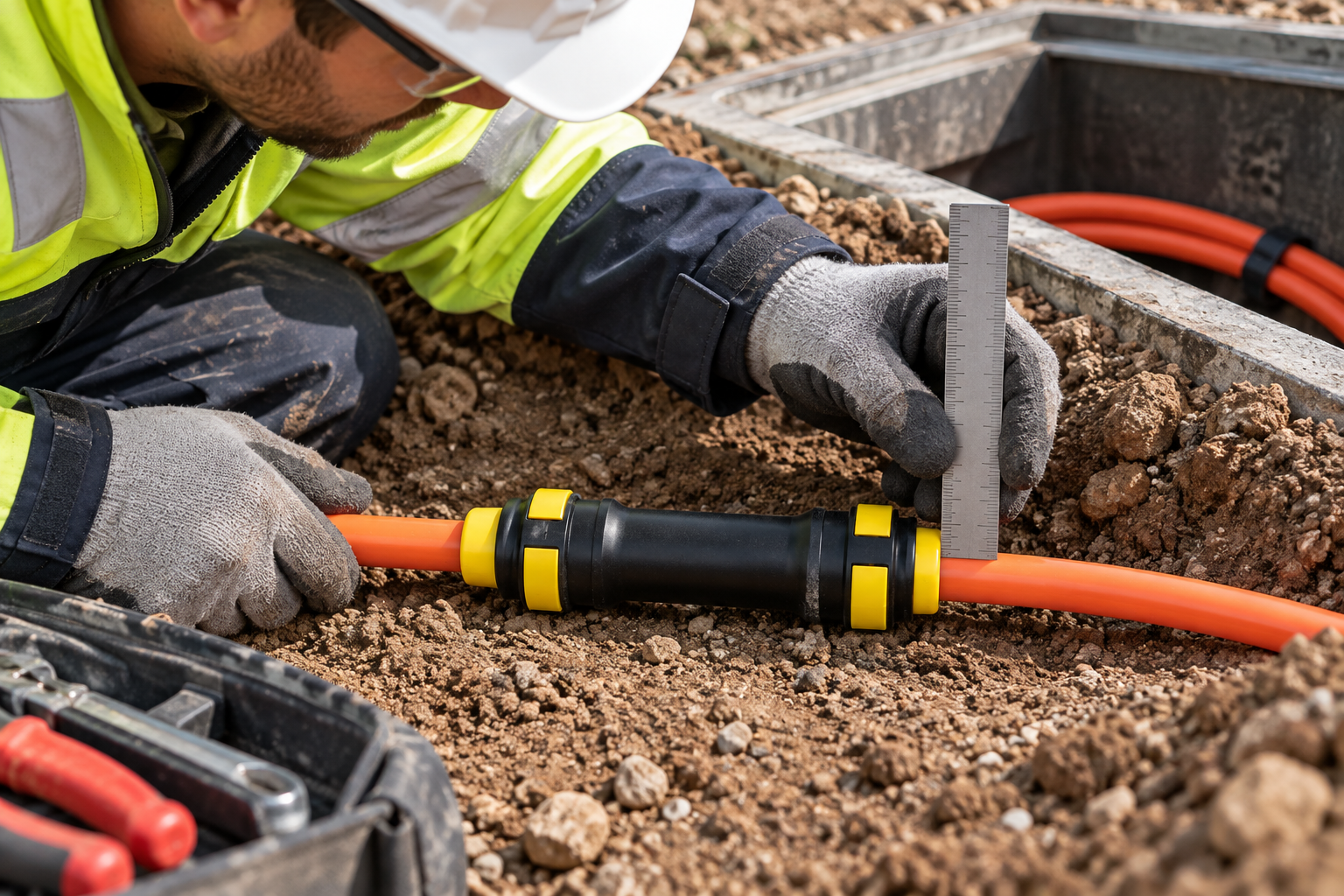
直接埋設はシステム全体の設計上の判断であり、コネクタだけでは不適切なダクト構造を補うことはできません。属性を持つメーカーの一例として、, サンボル社のコネクタ適用ガイド 特定のDB使用ファミリー、CV4580-V4580およびCV4750-V4750を特定しています。また、コネクタが正常に動作していても故障する可能性があるため、薄型マイクロダクトの埋設についても警告しています。これらはサンボル社独自の見解であり、オウル社製部品の承認を意味するものではありません。.
提案されている組み立てについて、直接埋設に適した正確な部品コード、評価されたダクト構造、および保護部品の必要性を確認してください。証拠には、試験された形状および組み立て状態を明示する必要があります。同一ファミリーのラベルだけでは、すべてのサイズ、リビジョン、管壁厚、または設置方法が同等の適合性を持つことを保証するものではありません。.
ロッククリップは、意図しない開放を防ぐためのものであり、誤ったダクト径、損傷したチューブ、または不良なシールを補正するものではありません。外部カバーには別の役割があり、圧力やガスのシールとして扱うべきではありません。関連する カバーシェル トラブルシューティングガイド 保護と密閉を区別するのに役立ちます。.
ダクトの寸法やレデューサーの変換は、選定にどのように影響しますか?
各コネクタ端部を測定したダクトの外径に合わせた後、内径と壁構造を確認してください。外径が一致しても、内径が必ずしも一致するわけではありません。公称表記から適合を推測するのではなく、寸法入り図面をご請求ください。 プッシュフィットコネクタのサイズと用途の比較 関連する選択コンテキストを提供します。.
〜のために 直接埋設用マイクロダクトカプラー, 、レデューサーは、小型ダクトの周りに即席で作られたシールではなく、認可された移行部品でなければなりません。公式な EN 50411-2-8:2009 カタログの範囲 レデューサーまたはエンジャラーの変径部では、サイズの段差による圧力勾配のため、手動供給が必要になる場合があります。したがって、両方のチューブに対応するコネクターであっても、変径部を通じて連続してブローできるとは限りません。.
| 提案された接続 | 何を検証すべきか | 前提とできないこと |
|---|---|---|
| 同サイズの埋設継手 | 正確なDBコード、ダクト外径および構造、穴の位置合わせ | その公称サイズのすべてのカップリングは埋設用に認定されています。 |
| レデューサージョイント | 両端の寸法、内部遷移、計画された供給方法 | 異なる穴径でも、連続した同一サイズのダクトのように吹きます。 |
| Covered chamber coupler | Approved location and purpose of the cover | The cover upgrades the coupler to direct-burial service |
| Occupied duct seal | Compatible cable seal and separate operating state | A straight coupler seals the annulus around a cable |
Which pressure and exposure claims need separate evidence?
Keep working, proof, burst, cable-sealing and route-acceptance pressures separate. A test value without its medium, procedure, assembly state and acceptance criterion is not a usable installation limit. This article assigns no generic pressure, material, OD range or IP rating to the direct-bury family; obtain those details for the supplied code.
EN 50411-2-8 concerns initial dimensional, optical, mechanical and environmental requirements, with protected installations described in its scope. Because direct sunlight is excluded, a standards reference cannot also prove UV suitability. For exposed storage, installation or service, request separate evidence matching those conditions. ISO 4892-1:2024 provides general guidance on laboratory light-exposure methods and interpreting accelerated-weathering data. It does not certify a product or supply a fixed hours-to-field-years conversion.
The official IEC TR 63431:2025 synopsis describes guidance on microduct design types, colour codes, repairs, environmental expectations and installation. It supplements the microduct sections of IEC 60794-5. Use that Technical Report as system-planning context, not a universal component rating or replacement for connector-specific evidence.
What should installers check before releasing a joint for backfill?
Prepare the tube according to the exact maker’s instructions. As an external example, FCST’s installation instructions, published 22 August 2025, call for clean, round, undamaged duct, a square cut and burr removal. They warn that a tube can be gripped without being fully seated, causing leakage. Their transparent-body checks and clip instructions are product-specific examples, not universal dimensions or Oulu test results.
Use the specified insertion reference, clip and preparation method. Depressurize before release or investigation. Do not improvise with tape, sealant or lubricant unless the maker approves the material and procedure. If an interface fails inspection, correct it before the agreed retest rather than relying on burial to restrain it.
| Record item | Product evidence | Before-backfill release evidence |
|---|---|---|
| Identity and fit | Code, drawing, approved duct geometry | Installed code or lot, measured geometry, route location |
| Assembly | Preparation, insertion and accessory instructions | Seating, condition and specified accessory checks |
| Testing | Declared ratings and relevant test conditions | Medium, procedure, instrument, result and corrections |
| Release | Permitted application and limitations | Acceptance decision, date and responsible approver |
This direct-burial connector acceptance record is practical traceability advice, not a claimed universal statutory form. A datasheet describes the product; a release record shows what was installed and accepted. Identify local interface checks separately from route tests, and do not treat an empty-duct result as proof of an occupied cable-annulus seal. Where that distinction matters, compare end stops and gas-block connectors.
What else should installers ask before approving a buried joint?
Why does a direct buried microduct connector leak during or after fibre blowing?
Investigate duct dimensions, cut quality, contamination, insertion and damage before blaming the fitting. Depressurize and isolate interfaces; water found at a connector does not by itself identify where it entered the pathway.
Are tools or lubricant needed to fit the connector correctly?
Push-fit retention does not eliminate cutting, measurement or test equipment. Follow the supplied instructions, and use lubricant only if the maker approves it for that exact assembly.
Can the connector join ducts with different wall thicknesses?
Possibly, if the exact connector accepts both ODs and the duct constructions are approved. Check the resulting ID transition separately, including whether the cable and feeding method can accommodate it.
What temperature range should the connector withstand?
Confirm installation and service conditions against the exact product’s documented limits. Do not transfer another size’s temperature range or assume that buried service removes every exposure concern.
How can installers visually check full insertion?
Use the maker’s insertion mark or reference. A transparent body may help on applicable designs, but visible grip alone is not proof of seating or successful acceptance testing.
When should the seals or connector body be replaced?
Follow the maker’s inspection and replacement criteria for damage, contamination, loss of grip or failed sealing. Reuse requires exact-model approval, inspection and retesting; there is no universal permitted reuse count.
Can an ordinary chamber connector be buried inside a cover?
Not without documented approval of that assembly for direct burial. External protection and connector qualification are different questions, so confirm both rather than inferring approval from appearance.
Does a passed pressure test remove the need for a release record?
No. Without the code, geometry, assembly state, procedure and result, the test cannot be reliably tied to the buried joint. Record corrections and acceptance before access is lost.
Which sources support the selection checks?
- NEN: EN 50411-2-8:2009 official scope, sunlight exclusion and reducer limitation.
- Sanbor: connector applications and the thin-microduct burial warning.
- ISO: ISO 4892-1:2024 laboratory light-exposure guidance.
- IEC: IEC TR 63431:2025 microduct technology guidance synopsis.
- FCST:マイクロダクトコネクタの取り付け説明書、22 8月 2025.
How should buyers make the final burial decision?
Approve the assembly, not the phrase direct bury. Start with the duct construction and route conditions, identify the exact connector code, and reconcile its drawing and instructions with the proposed OD, ID and transition. Then separate product ratings from field acceptance and establish what evidence must be recorded before backfill. Neither a gripping tube nor a generic IP claim is a reason to skip that sequence. If sunlight or a reducer is involved, resolve its specific limitation before scheduling blowing or closing the trench. Oulu’s direct-bury connector product page is a starting point for a code-specific enquiry: provide the duct geometry, construction and installation conditions, and request the applicable documents before releasing the order.



