
Когда в Оулу руководитель службы технического обслуживания заменил протекающие соединители на упаковочной линии, утечки прекратились, но цилиндры по‑прежнему теряли скорость. На данном участке использовались трубки разных диаметров, несертифицированный переходник и имелось сужение в портах. Проблема заключалась не только в некачественном фитинге — дело было в правильном выборе и подборе размеров элементов пневмоконтурной системы.
Быстрый ответ: Пневматические фитинги соединяйте трубки, шланги, клапаны и приводы, но их эффективность зависит от совместимых размеров, формы резьбы, материала, уплотнения и опубликованных данных о расходе. ISO 6358-1 предоставляет метод для выражения характеристик потока пневматических компонентов; используйте его вместе с требуемыми условиями давления, температуры и качества воздуха, чтобы сравнивать аналогичные детали. Укажите каждое соединение, затем проверьте собранную ветвь на герметичность и перепад давления.
Связанное чтение: Руководство по поиску и выбору фитингов для воздушных шлангов.
Где используется каждый пневматический фитинг
Пневматические фитинги образуют функциональные соединения в системах сжатого воздуха. Прямые муфты соединяют трубопроводы, расположенные на одной оси; отводы изменяют направление потока; тройники разделяют подачу; переходники соединяют трубы различного диаметра; а резьбовые адаптеры присоединяют трубопроводы к клапанам, регуляторам, распределительным коллекторам и цилиндрам. Фитинг является одновременно механическим соединением и возможным местом ограничения потока.
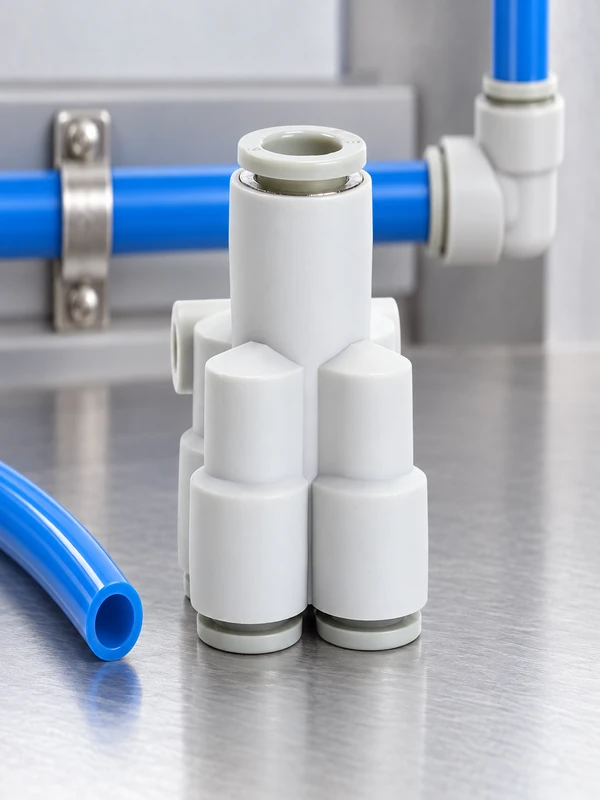
Функции зависят от конкретного приложения. Нажимное соединение Конструкции могут ускорить сборку труб; резьбовые соединения определяют интерфейс оборудования; поворотные элементы могут облегчить прокладку. Проверьте внутренний диаметр, систему фиксации, совместимость уплотнений и зазоры. ISO 6358-1 определяет характеристики расхода при работе с сжимаемыми жидкостями, поэтому покупатели могут запросить сопоставимые данные вместо того, чтобы полагаться на неквалифицированную маркировку “высокий расход”.
Выберите подходящую форму для трассы трубопровода.
Выберите компоновку корпуса по реальной трассе, а не по изображению из каталога. Прямой фитинг может сохранить простоту прямолинейного участка трубопровода, тогда как колено позволяет защитить трубопровод от сильного изгиба. Для оформленного ответвления используйте тройник. При монтаже на подвижном оборудовании обеспечьте зазор для вставки и поддерживайте трубопровод, чтобы предотвратить деформацию под нагрузкой.
| Тип соединения | Типичное применение | Основная проверка выбора | Распространённый предотвратимый риск |
|---|---|---|---|
| Прямой соединитель или коннектор | Выровненное трубное удлинение или соединение патрубка | Наружный диаметр трубы, эффективный проход и портовый интерфейс | Выбор по размеру резьбы без проверки совместимости с трубой |
| Локоть | Изменение направления вблизи клапана или привода | Зазор при прокладке и допустимый радиус изгиба трубопровода | Создание резкого изгиба или недоступного кольца освобождения |
| Чай или Y-образный разветвитель | Планируемая ветвь питания или сигнала | Данные о потреблении и расходе по ветвям для конкретной серии | Недостаточное проектирование общей входной ветви |
| Редуктор | Переход между указанными размерами труб | Как внешние диаметры труб, так и требуемый расход | Использование редуктора как непроверенного узкого места |
| Резьбовой переходник | Переход от трубы к патрубку | Обозначение резьбы и метод уплотнения | Соединение резьб, внешне похожих, но несовместимых |
Сопоставьте материалы фитинга, трубки и уплотнения.
К наиболее распространённым материалам относятся технические полимеры, латунь с никелевым покрытием и нержавеющая сталь. Полимерные корпуса могут подходить для компактных конструкций; латунь обеспечивает металлическую резьбовую соединительную поверхность; нержавеющая сталь подходит для условий, характеризующихся документированной коррозионной активностью. Выбор следует осуществлять исходя из конкретных требований к рабочей среде, условиям эксплуатации, используемым моющим средствам, температурному режиму и характеристикам оборудования.

Материал трубки также имеет большое значение. Полиуретановые и полиамидные трубки различаются по гибкости и эксплуатационным характеристикам, поэтому технические характеристики трубки должны соответствовать заявленному диапазону трубок производителем фитингов. Команды по закупкам, сравнивающие пневматические шланги из ПУ и ПА, перед утверждением пресс-фитинга должны проверить допуск на внешний диаметр, твердость, рабочие условия и минимальный радиус изгиба.
| Рабочее состояние | Информация для документации | Почему это важно | Шаг проверки |
|---|---|---|---|
| Общая сухость воздуха на заводе | Наружный диаметр трубы, диапазон давления, температура, резьба и тип уплотнения | Устанавливает базовую совместимую сборку | Проверьте чертежи и инструкции по монтажу от поставщика. |
| Частые перемещения оборудования | Гибкость трубы, радиус изгиба, точки опоры и ориентация фитингов | Ограничивает боковую нагрузку и усталостное напряжение в соединении | Соблюдайте типичный рабочий цикл. |
| Wet, oily, or chemical exposure | Fluid and cleaner identity, contact duration, body and seal materials | Material compatibility cannot be inferred from a generic name | Obtain documented compatibility guidance |
| High-consequence production point | Flow characteristics, air-quality requirement, access, and inspection plan | Supports repeatable response and faster fault isolation | Run an acceptance leak and pressure check |
Check thread type and flow before installation
Thread labels that appear close are not automatically interchangeable. BSPP, BSPT, NPT, metric, and other forms can differ in profile, taper, pitch, and sealing arrangement. Confirm the port drawing and the component manufacturer’s instructions, including whether the seal is made on the thread, an O-ring or bonded seal, or a sealing face. Thread tape or sealant should be used only where the assembly instructions call for it; excess material can enter the pneumatic circuit.
Pressure loss is a system question. Collect cylinder bore and stroke, cycle rate, supply pressure, tube ID and length, valve port size, and every branch component. Compare proposed parts using a defined method such as ISO 6358-1. A lower unit price can be outweighed by commissioning time, leak checks, stops, or replacing an inaccessible fitting; these are evaluation factors, not a promise of savings.
Check the rating and inspect the finished joint
- Map the route from air preparation to end device, recording each tube size, port, adapter, and branch.
- State the pressure and temperature range, tube material, air-quality requirement, thread form, and sealing method on the purchase request.
- Request drawings, material information, and flow data for the exact configuration; inspect a first assembled unit before a larger order.
- Cut tubing squarely and burr-free, insert it to the specified depth, avoid side loading, and leak-test the completed branch.
ISO 4414 provides general pneumatic-system safety rules; it is not a blanket fitting certification. In the United States, OSHA’s 29 CFR 1910.242(b) 30 psi limit addresses сжатый воздух used for cleaning, not normal automation-circuit design pressure. Assess requirements against the destination market, intended use, and product claims.
OULU can help buyers structure a fitting inquiry around the actual interfaces and application conditions. Start with the relevant pneumatic parts category, and provide the tube, port, media, and duty-cycle details needed to evaluate a configuration responsibly.
Start with the failure you need to avoid
“Pneumatic fitting” is a broad category, so the useful selection question is what could fail in this circuit. A push-in fitting may shorten assembly time but still needs a clean, correctly sized tube and bend support. A threaded adapter may suit a fixed port but can leak when the thread form or seal method is wrong. A barbed connection depends on hose ID and retention, while a bulkhead fitting adds panel thickness and access constraints.
Связанное чтение: Руководство по применению высоконапорного воздушного шланга.
| Likely failure | Проверка выбора | Installation control |
|---|---|---|
| Tube pulls out | Tube OD, hardness and collet range | Square cut, full insertion and pull-back check |
| Thread leaks | BSP, NPT or metric form and seal method | Use the specified seal and avoid cross-threading |
| Hose slips from a barb | Hose ID, barb geometry and clamp method | Inspect retention after movement and pressure cycling |
| Line becomes hard to service | Access, release clearance and spare standard | Keep an approved part number at the machine |
For the most common push-in questions, see one-touch fitting operation; for a family comparison, use the air hose fitting guide.
How do fitting design, flow and maintenance interact?
A fitting choice should be tied to the failure the line must avoid. Push-in parts reduce assembly time but depend on tube OD, cut quality, seal and release access. Threaded adapters need the correct thread form and sealing face. Elbows can protect a tight bend or improve access, while a straight body can shorten an aligned path; neither shape guarantees a flow result. Record the complete pressure boundary before standardizing a spare.
Flow data also need a common basis. ISO 6358-1 is a reference for compressible-fluid flow characteristics, but a value from one test condition cannot be ranked directly against a value from another. Measure point-of-use pressure under the representative cycle and inspect recurring leaks at the tube, port, coupler and nearby accessories. This creates a practical bridge between catalogue comparison and maintenance evidence.
| Choice | Главное преимущество | Control point |
|---|---|---|
| Включение с помощью давления | Fast tube installation | OD, cut, insertion, collet and seal |
| С шнековым механизмом | Port or manifold transition | Thread standard, face and seal method |
| Локоть | Route or bend management | Flow, support and access envelope |
| Barb or compression | Flexible or fixed hose connection | Hose ID, wall, clamp and service movement |
Часто задаваемые вопросы
What are pneumatic fittings used for?
Pneumatic fittings connect tubing or hose to valves, regulators, manifolds, and cylinders. They also create branches, direction changes, and tube-size transitions. Select them as part of the complete circuit because the smallest passage or incompatible interface can affect the result.
What types of pneumatic fittings are available?
Common types include straight unions, elbows, tees, Y connectors, reducers, bulkhead fittings, threaded adapters, and push-to-connect fittings. Choose by route, equipment port, access, and required flow. Confirm series data rather than assuming identical shapes are equivalent.
How do I choose pneumatic fitting material?
Start with the media, pressure and temperature range, ambient exposure, cleaners, and required documentation. Then verify body, seal, and tube compatibility with supplier data. If corrosion or chemical resistance matters, obtain a documented assessment for the actual exposure.
Надёжны ли фитинги с прямым подключением?
They can provide a dependable connection when the tube is within the stated range, cut correctly, fully inserted, and protected from side load. Reliability also depends on air quality, vibration, temperature, and the tube-and-seal combination. Inspect the first assembly and test the completed branch under representative conditions.
What thread types are used for pneumatic fittings?
Pneumatic equipment can use BSPP, BSPT, NPT, metric, and other thread systems. Their sealing approaches and geometry differ, so similar nominal sizes are not interchangeable. Use the port drawing and fitting instructions to confirm the designation and intended sealing method.
How do I prevent air leaks in pneumatic fittings?
Use compatible tube and fitting sizes, cut the tube squarely, remove damage or burrs, insert to the specified depth, and avoid excess thread sealant. Support tubing against vibration and side load, then leak-test after installation. Investigate actuator pressure changes before replacing parts blindly.
Связанное чтение: Информация о компании Oulu Connector.
Ссылки
- ISO 4414:2010 – pneumatic system safety.
- ISO 6358-1 – flow-rate characteristics.
- ISO 8573-1 – compressed-air contaminants.
- UK HSE INDG261 – pressure-system precautions.
Краткое содержание
Pneumatic fitting selection becomes clearer when the interface and failure mode are stated together. Match tube or hose dimensions, thread, seal, medium, temperature and pressure before comparing materials or shapes. Use ISO 4414 for system-safety context and ISO 6358-1 for a flow-characteristics reference, but keep the exact model and test conditions attached to every number. Confirm pressure at the point of use under load, inspect recurring leakage and document an approved replacement assembly. Keep a labelled mating part and revision record with the spare so maintenance does not substitute a similar-looking interface. Oulu’s pneumatic parts range can support that review when the route, duty cycle and maintenance access are known.



