
Серебристый фитинг и фитинг из жёлтой латуни могут выглядеть взаимозаменяемыми на столе технического обслуживания. Оба могут подходить к одной и той же трубке и вкручиваться в один и тот же патрубок, однако их поверхностная обработка, уплотнения и допустимые условия эксплуатации могут различаться. Выбор только по цвету оставляет без ответа самые важные вопросы.
Латунные фитинги с никелевым покрытием Следует учитывать, когда применённое покрытие соответствует требованиям к экспозиции поверхности в данной области применения. Непокрытая латунь может оставаться подходящим выбором, если сам сплав и конструкция изделия в целом удовлетворяют условиям эксплуатации. Ни одно из этих покрытий автоматически не обеспечивает более высокий допустимый рабочий давление, универсальную химическую стойкость или одобрение для использования с питьевой водой. Перед принятием решения сравните технические характеристики продукта, свойства рабочей среды и условия монтажа.
Что изменяет никелирование на латунном фитинге?
Никелирование наносит на латунный компонент поверхностный слой. Основной материал при этом остаётся латунью. Это покрытие может влиять на внешний вид и поведение поверхности, но оно не превращает деталь в нержавеющую сталь и не обеспечивает соответствия требованиям для всех остальных внутренних элементов арматуры.
Техническая брошюра Parker’s LF 3600 указывает на компоненты из латуни с химическим никелированием с высоким содержанием фосфора и отдельно выделяет уплотнительное кольцо из ФКМ. Устойчивость к истиранию и коррозии приписывается именно этой системе покрытия. Это является свидетельством для указанного семейства продукции, а не обещанием того, что каждое серебристое соединение имеет такое же покрытие или такие же эксплуатационные характеристики.
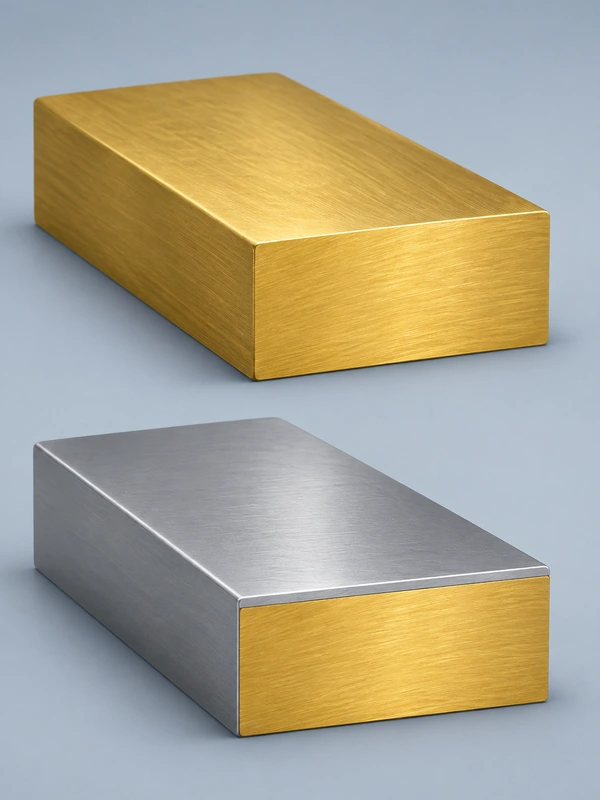
Уточните, указывает ли коммерческое предложение на гальваническое никелирование или химическое никелирование, и запросите соответствующую спецификацию покрытия. Описания «никелированный» недостаточно для определения технологического процесса, толщины, равномерности нанесения или критериев приемки. В случае химических никель‑фосфорных покрытий содержание фосфора может быть одним из параметров, задаваемых в технических требованиях; не следует полагать, что все никелевые покрытия идентичны.
Материальное изображение является концептуальным сравнением, при этом поверхностный слой утрирован для большей наглядности. Оно не отражает конструкцию или толщину покрытия конкретного фитинга. Изображения продукции в других частях данной статьи иллюстрируют процедуры осмотра и идентификации; внешний вид сам по себе не позволяет определить тип их покрытия.
Когда непокрытая латунь является разумным выбором?
Латунные фитинги без покрытия Может быть целесообразно применять в защищённых условиях эксплуатации, если сплав, рабочая среда, уплотнения и предельные параметры эксплуатации документально подтверждены как соответствующие требованиям. Модернизация поверхности должна решать реальную задачу защиты от воздействия или удовлетворять требованиям технического обслуживания. Её не следует включать в спецификацию исключительно потому, что более глянцевый компонент выглядит более солидным.
Для защищённого шкафа сжатого воздуха сначала определите необходимые параметры трубопровода: диаметр, резьбу, давление, температуру и условия внешнего воздействия. Руководство по… Выбор размера и резьбы латунного пневматического фитинга Охватывает эти механические проверки. После выполнения указанных условий сравните, обеспечивает ли поверхностная обработка документально подтверждённую выгоду для данного места эксплуатации.
| Вопрос на выбор | Латунь с никелевым покрытием | Непокрытая латунь |
|---|---|---|
| Какой материал находится снизу? | Латунь; уточните сплав и систему покрытия | Латунь; подтвердите сплав |
| С чем контактирует окружающая среда? | Покрытие, где указана степень покрытия, плюс любые открытые компоненты | Открытая латунь и другие материалы сборки |
| Является ли внешний вид доказательством совместимости? | Нет; серебристая отделка не определяет полную техническую спецификацию материала. | Нет; жёлтый цвет не позволяет определить сплав или сертификации. |
| Определяет ли тип покрытия класс давления? | Используйте установленный производителем предел для данной детали. | Используйте установленный производителем предел для данной детали. |
| What extra evidence is useful? | Coating process, coverage and relevant exposure testing | Alloy identification and relevant exposure suitability |
This comparison deliberately avoids a universal winner. If the application lacks the information needed to approve the brass substrate, adding an unspecified coating does not close that gap. Ask the supplier to assess the complete operating conditions.
Will nickel-plated brass resist the fluid and cleaning chemicals?
Separate internal fluid exposure from external cleaning exposure. A fitting carrying compressed air may still be sprayed with detergent, contacted by coolant or exposed to condensation. Record the chemical identity, concentration, temperature and contact time. A general corrosion-resistant description does not answer that compatibility question.
Check all relevant materials: coating, brass substrate, O-ring, plastic release components, lubricant and tubing. SMC’s KQ2 catalogue lists several materials within one fitting family and distinguishes its permitted fluids and operating conditions. The practical lesson is that body material alone does not describe the complete assembly.
Consider a hypothetical maintenance change: a workshop switches cleaning products while keeping the same air fittings. A finish that previously performed acceptably does not establish compatibility with the new cleaner. Before blaming the supplier for later deterioration, compare the revised exposure with the approved specification and inspect the other affected materials.
For frequent washdown or an aggressive process environment, evaluate an explicitly approved alternative rather than assuming a thicker-looking nickel layer will solve every problem. Obtain a written compatibility statement for the selected product. Avoid transferring another brand’s resistance claims to a visually similar part.
What coating damage should be checked before installation?
Inspect accessible surfaces for flaking, blistering, pitting and obvious mechanical damage. Compare incoming parts with the supplier’s finish acceptance criteria and retain the batch identification. A visual check can identify a reason for further investigation, but cannot measure coating thickness or prove internal coverage.
Distinguish a superficial handling mark from damage that may affect a functional surface. A mark near a sealing interface or a thread deserves attention even when the fitting still appears usable. Isolate suspect stock and ask the supplier whether replacement or further inspection is required; do not polish away evidence before the cause is understood.
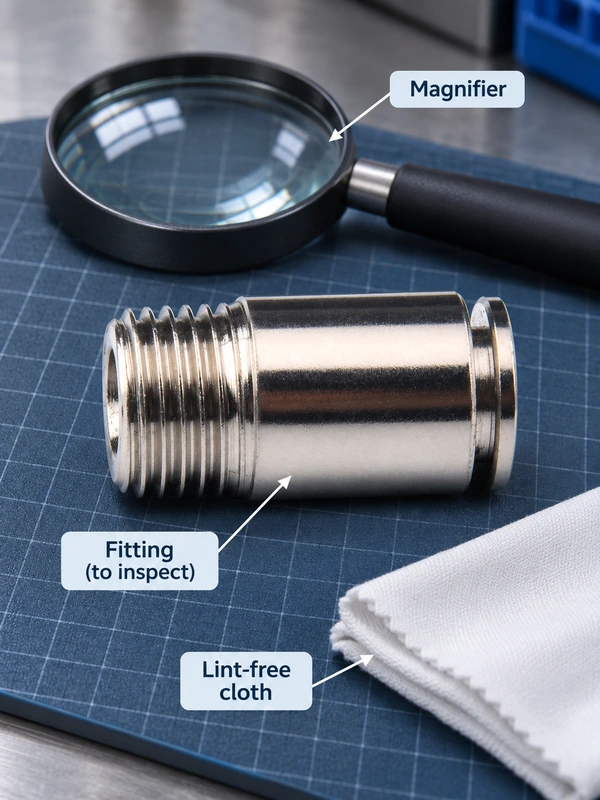
Follow the specified wrenching and installation method. Do not grip a finished body with an inappropriate tool, scrape its surface to improve fit, or attempt field replating of an assembled fitting. Coating repair can affect dimensions, cleanliness and seals, and needs a documented process rather than an improvised cosmetic correction.
If the joint leaks, investigate tube condition, thread compatibility, insertion and sealing arrangements as well as surface damage. The brass fitting leak-check guide helps separate these causes. A leak should not automatically be diagnosed as a plating fault.
Does nickel plating change thread sealing or pressure limits?
The connector design determines how a joint seals. A threaded port may use a specified thread sealant, washer, O-ring or another arrangement; a push-in tube entry uses its own sealing interface. Nickel plating is not a substitute for any of these features.
Confirm the actual thread designation and the manufacturer’s tightening instructions. Similar diameters do not make BSPP, BSPT and NPT interchangeable. Compare the coating condition against the supplied finished-part dimensions rather than treating plating as permission to force a tight connection.
Use the lowest applicable limit in the assembled system, including tube, fitting, valves and other connected components. Parker’s LF 3600 brochure distinguishes product generations and their associated seals when discussing performance. That is a useful warning against assigning a pressure or temperature rating from the finish name alone.
After installation, use the equipment manufacturer’s approved leak-check and commissioning procedure. Depressurize before disconnecting or adjusting a fitting. Neither a shiny body nor a successful initial seal establishes indefinite service life.
Does nickel plating make a brass fitting lead-free or food-safe?
No. A surface finish does not establish the brass alloy’s composition or the finished product’s approval for drinking water. The US Environmental Protection Agency describes a maximum weighted average lead content of 0.25% across the wetted surfaces of covered pipes, fittings and fixtures. This is a regulatory definition with a defined scope, not a visual inspection rule.
EPA also explains certification requirements for products regulated under the US Lead Free Rule and the existence of exemptions. Check the actual application, market and product documentation. Do not apply the drinking-water rule indiscriminately to every industrial pneumatic fitting, and do not describe an industrial fitting as potable-water approved without the relevant evidence.
The LF 3600 brochure references ASTM B733-04 for autocatalytic nickel-phosphorus coatings and makes product-specific material compliance statements. That historical reference identifies a coating specification; it is not a blanket drinking-water certificate, nor proof that an unrelated product complies. Request the currently applicable document and exact model coverage for a new purchase.
Food-contact suitability, cleaning compatibility and drinking-water approval are separate questions. A fitting near a food-processing machine may have a different exposure from one carrying a beverage. Describe the actual contact and service conditions when requesting documentation.
When does nickel plating justify the extra cost?
Compare installed cost and maintenance consequences, not just the unit price. A documented finish may be useful where it addresses a relevant exposure and reduces the need for replacement or cleaning intervention. Those benefits need evidence from the selected product and application; they should not be presented as guaranteed savings.
Use fitting material compatibility as the first approval step. Then compare purchase cost, installation labour, access, planned replacement and the consequence of an unexpected stoppage. If exposure is mild and both approved products meet the requirements, an additional finish may not deliver a meaningful operational advantage.
| Условие применения | What to investigate | Evidence needed before choosing |
|---|---|---|
| Protected dry air cabinet | Whether a surface-treatment requirement actually exists | Complete fitting and tubing suitability |
| Regular external cleaning | Compatibility with the actual cleaner | Chemical, concentration, temperature and contact-time assessment |
| Repeated maintenance handling | Surface damage and correct tool access | Installation instructions and finish acceptance criteria |
| Drinking-water service | Applicable product approval and lead requirements | Model-specific certification within its scope |
| Corrosive process exposure | Whether coating, substrate and seals are all suitable | Application-specific material approval or an alternative assembly |
What should a nickel-plated brass fitting quotation include?
Send the supplier the tube size, thread designation, operating pressure and temperature, internal fluid and external exposure. Request the exact brass alloy, coating system and applicable seal materials. Add any cleaning, food-contact or drinking-water requirements explicitly rather than assuming they follow from the material name.
Ask which surfaces are coated and how coating quality is accepted. Where a test report is offered, check the model, sample configuration, method and result. A test on a coupon or another product size may provide useful information, but its relevance to the purchased assembly must be explained.
Keep the approved specification with the order and batch record. If a substitute is proposed later, compare the same requirements again. A replacement should not be approved merely because it has the same colour and fits the available port.
Часто задаваемые вопросы
Are nickel-plated brass fittings better than unplated brass?
They can offer useful surface properties when the specific coating is suitable for the exposure. They are not universally better. Compare the complete fitting, fluid, environment and documentation; an approved unplated fitting may be sufficient for protected service.
Can nickel-plated brass fittings corrode?
They can deteriorate in unsuitable conditions or when the coating is damaged. A corrosion-resistance claim needs its test and application context. Confirm compatibility with both internal fluids and external cleaners rather than assuming the finish is an unrestricted barrier.
Does nickel plating increase a brass fitting’s pressure rating?
Do not infer a higher rating from plating. Use the published pressure-temperature limits of the exact finished fitting and the lowest applicable limit in the assembly. The body design, seals, tubing and connection method remain relevant.
Are nickel-plated brass fittings safe for drinking water?
Only when the actual product has the documentation required for that use and market. Nickel plating alone does not demonstrate lead-free compliance or drinking-water suitability. Check model-specific certification and its scope before installation.
Should a scratched nickel-plated fitting be replaced?
Assess the location and extent of damage against the manufacturer’s criteria. Damage at a sealing surface, loose coating or visible deterioration warrants investigation. Do not conceal it by polishing or continue service on the assumption that any scratch is harmless.
How can I tell nickel-plated brass from stainless steel?
Use the part number, material specification and supplier documentation. Colour and appearance are insufficient, and a simple magnet check is not a universal identification method. Request traceable material confirmation when an unidentified component must be replaced.
Ссылки
- Parker Legris, LF 3600 Nickel-Plated Brass Instant Fittings, technical brochure hosted by RS: identified coating, component materials and product-specific requirements. Historical edition; obtain current model documentation for procurement.
- SMC, KQ2 One-Touch Fittings catalogue: separate assembly materials, fluids and operating conditions.
- US EPA, Use of Lead Free Pipes, Fittings, Fixtures, Solder, and Flux for Drinking Water: lead-content definition, certification requirements and regulatory scope.
Краткое содержание
Choose nickel-plated brass when the documented coating addresses a real service requirement. Choose unplated brass when its complete specification already fits the job. In either case, verify the substrate, seals, interfaces and approvals; finish colour cannot answer those questions.
For sourcing, review ANMASPC’s straight brass fitting and contact the team with your application details. Request written confirmation of the supplied finish, alloy and operating limits before ordering; the current product page does not establish nickel plating.



