
銀色の継手と黄色い真鍮製の継手は、保守作業台の上で互いに代替可能に見えることがあります。どちらも同じチューブに対応し、同じポートにねじ込むことができる場合がありますが、表面処理やシール材、認証された使用条件は異なることがあります。色だけで選択すると、最も重要な点についての疑問が解決されません。.
ニッケルめっき真鍮継手 文書化された被覆が用途の表面暴露要件を満たしている場合には、その選択を検討する価値があります。実際の合金および継手全体が使用条件を満たす場合、無めっき真鍮も適切な選択肢となり得ます。いずれの仕上げも、自動的により高い耐圧性能、万能の耐薬品性、または飲料水適合認証を保証するものではありません。決定に先立って、製品仕様、流体、および設置環境を比較検討してください。.
真鍮製継手にニッケルめっきを施すと、何が変わりますか?
ニッケルめっきは、真鍮製部品の表面に皮膜を付与します。基材は依然として真鍮です。仕上げは外観や表面特性に影響を与えることがありますが、部品をステンレス鋼へ変化させたり、継手内部の他のすべての部品の適合性を保証したりするものではありません。.
Parker社のLF 3600技術パンフレットでは、高リン含有化学ニッケルめっきを施した真鍮部品が特定されており、さらにFKM製Oリングも別途示されています。同パンフレットは、耐摩耗性および耐食性を当該めっきシステムに起因するものとしています。これは、記載された製品ファミリーに関する証拠であり、すべてのシルバーフィッティングが同一のコーティングまたは性能を持つことを保証するものではありません。.
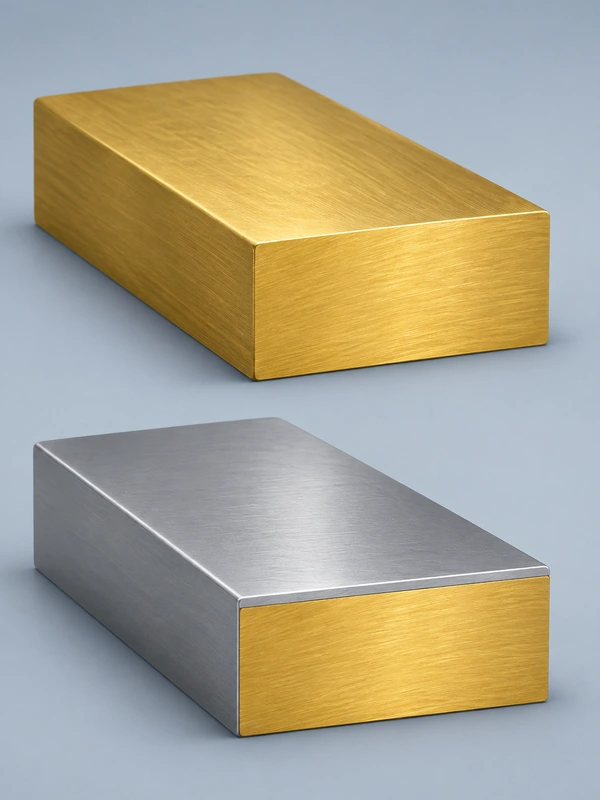
見積もりに電解ニッケルめっきか無電解ニッケルめっきのいずれを指定しているのか確認し、該当するめっき仕様書を請求してください。「ニッケルめっき」という記述だけでは、処理方法、膜厚、覆蓋範囲、および受入基準を明確にできません。無電解ニッケル–リンめっきの場合、リン含有量が指定されたシステムの一部となることがあります。すべてのニッケルめっきが同一であると仮定しないでください。.
この図示は概念的な比較を示したものであり、視認性を高めるため表面層が誇張されています。特定の継手の構造や被覆層の厚さを示すものではありません。本記事の他の箇所に掲載されている製品画像は、検査および識別の参考として示されたものです。外観のみでは、その被覆タイプを確定することはできません。.
無めっき真鍮はどのような場合に適切な選択と言えますか?
Unplated brass fittings may be appropriate in protected service when the alloy, medium, seals and operating limits are documented as suitable. A finish upgrade should address a real exposure or maintenance requirement. It should not be added to a specification solely because a brighter component looks more substantial.
For a protected compressed-air cabinet, first establish the required tube dimensions, thread, pressure, temperature and external exposure. The guide to brass pneumatic fitting size and thread selection covers these mechanical checks. Once those conditions are satisfied, compare whether surface treatment provides a documented benefit for the location.
| 選択問題 | Nickel-plated brass | Unplated brass |
|---|---|---|
| What material is underneath? | Brass; confirm the alloy and coating system | Brass; confirm the alloy |
| What contacts the environment? | The coating where coverage is specified, plus any exposed components | The exposed brass and other assembly materials |
| Does appearance prove compatibility? | No; a silver finish does not identify the complete material specification | No; a yellow appearance does not identify the alloy or approvals |
| Does the finish determine pressure rating? | Use the exact fitting’s published limit | Use the exact fitting’s published limit |
| What extra evidence is useful? | Coating process, coverage and relevant exposure testing | Alloy identification and relevant exposure suitability |
This comparison deliberately avoids a universal winner. If the application lacks the information needed to approve the brass substrate, adding an unspecified coating does not close that gap. Ask the supplier to assess the complete operating conditions.
Will nickel-plated brass resist the fluid and cleaning chemicals?
Separate internal fluid exposure from external cleaning exposure. A fitting carrying compressed air may still be sprayed with detergent, contacted by coolant or exposed to condensation. Record the chemical identity, concentration, temperature and contact time. A general corrosion-resistant description does not answer that compatibility question.
Check all relevant materials: coating, brass substrate, O-ring, plastic release components, lubricant and tubing. SMC’s KQ2 catalogue lists several materials within one fitting family and distinguishes its permitted fluids and operating conditions. The practical lesson is that body material alone does not describe the complete assembly.
Consider a hypothetical maintenance change: a workshop switches cleaning products while keeping the same air fittings. A finish that previously performed acceptably does not establish compatibility with the new cleaner. Before blaming the supplier for later deterioration, compare the revised exposure with the approved specification and inspect the other affected materials.
For frequent washdown or an aggressive process environment, evaluate an explicitly approved alternative rather than assuming a thicker-looking nickel layer will solve every problem. Obtain a written compatibility statement for the selected product. Avoid transferring another brand’s resistance claims to a visually similar part.
What coating damage should be checked before installation?
Inspect accessible surfaces for flaking, blistering, pitting and obvious mechanical damage. Compare incoming parts with the supplier’s finish acceptance criteria and retain the batch identification. A visual check can identify a reason for further investigation, but cannot measure coating thickness or prove internal coverage.
Distinguish a superficial handling mark from damage that may affect a functional surface. A mark near a sealing interface or a thread deserves attention even when the fitting still appears usable. Isolate suspect stock and ask the supplier whether replacement or further inspection is required; do not polish away evidence before the cause is understood.
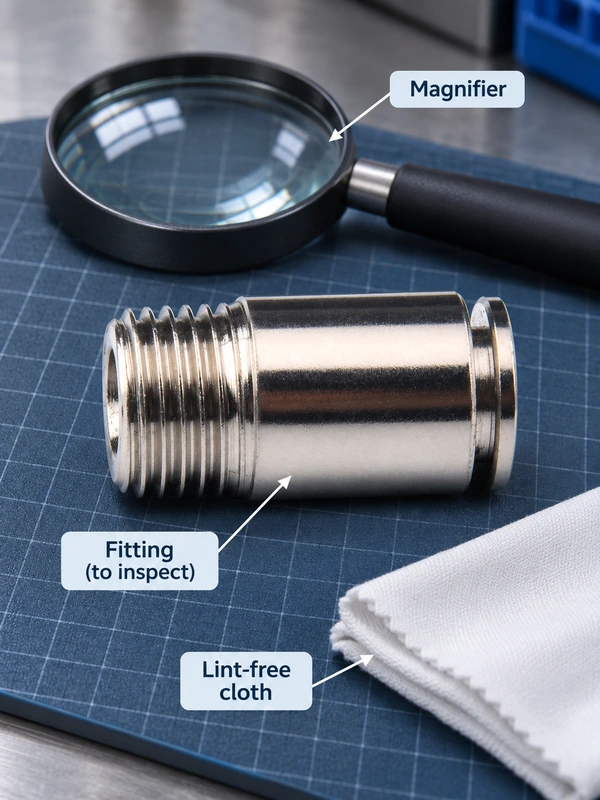
Follow the specified wrenching and installation method. Do not grip a finished body with an inappropriate tool, scrape its surface to improve fit, or attempt field replating of an assembled fitting. Coating repair can affect dimensions, cleanliness and seals, and needs a documented process rather than an improvised cosmetic correction.
If the joint leaks, investigate tube condition, thread compatibility, insertion and sealing arrangements as well as surface damage. The brass fitting leak-check guide helps separate these causes. A leak should not automatically be diagnosed as a plating fault.
Does nickel plating change thread sealing or pressure limits?
The connector design determines how a joint seals. A threaded port may use a specified thread sealant, washer, O-ring or another arrangement; a push-in tube entry uses its own sealing interface. Nickel plating is not a substitute for any of these features.
Confirm the actual thread designation and the manufacturer’s tightening instructions. Similar diameters do not make BSPP, BSPT and NPT interchangeable. Compare the coating condition against the supplied finished-part dimensions rather than treating plating as permission to force a tight connection.
Use the lowest applicable limit in the assembled system, including tube, fitting, valves and other connected components. Parker’s LF 3600 brochure distinguishes product generations and their associated seals when discussing performance. That is a useful warning against assigning a pressure or temperature rating from the finish name alone.
After installation, use the equipment manufacturer’s approved leak-check and commissioning procedure. Depressurize before disconnecting or adjusting a fitting. Neither a shiny body nor a successful initial seal establishes indefinite service life.
Does nickel plating make a brass fitting lead-free or food-safe?
No. A surface finish does not establish the brass alloy’s composition or the finished product’s approval for drinking water. The US Environmental Protection Agency describes a maximum weighted average lead content of 0.25% across the wetted surfaces of covered pipes, fittings and fixtures. This is a regulatory definition with a defined scope, not a visual inspection rule.
EPA also explains certification requirements for products regulated under the US Lead Free Rule and the existence of exemptions. Check the actual application, market and product documentation. Do not apply the drinking-water rule indiscriminately to every industrial pneumatic fitting, and do not describe an industrial fitting as potable-water approved without the relevant evidence.
The LF 3600 brochure references ASTM B733-04 for autocatalytic nickel-phosphorus coatings and makes product-specific material compliance statements. That historical reference identifies a coating specification; it is not a blanket drinking-water certificate, nor proof that an unrelated product complies. Request the currently applicable document and exact model coverage for a new purchase.
Food-contact suitability, cleaning compatibility and drinking-water approval are separate questions. A fitting near a food-processing machine may have a different exposure from one carrying a beverage. Describe the actual contact and service conditions when requesting documentation.
When does nickel plating justify the extra cost?
Compare installed cost and maintenance consequences, not just the unit price. A documented finish may be useful where it addresses a relevant exposure and reduces the need for replacement or cleaning intervention. Those benefits need evidence from the selected product and application; they should not be presented as guaranteed savings.
Use fitting material compatibility as the first approval step. Then compare purchase cost, installation labour, access, planned replacement and the consequence of an unexpected stoppage. If exposure is mild and both approved products meet the requirements, an additional finish may not deliver a meaningful operational advantage.
| 応募条件 | What to investigate | Evidence needed before choosing |
|---|---|---|
| Protected dry air cabinet | Whether a surface-treatment requirement actually exists | Complete fitting and tubing suitability |
| Regular external cleaning | Compatibility with the actual cleaner | Chemical, concentration, temperature and contact-time assessment |
| Repeated maintenance handling | Surface damage and correct tool access | Installation instructions and finish acceptance criteria |
| Drinking-water service | Applicable product approval and lead requirements | Model-specific certification within its scope |
| Corrosive process exposure | Whether coating, substrate and seals are all suitable | Application-specific material approval or an alternative assembly |
What should a nickel-plated brass fitting quotation include?
Send the supplier the tube size, thread designation, operating pressure and temperature, internal fluid and external exposure. Request the exact brass alloy, coating system and applicable seal materials. Add any cleaning, food-contact or drinking-water requirements explicitly rather than assuming they follow from the material name.
Ask which surfaces are coated and how coating quality is accepted. Where a test report is offered, check the model, sample configuration, method and result. A test on a coupon or another product size may provide useful information, but its relevance to the purchased assembly must be explained.
Keep the approved specification with the order and batch record. If a substitute is proposed later, compare the same requirements again. A replacement should not be approved merely because it has the same colour and fits the available port.
よくある質問
Are nickel-plated brass fittings better than unplated brass?
They can offer useful surface properties when the specific coating is suitable for the exposure. They are not universally better. Compare the complete fitting, fluid, environment and documentation; an approved unplated fitting may be sufficient for protected service.
Can nickel-plated brass fittings corrode?
They can deteriorate in unsuitable conditions or when the coating is damaged. A corrosion-resistance claim needs its test and application context. Confirm compatibility with both internal fluids and external cleaners rather than assuming the finish is an unrestricted barrier.
Does nickel plating increase a brass fitting’s pressure rating?
Do not infer a higher rating from plating. Use the published pressure-temperature limits of the exact finished fitting and the lowest applicable limit in the assembly. The body design, seals, tubing and connection method remain relevant.
Are nickel-plated brass fittings safe for drinking water?
Only when the actual product has the documentation required for that use and market. Nickel plating alone does not demonstrate lead-free compliance or drinking-water suitability. Check model-specific certification and its scope before installation.
Should a scratched nickel-plated fitting be replaced?
Assess the location and extent of damage against the manufacturer’s criteria. Damage at a sealing surface, loose coating or visible deterioration warrants investigation. Do not conceal it by polishing or continue service on the assumption that any scratch is harmless.
How can I tell nickel-plated brass from stainless steel?
Use the part number, material specification and supplier documentation. Colour and appearance are insufficient, and a simple magnet check is not a universal identification method. Request traceable material confirmation when an unidentified component must be replaced.
参考文献
- Parker Legris, LF 3600 Nickel-Plated Brass Instant Fittings, technical brochure hosted by RS: identified coating, component materials and product-specific requirements. Historical edition; obtain current model documentation for procurement.
- SMC, KQ2 One-Touch Fittings catalogue: separate assembly materials, fluids and operating conditions.
- US EPA, Use of Lead Free Pipes, Fittings, Fixtures, Solder, and Flux for Drinking Water: lead-content definition, certification requirements and regulatory scope.
要約
Choose nickel-plated brass when the documented coating addresses a real service requirement. Choose unplated brass when its complete specification already fits the job. In either case, verify the substrate, seals, interfaces and approvals; finish colour cannot answer those questions.
For sourcing, review ANMASPC’s straight brass fitting and contact the team with your application details. Request written confirmation of the supplied finish, alloy and operating limits before ordering; the current product page does not establish nickel plating.



