
Imagine um engenheiro de manutenção em Nottingham selecionando uma tubulação de ar de reposição ao lado de uma máquina que é limpa regularmente. A tubulação existente é flexível e fácil de instalar, por isso o pedido indica apenas “tubo de PU”. Algumas semanas depois, a equipe observa uma alteração nas condições da superfície após a introdução de um novo detergente. Essa situação hipotética ilustra a especificação ausente: o nome do polímero por si só não define a compatibilidade com as condições reais de exposição.
A Tubo de PU Deve ser aprovado para o fluido ou contaminante externo específico, considerando concentração, temperatura, duração do contato e pressão. Inclua o encaixe conectado e o vedante nessa avaliação. A adequação ao ar comprimido não implica automaticamente a adequação ao transporte contínuo de óleo ou água, e um respingo ocasional não equivale à mesma condição de contato interno em tempo integral.
Separe a exposição externa do fluido transportado dentro do tubo
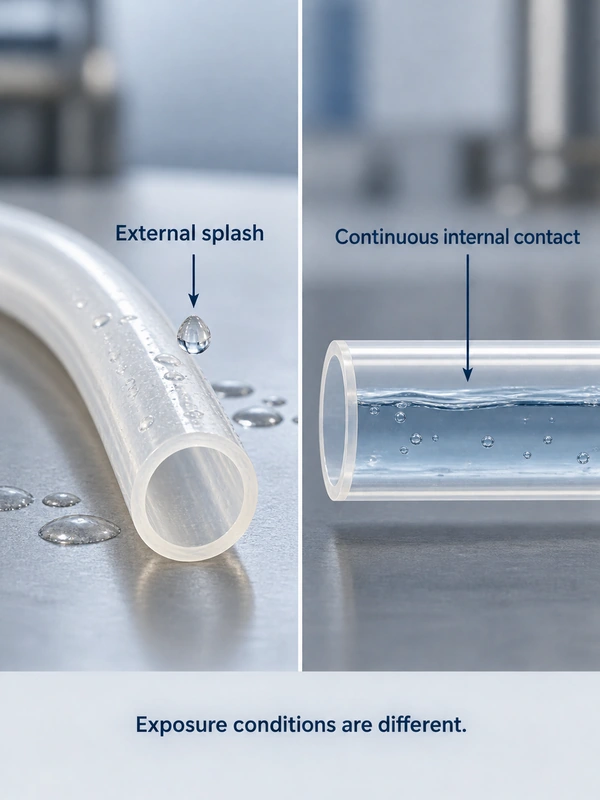
Descreva onde o produto químico entra em contato com o tubo. A pulverização externa pode entrar em contato apenas com parte da parede por um curto período, antes do enxágue ou da secagem. Um fluido interno pode permanecer em contato contínuo, atingir a vedação da conexão e criar condições distintas de pressão e temperatura. Imersão, respingos intermitentes, vapores e lubrificantes transportados pelo ar comprimido devem, portanto, ser registrados como exposições separadas.
O tempo de contato é tão importante quanto a concentração. Um produto de limpeza que seja inofensivo durante um ciclo de limpeza curto e validado pode não ser aceitável se resíduos se acumularem sob uma braçadeira. Da mesma forma, um tubo que pareça inalterado após uma imersão breve não demonstrou manter as propriedades mecânicas exigidas ao longo de sua vida útil. A inspeção visual é útil, mas representa apenas uma parte das evidências de compatibilidade.
Liste as misturas com precisão. Óleo pode referir-se a diferentes fluidos básicos e conjuntos de aditivos; detergente pode descrever diversas formulações. Obtenha a identificação do produto e a documentação técnica ou de segurança relevante, em vez de solicitar aprovação para uma categoria genérica. Inclua a diluição normal, a concentração máxima esperada e quaisquer fluidos de limpeza ou de purga que possam entrar na linha durante a manutenção.
| Exposição | Informações necessárias | Por que uma resposta genérica é insuficiente |
|---|---|---|
| Arraste de óleo do compressor | Identidade do lubrificante e contato esperado | A química dos óleos e os aditivos diferem. |
| Água transportada internamente | Tipo de água, temperatura, duração e pressão | As qualidades de PU apresentam diferentes restrições quanto ao uso de água. |
| Spray de limpeza externa | Limpador, diluição, tempo de contato e enxágue | Resíduos e temperatura alteram a exposição |
| Mistura química | Composição completa e condições de funcionamento | Um gráfico para uma substância química pura pode não ser aplicável. |
Check the actual polyurethane grade before approving water service
Tubo de poliuretano includes different formulations and constructions. A colour or flexible feel does not identify the grade. Ask for the manufacturer’s exact series and written fluid restrictions, particularly where water, humidity or hot cleaning is involved. Do not approve a water duty simply because another polyurethane product from a different series is listed for it.
SMC’s TU catalogue provides a concrete example. The TU/TIUB section lists air and water with stated conditions, while the TUH precautions prohibit water because of hydrolysis. These are manufacturer-specific instructions, not an evaluation of every PU formulation. They demonstrate why a broad statement such as polyurethane is waterproof is not adequate for selecting a pressurized tube assembly.
The same document gives a maximum operating pressure at a specified temperature and separate temperature conditions for water. This reinforces a second point: fluid approval and mechanical limits have to be read together. A tube may be suitable for a medium within one defined range without being suitable at every temperature or pressure listed elsewhere in a catalogue.
For recurring failures, retain the tube packaging, supplier code and batch information when available. Compare these with the original approved material. If the only recorded description is blue PU, it may be impossible to tell whether the replacement uses the same grade. A more complete purchasing description helps distinguish an exposure change from an unintended material substitution.
Assess oil and chemical contact across the entire assembly
The tube is only one wetted component. Check the fitting body, gripping arrangement, seal and any thread-sealing material that can encounter the fluid. A stainless fitting can contain an elastomer with different chemical limits. SMC’s KQG2 fluid guidance evaluates body and seal materials separately, which is a useful reminder that metal compatibility does not establish assembly compatibility.
Do not treat a chemical-resistance chart as a complete operating approval. Check the tested material, concentration, temperature, exposure time and the meaning of its rating. A chart based on static immersion does not necessarily establish pressure capability, fatigue life or performance of a stressed tube in motion. Where the duty is consequential, request confirmation for the actual use and a suitable qualification plan.
O stainless fitting media compatibility guide explains this component-by-component review. It is particularly relevant when the tube appears to survive but leakage develops at the socket. A seal response, dimensional change or tube-surface damage can affect the connection without visible corrosion of the metal body.
Watch for swelling, softening, cracking, unusual stiffness and changes at the clamped or inserted sections. These observations should trigger investigation rather than a definitive chemical diagnosis. Remove affected components from service under the approved procedure and retain evidence where useful. Do not continue pressurized testing merely to see how long visibly degraded tubing will last.
Keep temperature, pressure and routing within the approved range
Pressure-temperature limits are tied to the exact tube construction. The Oulu PU tube listing identifies available size combinations, including 6 × 4 mm and 8 × 5 mm, and states a temperature range. That information is not a complete pressure-versus-temperature curve or a chemical-service approval. Request the missing working and bend data for the chosen variant before specifying the assembly.
Record outside and inside diameters separately. The socket matches the approved outside diameter; the bore contributes to flow delivery. A tube with the correct outer size may still restrict a long pneumatic run if its bore is smaller than the original. Do not compensate for that change by increasing supply pressure without investigating the actual restriction and permitted operating limits.
Routing can increase the effect of an unsuitable exposure. A tight bend, abrasion point or heavily compressed clamp creates an additional mechanical concern at the same location. Keep the line away from sharp edges and hot surfaces, provide room for motion and follow the exact minimum bend requirement. A room-temperature bend value should not be assumed to validate continuous flexing in a warm chemical environment.
Cut and insert tubing only after safe isolation and depressurization. Use a suitable cutter, inspect the outside sealing surface and insert to the fitting’s specified position. The PU hose leak and kink guide helps distinguish installation damage from a broader material-compatibility problem. Neither a fresh cut nor a new fitting can make an unapproved chemical duty suitable.
Ask for compatibility evidence that matches the real duty
Send a complete enquiry rather than asking whether PU resists chemicals. Include exact tube grade and dimensions, fitting and seal identity, chemical name, concentration, fluid and ambient temperatures, pressure, contact duration and whether the tube moves. State any cleaning cycle or abnormal exposure that the system is expected to tolerate. Missing information should remain an open question, not become an assumed approval.
| Required field | Example of useful information | Evidence requested |
|---|---|---|
| Material identity | Exact tube series, size and fitting seal | Matching datasheets and variant confirmation |
| Chemical identity | Named fluid and documented dilution | Compatibility statement for that composition |
| Operating conditions | Pressure, temperatures and contact duration | Limits and any derating or exclusions |
| Mechanical duty | Fixed route or repeated motion | Bend and installation requirements |
| Special requirements | Actual food contact or clean-air duty | Documents covering the intended use |
Define the acceptance criteria before any application trial. These may include leakage, dimensional change and mechanical condition under a documented procedure, with limits agreed by the responsible engineer and supplier. A casual soak test is not certification. If food contact or clean process air is required, obtain the applicable documents for the exact material and use; a generic industrial PU listing is insufficient.
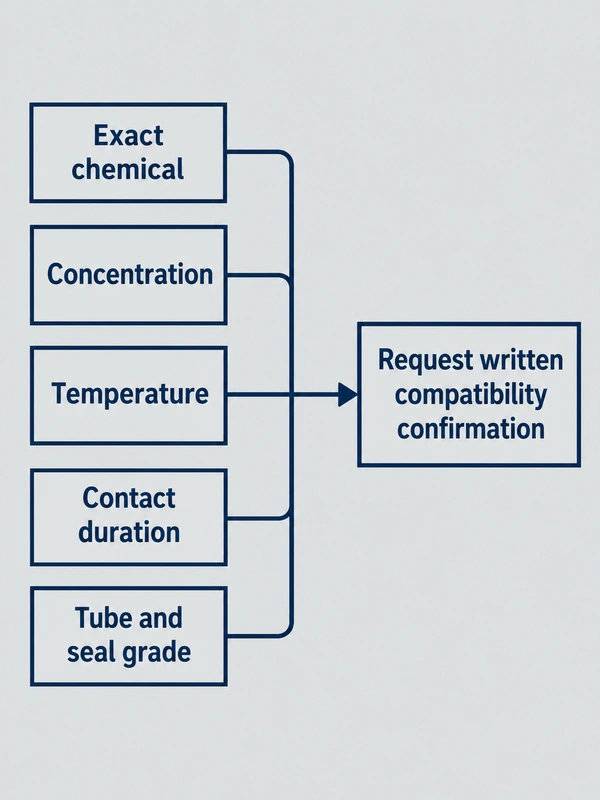
Keep compatibility decisions with the maintenance record so future changes can be reviewed. A new cleaner, higher temperature or different lubricant may invalidate an earlier selection even if the tube part number stays the same. The most useful approval states its conditions clearly enough that technicians can recognize when those conditions have changed.
Perguntas frequentes
What tube size and bend radius should be used?
Select outside diameter to match the approved fitting and inside diameter to support the required flow. Use the bend limit for the exact tube size, grade and conditions. A generic PU description does not provide a universal radius or confirm suitability for repeated movement.
How do you prevent abrasion and kinks in PU tubing?
Provide supported routing with adequate bend clearance and room for machine movement. Avoid sharp edges, hot surfaces and clamps that distort the wall. Inspect the complete movement range and keep side load away from the fitting entry.
What pressure and temperature limits apply to a PU tube?
Use the exact product’s working limits and temperature-dependent restrictions, including the connected fittings and seals. Do not substitute burst pressure for working pressure. A rating quoted at room temperature may not apply at the hottest operating condition.
Which connector thread matches a PU tube without leaking?
The tube itself is matched to a socket by outside diameter, approved material and tolerance, not by a pipe thread. If the connector has a threaded equipment end, identify that port separately. Both interfaces must be correctly specified for a reliable assembly.
How should PU tubing be cut and inserted for a reliable seal?
After isolation, make a clean square cut and check that the tube is round and free of scoring. Insert it straight to the fitting manufacturer’s required position and perform the specified retention check. Replace damaged or degraded tube rather than reusing an unsuitable sealing surface.
Can a PU tube carry oil, water or chemicals?
Only where the exact grade and complete assembly are approved for the named medium and conditions. Water restrictions can differ even between polyurethane series from the same manufacturer. Obtain written compatibility confirmation covering concentration, temperature, pressure and contact duration.
Referências
- SMC: TU, TIUB and TUH fluid and temperature precautions
- SMC: KQG2 body and seal fluid guidance
- SMC: KQ2 fitting and tube selection information
Resumo
PU compatibility depends on a defined material meeting a defined exposure, not on the polymer name alone. Check the fluid, concentration, temperature, duration and mechanical duty, then include every wetted seal and fitting in the decision. For an Oulu polyurethane tube quotation, provide that operating information with the required OD and ID so the proposed product can be checked against the intended service before installation.



