The choice between a pneumatic air fitting and a threaded fitting is often reduced to installation speed, yet the real decision is about the complete air-line interface. A push-in connector may be easier to service, while a threaded connection may suit a fixed port or an assembly that is rarely disturbed. Either can leak when the thread standard, seal, tube support or maintenance method is wrong. This comparison gives a practical way to select the connection type without treating one design as universally better.
Quick answer: choose a push-in pneumatic air fitting when a correctly measured tube, clean access and repeatable maintenance are priorities; choose a threaded fitting when the port and sealing method are fixed and the assembly is designed around verified threads. Compare pressure, temperature, vibration, chemical exposure, access and the supplier’s limits against ISO 4414:2010 before approving the design. A threaded push-in fitting can combine both interfaces, so identify which connection is being compared before choosing a design or assessing its maintenance cost.
Can one fitting have both a push-in connection and a threaded connection?
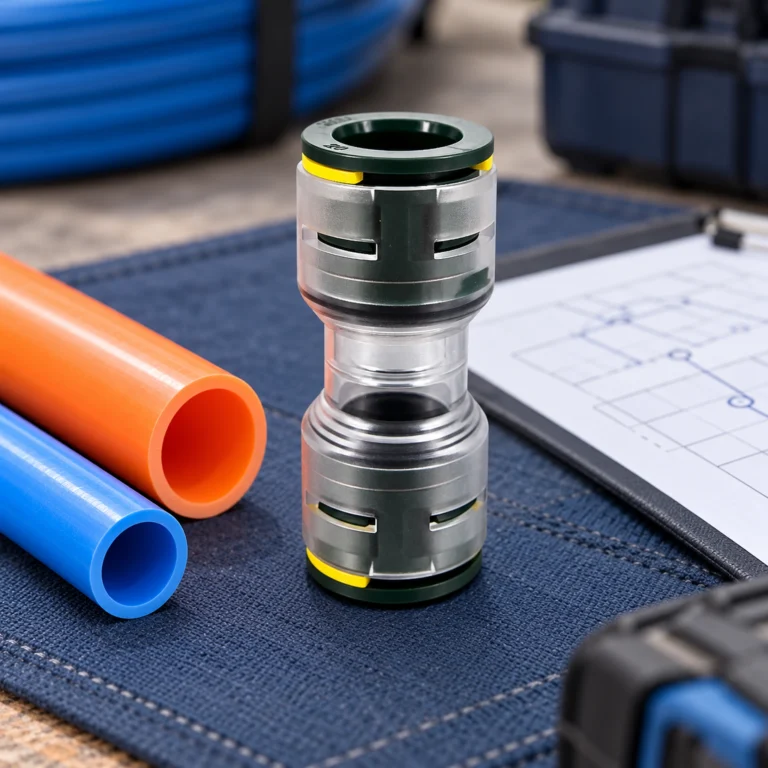
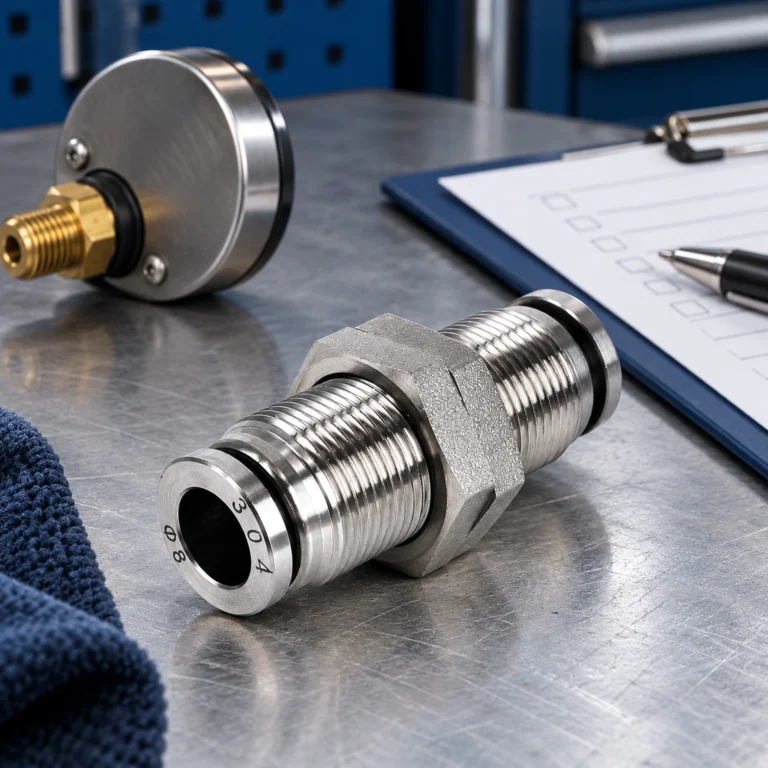
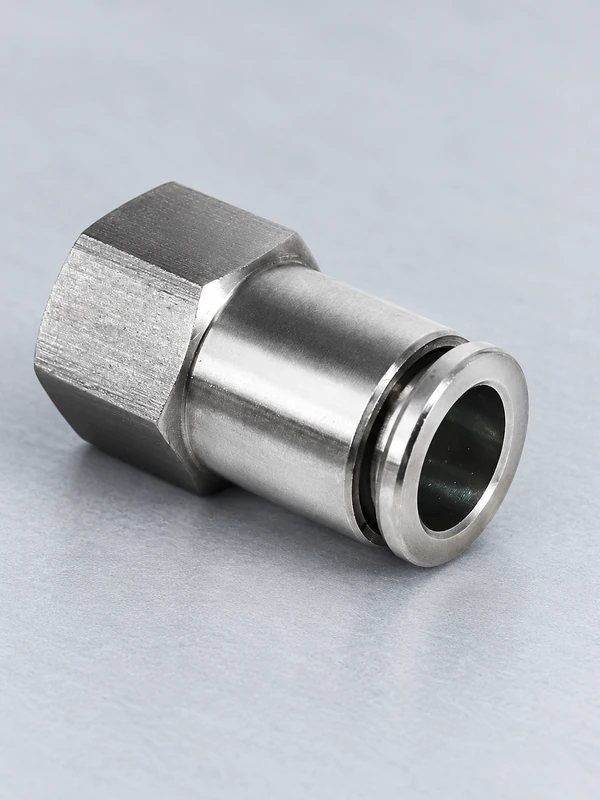
Yes. A threaded push-in fitting combines a tube-side collet and seal with a threaded port connection. Therefore, push-in and threaded are not always mutually exclusive categories. A useful comparison specifies which interface is changing: push-in tube retention versus a compression tube end, or one port-sealing design versus another. SMC’s archived KQ2 catalogue illustrates this combination with separate tube, collet, O-ring and threaded-stud elements. Its construction is an example, not proof that another manufacturer has the same limits or interchangeable parts. The comparison table above describes interfaces; the part drawing determines which interfaces exist on the selected fitting.
What does each connection actually seal?
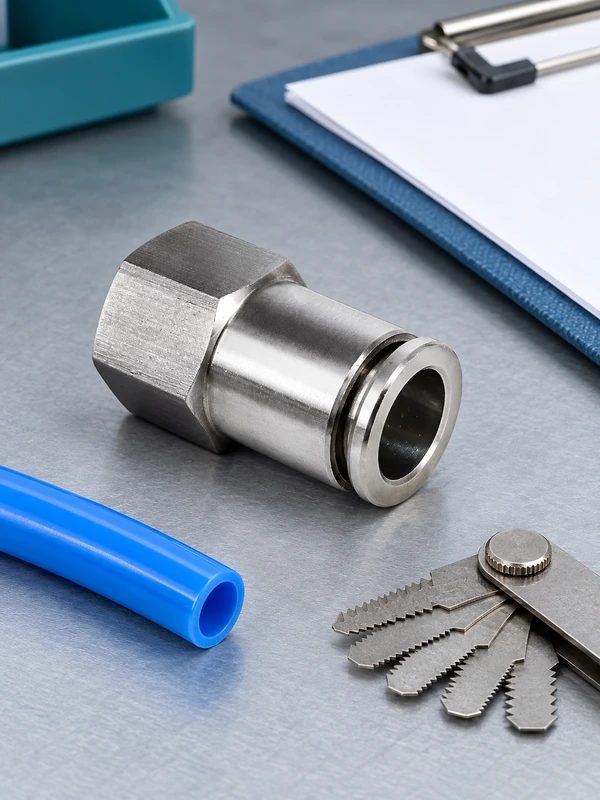
A push-in fitting uses a collet to retain the tube and an internal seal to close around its outside diameter. The tube end, OD tolerance and side load therefore matter directly. A threaded fitting seals through the specified thread form, gasket, O-ring, cone or sealant arrangement, depending on the design. BSPP, BSPT and NPT are not interchangeable simply because they appear similar. The correct comparison is the whole interface: fitting, tube or port, sealing element, installation tool and access for later service.
When is a push-in fitting the more practical choice?
Push-in fittings are useful on machine manifolds, valve islands and compact routing where technicians need to replace tubing without turning the entire assembly. They can reduce tool use and make a branch easy to identify during maintenance. Their advantages disappear when the tube is badly supported, contaminated or repeatedly removed without inspection. A push-in design also needs enough clearance to press the release collar and enough straight length for the tube to enter without bending. In a moving axis, guides and bend-radius control remain essential.
When does a threaded fitting make more sense?
Threaded fittings are often selected for fixed ports, metal pipe transitions, pressure regulators and assemblies where the connection is made once and protected from routine disturbance. They can provide a robust mechanical interface when the port standard, torque method and sealing element are documented. The trade-off is slower replacement and a higher risk of cross-threading or sealant contamination during field work. The installer must know whether the joint seals on the thread, a face, a washer or an O-ring; adding tape to the wrong design can create a leak.
How do vibration and movement change the decision?
Vibration does not automatically disqualify either type. The question is where the movement is absorbed. A push-in fitting needs a supported tube route so the collet and seal do not carry a bending moment. A threaded fitting needs adequate engagement and a locking or support arrangement when the port can rotate. Flexible tubing, clamps and strain relief should be specified as part of the assembly rather than added after the first failure. If technicians must disconnect the line often, access and repeatability may outweigh a small difference in initial assembly time.
Does switching connection type automatically solve pressure drop?
No. Pressure measured upstream at idle does not establish the pressure available at an actuator while air is flowing. The passage through the fitting, tube length and bore, valve capacity, filters and exhaust components all affect the working circuit. Compare supplier flow or pressure-drop data using equivalent conditions where it is available. If no suitable data exists, request clarification or conduct the machine-approved functional assessment rather than assigning a flow rating from nominal thread size. Changing only the connection method may leave the restrictive passage unchanged. Record the gauge positions and machine state when comparing before and after results.
What are the maintenance and total-cost trade-offs?
Initial purchase price is only one line in the decision. Consider labour for tube changes, thread cleaning, replacement seals, leak investigation, downtime and inventory. A push-in fitting can make a planned tube change quicker, but repeated removal can mark the tube or wear the seal. A threaded fitting can remain stable for a long period, but a seized or contaminated thread may extend a repair. Record the maintenance interval and failure mode for the actual machine; do not convert a catalogue claim into a promise about service life across the site. Separate failures caused by installation or routing from wear findings before using maintenance records to compare the two connection designs.
How should a trial compare installation and maintenance effort?
Use the same tube route, port requirement and acceptance method for both candidates. Record preparation, assembly, support installation, leak-check time and the work needed to disconnect and reconnect during a representative service task. Include spare seals and adapters where required. Separate active labour from time spent waiting for the machine to be made safe. Do not compare a fully prepared push-in connection with a threaded joint that still needs port identification. Repeated removal should follow each manufacturer’s reuse instructions. This method produces a site-specific cost comparison without claiming that one fitting universally saves a percentage of labour or energy. Record whether both candidates fit the same maintenance envelope and require the same isolation work. A fast release has little value if the technician must remove a neighbouring manifold to reach it. Likewise, a fixed threaded joint is not automatically more economical when every repair requires another seal or adapter.
Which specifications must be matched?
For a push-in design, confirm tube OD, material, wall, medium, pressure, temperature, minimum bend radius and seal compatibility. For a threaded design, confirm thread family, nominal size, engagement, sealing method, torque or assembly instruction and material compatibility. For both, check vibration, cleaning chemicals, ambient conditions and the lowest limit in the complete circuit. A connector that meets a catalogue value alone does not prove the assembled line meets the machine requirement. Retain the exact tube and port designations with the selected drawing so purchasing and installation review the same assembly rather than similar names.
How should the final choice be documented?
A purchase line should name the connection type, tube or port interface, thread standard, seal material, medium, operating envelope and required documentation. Include a small installation sketch when the route or support is safety-relevant. The comparison should be revisited after a pilot installation or recurring maintenance review. If the selected option changes, update spare parts, work instructions and training together so the next technician does not mix two sealing methods.
How should replacement compatibility be approved?
A substitute needs more than the same nominal tube and thread labels. Compare overall envelope, port depth, wrench access, release-collar clearance, tube compatibility, seal arrangement and the documented operating limits. A longer stud may bottom before the intended seal seats; a larger body can obstruct an adjacent fitting. Treat an added adapter as another interface to inspect, not as an invisible part of the connection. Update the approved bill of materials and service instruction together. Otherwise the next repair may reintroduce the old sealing method even though the replacement was correctly installed once.
Which differences matter when comparing air-line connections?
| Factor | Push-in pneumatic air fitting | Threaded fitting |
|---|---|---|
| Primary interface | Tube OD, collet and internal seal | Verified thread plus specified seal |
| Routine service | Fast tube release with collar access | Tools and thread/seal inspection required |
| Main risk | Scored tube, shallow insertion or side load | Wrong thread, cross-threading or sealant misuse |
| Best decision evidence | Tube drawing and routing review | Port drawing, sealing method and assembly instruction |
What should an installer record?
- Identify the service task: fixed installation, frequent tube change or moving route.
- Verify the interface and seal from the drawing rather than visual similarity.
- Check the complete pressure, temperature, medium and vibration envelope.
- Provide support, strain relief and tool access in the layout.
- Record the selected interface and the acceptance test in the work pack.
Perguntas frequentes
Are push-in fittings always better than threaded fittings?
No. Specify the interface being compared first because a fitting can have both a threaded port and push-in tube connection. Then compare service access, movement, sealing method and documented limits rather than declaring one design universally better.
Can BSPT be screwed into an NPT port?
Do not assume compatibility. Similar nominal sizes do not establish a correct thread match. Confirm both standards from controlled information and use an approved adapter or matching fitting if the equipment design requires one.
Do threaded fittings eliminate leaks?
No. A damaged thread, wrong port, unsuitable sealing arrangement or incorrect assembly can still leak. Establish the leak location under the approved procedure before tightening or adding sealant. Check the tube interface separately where one is present.
Can push-in fittings be used on moving equipment?
Only when the selected fitting and tube are suitable for the documented duty. Review the full travel, support and bend radius so movement is absorbed by the intended flexible route. Do not interpret an adjustable body as a continuously rotating union.
Which type is easier to maintain?
Push-in tube connections can simplify release where the collar is accessible and reuse is permitted. Threaded port connections require tools and the correct sealing procedure. The actual service task, not the catalogue label alone, determines maintenance effort.
What should be compared besides price?
Include assembly labour, isolation and test work, adapters, spare seals, downtime and the consequences of failure. Use equivalent application conditions for the comparison. Do not transfer a saving measured on one machine to every installation.
Referências
- SMC, archived KQ2 One-touch Fittings catalogue: construction and configuration illustrations; historical reference, not a specification for ANMASPC/Oulu fittings.
- U.S. Department of Energy, Minimize Compressed Air Leaks, Compressed Air Tip Sheet 3, revised August 2004: leak identification, repair and verification; historical maintenance guidance.
- OSHA 29 CFR 1910.147, Control of hazardous energy: applicable U.S. servicing requirements, including stored energy. Other jurisdictions require their own regulatory review.
Conclusão
There is no universal winner between a pneumatic air fitting and a threaded fitting. Start with the port and tube interface, then assess service frequency, movement, environment, sealing method and maintenance access. A push-in choice is only efficient when the tube is prepared and supported correctly; a threaded choice is only reliable when the thread and seal are positively identified. Document the complete assembly and test method before release to production. ANMASPC/Oulu’s pneumatic parts range can be reviewed against those inputs, while the final decision should remain tied to the machine drawing and operating limits. Review the pneumatic parts range with the verified tube, port and service requirements when requesting a configuration.