
A questão não é se uma peça é chamada de conexão para tubos ou de acoplador padrão. Esses nomes abrangem muitos produtos. Para um percurso de fibra soprada, a pergunta relevante é se o conjunto específico oferece a vedação pneumática necessária, a retenção no duto, a passagem do cabo e a adequação às condições ambientais. Um conector pneumático genérico que aceite o diâmetro externo do tubo ainda pode ser o componente inadequado para o trajeto do cabo.
Comparar acessórios para tubos de microduto utilizando interfaces documentadas e condições de instalação. Não os classifique pelo material da carcaça, pela cor ou pelos termos "alta resistência". Este guia separa as funções que o comprador deve especificar, com especial atenção aos redutores e à passagem reduzida que eles introduzem.
Um acoplador pneumático padrão pode substituir um encaixe para microduto?
Um fornecedor pode usar o termo “acoplador padrão” para se referir a um conector reto para microduto, a um acessório geral de ar comprimido ou a uma luva mecânica para eletroduto. Esses itens não são automaticamente intercambiáveis. Antes de comparar preços, solicite o desenho do modelo, o fluido de aplicação previsto, os materiais de tubo aprovados e as informações sobre a passagem do cabo.
Uma luva mecânica pode unir condutas sem fornecer a vedação sob pressão necessária para o insuflamento. Uma conexão pneumática pode vedar ar comprimido, ao mesmo tempo em que apresenta uma geometria interna inadequada para um cabo. Um acoplador de microduto projetado especificamente ainda deve ser verificado em relação ao duto e ao trajeto reais; sua categoria de produto é apenas um ponto de partida, não uma qualificação completa.
| Componente candidato | Possível emprego pretendido | Evidências necessárias para um trajeto de fibra soprada |
|---|---|---|
| Acoplador de microduto reto | Una microcondutas compatíveis | Ajuste OD, diâmetro interno, retenção e condições de teste |
| Redutor de microduto | Junte diferentes tamanhos de dutos | Ambas as interfaces e a passagem limitadora |
| Conexão pneumática geral | Transporte ar comprimido através de tubos | Aprovação explícita para a aplicação em dutos e cabos |
| Mechanical conduit sleeve | Connect protective conduit sections | Evidence of any required pressure sealing |
| Bloco de gás | Vedar ao redor de um cabo instalado | Duct size, cable range and sealed-state performance |
Use exact part numbers in the comparison. If two quotations omit different details, the cheaper price is not yet a like-for-like offer. Resolve those omissions before treating the products as substitutes.
What makes a microduct joint airtight while keeping the cable passage clear?
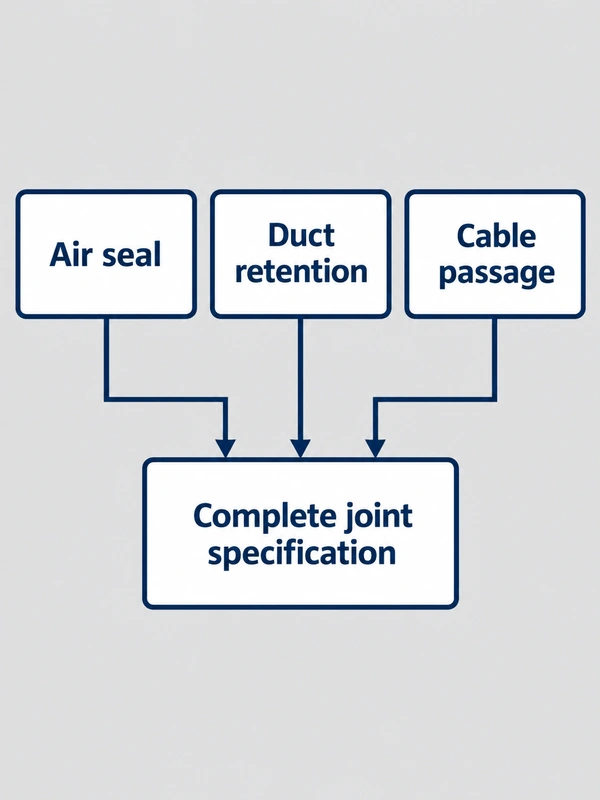
Joint airtightness concerns leakage under defined conditions. Duct retention concerns resistance to separation under the specified test or service loading. Cable passage concerns the usable route through the joint. A useful specification addresses all three rather than treating a successful pressure check as proof of every function.
Hexatronic’s MPB30601+ documentation describes pressure seals and internal gripping features separately. Its application information also distinguishes straight connectors, reducers and end stops. This is a useful model for organizing a purchasing checklist, but its published results must not be assigned to products from another manufacturer.
Locking accessories introduce another distinction. They may protect against unintended release, but they do not seal around the cable. The article on microduct locking clips and gas blocks explains why those parts cannot replace each other merely because both are fitted near a joint.
Will the cable fit through the smaller bore of a microduct reducer?
A conector de redução needs two dimensional descriptions, one for each duct end. Record both outside diameters and bores. Confirm the internal transition and the intended cable-installation direction where the product or route instructions make it relevant.
The cable must pass the smaller duct section, not just the larger entry where installation begins. Avoid assuming that a reducer’s nominal OD pair describes its complete internal passage. Obtain the current drawing and cable-clearance guidance rather than reconstructing internal geometry from a product photograph.
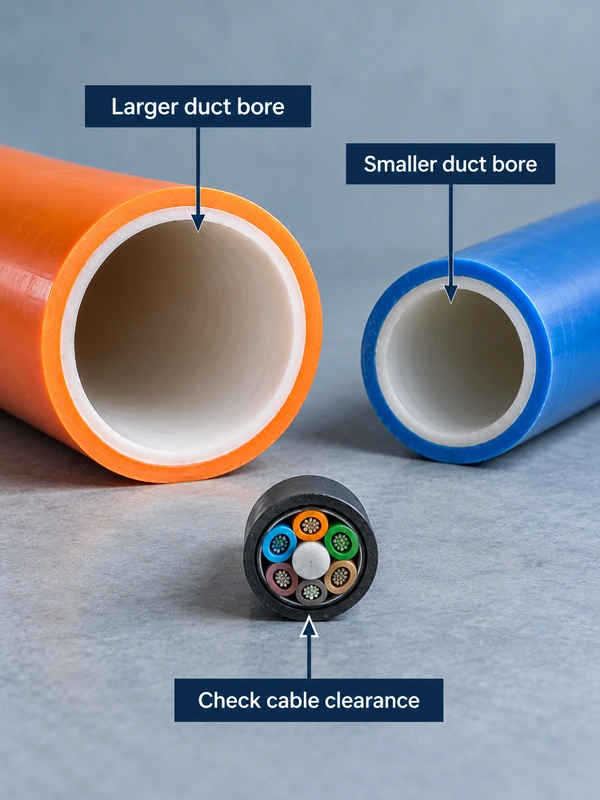
Consider a hypothetical route upgrade that connects a new larger duct to an existing smaller branch. The reducer may solve the mechanical joining problem, but it cannot make the old branch accept every cable that fits the new duct. The decision may require a different cable, another route or replacement of the limiting section.
| Reducer specification | Record for side A | Record for side B |
|---|---|---|
| Diâmetro externo do duto | Nominal dimension and tolerance | Nominal dimension and tolerance |
| Duct inside diameter | Documented bore | Documented bore |
| Duct construction | Material and approved wall construction | Material and approved wall construction |
| End condition | Round, clean and correctly cut | Round, clean and correctly cut |
| Route information | Upstream cable and access details | Downstream limitations and access details |
O Guia do conector de microduto 7 mm illustrates why a familiar nominal outside diameter should still be accompanied by the duct bore and application details. Do not silently fill gaps in a supplier’s size table when the listed combinations are inconsistent.
How to compare connector pressure ratings without confusing test types
Ask whether a published pressure is a working limit, a proof-test condition, a burst result or a gas-seal value. Record the temperature, duration, duct combination and acceptance criterion. Figures taken from different test types cannot form a meaningful ranking of competing connectors.
Emtelle’s gas-block datasheet provides a clear example: it identifies the seal of the space around the fibre unit separately from the tube joint and fibre-blowing pressure information. A connector capable of handling a stated installation condition is not necessarily approved to block gas at that same pressure after the cable seal is activated.
Ask for traceable documentation covering the quoted variant. A report for a different size, material or protective configuration may not cover the purchased assembly. If only a general brochure is available, describe the missing evidence openly in the comparison instead of treating the absence as a pass.
Should the microduct fitting be plastic or metal for this location?
Plastic and metal are broad material categories. The relevant questions are the actual resin or alloy, seal materials, exposure, temperature and mechanical requirements. A metal body does not automatically improve cable passage or compatibility, while a black plastic body does not prove resistance to sunlight.
Differentiate a sheltered cabinet, an access chamber and direct burial. Hexatronic specifies an external cover for direct-buried use of the referenced family. That illustrates how an accessory can form part of the approved configuration. It does not mean any cover makes any coupler suitable for burial.
Where the route needs both a duct joint and control of migration around cable, assess an appropriate conector do bloco de gases as a separate functional requirement. Confirm the actual product’s cable range and activation sequence, rather than expecting a standard straight coupler to provide an additional hidden seal.
How do fitting installation and maintenance requirements differ?
Two dimensionally compatible fittings can have different preparation, insertion and release instructions. Compare the required cutter, insertion indication, retention check, cover arrangement and reuse policy. Include access requirements: a joint that can be serviced on a bench may be difficult to release inside a crowded chamber.
Before assembly, inspect duct ends for scratches, ovality, crushed edges and contamination. Keep the cable passage clean. Do not wrap the duct in tape to compensate for a loose fit or use a generic sealant where the fitting relies on an internal seal against the tube surface.
After placement, check supports and bends. The installed joint should not be continuously pulled sideways or used to force two misaligned ducts together. Verify the final configuration through the operator’s approved passage and leakage procedures; record both rather than treating one as a substitute for the other.
What does a microduct joint cost to install and replace?
The cost of a joint includes access, preparation, testing and the consequences of repeating the work. A low purchase price does not establish low installed cost when the component lacks the required documentation or needs an unsuitable adapter. Conversely, a more expensive material is not justified unless it addresses a real requirement.
Prepare a short acceptance sheet before ordering. List the route location, duct dimensions, cable requirements, environment, operating conditions and documents required. Mark unresolved items explicitly. This gives purchasing and installation teams the same definition of an acceptable replacement.
Perguntas frequentes
Where can microduct tube fittings be used in a fibre system?
Use them where the exact model is approved to join the specified ducts and support the intended installation method. Confirm whether the location is above ground, in a chamber or directly buried. A category name does not establish every environmental approval.
How are microduct fittings matched to duct and cable diameter?
Match the connector entries to duct outside diameters, then assess duct bores and minimum joint passage against cable requirements. Gas blocks additionally need a compatible cable-seal range. Keep those interfaces separate on the specification.
How can a microduct fitting be installed without restricting the cable?
Preserve clean round ends, avoid inward burrs, seat the ducts correctly and support the route. For reducers, review the smaller passage and transition. Use an approved passage check; an airtight joint alone does not prove an unobstructed cable path.
Which leakage tests are needed after installing microduct fittings?
Follow the operator’s documented procedure within the complete assembly’s limits. Record pressure, duration, temperature and acceptance result. Do not select a pressure from an unrelated product page or use burst pressure as the normal test setting.
Can standard couplers be installed outdoors or underground?
Only if the exact configuration is documented for that exposure. Ask about water, sunlight, temperature, mechanical loads and required covers. The word standard provides no environmental classification and should not replace a model-specific assessment.
What should be inspected on microduct fittings before cable installation?
Check component identification, duct dimensions, end condition, seating, retention, supports and route records. Complete the specified passage and leakage checks. Remove suspect components from service rather than using cable installation as an improvised test of an uncertain joint.
Referências
- Hexatronic, MPB30601+ connectors and end stops: component functions, construction and application conditions.
- Emtelle, Gas Block Connector: sealing around the fibre cable.
- Emtelle, Gas Block Connectors datasheet: separate tube and fibre interfaces and model-specific sealing information.
Resumo
The right fitting is the one documented for the duct, cable route and environment. Compare air sealing, retention and passage independently, and assess the smaller bore whenever a reducer is involved. A complete specification makes the quotation meaningful and prevents a familiar-looking general coupler from becoming an unsupported substitute.
For a size transition, request the current drawing and confirmed size pair for the acoplador redutor de microduto. Include both duct bores and the cable details in the enquiry so the quotation addresses the complete transition rather than only the visible end sizes.



