
問題は、その部品が「チューブ継手」なのか「標準コプラ」なのかではありません。これらの名称は多くの製品を包含しています。吹込式光ファイバー配線において重要なのは、その組み立てが、求められる気密性、ダクト保持力、ケーブル通過性能、環境適応性を確実に満たしているかどうかです。チューブの外径に対応する一般的な空気圧用コネクタであっても、ケーブル経路には不適切な部品である可能性があります。.
比較する マイクロダクト用管継手 文書化されたインターフェースおよび設置条件を用いること。本体材質、色、または「ヘビーデューティー」という表現でランク付けしないでください。本ガイドでは、購入者が明示すべき機能を整理し、特に減速機と、それがもたらす小さな流路に重点を置いています。.
標準の空気圧継手はマイクロダクト用継手の代わりになりますか?
サプライヤーによっては、「標準カプラー」という用語を、直通マイクロダクトコネクタ、一般的な圧縮空気用継手、または機械式導管スリーブを指す場合があります。これらは必ずしも互換性があるわけではありません。価格を比較する前に、モデル図面、使用対象媒体、適合するチューブ材質、およびケーブル通過に関する情報を必ず確認してください。.
機械式スリーブは、ブロー作業に必要な圧力シールを提供せずにダクトを接続できます。空気圧用継手は圧縮空気を密閉できますが、ケーブルには不適切な内部形状を有しています。専用設計のマイクロダクトカプラーであっても、実際のダクトおよび配管経路との適合性を確認する必要があります。製品カテゴリーはあくまで出発点であり、完全な適合性を保証するものではありません。.
| 候補コンポーネント | 考えられる想定職種 | 吹込み光ファイバー経路に必要な証拠 |
|---|---|---|
| ストレートマイクロダクトカプラー | 互換性のあるマイクロダクトを接続する | 軸受のすきま、内径、保持および試験条件 |
| マイクロダクト用レデューサー | 異なるダクトサイズを接続する | 両方のインターフェースと制限通路 |
| 一般的な空気圧継手 | チューブを通して圧縮空気を送る | ダクトおよびケーブル用途に対する明示的な承認 |
| 機械式導管スリーブ | 保護用導管の各セクションを接続する | 必要な圧力シーリングの証拠 |
| ガスブロック | 設置済みのケーブルの周囲をシールする | ダクトサイズ、ケーブル範囲、および密閉状態の性能 |
比較には正確な部品番号を使用してください。2つの見積書で省かれた詳細が異なる場合、価格が安いからといって必ずしも同等の提案とは限りません。代替品として扱う前に、それらの不足点を解消してください。.
マイクロダクトの接合部を気密にしつつ、ケーブル通路を確保するには何が必要ですか?
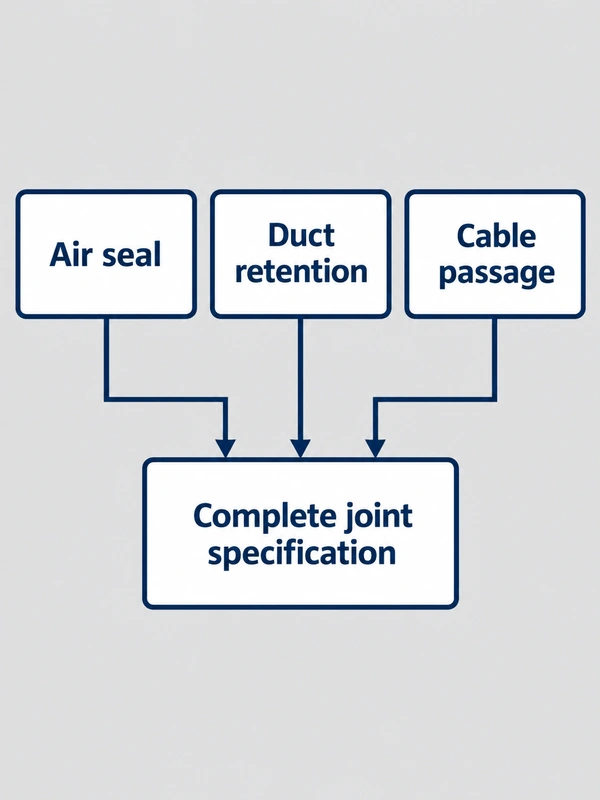
接合部の気密性 漏れに関する要件は、定められた条件下での漏れを対象とします。ダクトの保持に関する要件は、規定された試験または使用時の荷重下における分離に対する耐性を対象とします。ケーブル通過に関する要件は、継手内を通る利用可能な経路を対象とします。有用な仕様書では、圧力試験に合格したことをもってすべての機能が満たされている証拠とするのではなく、これら3つの要素すべてに対処する必要があります。.
HexatronicのMPB30601+に関するドキュメントでは、圧力シールと内部グリップ機能が別々に説明されています。また、そのアプリケーション情報では、ストレートコネクタ、レデューサー、エンドストップが区別されています。これは購買チェックリストを整理するうえで有用なモデルですが、公開されている結果を他社製品に適用してはなりません。.
ロック用アクセサリーは、もう一つの区分を示します。これらは意図しない開放を防ぐことはできますが、ケーブル周囲を密閉する機能はありません。記事では マイクロダクト用ロッククリップおよびガスブロック それらの部品が、どちらも接合部付近に取り付けられているというだけで互いに代替できない理由を説明しています。.
ケーブルはマイクロダクトレデューサーの小さな穴に通りますか?
A レデューサーコネクター needs two dimensional descriptions, one for each duct end. Record both outside diameters and bores. Confirm the internal transition and the intended cable-installation direction where the product or route instructions make it relevant.
The cable must pass the smaller duct section, not just the larger entry where installation begins. Avoid assuming that a reducer’s nominal OD pair describes its complete internal passage. Obtain the current drawing and cable-clearance guidance rather than reconstructing internal geometry from a product photograph.
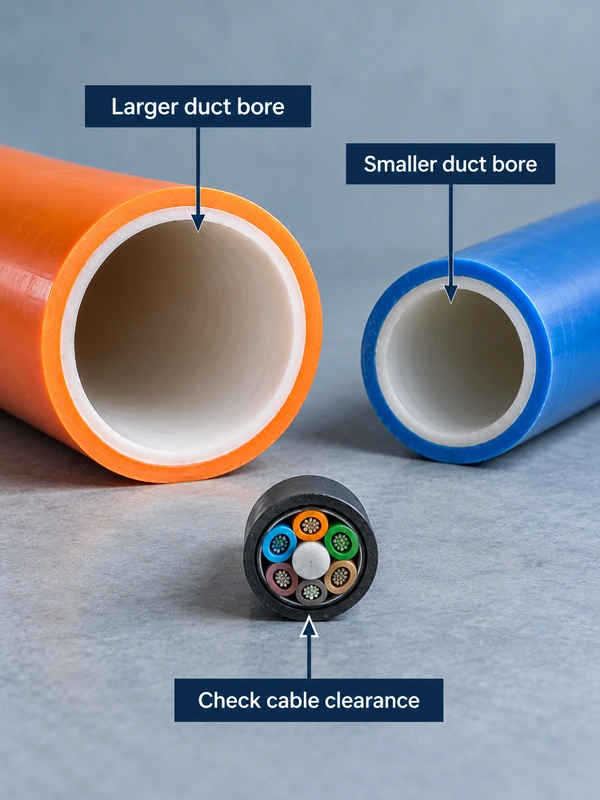
Consider a hypothetical route upgrade that connects a new larger duct to an existing smaller branch. The reducer may solve the mechanical joining problem, but it cannot make the old branch accept every cable that fits the new duct. The decision may require a different cable, another route or replacement of the limiting section.
| Reducer specification | Record for side A | Record for side B |
|---|---|---|
| ダクト外径 | Nominal dimension and tolerance | Nominal dimension and tolerance |
| Duct inside diameter | Documented bore | Documented bore |
| Duct construction | Material and approved wall construction | Material and approved wall construction |
| End condition | Round, clean and correctly cut | Round, clean and correctly cut |
| Route information | Upstream cable and access details | Downstream limitations and access details |
ザ 7 mm マイクロダクトコネクタガイド illustrates why a familiar nominal outside diameter should still be accompanied by the duct bore and application details. Do not silently fill gaps in a supplier’s size table when the listed combinations are inconsistent.
How to compare connector pressure ratings without confusing test types
Ask whether a published pressure is a working limit, a proof-test condition, a burst result or a gas-seal value. Record the temperature, duration, duct combination and acceptance criterion. Figures taken from different test types cannot form a meaningful ranking of competing connectors.
Emtelle’s gas-block datasheet provides a clear example: it identifies the seal of the space around the fibre unit separately from the tube joint and fibre-blowing pressure information. A connector capable of handling a stated installation condition is not necessarily approved to block gas at that same pressure after the cable seal is activated.
Ask for traceable documentation covering the quoted variant. A report for a different size, material or protective configuration may not cover the purchased assembly. If only a general brochure is available, describe the missing evidence openly in the comparison instead of treating the absence as a pass.
Should the microduct fitting be plastic or metal for this location?
Plastic and metal are broad material categories. The relevant questions are the actual resin or alloy, seal materials, exposure, temperature and mechanical requirements. A metal body does not automatically improve cable passage or compatibility, while a black plastic body does not prove resistance to sunlight.
Differentiate a sheltered cabinet, an access chamber and direct burial. Hexatronic specifies an external cover for direct-buried use of the referenced family. That illustrates how an accessory can form part of the approved configuration. It does not mean any cover makes any coupler suitable for burial.
Where the route needs both a duct joint and control of migration around cable, assess an appropriate ガスブロックコネクター as a separate functional requirement. Confirm the actual product’s cable range and activation sequence, rather than expecting a standard straight coupler to provide an additional hidden seal.
How do fitting installation and maintenance requirements differ?
Two dimensionally compatible fittings can have different preparation, insertion and release instructions. Compare the required cutter, insertion indication, retention check, cover arrangement and reuse policy. Include access requirements: a joint that can be serviced on a bench may be difficult to release inside a crowded chamber.
Before assembly, inspect duct ends for scratches, ovality, crushed edges and contamination. Keep the cable passage clean. Do not wrap the duct in tape to compensate for a loose fit or use a generic sealant where the fitting relies on an internal seal against the tube surface.
After placement, check supports and bends. The installed joint should not be continuously pulled sideways or used to force two misaligned ducts together. Verify the final configuration through the operator’s approved passage and leakage procedures; record both rather than treating one as a substitute for the other.
What does a microduct joint cost to install and replace?
The cost of a joint includes access, preparation, testing and the consequences of repeating the work. A low purchase price does not establish low installed cost when the component lacks the required documentation or needs an unsuitable adapter. Conversely, a more expensive material is not justified unless it addresses a real requirement.
Prepare a short acceptance sheet before ordering. List the route location, duct dimensions, cable requirements, environment, operating conditions and documents required. Mark unresolved items explicitly. This gives purchasing and installation teams the same definition of an acceptable replacement.
よくある質問
Where can microduct tube fittings be used in a fibre system?
Use them where the exact model is approved to join the specified ducts and support the intended installation method. Confirm whether the location is above ground, in a chamber or directly buried. A category name does not establish every environmental approval.
How are microduct fittings matched to duct and cable diameter?
Match the connector entries to duct outside diameters, then assess duct bores and minimum joint passage against cable requirements. Gas blocks additionally need a compatible cable-seal range. Keep those interfaces separate on the specification.
How can a microduct fitting be installed without restricting the cable?
Preserve clean round ends, avoid inward burrs, seat the ducts correctly and support the route. For reducers, review the smaller passage and transition. Use an approved passage check; an airtight joint alone does not prove an unobstructed cable path.
Which leakage tests are needed after installing microduct fittings?
Follow the operator’s documented procedure within the complete assembly’s limits. Record pressure, duration, temperature and acceptance result. Do not select a pressure from an unrelated product page or use burst pressure as the normal test setting.
Can standard couplers be installed outdoors or underground?
Only if the exact configuration is documented for that exposure. Ask about water, sunlight, temperature, mechanical loads and required covers. The word standard provides no environmental classification and should not replace a model-specific assessment.
What should be inspected on microduct fittings before cable installation?
Check component identification, duct dimensions, end condition, seating, retention, supports and route records. Complete the specified passage and leakage checks. Remove suspect components from service rather than using cable installation as an improvised test of an uncertain joint.
参考文献
- ヘキサトロニック、MPB30601+コネクタおよびエンドストップ: component functions, construction and application conditions.
- Emtelle, Gas Block Connector: sealing around the fibre cable.
- Emtelle, Gas Block Connectors datasheet: separate tube and fibre interfaces and model-specific sealing information.
要約
The right fitting is the one documented for the duct, cable route and environment. Compare air sealing, retention and passage independently, and assess the smaller bore whenever a reducer is involved. A complete specification makes the quotation meaningful and prevents a familiar-looking general coupler from becoming an unsupported substitute.
For a size transition, request the current drawing and confirmed size pair for the マイクロダクト用レデューサーカプラ. Include both duct bores and the cable details in the enquiry so the quotation addresses the complete transition rather than only the visible end sizes.



