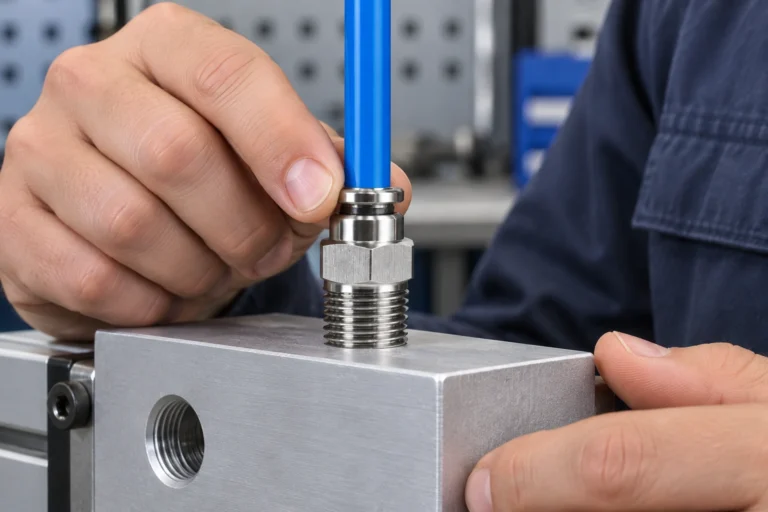
Choosing between a push-in pneumatic air fitting and a threaded fitting is a service decision, not a race for the fastest catalogue installation. Tube changes, vibration, access and maintenance frequency often matter more than the fitting’s appearance.
Quick answer: push-in fittings suit clean, accessible tube runs where measured OD and seal condition can be controlled; threaded fittings suit fixed ports and assemblies designed around a verified thread and sealing method. Compare the complete circuit against ISO 4414:2010 and supplier limits.
What differs between push-in and threaded connections?
Push-in designs retain and seal a tube with a collet and elastomer. Threaded fittings mate machine ports through BSPP, BSPT, NPT or another stated system. The two interfaces solve different problems and are not interchangeable by nominal size.
Which option is faster to maintain?
Push-in joints can reduce tube-change time when the cut and release access are good. Threaded joints may be preferable where the port is permanent or exposed to loads that could pull a tube. Maintenance records should state the actual interface.
| Fator de decisão | Push-in | Threaded |
|---|---|---|
| Tube replacement | Quick when tube is clean and square | Usually requires fitting/port access |
| Port matching | Still needs correct thread at machine | Thread identity is central |
| Vibration | Requires tube support | Requires correct torque/seal |
| Inspection | Tube, collet and seal visible | Thread engagement and sealing face |
How should engineers compare total risk?
Check tube OD, pressure, temperature, chemicals, bend radius, access and replacement policy. Do not copy a rating from a different size or medium. ISO 12100:2010 can structure the machinery risk review.
When is a plastic pneumatic fitting appropriate?
Use plastic only when the documented body, seal and tube combination meets the complete duty. Consider metal where impact, heat or vibration requirements demand it; verify the exact grade rather than assuming superiority.
What records make the choice repeatable?
Retain drawing, thread callout, tube specification, seal material, installation date and leak-check result. Link the decision to the maintenance guide, thread guide e pneumatic parts range.
Perguntas frequentes
Are push-in fittings always better?
No; duty and maintenance access decide.
Can BSPP replace NPT?
No. Confirm thread system and seal.
Do threaded fittings eliminate leaks?
No; wrong engagement or sealing still leaks.
What is the first measurement?
Tube outside diameter and port thread.
Can plastic be used near heat?
Only within documented limits.
Should a fitting be selected by photo?
No; use drawing and datasheet.
Referências
- ISO 4414:2010.
- ISO 12100:2010.
- Current supplier drawing and datasheet.
Conclusion
Select push-in or threaded architecture after confirming interfaces, environment and maintenance method. Push-in may simplify controlled tube changes; threaded joints may suit fixed ports. The safe decision sequence is measure, verify, install and test. ANMASPC/Oulu can provide configuration information, while the project specification remains the controlling evidence.