
Imagine a contractor planning a fiber link between two warehouses in Rotterdam. Two quotations both say HDPE innerduct, but one product will sit inside an existing conduit and the other is proposed for direct burial. Treating them as interchangeable leaves important questions unanswered: wall design, installation loads, sunlight exposure before burial and the transition into each building.
Choose HDPE innerduct by matching the complete route to a documented duct-and-cable arrangement. Compare actual outside diameter, minimum usable bore, wall construction and the intended installation method before comparing price per meter. PPI’s TN-50 guide distinguishes conduit-specific standards such as ASTM F2160 from older water-pipe specifications; a polyethylene material description alone is not a complete purchasing specification.
Match HDPE innerduct to burial, sunlight and building entry
Start by dividing the route into environmental segments. A duct pulled into an existing conduit is supported and protected differently from a direct-buried duct. Exposed risers, storage reels, chambers and building entrances add conditions that may be absent from the main underground run. Identify these segments before choosing a single product for the entire project.
Ask the supplier to state the intended use of the exact duct construction, including any outer sheath or protective bundle. For direct burial, the installation design also needs appropriate ground preparation, cover, backfill and protection at crossings. A claim that the polymer is tough does not establish how a complete route should be installed in a particular soil or traffic condition.
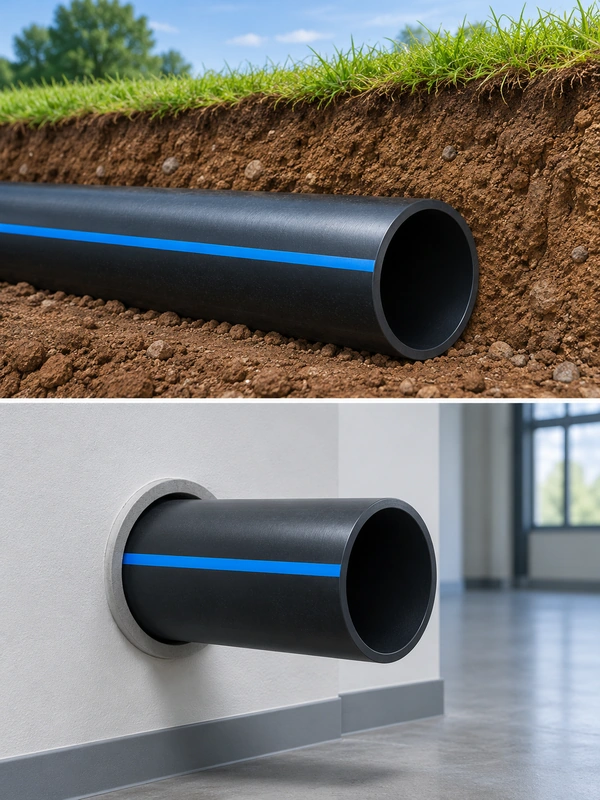
Sunlight exposure requires its own check. Compare the manufacturer’s outdoor exposure statement with both the operating environment and storage plan. A coil left outside during a delayed project may face a different exposure duration from that assumed in the quotation. Do not infer indefinite ultraviolet resistance from black color or copy an exposure limit from another HDPE product.
At building entry, assess the required fire classification and penetration treatment. An outdoor duct’s moisture resistance does not establish indoor fire suitability. FOA explains that cable construction must change with indoor and outdoor requirements; the pathway, fittings and penetration system require the same route-specific attention. Document where a transition occurs and who is responsible for supplying it.
Check the cable diameter against the smallest usable bore
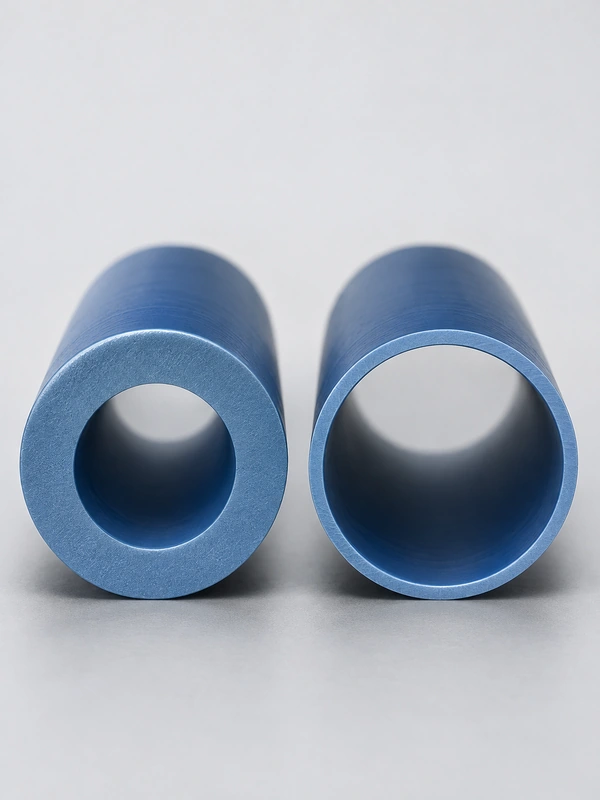
Fiber innerduct sizing begins with the selected cable’s maximum outside diameter and the duct’s minimum available inside diameter. Nominal size, outside diameter and bore are different quantities. For an ideal round solid-wall tube, ID equals OD minus twice the wall thickness, but manufacturing tolerances, internal ribs and deformation must also be considered.
An illustrative pair of ducts with a 32 mm outside diameter and walls of 2 mm and 3 mm would have calculated bores of 28 mm and 26 mm. These are hypothetical values, not catalog dimensions. The thicker wall reduces the available cross-sectional area by about 14 percent in that comparison. This explains why an unchanged outside size can still affect cable clearance.
The smallest passage may be at a coupling, reducer or damaged bend rather than in a straight duct sample. Include the pulling eye and any protective attachment in the clearance review. For cable blowing, use the selected cable-and-duct system’s recommended pairing, rather than adopting an electrical-conduit fill percentage as a blowing rule.
Check ovality and the condition of coiled duct after handling. A nominally round tube can become flattened by poor storage or an overly tight route. Acceptance should follow the supplier’s specified inspection or proving method and the project specification. A successful clearance check on a short sample does not establish that a completed route is continuous and clean.
| Selection item | Question for the supplier | Project consequence |
|---|---|---|
| Duct OD and tolerance | Which dimensions control coupling fit? | Incorrect grip or sealing at joints |
| Minimum usable ID | What clearance remains after wall and tolerance allowances? | Cable or pulling attachment may not pass |
| Wall and sheath construction | What installation is this construction intended for? | Different handling and burial requirements |
| Cable limits | What diameter, bend radius and pull load apply? | Installation may damage an otherwise suitable cable |
| Installation method | Is this pairing intended for pulling or blowing? | Equipment and joint requirements change |
Order couplings, seals and closures as part of the route
A continuous duct route requires more than reels of tube. Count the planned joints, changes of duct size, spare ends, cable exits and branch locations. Identify which fiber innerduct fittings merely connect duct sections and which must seal around an installed cable. A gas-block connector and an empty-duct end cap serve different purposes.
Review outdoor duct coupler selection alongside the duct specification. The accessory needs to match actual dimensions and the environment at its location. A connector sheltered inside a cabinet and one exposed in an underground chamber may require different supporting evidence, even if the duct diameter is identical.
For a blowing route, ask for the operating conditions of the complete assembly. A short-duration pressure test printed on one component is not automatically its continuous operating limit, nor does it raise the limit of another component. Establish the agreed installation conditions from the cable, duct, connection and equipment instructions together.
Keep spare parts specific. Record the approved part number and supported duct or cable ranges rather than listing a generic connector in the maintenance schedule. If a joint later leaks, use a structured fiber duct connector leak check to distinguish preparation problems, damaged tubing and an unsuitable component before replacing the whole route.
Inspect the route before pulling or blowing fiber
FOA’s installation guidance starts with route assessment and the cable manufacturer’s handling limits. Confirm that the installed pathway reaches the correct destination, has usable access at both ends and contains no undocumented change of size. Review the as-built route, not only the initial design drawing.
Inspect exposed ends and accessible joints for contamination, damage and alignment. Use the specified cleaning and proving procedure to assess the enclosed route. A passing obstruction check, a pressure check and an optical cable test answer different questions. Do not treat one result as a substitute for the others or improvise pressure values without the system instructions.
For a pull, verify rope or tape rating, cable attachment, compatible lubricant and tension control. FOA cautions against pulling by the jacket unless the cable design and approved grip allow it. For blowing, confirm equipment setup, cable handling and the condition of the air path. Record the applicable cable bend radius under installation tension separately from the relaxed storage limit.
Check the handoff between civil works and cable installation. The crew receiving the route needs duct identifiers, joint locations, test records and any unresolved defects. A route accepted as buried infrastructure may still need preparation before cable installation, especially if ends were left open or another contractor subsequently worked in the chambers.
Compare installed cost and supplier documents before placing the order
The lowest material price does not necessarily give the lowest installed cost. Include accessory quantities, reel handling, route preparation, installation equipment, proving and the cost of replacing a damaged section. Avoid assigning a universal savings percentage: labor access and the cost of reopening the route differ substantially between projects.
For a staged rollout, compare two explicit options: installing the final cable capacity immediately or reserving additional usable pathways for later cables. FOA’s air-blown fiber discussion notes that spare tubes have value only when sufficient routes are installed initially, and that the alternative of installing extra fibers at the outset also deserves consideration.
| Quotation section | Required detail | How to compare offers |
|---|---|---|
| Duct supply | Dimensional system, wall type, lengths and tolerances | Compare the same usable route, not just nominal size |
| Аксессуарлар | Exact couplings, caps, transitions and closures | Check whether every route endpoint is covered |
| Шайкештик | Applicable standard edition, listing and product identification | Match evidence to the supplied item and intended use |
| Installation | Handling limits, proving method and equipment needs | Include labor and acceptance work in the estimate |
| Future additions | Spare paths, records and maintenance access | Assess realistic expansion work and cost |
PPI’s 2019 TN-50 edition is useful for understanding standards scope and dimensional terminology, but it is not a substitute for the current contract edition or local requirements. Request the current product drawing and applicable declarations. Do not combine a certificate for one construction with a quotation for another wall thickness or application.
ANMASPC’s published two-way 14/10 mm tube page illustrates another distinction: individual microduct size and the overall bundle envelope are separate dimensions. State both in a procurement request. The cable travels through an individual channel, while the bundle envelope determines installation space and handling clearances.
Көп берилүүчү суроолор
What is HDPE innerduct used for in a fiber network?
It provides a protected, identifiable path for fiber cable and can reserve routes for expansion. It is often placed inside a larger conduit, although some products are intended for other installation methods. Confirm the intended use of the exact construction.
How do I choose fiber innerduct sizes?
Compare cable OD, duct minimum bore, pulling attachment size, route bends and the installation method. Check actual dimensions and tolerances rather than nominal size alone. Cable blowing requires a supported cable-and-duct pairing, not just visible clearance at the entrance.
Which fiber innerduct fittings are needed for a continuous route?
Typical requirements include compatible couplings, end caps and appropriate transitions or seals at cable exits. Branch routes may need a suitable closure. The exact list depends on the route and whether it must support cable blowing.
How does the installation environment affect innerduct selection?
Burial, sunlight, indoor fire classification and mechanical exposure change what must be verified. A protected duct inside another conduit is not in the same situation as an exposed riser. Evaluate each route segment before approving a product.
Can HDPE innerduct protect outdoor fiber cable?
Yes, when the duct and cable are both selected for the proposed outdoor installation. The duct does not make an indoor-only cable suitable for a wet underground environment. Confirm the complete route, joints and entry conditions.
What information should I give a fiber innerduct supplier for a quotation?
Provide the cable diameter and construction, required duct dimensions, route environment, length, installation method and accessories. Include required standards, spare capacity and delivery lengths. Ask the supplier to identify any assumptions that affect product selection.
What should be checked before pulling fiber through innerduct?
Check continuity, cleanliness, access, joint condition, pulling provision and the cable’s bend and tension limits. Confirm the correct destination and a documented pulling plan. Resolve obstructions before applying higher pulling force.
Деректер
- Plastics Pipe Institute: Guide to Specifying HDPE Conduit, TN-50, 2019.
- Fiber Optic Association: Installing Fiber Optic Cable.
- Fiber Optic Association: Air Blown Fiber Installation.
- Fiber Optic Association: Fiber Optic Cable Construction.
Summary
A useful HDPE innerduct specification describes the whole cable route: environment, dimensions, accessories, installation limits and acceptance checks. Comparing those items makes differences between quotations visible and prevents nominal size from hiding a restricted bore or an unsuitable construction. Reserve expansion paths only where they can be identified, protected and reached later.
For a route requiring separate small fiber channels, review the two-way 14/10 mm HDPE microduct bundle and contact ANMASPC with your cable and route details to confirm the appropriate configuration.



