
“「FTTXの未来」というと、しばしば単に帯域幅の拡大という約束に矮小化されがちです。ネットワーク設計者は、より実用的な問いに向き合う必要があります。すなわち、アクセス経路のどの部分を今すぐ構築すべきか、どの容量は段階的に増設できるのか、そして、いかなるエビデンスがあればネットワークの保守運用を維持し続けられるのか、という点です。FTTXにはFTTH、FTTB、FTTC、FTTNなどが含まれるため、密集した集合住宅向けの手法が農村部のルートには適さないこともあります。本稿では、この広範なテーマを、光ファイバートラック、マイクロダクト、コネクタ、試運転に関する実践的な計画チェックへと落とし込んでいきます。.
FTTXの計画立案は、段階的な土木工事とより充実したルート記録に支えられた、より深く柔軟な光ファイバーアクセスにますます依存するようになっています。高容量の固定アクセスに対する需要は公的な接続状況報告にも記載されていますが、いずれの報告も具体的なコネクタを選定したり、プロジェクト設計を実証したりしていません。計画担当者は、サービス目標、対象地域、経路、ダクトの寸法、ケーブル敷設手法、受入試験の順でこれらを確定すべきです。.
FTTXには何が含まれますか?
FTTXとは、「Fiber to the X」の略で、Xは接続先を示し、それぞれ「Home(家庭)」「Building(建物)」「Curb(路上)」「Node(ノード)」を意味します。光ファイバーがユーザーに近づくほど、末端までの配信経路における光伝送部分の割合が増加しますが、導入条件は地域ごとに異なります。ネットワーク事業者は、すべての地域で同一の方式を強制するのではなく、地区ごとに異なるアーキテクチャを組み合わせて運用することもあります。.
| 建築 | ファイバーエンドポイント | 計画に関する質問 |
|---|---|---|
| FTTH | 自宅または敷地 | ドロップおよび建物内経路は設置および保守が可能ですか? |
| FTTB | 建物 | ライザーおよび最終顧客への配布はどのように管理されますか? |
| FTTC | 路上設置型キャビネット | 残存する銅線網またはアクセスセグメントはどのようなもので、どのようにアップグレードされますか? |
| FTTN | 近隣ノード | どのローカルセグメントが容量と保守効率を制限していますか? |
どのFTTXトレンドが調達およびルート計画に影響を与えますか?
4つのトレンドは、エンジニアリングに直接的な影響を及ぼします。第一に、需要とインフラ整備の経済性が見合う地域では、事業者が光ファイバー網をより深く展開しています。第二に、段階的な敷設では、後から追加するケーブルのために掘削が必要にならないよう、予備のラベル付きルートに依存するケースが増えています。第三に、農村部やサービス供給が不十分な地域におけるプロジェクトでは、単一のピーク速度の主張よりも、路線の延長距離やアクセス、保守・修理のロジスティクスが重視されています。第四に、複数の施工業者が同一ルートを共有する場合、事業者は追跡可能な施工記録を必要としています。.
欧州委員会の デジタル・ディケイドの現状 2025 レポート 欧州のコネクティビティの進展に関する一般的な背景情報を提供します。これは、地域ごとの需要や製品の適合性、あるいは普遍的な導入手法を確立するものではありませんので、部品表としてではなく、市場状況を把握するための参考情報としてご活用ください。.
現在 FTTxの動向, カバレッジレポートや設備投資予測は、実務上の計画上の課題を提起します。事業者は、より深いファイバー網がどこで価値を生むのか、また段階的な展開がどの時点で選択肢を維持できるのかを判断しなければなりません。プライズミアンとアナリシス・メイソンはFTTH/FTTxのさらなる拡張について議論していますが、市場予測だけでは個々の地域における資材リストは決まりません。ルート計画には依然として、建物への接続条件、土木工事のアクセス、電力供給、保守作業のロジスティクス、そして文書化された引き渡し境界が必要です。.
| 観測された計画上の圧力 | それが生み出す決定 | 証拠が必要 |
|---|---|---|
| 大容量アクセスに対する需要の増加 | 段階的な導入によるより深いファイバーの比較 | 需要、サービス対象および光学設計 |
| 土木工事費の高さ | アクセス可能な予備経路を確保する | ダクトスケジュール、チャンバーのアクセスおよび閉鎖記録 |
| 混在する既存プラント | 再利用前に遷移を測定してください | 外径/内径、材質、継手および試験データ |
| 農村部または困難な地形 | 値の修復アクセスとセクションの長さ | 在庫、アクセスポイント、および物流の最適化 |
カバレッジ数値は文脈の中で捉えてください。カバレッジの統計値は、定められた手法に基づく配線通過件数またはネットワークの利用可能状況を示すものであり、契約数、提供速度、あるいは予備のダクトが新しいケーブルの敷設に即時対応可能であるという保証を意味するものではありません。拡張を承認する前に、目的とする経路について、回線の連続性、アクセス権、寸法、ラベル、閉塞装置の状態、および試験記録を必ず確認してください。.
適合する境界線には、サイトの 製品カタログ ストレート、レデューサー、エンドストップ、またはガスブロックの機能を選択した後でのみ。 HDPEマイクロダクト経路 および関連する FTTx受入ガイド 市場予測を製品の主張に変えることなく、土木、ダクト、光ファイバーの記録をつなげるのに役立ちます。.
欧州の最新カバレッジレポートは、ルートプランナーに何を示しているのでしょうか?
欧州委員会の ヨーロッパの接続性カバレッジ 2025 レポート, published in the Digital Decade 2026 package and last updated on 24 August 2026, reports EU27 FTTP coverage of 74.1% and fixed very-high-capacity-network coverage of 85.6%. Its observation period is mid-2025. These are coverage measures, not subscription rates, measurements of delivered speed or forecasts for October 2026.
その違いは使用する際に重要です FTTPのカバレッジデータ ビジネスケースにおいて、固定VHCNとFTTPは互換性のあるカテゴリではありません。また、本報告書では、人口密度が低く地理的に困難な地域において、固定無線アクセスへの依存度が高まっていることが示されています。さらに、XGS-PONが常に最適な農村向けソリューションであるとは断定していません。機器を選定する際には、地域の住所、サービス要件、既存インフラ、光設計、保守アクセスなどを考慮し、候補となるアーキテクチャを比較検討してください。.
ルートには、より大容量の光ファイバーを採用すべき場合と、段階的な展開を行うべき場合があります。
| プロジェクトの状態 | 応答の計画 | Proof to retain |
|---|---|---|
| Dense urban access with repeat work risk | Prioritize accessible spare microduct capacity and clear labeling | Route drawing, duct schedule and chamber records |
| Rural or long route | Compare civil cost, blowing sections and repair access | Section lengths, bend inventory and test results |
| Mixed legacy and new ducts | Measure actual OD/ID and map each connector transition | Sample measurements and compatibility matrix |
| Building retrofit | Coordinate riser, endpoint power and fire/local-code review | Building survey and approved method statement |
を使用してください 製品カタログ only after the duct dimensions and function are known. Straight, reducer, end-stop and gas-block functions are not interchangeable; the fitting should match the route transition and the required environmental boundary.
How should spare microduct capacity be verified before expansion?
Count usable pathways, not just empty tubes shown on an old drawing. As a planning checklist, verify the intended duct is continuous to the required access points, appropriately closed, dimensionally compatible and available under the owner’s access arrangements. Match labels in chambers to the as-built schedule and record inaccessible or unverified sections separately. A spare duct is an expansion option, not proof that a later cable can be installed without further work.
For a proposed staged fibre rollout, separate installed civil capacity, qualified cable pathways and commissioned optical service in the project schedule. That prevents a civil-work completion figure from being presented as a ready-to-connect premises count. Use the FTTX architecture and acceptance guide to define the handover boundary for each stage, and retain evidence for any claimed cost reduction rather than inserting a universal civil-cost percentage.
Why do connector and duct records matter to future FTTX?
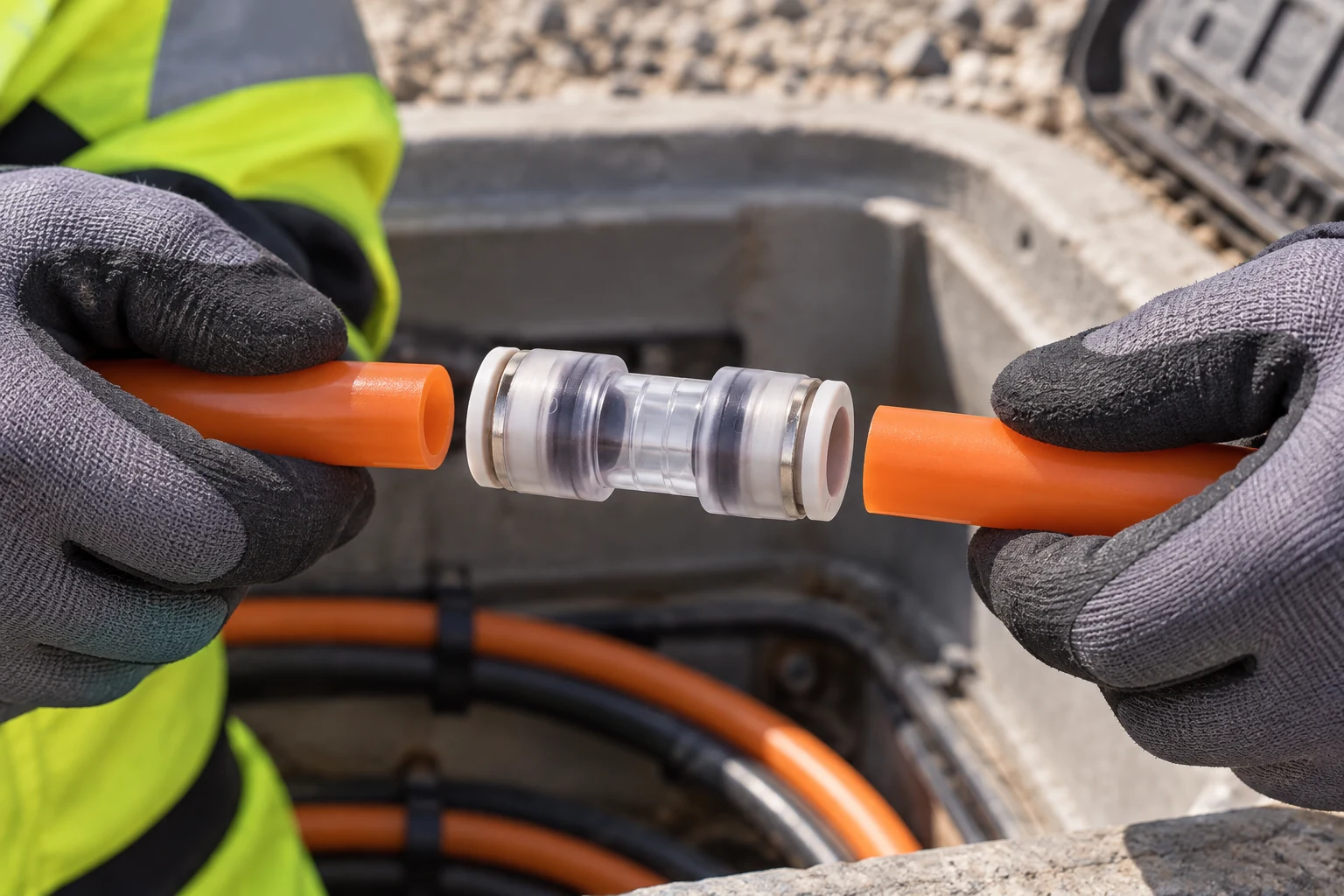
A fiber route is easier to expand when every joint can be identified and tested. Before cable blowing, inspect square duct cuts, full insertion and the condition of the visible sealing area. Confirm the connector’s approved OD range, document the pressure or leakage method selected by the project, and record each transition. IEC 60794-5-20 addresses microduct fibre units, microducts and protected microducts installed by blowing. Its cable-system scope does not establish a universal field pressure or certify an arbitrary connector. Keep the supplier’s exact configuration and the network owner’s acceptance method with the route record.

What should be tested before an FTTX section is accepted?
Test a representative assembled section before production quantities are released. Confirm duct continuity, route access, connector seating, temporary caps, pressure stabilization and the agreed hold period. Record the cable and duct identifiers, weather or temperature conditions where relevant, gauge readings and any intervention. A pressure drop can come from a joint, test equipment or temperature change; isolate sections before replacing hardware.
How should a network plan respond when its assumptions change?
Keep the demand assumptions, architecture decision and pathway qualification separate in the project record. A new coverage report may update the market context without changing the measured condition of a local duct. Conversely, a newly discovered blockage can change the installation plan even when the demand forecast is unchanged. Identify which evidence has changed before revising the bill of materials.
For each expansion stage, record the addresses or sections in scope, the route owner, access arrangements and outstanding checks. Link procurement to those boundaries so that a planned spare pathway is not treated as qualified capacity merely because it appears on a drawing. Review the selected connector function and duct dimensions before substitutions, and keep the accepted drawing revision with the order.
Use the next handover to close the gap between planned and actual capacity. Record which pathways were verified, which cables were installed and which optical services passed their specified checks. Where a section remains inaccessible or untested, state that limitation in the schedule. This gives later planners a clearer starting point than a single completion percentage and helps them distinguish an expansion opportunity from a ready-to-use route.
よくある質問
Will FTTH replace every other FTTX architecture?
No. Architecture depends on density, civil cost, building access, existing assets and the service target.
Is more fiber always the cheapest long-term option?
No. Compare civil work, pathway access, maintenance, power, spares and future additions rather than cable count alone.
Why are microducts used in staged FTTX builds?
They can reserve organized pathways for later cable placement, provided the route remains accessible, sealed, labeled and dimensionally compatible.
What is the main risk in mixed legacy routes?
Nominal labels may hide different outside diameters, materials or joint conditions. Measure a representative sample and qualify the transition.
Do standards certify a complete FTTX network?
No. Standards define the scope of a method or component requirement. The owner still needs configuration-specific evidence and acceptance tests.
What is the most useful trend metric for a buyer?
Use route-specific demand, civil cost, serviceability and staged capacity. Do not substitute a global forecast for a project measurement.
Is the 2026 report based on coverage measured during all of 2026?
No. The Commission’s Connectivity Coverage in Europe 2025 report belongs to the 2026 Digital Decade package but reports coverage as of mid-2025. State both the publication context and observation period when quoting its figures.
Does an empty microduct guarantee room for the next cable?
No. Check continuity, actual dimensions, closure condition, access rights and route availability. Treat undocumented sections as unverified capacity until the project-specific checks are complete.
Does a higher FTTx forecast prove local demand?
No. Forecasts provide market context. Address-level demand, civil access and the service plan determine the local decision.
参考文献
- European Commission, State of the Digital Decade 2025
- IEC 60794-5-20: microduct fibre units and microducts installed by blowing
- IEC standards portal (verify the applicable 60794-5 edition)
- Prysmian FTTH/B and FTTx market context
- Analysys Mason FTTx coverage and capex scope
要約
FTTX planning should connect demand and coverage evidence to a route that can be built, tested and maintained. Choose deeper fiber or staged deployment from local conditions, verify spare pathways before counting them as usable capacity, and retain duct, connector and optical acceptance records. Review the 製品ラインナップ against those measured requirements. Market growth provides context; the qualified route and service boundary determine what the project can deliver.



