
“El futuro de la FTTX” a menudo se reduce a la promesa de mayor ancho de banda. Los planificadores de redes enfrentan una pregunta más útil: ¿qué tramos de la ruta de acceso deben construirse ahora, qué capacidad puede implementarse por etapas y qué medidas garantizarán el mantenimiento de la red? La FTTX incluye FTTH, FTTB, FTTC y FTTN, por lo que una tendencia que beneficia a un edificio de apartamentos muy denso podría no ser adecuada para una ruta rural. Este artículo desglosa este tema amplio en comprobaciones prácticas de planificación para los recorridos de fibra óptica, los microconductos, los conectores y la puesta en servicio.
La planificación de FTTX depende cada vez más de una red de acceso de fibra más profunda y adaptable, respaldada por trabajos civiles escalonados y registros de rutas más precisos. La demanda de acceso fijo de alta capacidad está documentada en los informes públicos sobre conectividad, pero ninguno de esos informes especifica un conector ni valida el diseño del proyecto. Los planificadores deben definir, en ese orden, el objetivo del servicio, la zona geográfica, la ruta, las dimensiones de los conductos, el método de instalación del cable y las pruebas de aceptación.
¿Qué incluye FTTX?
FTTX significa Fibra hasta el X, donde X identifica el punto final: Hogar, Edificio, Bordillo o Nodo. Cuanto más cerca llegue la fibra al usuario, mayor será la parte de la red de distribución local que sea óptica, pero las condiciones de despliegue varían. Un operador de red puede combinar diferentes arquitecturas en distintos barrios en lugar de imponer un único modelo en todos los lugares.
| Arquitectura | Punto final de fibra | Pregunta de planificación |
|---|---|---|
| FTTH | Hogar o local | ¿Se pueden instalar y mantener la ruta de caída y la ruta interior del edificio? |
| FTTB | Construcción | ¿Cómo se gestionarán la rampa de distribución y la distribución final a los clientes? |
| FTTC | Gabinete en la acera | ¿Qué segmento de cobre o de acceso queda, y cómo se actualizará? |
| FTTN | Nodo de vecindario | ¿Qué segmento local limita la capacidad y la eficiencia del mantenimiento? |
¿Qué tendencias de FTTX afectan a la adquisición y la planificación de rutas?
Cuatro tendencias tienen consecuencias directas para la ingeniería. En primer lugar, los operadores están extendiendo la fibra óptica a distancias mayores allí donde la demanda y la viabilidad económica lo permiten. En segundo lugar, las implementaciones por etapas dependen cada vez más de vías reservadas y etiquetadas, de modo que los cables posteriores no requieran excavación. En tercer lugar, en los proyectos rurales y en zonas desatendidas se otorga mayor importancia a la longitud del trazado, al acceso y a la logística de reparación que a una sola afirmación sobre la velocidad máxima. En cuarto lugar, los operadores necesitan registros de instalación trazables cuando varios contratistas comparten una misma ruta.
La Comisión Europea Informe del Estado de la Década Digital 2025 Proporciona un contexto público sobre los avances en conectividad europea. No establece la demanda local, la conformidad del producto ni un método de despliegue universal, por lo que debe utilizarse como referencia de mercado más que como una lista de materiales.
Actual Tendencias de FTTx, Los informes de cobertura y las previsiones de gastos de capital plantean una cuestión práctica de planificación: los operadores deben decidir dónde el despliegue de fibra más profunda genera valor y dónde una estrategia gradual preserva opciones. Prysmian y Analysys Mason analizan la continua expansión de FTTH/FTTx, pero las proyecciones de mercado no determinan la lista de materiales local. Un planificador de rutas sigue necesitando datos sobre las instalaciones, acceso civil, suministro eléctrico, logística de reparación y un límite de entrega documentado.
| Observed planning pressure | Decision it creates | Se necesitan pruebas |
|---|---|---|
| More demand for high-capacity access | Compare deeper fiber with staged deployment | Address demand, service target and optical design |
| High civil-work cost | Reserve accessible spare pathways | Duct schedule, chamber access and closure records |
| Mixed legacy plant | Measure transitions before reuse | OD/ID, material, joint and test data |
| Rural or difficult terrain | Value repair access and section length | Bend inventory, access points and logistics |
Keep coverage numbers in context. A coverage statistic describes premises passed or network availability under a defined methodology; it is not the same as subscriptions, delivered speed or a guarantee that a spare duct is ready for a new cable. Before approving an expansion, verify continuity, access rights, dimensions, labels, closure condition and the test record for the intended pathway.
For the fitting boundary, use the site’s catálogo de productos only after choosing straight, reducer, end-stop or gas-block function. The Vía de microconductos de HDPE and related FTTx acceptance guide help connect civil, duct and optical records without turning a market forecast into a product claim.
What does Europe’s latest coverage report tell a route planner?
La Comisión Europea Connectivity Coverage in Europe 2025 report, published in the Digital Decade 2026 package and last updated on 24 August 2026, reports EU27 FTTP coverage of 74.1% and fixed very-high-capacity-network coverage of 85.6%. Its observation period is mid-2025. These are coverage measures, not subscription rates, measurements of delivered speed or forecasts for October 2026.
The distinction matters when using FTTP coverage data in a business case. Fixed VHCN and FTTP are not interchangeable categories. The report also describes greater reliance on fixed wireless access in low-density and geographically difficult areas. It does not establish that XGS-PON is always the best rural solution. Compare the candidate architecture against local addresses, service requirements, available infrastructure, optical design and repair access before choosing equipment.
When should a route use deeper fiber or a staged deployment?
| Condición del proyecto | Planning response | Proof to retain |
|---|---|---|
| Dense urban access with repeat work risk | Prioritize accessible spare microduct capacity and clear labeling | Route drawing, duct schedule and chamber records |
| Rural or long route | Compare civil cost, blowing sections and repair access | Section lengths, bend inventory and test results |
| Mixed legacy and new ducts | Measure actual OD/ID and map each connector transition | Sample measurements and compatibility matrix |
| Building retrofit | Coordinate riser, endpoint power and fire/local-code review | Building survey and approved method statement |
Utilice el catálogo de productos only after the duct dimensions and function are known. Straight, reducer, end-stop and gas-block functions are not interchangeable; the fitting should match the route transition and the required environmental boundary.
How should spare microduct capacity be verified before expansion?
Count usable pathways, not just empty tubes shown on an old drawing. As a planning checklist, verify the intended duct is continuous to the required access points, appropriately closed, dimensionally compatible and available under the owner’s access arrangements. Match labels in chambers to the as-built schedule and record inaccessible or unverified sections separately. A spare duct is an expansion option, not proof that a later cable can be installed without further work.
For a proposed staged fibre rollout, separate installed civil capacity, qualified cable pathways and commissioned optical service in the project schedule. That prevents a civil-work completion figure from being presented as a ready-to-connect premises count. Use the FTTX architecture and acceptance guide to define the handover boundary for each stage, and retain evidence for any claimed cost reduction rather than inserting a universal civil-cost percentage.
Why do connector and duct records matter to future FTTX?
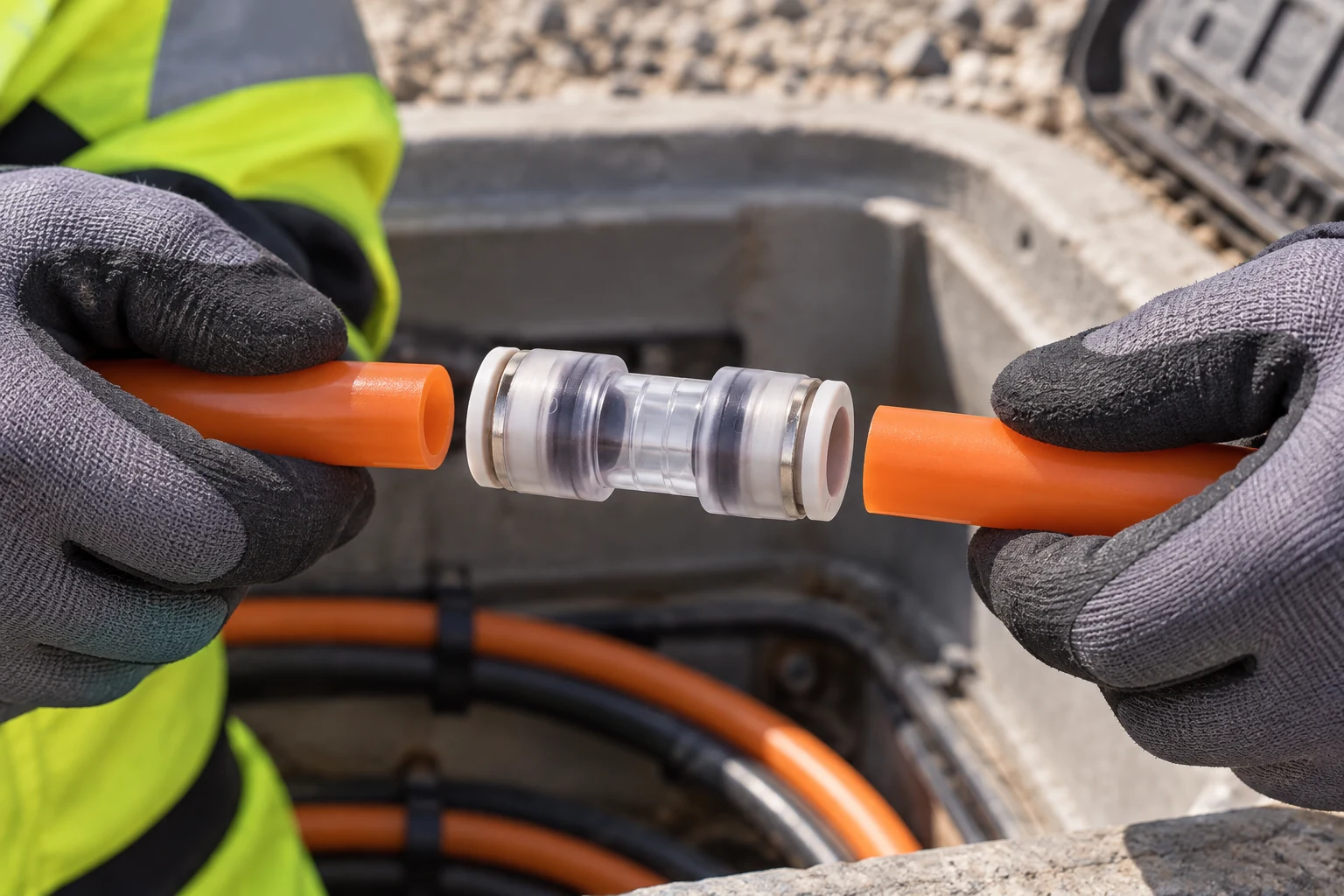
A fiber route is easier to expand when every joint can be identified and tested. Before cable blowing, inspect square duct cuts, full insertion and the condition of the visible sealing area. Confirm the connector’s approved OD range, document the pressure or leakage method selected by the project, and record each transition. IEC 60794-5-20 addresses microduct fibre units, microducts and protected microducts installed by blowing. Its cable-system scope does not establish a universal field pressure or certify an arbitrary connector. Keep the supplier’s exact configuration and the network owner’s acceptance method with the route record.

What should be tested before an FTTX section is accepted?
Test a representative assembled section before production quantities are released. Confirm duct continuity, route access, connector seating, temporary caps, pressure stabilization and the agreed hold period. Record the cable and duct identifiers, weather or temperature conditions where relevant, gauge readings and any intervention. A pressure drop can come from a joint, test equipment or temperature change; isolate sections before replacing hardware.
How should a network plan respond when its assumptions change?
Keep the demand assumptions, architecture decision and pathway qualification separate in the project record. A new coverage report may update the market context without changing the measured condition of a local duct. Conversely, a newly discovered blockage can change the installation plan even when the demand forecast is unchanged. Identify which evidence has changed before revising the bill of materials.
For each expansion stage, record the addresses or sections in scope, the route owner, access arrangements and outstanding checks. Link procurement to those boundaries so that a planned spare pathway is not treated as qualified capacity merely because it appears on a drawing. Review the selected connector function and duct dimensions before substitutions, and keep the accepted drawing revision with the order.
Use the next handover to close the gap between planned and actual capacity. Record which pathways were verified, which cables were installed and which optical services passed their specified checks. Where a section remains inaccessible or untested, state that limitation in the schedule. This gives later planners a clearer starting point than a single completion percentage and helps them distinguish an expansion opportunity from a ready-to-use route.
Preguntas frecuentes
Will FTTH replace every other FTTX architecture?
No. Architecture depends on density, civil cost, building access, existing assets and the service target.
Is more fiber always the cheapest long-term option?
No. Compare civil work, pathway access, maintenance, power, spares and future additions rather than cable count alone.
Why are microducts used in staged FTTX builds?
They can reserve organized pathways for later cable placement, provided the route remains accessible, sealed, labeled and dimensionally compatible.
What is the main risk in mixed legacy routes?
Nominal labels may hide different outside diameters, materials or joint conditions. Measure a representative sample and qualify the transition.
Do standards certify a complete FTTX network?
No. Standards define the scope of a method or component requirement. The owner still needs configuration-specific evidence and acceptance tests.
What is the most useful trend metric for a buyer?
Use route-specific demand, civil cost, serviceability and staged capacity. Do not substitute a global forecast for a project measurement.
Is the 2026 report based on coverage measured during all of 2026?
No. The Commission’s Connectivity Coverage in Europe 2025 report belongs to the 2026 Digital Decade package but reports coverage as of mid-2025. State both the publication context and observation period when quoting its figures.
Does an empty microduct guarantee room for the next cable?
No. Check continuity, actual dimensions, closure condition, access rights and route availability. Treat undocumented sections as unverified capacity until the project-specific checks are complete.
¿Una previsión más alta de FTTx demuestra la demanda local?
No. Las previsiones aportan el contexto del mercado. La demanda a nivel de dirección, el acceso civil y el plan de servicio determinan la decisión local.
Referencias
- Comisión Europea, Estado de la Década Digital 2025
- IEC 60794-5-20: microduct fibre units and microducts installed by blowing
- IEC standards portal (verify the applicable 60794-5 edition)
- Prysmian FTTH/B and FTTx market context
- Analysys Mason FTTx coverage and capex scope
Resumen
FTTX planning should connect demand and coverage evidence to a route that can be built, tested and maintained. Choose deeper fiber or staged deployment from local conditions, verify spare pathways before counting them as usable capacity, and retain duct, connector and optical acceptance records. Review the gama de productos against those measured requirements. Market growth provides context; the qualified route and service boundary determine what the project can deliver.



