
Quando Maya, un ingegnere della manutenzione a Birmingham, ha riavviato una cella di confezionamento dopo una sostituzione del raccordo, l’attuatore si è bloccato e in pochi minuti si è sentito un sibilo al collettore. Questo è uno scenario illustrativo di messa in servizio, non un caso segnalato da un cliente. La prima reazione è stata quella di serrare il connettore, ma la soluzione più efficace è stata un’altra: il raccordo non era necessariamente difettoso; la porta era stata specificata come “1/4 pollici” senza verificare se fosse BSP, BSPT o NPT, e il tubo di ricambio non era stato controllato per il diametro esterno (OD). Questa guida mostra come abbinare tali interfacce, controllare i percorsi di perdita e documentare un collegamento pneumatico prima che raggiunga la linea dell’aria.
La risposta breve è: Confermare il Diametro esterno del tubo e le condizioni di esercizio, identificare la famiglia di filettature da un disegno o da un calibro verificato, quindi controllare i limiti di pressione e temperatura documentati del raccordo per l’intero assemblaggio. BSPP, BSPT e NPT sono sistemi di filettatura diversi; una dimensione nominale simile non è garanzia di compatibilità. ISO 4414:2010 integra la scelta dei componenti nel processo di progettazione sicura di un sistema pneumatico, pertanto si raccomanda di annotare sul documento d’acquisto il tubo, la filettatura, le condizioni di servizio e il controllo di accettazione prima dell’installazione.
Perché un raccordo a innesto può guastarsi anche quando la dimensione nominale sembra corretta?
Un raccordo a innesto rapido presenta due interfacce che devono essere controllate separatamente. Il tubo entra in una boccola e nella guarnizione, mentre il lato filettato si accoppia con una porta della macchina, un collettore o una valvola. Un’etichetta nominale “6 mm,” “1/4 inch” o “G1/4” può descrivere solo un lato di tale assemblaggio. Un tubo può essere troppo grande per essere inserito correttamente, troppo piccolo per una tenuta affidabile, ovalizzato dopo il taglio o graffiato nel punto in cui la guarnizione lo tocca.
L’interfaccia filettata determina un diverso percorso di guasto. BSPP (spesso contrassegnato con G), BSPT (spesso contrassegnato con R) e NPT utilizzano geometrie delle filettature e tecniche di tenuta differenti. Una corrispondenza approssimativa potrebbe avvitarsi a mano ma comunque causare l’avvitamento incrociato, raggiungere il fondo prematuramente o lasciare un percorso di perdita a spirale. Il disegno del porto, il manuale dell’apparecchiatura, la marcatura del componente smontato o uno strumento di misura verificato devono identificare la famiglia di filettature e la dimensione nominale; una misurazione del diametro esterno da sola non è sufficiente.
La perdita di flusso può anche essere erroneamente diagnosticata come un problema del raccordo. Un gomito con una sezione di passaggio ristretta, un filtro contaminato, una valvola sottodimensionata o un lungo tratto di tubo possono causare una caduta di pressione a monte dell’attuatore. Esaminare raccordo, tubo, regolatore e valvola come un unico percorso d’aria collegato. Il Gamma di componenti pneumatici È un punto di riferimento utile per confrontare le configurazioni dei componenti, ma la scelta definitiva richiede comunque i dati relativi alle porte e ai servizi del produttore dell’apparecchiatura.
Come devono gli ingegneri abbinare il diametro esterno del tubo al raccordo?
Inizia dalle specifiche del tubo installato anziché dalla confezione del raccordo. Annota il diametro esterno effettivo, il sistema di unità di misura, il materiale del tubo, la struttura della parete e la tolleranza fornita dal produttore. In caso di sostituzione, confronta la marcatura sul tubo o la distinta materiali controllata con la descrizione riportata nel catalogo dei raccordi. Un tubo metrico e un tubo in pollici non devono essere intercambiati, poiché i loro valori nominali possono sembrare simili.
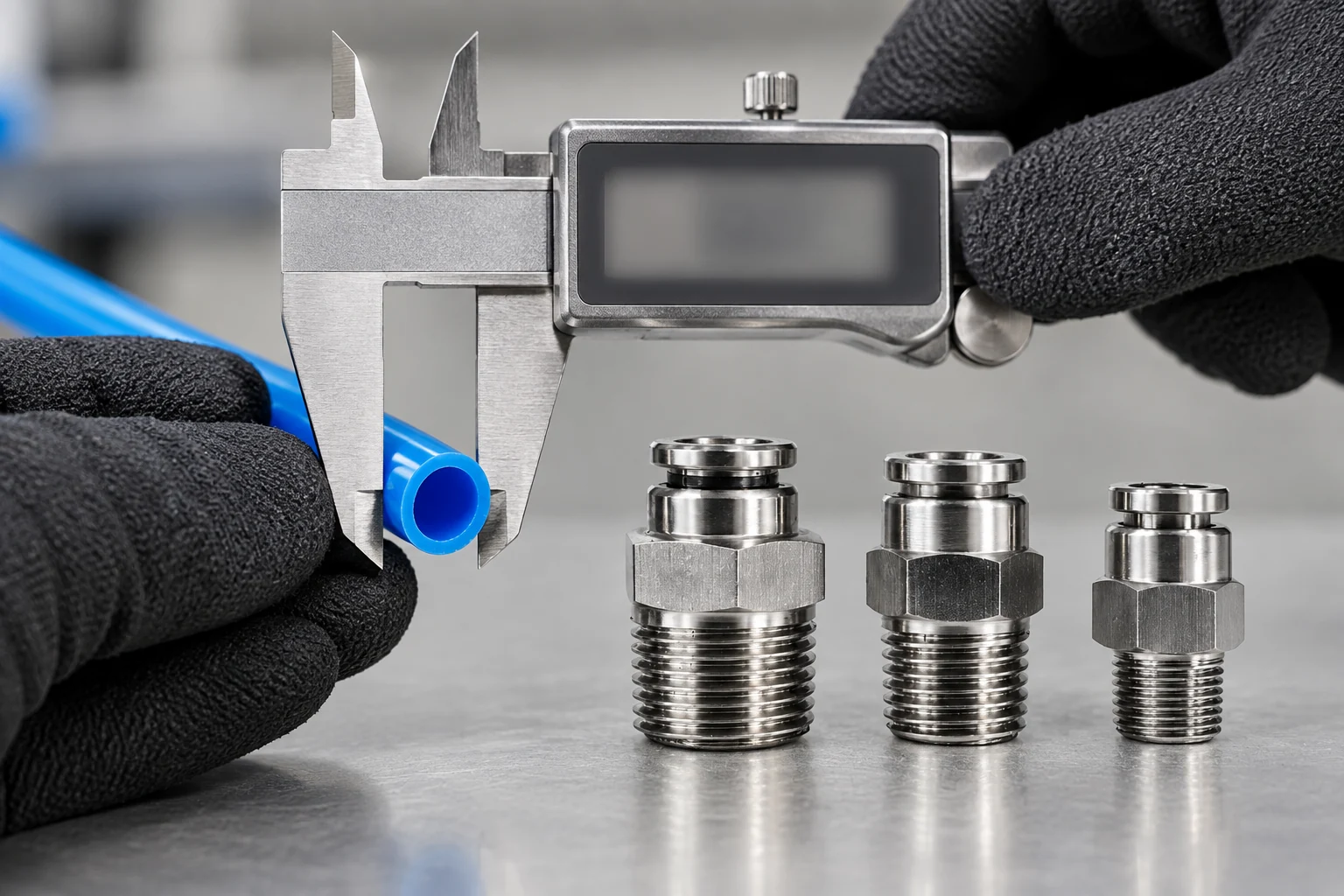
| Punto di controllo | Prove da registrare | Perché è importante |
|---|---|---|
| Diametro esterno del tubo | Diametro esterno nominale, unità, materiale e tolleranza del fornitore | Determina se il mandrino a morse e la guarnizione sono in grado di trattenere il tubo. |
| Estremità del tubo | Taglio quadrato, bordo netto, senza schiacciamenti né graffi longitudinali | Fornisce una superficie di tenuta uniforme e la profondità di inserimento completa. |
| Filettatura della porta | BSPP/G, BSPT/R o NPT; dimensione nominale; riferimento al disegno o al pezzo smontato | Previene l’avvitamento incrociato e una tenuta filettata poco affidabile |
| Geometria di montaggio | Forma diritta, a gomito, a T, a paratia o a collettore | Mantiene il raggio di curvatura, l’accesso per le chiavi e il percorso di flusso previsto. |
Tagliare il tubo in modo perfettamente perpendicolare con un utensile adeguato e verificare la circonferenza prima dell’inserimento. Non smussare eccessivamente l’estremità né lasciare un taglio a forma di cuneo, a meno che il produttore del tubo non lo consenta espressamente. Inserire il tubo diritto fino al punto di arresto indicato, quindi effettuare il controllo di tenuta consigliato dal fornitore. Una leggera prova di trazione può confermare il montaggio, ma non sostituisce le prove di pressione o tenuta prescritte dal progetto. Se il tubo ruota eccessivamente, si sfila o si allenta quando si muove la linea, interrompere immediatamente e controllare il taglio, il diametro esterno e il morsetto anziché serrare il tubo con forza.
Come si distinguono gli attacchi BSP, BSPT e NPT?
L’identificazione del filetto deve provenire da una fonte controllata. Il BSPP è un filetto per tubi parallelo che comunemente utilizza una guarnizione a faccia, una rondella adesiva o un O-ring. Il BSPT è un filetto britannico per tubi conico, mentre il NPT è un sistema americano separato di filettature coniche per tubi, con un profilo e una base di calibrazione propri. Le loro denominazioni nominali possono apparire simili, ma passo, angolo dei fianchi e metodo di tenuta differiscono.
Utilizzare il disegno del raccordo, un calibro per filettature adeguato o l’identificazione fornita dal produttore; non dedurre la filettatura esclusivamente da una fotografia o dal solo diametro esterno. Registrare la forma maschio o femmina, la dimensione nominale, l’elemento di tenuta e le istruzioni di serraggio. Il sigillante per filettature non è un metodo di conversione. Deve essere compatibile con la filettatura e con il fluido identificati e non deve entrare nel circuito dell’aria né impedire il corretto accoppiamento del raccordo.
| Citazione del thread | Basic interface | Buyer verification |
|---|---|---|
| BSPP / G | Parallel thread with a specified face or bonded sealing arrangement | Standard del porto, rondella o O-ring, superficie di seduta e istruzioni di serraggio |
| BSPT / R | Tapered BSP thread using the specified sealing practice | Designazione maschio/femmina, regola del sigillante, innesto e profondità disponibile |
| NPT | Tapered US pipe-thread system with a different profile and gauge basis | NPT size, mating port, sealant compatibility and drawing or gauge evidence |
| Unconfirmed “inch” label | Nominal wording without a thread system | Pause the order and obtain a controlled identification before substitution |
The honest answer to “BSP or NPT?” is that neither is universally better. The correct choice is the thread already present in the equipment, unless the machine builder approves a documented port change. A fitting that threads in only a few turns or requires unusual force should be removed and identified again; forcing it can damage a manifold that is more expensive to repair than the connector.
Which pressure, temperature and flow details belong on the specification?
Pressure and temperature must be evaluated together. Ask for the fitting’s documented working range, test basis, temperature range, medium restrictions and any derating for the exact body, seal, tube and thread configuration. Do not turn a burst value, a short laboratory reading or a rating for another size into a continuous operating limit. ISO 4414:2010 addresses safe pneumatic fluid-power systems; it does not create a universal pressure rating for every commercial fitting.
Also record the actual air quality and environment: dry or lubricated air, water carryover, cleaning chemicals, outdoor exposure, heat near an actuator and repeated movement can all affect the body or seal. If the catalogue provides flow or pressure-drop data, use the supplier’s stated conditions and compare the entire circuit. If no curve is supplied, ask for one rather than inventing a flow-rate number from the tube OD.
For moving installations, route the tube so the connector is not carrying a bending load. Support long runs, preserve the specified bend radius and leave access to depress the release collar during maintenance. The Guida alla manutenzione dei raccordi pneumatici can help turn those checks into a repeatable inspection routine.

What changes for replacement parts and compatibility?
Replacement compatibility means more than matching a catalogue family name. Compare tube OD, thread form, body geometry, sealing interface, port depth, release access and flow direction where the component requires it. A visually similar elbow can have a different passage or wrench envelope, while a different seal compound may change chemical or temperature suitability.
Keep the removed-part label, new-part datasheet and fit check together. If one field is unknown, quarantine the substitute until the equipment owner or component supplier confirms it. Record the installation date, circuit location and acceptance check so the next maintenance technician does not have to identify the thread from memory. The directory dei prodotti can help locate a matching form factor, but the controlled drawing remains the approval document.
How do ISO 4414 and ISO 12100 affect procurement?
ISO 4414:2010 provides general rules and safety requirements for pneumatic fluid-power systems and their components. In procurement terms, the connector should be considered with isolation, stored energy, pressure control, routing and maintenance access. ISO 12100:2010 provides a machinery risk-assessment and risk-reduction framework; it helps the machine builder address unexpected movement, hose release and maintenance hazards. Neither standard should be presented as a product certification unless relevant conformity evidence exists.
The U.S. Department of Energy’s industrial compressed-air resources also treat leakage and pressure management as system issues. The commercial consequence is practical: require the thread designation, tube data, material information, pressure-temperature basis and installation instructions before approving a substitute. Tie those records to the technical file so future replacement decisions remain auditable.
What is a practical selection and installation checklist?
- Identify the interfaces: record tube OD, material, cut condition, thread family, nominal size and fitting geometry.
- Match the service: state normal and transient pressure, temperature, medium, vibration, chemicals and air quality.
- Check the flow path: compare the internal passage and geometry with the valve, regulator, actuator and tube run.
- Control installation: isolate stored energy, cut square, insert to the stop, confirm retention and support the route.
- Document acceptance: perform the approved leak or pressure check and retain the result by circuit location.
Oulu / ANMASPC (Zhejiang Oulu Automatic Equipment Co., Ltd.) supplies pneumatic push-in fittings, tubing, valves, cylinders and related parts for B2B sourcing. Treat that range as a starting point for a documented proposal: send the tube OD, port thread, service conditions, geometry and replacement requirement so the supplier can confirm a configuration rather than offer a visually similar connector. For a machine with multiple control functions, the Guida ai tipi di elettrovalvole can help keep valve and fitting decisions aligned.
What the latest thread-matching questions reveal
Google’s related questions continue to separate three decisions that are often mixed together: tube outside diameter, thread form and working limits. BSPP, BSPT and NPT should be identified from controlled drawings or datasheets; visual similarity is not proof of interchangeability. ISO 4414 and ISO 12100 help set the system-safety discipline, while the fitting datasheet remains the source for the exact pressure, temperature, media and flow limits.
For a replacement project, send the old fitting code or drawing, tube OD, thread callout, machine zone, service medium and operating conditions. The Gamma di componenti pneumatici e Guida alla manutenzione provide the internal path for matching the part without relying on a photo alone.
Domande frequenti
How do you check flow direction and airflow loss through the Push In Fittings?
Trace the air path from the regulator through the fitting, tube, valve and actuator, then compare the supplier’s passage or pressure-drop data at the actual service conditions. A directional component or restrictive elbow may need orientation shown on the assembly drawing. If no measured curve is available, record that limitation and ask the supplier rather than assigning a flow value from nominal size alone.
What signs show that the collet or O-ring in the Push In Fittings needs replacement?
A tube that backs out, rotates excessively, leaks after a clean square cut or shows damage at the sealing zone warrants inspection of the collet and O-ring. Depressurize and isolate the circuit, then compare the parts with the manufacturer’s service instructions. Replace components that are worn, contaminated, cut or no longer provide documented retention.
How do you match tube outside diameter to the Push In Fittings?
Use the tube marking, controlled specification or an approved measurement method to confirm the actual OD, units, material and tolerance. Compare those details with the fitting drawing, and inspect the end for ovality, scratches or contamination before insertion. A nominal label or a tube that “almost fits” is not sufficient evidence of compatibility.
How can you tell whether a Push In Fittings uses BSP, BSPT or NPT threads?
Use the equipment or fitting drawing, a verified thread gauge or written manufacturer identification. BSPP/G is parallel, BSPT/R is tapered and NPT is a separate tapered system; the nominal size alone cannot distinguish them reliably. Confirm the mating port, sealing method and tightening instruction before ordering.
Why does the Push In Fittings leak even after the fitting has been tightened?
Tightening the threaded side cannot correct a wrong thread form, undersized tube, damaged tube end, incomplete insertion, worn collet or unsuitable seal. Isolate the line, inspect both interfaces and replace any component outside the documented condition. Finish with the project’s approved leak or pressure check rather than relying on the absence of an audible hiss.
What working pressure and temperature should the Push In Fittings support?
The fitting, tube and seal should support the highest documented pressure and temperature of the complete circuit, including start-up, shutdown and cycling. Use the supplier’s value for the exact configuration, medium and installation method; do not transfer a rating from another size or material. Record the rating basis and any derating or environmental limits with the purchase documentation.
Does the same nominal thread size make BSP and NPT interchangeable?
No. Thread form, pitch, taper and sealing method can differ. Confirm the standard from the drawing or datasheet and use the approved adapter or fitting rather than forcing a visually similar thread.
What should be written on a push-in fitting replacement request?
State tube OD and material, port thread and standard, medium, pressure and temperature, motion or vibration, required orientation, quantity and the existing fitting code or drawing. Those fields let a supplier check the complete interface.
Riferimenti
- ISO 4414: Pneumatic fluid power – general rules and safety requirementsOfficial ISO standard page; system-safety boundary.
- ISO 12100: Sicurezza delle macchine – valutazione del rischio e riduzione del rischioOfficial ISO standard page; machinery-risk reference.
- ASME B1.20.1: Pipe Threads, General Purpose (Inch)Official ASME standard page; controlled thread identification reference.
Conclusione
A dependable Push In Fittings connection starts with identification, not tightening force. Confirm the tube OD and cut condition, identify BSPP, BSPT or NPT from controlled information, and compare the exact pressure and temperature duty with the supplier’s documented limits. Then check the flow path, geometry, vibration support and replacement interfaces as one connected decision. ISO 4414 and ISO 12100 provide useful system discipline, but neither replaces a fitting datasheet or a controlled commissioning check. Oulu / ANMASPC can help B2B buyers compare pneumatic fittings, tubing and related parts when the request includes port, tube and service data. The principle is simple: match evidence to every interface, document the choice, and only then pressurize the machine.
For a project-specific recommendation, review the Gamma di componenti pneumatici and contact the supplier with your tube OD, thread, pressure, temperature and application details.



