
A raccord de conduit en plastique Il convient de choisir le connecteur en fonction de l’environnement d’installation défini, et non pas uniquement sur la base d’une mention « pour usage extérieur ». Un armoire abritée, une chambre d’accès humide et un raccord enterré directement sont soumis à des conditions d’exposition différentes. Le connecteur approprié doit présenter une compatibilité dimensionnelle, une étanchéité, une tenue mécanique et une protection documentées, adaptées à l’emplacement d’installation réel.
Commencez par étudier le parcours des conduits et des câbles, puis évaluez les conditions relatives à l’eau, à la lumière solaire, à la température et aux contraintes mécaniques. Demandez des justificatifs précis concernant le produit en question et ses accessoires requis. La couleur noire, un corps d’apparence épaisse ou une dénomination de produit comportant l’expression « pour pose souterraine » ne constituent pas, à elles seules, une garantie d’adéquation.
Le raccord de conduit en plastique sera-t-il exposé, installé dans une chambre ou enterré directement ?
Indiquez si le joint est exposé aux rayons du soleil, protégé à l’intérieur d’un enceinte, installé dans une chambre ou placé directement dans le sol. Précisez également l’accès prévu pour la maintenance et la possibilité de présence d’eau stagnante. L’exposition pendant le transport, le stockage et l’installation peut différer de l’emplacement d’exploitation final.
Une enceinte peut protéger un connecteur des rayons directs du soleil tout en l’exposant à l’eau et aux manipulations lors des travaux ultérieurs sur le réseau. Un armoire aérienne peut réduire l’exposition directe à la pluie, mais reste soumise aux variations de température et à des chemins de câbles encombrés. L’enterrage direct implique quant à lui des contraintes mécaniques et d’installation spécifiques. Ces conditions doivent être décrites séparément dans la demande d’achat.
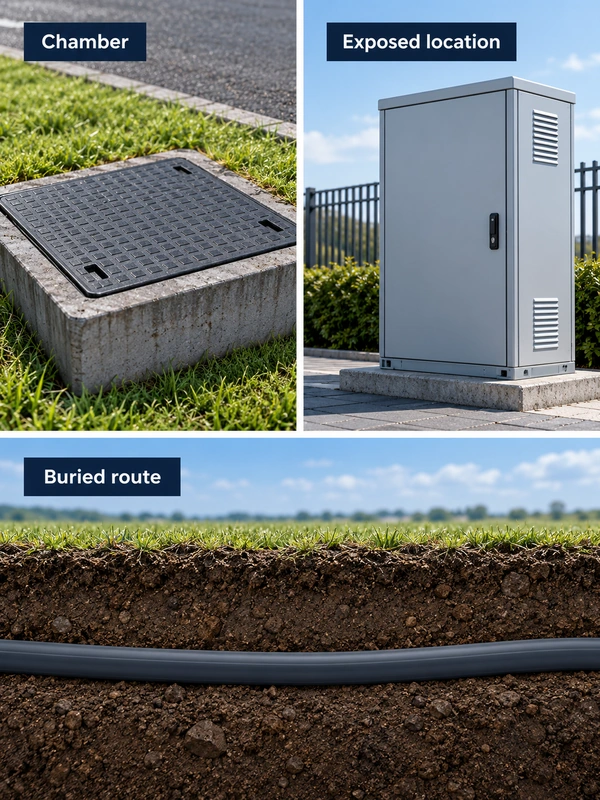
| Emplacement | Questions à examiner | Documentation à demander |
|---|---|---|
| Armoire abritée | Température, condensation et accès pour la maintenance | Limites de fonctionnement et dégagement d’installation |
| Chambre d’accès | Exposition à l’eau, soutien sur le parcours et manipulations répétées | Conditions d’étanchéité et configuration de protection |
| Installation apparente | Lumière du soleil, intempéries et variations de température | Preuves d’exposition spécifiques au modèle |
| Enfouissement direct | Contact avec le sol, charges d’installation et protection requise | Approbation pour l’ensemble enterré complet |
Ne supposez pas qu’une protection contre un type d’exposition en remplace une autre. Une certification d’imperméabilité ne garantit pas automatiquement la résistance aux UV, et une affirmation relative à la protection contre les UV ne prouve pas la résistance aux charges de montage. Assurez-vous que chaque exigence puisse être rattachée à la pièce et à la configuration réellement fournies.
Quelles sont les dimensions du conduit qui doivent correspondre au raccord en plastique ?
Enregistrez le diamètre extérieur, le diamètre intérieur, le matériau et la tolérance approuvée de chaque extrémité du conduit. Un raccord droit relie généralement deux interfaces compatibles de même dimension ; un réducteur nécessite deux désignations de dimensions distinctes. Vérifiez le passage interne lorsque l’espacement des câbles ou une transition est pertinent.
Pour une mise à niveau, mesurez et identifiez le conduit existant plutôt que de vous fier uniquement à un plan ancien. Les déformations, les dommages ou les substitutions non documentées peuvent rendre la taille nominale trompeuse. Utilisez un matériel de mesure fiable et vérifiez la construction du conduit conformément aux spécifications d’homologation du fabricant des raccords.
Le guide de fixation du connecteur microduct enterré directement fournit un contexte de sélection pertinent, mais le modèle exact doit encore être mis en correspondance avec l’itinéraire réel. Un composant annoncé comme étant destiné à l’enfouissement n’est pas automatiquement compatible avec tous les conduits pouvant être insérés dans son orifice d’entrée.
Quelles sont les preuves qui attestent de la résistance aux intempéries, aux UV et aux charges d’un coupleur de conduit ?
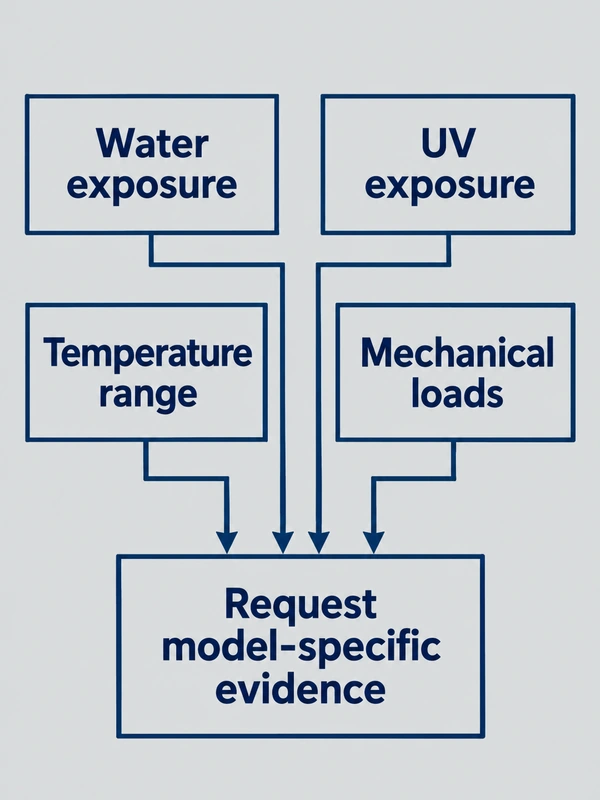
Adaptabilité environnementale Il faut plus qu’une simple liste de propriétés matérielles intéressantes. Demandez des informations concernant l’exposition à l’eau, la température, l’ensoleillement le cas échéant, ainsi que les conditions mécaniques. Renseignez-vous sur la manière dont ces essais sont liés à la taille du connecteur, au matériau du conduit et aux accessoires figurant dans le devis.
La documentation de l’appareil MPB30601+ d’Hexatronic constitue un exemple utile des exigences spécifiques à la configuration : son utilisation en pose directe dans le sol implique une protection externe. Cela ne rend pas cette protection facultative, et cela n’autorise pas l’utilisation d’un connecteur non protégé d’un autre fabricant. C’est l’ensemble complet, testé ou approuvé, qui compte.
When a supplier cites a standard, ask for the applicable scope and report. A standard number alone does not demonstrate independent certification, coverage of every size or equivalence to another product. Record the document revision so purchasing and installation teams are using the same information.
| Claim in a listing | Useful follow-up question | Insufficient substitute |
|---|---|---|
| Water resistant | Under what conditions and for which assembly? | A photograph of the part near water |
| UV resistant | What evidence covers this material and variant? | Black body colour alone |
| Direct buried | Are a cover or other protective measures required? | The words underground in a title |
| Pressure rated | Working, proof, burst or sealing pressure? | An unexplained maximum number |
| Tested to a standard | Which model, method, conditions and results? | A standard number without supporting scope |
Where evidence is missing, request it before approving the part. Do not fill gaps by borrowing ratings from a visually similar connector. Product-specific data is especially important when a family includes several body materials, sizes or protective configurations.
Does the route need a duct coupler, a cable seal or both?
A coupler joining the outside surfaces of two ducts can leave the space around the cable open. If the route requires control of gas or water migration along that space, specify a separate sealing function. Emtelle describes its gas-block connector as sealing between connector, tube and fibre cable.
Its gas-block datasheet also separates tube dimensions from fibre-unit or cable ranges and distinguishes gas sealing from pressure information associated with fibre installation. These distinctions matter at building entries and other defined boundaries. They do not mean that every coupler needs a gas block or that a gas block replaces a building penetration seal.
Assess a suitable connecteur microduct pour gaz when the route design calls for cable-annulus sealing. Confirm cable diameter, activation sequence, location and sealed-state conditions. Do not infer those properties from the outdoor rating of the adjacent straight coupler.
When does a microduct coupler need a protective cover and supports?
An external shell can be part of a connector’s approved protective arrangement, but it cannot correct a wrong duct diameter or damaged seal. Install the specified accessory and check that it closes correctly without trapping debris or pressing a release mechanism.
Le Guide de dépannage des gaines microducts discusses common protection and fit issues. Investigate the underlying joint before covering it. If a shell repeatedly opens or does not seat, confirm the model pairing and route loading instead of improvising a fastening method.
Support the duct to avoid continuous tension, sharp bending and unintended loads at the connector. Keep the final arrangement accessible where maintenance is expected. A well-protected body can still be undermined by a duct forced into a misaligned route or a collar pressed against nearby hardware.
Which connector checks should be completed before burial or enclosure?
Check component identity, duct dimensions, cut quality, outside sealing surfaces, insertion and retention according to the manufacturer’s instructions. Complete the route’s approved passage and leakage checks before handover. Keep them separate: a pressure-tight joint does not prove an unobstructed cable route.
Use the project-defined pressure, duration, temperature conditions and acceptance criteria within the limits of every component in the test assembly. Check temporary adapters and closures as well as installed joints. Isolate and release pressure before making adjustments; never use a catalogue burst figure as a routine operating instruction.
Record whether tests were completed before or after final placement. If subsequent handling, covering or burial can affect the joint, follow the project requirement for inspection or verification at that stage. A record should identify the final configuration, not just a successful bench assembly.
Can the existing duct coupler accommodate a future cable upgrade?
Network maintenance planning begins with an identifiable joint. Record location, connector variant, duct dimensions, accessories and acceptance results. Include cable details where a reducer or cable seal makes them relevant. Future crews should be able to determine what was installed without excavating solely to identify it.
For a hypothetical upgrade to a larger cable, an existing coupler might remain compatible with the duct outside diameter while the smaller route bore becomes limiting. A gas seal may also need replacement because of the new cable diameter. Review the whole route rather than approving the upgrade from the coupler’s external appearance.
Follow the manufacturer’s reuse and release policy during repairs. Inspect previously gripped duct surfaces and preserve enough length for a supported replacement. If cutting back creates tension, use an approved repair arrangement rather than stretching the remaining duct into the joint.
What to include when requesting an outdoor duct coupler quotation
A useful enquiry includes both duct dimensions, cable details, installation location, water and sunlight exposure, temperature requirements, operating conditions and required documentation. State whether the quote must include covers or other accessories. This prevents two suppliers from pricing different assemblies under the same coupler name.
Foire aux questions
Can a plastic duct coupler be used outdoors and underground?
Only when the exact variant and configuration are documented for the location. Distinguish exposed, chamber and direct-buried conditions. Required covers, supports and installation methods are part of the approval rather than optional extras.
What should be inspected on a plastic duct coupler before cable installation?
Check identification, dimensions, cut and surface condition, seating, retention, supports and protective accessories. Verify the approved passage and leak-test records. Investigate damage or uncertainty before cable installation rather than using the installation itself as a test.
How does a plastic duct coupler differ from a standard telecom coupler?
Plastic describes the body material, while standard telecom coupler is an imprecise category. Compare actual function, interfaces, bore, sealing, retention and environment. Two differently named products can serve the same role, while two similarly named ones can differ substantially.
How is a plastic duct coupler replaced during a network upgrade?
Plan access and isolation, follow the release instructions and inspect the remaining duct. Install a documented compatible replacement without route tension, reassess cable passage and any cable seal, then complete the specified acceptance checks and update the route record.
Which materials protect a coupler from moisture and UV?
Suitability depends on the exact formulation, seal system, configuration and exposure evidence. A broad resin name or black colour is insufficient. Request model-specific documentation rather than treating a material category as an unconditional performance guarantee.
Which installation errors can cause a plastic duct coupler to fail?
Wrong dimensions, damaged or dirty duct ends, incomplete insertion, unsupported loads, accidental release contact and missing required protection are all concerns to investigate. A site-specific examination is needed to identify the cause; appearance alone cannot establish it.
Références
- Hexatronic, connecteurs MPB30601+ et arrêts de fin: application, construction and external-cover conditions.
- Emtelle, connecteur de bloc de gaz: sealing around the fibre cable as a separate requirement.
- Emtelle, Connecteurs de blocs de gaz, numéro 5: separate duct and fibre interfaces and sealing information.
Résumé
Select an outdoor duct coupler by the actual route: dimensions, cable passage, water, sunlight, temperature and mechanical exposure. Confirm the complete protective configuration and keep cable sealing separate from duct joining. Document installation and acceptance before access becomes difficult so future repairs begin with reliable information.
Le black direct-buried microduct connector is a product to assess against those requirements. Request the exact size, current installation instructions and environmental evidence. Its intended application provides a starting point, while the project-specific confirmation determines whether it belongs in the route.



