
When Maya, a maintenance engineer in Birmingham, restarted a packaging cell after a fitting change, the actuator stalled and a hiss appeared at the manifold within minutes. This is an illustrative commissioning scenario, not a reported customer case. The first response was to tighten the connector, but the reversal was more useful: the fitting was not necessarily defective; the port had been specified as “1/4 inch” without confirming whether it was BSP, BSPT or NPT, and the replacement tube had not been checked by outside diameter (OD). This guide shows how to match those interfaces, control leak paths and document a pneumatic connection before it reaches the air line.
The short answer is: Confirm the tube OD and cut condition, identify the thread family from a drawing or verified gauge, and then check the fitting’s documented pressure and temperature limits for the complete assembly. BSPP, BSPT and NPT are different thread systems; a similar nominal size is not proof of compatibility. ISO 4414:2010 frames component selection as part of safe pneumatic-system design, so the recommended action is to put the tube, thread, service conditions and acceptance check on the purchase record before installation.
Why can a push-in fitting fail even when the nominal size looks right?
A push-in fitting has two interfaces that must be controlled separately. The tube enters a collet and seal, while the threaded side mates with a machine port, manifold or valve. A nominal “6 mm,” “1/4 inch” or “G1/4” label may describe only one side of that assembly. A tube can be too large to seat, too small for reliable retention, oval after cutting or scratched where the seal contacts it.
The threaded interface creates a different failure path. BSPP (often marked G), BSPT (often marked R) and NPT use different thread geometry and sealing practice. A near match may start by hand and still cross-thread, bottom early or leave a spiral leak path. The port drawing, equipment manual, removed-part marking or a verified gauge should establish the thread family and nominal size; an outside diameter measurement alone is not enough.
Flow loss can also be misdiagnosed as a connector problem. An elbow with a restrictive passage, a contaminated filter, an undersized valve or a long tube run may create pressure drop upstream of the actuator. Review the fitting, tube, regulator and valve as one connected air path. The Ámbito de piezas neumáticas is a useful place to compare component forms, but the final selection still needs the equipment maker’s port and service data.
How should engineers match tube OD to the fitting?
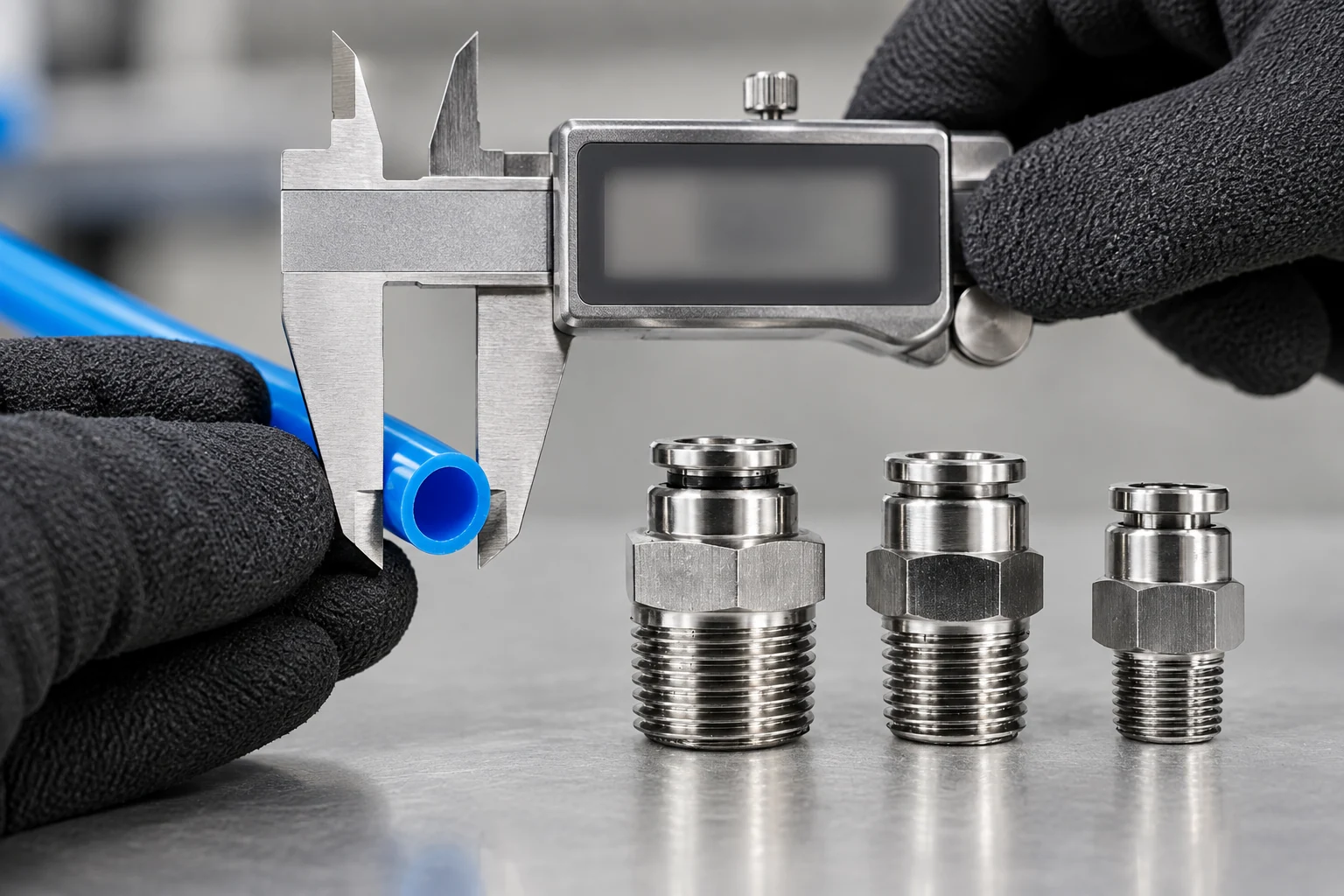
Start with the installed tube specification rather than the fitting carton. Record the actual outside diameter, unit system, tube material, wall construction and supplier tolerance. For a replacement, compare the marking on the tube or the controlled bill of materials with the fitting catalogue description. A metric tube and an inch tube should not be substituted because their nominal numbers appear close.
| Checkpoint | Evidence to record | Por qué importa |
|---|---|---|
| Tube outside diameter | Nominal OD, units, material and supplier tolerance | Determines whether the collet and seal can retain the tube |
| Tube end | Square cut, clean edge, no flattening or longitudinal scratches | Provides an even sealing surface and full insertion depth |
| Port thread | BSPP/G, BSPT/R or NPT; nominal size; drawing or removed-part reference | Prevents cross-threading and an unreliable threaded seal |
| Fitting geometry | Straight, elbow, tee, bulkhead or manifold form | Preserves bend radius, wrench access and the intended flow path |
Cut the tube square with a suitable tool and inspect the circumference before insertion. Do not aggressively chamfer the end or leave a wedge-shaped cut unless the tube maker expressly permits it. Push the tube straight to the documented stop, then apply the supplier’s retention check. A light pull check can confirm assembly, but it is not a substitute for the project’s specified pressure or leak test. If the tube rotates excessively, backs out or releases when the line is moved, stop and inspect the cut, OD and collet instead of tightening the tube by force.
How can you tell BSP, BSPT and NPT threads apart?
Thread identification should come from a controlled source. BSPP is a parallel pipe thread that commonly uses a defined face seal, bonded washer or O-ring. BSPT is a tapered British pipe thread, while NPT is a separate tapered US pipe-thread system with its own profile and gauge basis. Their nominal size labels can look similar while pitch, flank angle and sealing method differ.
Use the port drawing, a suitable thread gauge or written manufacturer identification; do not infer the thread from a photograph or an outside diameter alone. Record male or female form, the nominal size, sealing element and the tightening instruction. Thread sealant is not a conversion method. It must be compatible with the identified thread and medium, and it must not enter the air path or prevent the fitting from seating.
| Thread callout | Basic interface | Buyer verification |
|---|---|---|
| BSPP / G | Parallel thread with a specified face or bonded sealing arrangement | Port standard, washer or O-ring, seating face and tightening instruction |
| BSPT / R | Tapered BSP thread using the specified sealing practice | Male/female designation, sealant rule, engagement and available depth |
| NPT | Tapered US pipe-thread system with a different profile and gauge basis | NPT size, mating port, sealant compatibility and drawing or gauge evidence |
| Unconfirmed “inch” label | Nominal wording without a thread system | Pause the order and obtain a controlled identification before substitution |
The honest answer to “BSP or NPT?” is that neither is universally better. The correct choice is the thread already present in the equipment, unless the machine builder approves a documented port change. A fitting that threads in only a few turns or requires unusual force should be removed and identified again; forcing it can damage a manifold that is more expensive to repair than the connector.
Which pressure, temperature and flow details belong on the specification?
Pressure and temperature must be evaluated together. Ask for the fitting’s documented working range, test basis, temperature range, medium restrictions and any derating for the exact body, seal, tube and thread configuration. Do not turn a burst value, a short laboratory reading or a rating for another size into a continuous operating limit. ISO 4414:2010 addresses safe pneumatic fluid-power systems; it does not create a universal pressure rating for every commercial fitting.
Also record the actual air quality and environment: dry or lubricated air, water carryover, cleaning chemicals, outdoor exposure, heat near an actuator and repeated movement can all affect the body or seal. If the catalogue provides flow or pressure-drop data, use the supplier’s stated conditions and compare the entire circuit. If no curve is supplied, ask for one rather than inventing a flow-rate number from the tube OD.
For moving installations, route the tube so the connector is not carrying a bending load. Support long runs, preserve the specified bend radius and leave access to depress the release collar during maintenance. The pneumatic fittings maintenance guide can help turn those checks into a repeatable inspection routine.

What changes for replacement parts and compatibility?
Replacement compatibility means more than matching a catalogue family name. Compare tube OD, thread form, body geometry, sealing interface, port depth, release access and flow direction where the component requires it. A visually similar elbow can have a different passage or wrench envelope, while a different seal compound may change chemical or temperature suitability.
Keep the removed-part label, new-part datasheet and fit check together. If one field is unknown, quarantine the substitute until the equipment owner or component supplier confirms it. Record the installation date, circuit location and acceptance check so the next maintenance technician does not have to identify the thread from memory. The products directory can help locate a matching form factor, but the controlled drawing remains the approval document.
How do ISO 4414 and ISO 12100 affect procurement?
ISO 4414:2010 provides general rules and safety requirements for pneumatic fluid-power systems and their components. In procurement terms, the connector should be considered with isolation, stored energy, pressure control, routing and maintenance access. ISO 12100:2010 provides a machinery risk-assessment and risk-reduction framework; it helps the machine builder address unexpected movement, hose release and maintenance hazards. Neither standard should be presented as a product certification unless relevant conformity evidence exists.
The U.S. Department of Energy’s industrial compressed-air resources also treat leakage and pressure management as system issues. The commercial consequence is practical: require the thread designation, tube data, material information, pressure-temperature basis and installation instructions before approving a substitute. Tie those records to the technical file so future replacement decisions remain auditable.
What is a practical selection and installation checklist?
- Identify the interfaces: record tube OD, material, cut condition, thread family, nominal size and fitting geometry.
- Match the service: state normal and transient pressure, temperature, medium, vibration, chemicals and air quality.
- Check the flow path: compare the internal passage and geometry with the valve, regulator, actuator and tube run.
- Control installation: isolate stored energy, cut square, insert to the stop, confirm retention and support the route.
- Document acceptance: perform the approved leak or pressure check and retain the result by circuit location.
Oulu / ANMASPC (Zhejiang Oulu Automatic Equipment Co., Ltd.) supplies pneumatic push-in fittings, tubing, valves, cylinders and related parts for B2B sourcing. Treat that range as a starting point for a documented proposal: send the tube OD, port thread, service conditions, geometry and replacement requirement so the supplier can confirm a configuration rather than offer a visually similar connector. For a machine with multiple control functions, the solenoid valve types guide can help keep valve and fitting decisions aligned.
What the latest thread-matching questions reveal
Google’s related questions continue to separate three decisions that are often mixed together: tube outside diameter, thread form and working limits. BSPP, BSPT and NPT should be identified from controlled drawings or datasheets; visual similarity is not proof of interchangeability. ISO 4414 and ISO 12100 help set the system-safety discipline, while the fitting datasheet remains the source for the exact pressure, temperature, media and flow limits.
For a replacement project, send the old fitting code or drawing, tube OD, thread callout, machine zone, service medium and operating conditions. The Ámbito de piezas neumáticas y Guía de mantenimiento provide the internal path for matching the part without relying on a photo alone.
Preguntas frecuentes
How do you check flow direction and airflow loss through the Push In Fittings?
Trace the air path from the regulator through the fitting, tube, valve and actuator, then compare the supplier’s passage or pressure-drop data at the actual service conditions. A directional component or restrictive elbow may need orientation shown on the assembly drawing. If no measured curve is available, record that limitation and ask the supplier rather than assigning a flow value from nominal size alone.
What signs show that the collet or O-ring in the Push In Fittings needs replacement?
A tube that backs out, rotates excessively, leaks after a clean square cut or shows damage at the sealing zone warrants inspection of the collet and O-ring. Depressurize and isolate the circuit, then compare the parts with the manufacturer’s service instructions. Replace components that are worn, contaminated, cut or no longer provide documented retention.
How do you match tube outside diameter to the Push In Fittings?
Use the tube marking, controlled specification or an approved measurement method to confirm the actual OD, units, material and tolerance. Compare those details with the fitting drawing, and inspect the end for ovality, scratches or contamination before insertion. A nominal label or a tube that “almost fits” is not sufficient evidence of compatibility.
How can you tell whether a Push In Fittings uses BSP, BSPT or NPT threads?
Use the equipment or fitting drawing, a verified thread gauge or written manufacturer identification. BSPP/G is parallel, BSPT/R is tapered and NPT is a separate tapered system; the nominal size alone cannot distinguish them reliably. Confirm the mating port, sealing method and tightening instruction before ordering.
Why does the Push In Fittings leak even after the fitting has been tightened?
Tightening the threaded side cannot correct a wrong thread form, undersized tube, damaged tube end, incomplete insertion, worn collet or unsuitable seal. Isolate the line, inspect both interfaces and replace any component outside the documented condition. Finish with the project’s approved leak or pressure check rather than relying on the absence of an audible hiss.
What working pressure and temperature should the Push In Fittings support?
The fitting, tube and seal should support the highest documented pressure and temperature of the complete circuit, including start-up, shutdown and cycling. Use the supplier’s value for the exact configuration, medium and installation method; do not transfer a rating from another size or material. Record the rating basis and any derating or environmental limits with the purchase documentation.
Does the same nominal thread size make BSP and NPT interchangeable?
No. Thread form, pitch, taper and sealing method can differ. Confirm the standard from the drawing or datasheet and use the approved adapter or fitting rather than forcing a visually similar thread.
What should be written on a push-in fitting replacement request?
State tube OD and material, port thread and standard, medium, pressure and temperature, motion or vibration, required orientation, quantity and the existing fitting code or drawing. Those fields let a supplier check the complete interface.
Referencias
- ISO 4414: Pneumatic fluid power – general rules and safety requirementsOfficial ISO standard page; system-safety boundary.
- ISO 12100: Safety of machinery – risk assessment and risk reductionOfficial ISO standard page; machinery-risk reference.
- ASME B1.20.1: Pipe Threads, General Purpose (Inch)Official ASME standard page; controlled thread identification reference.
Conclusión
A dependable Push In Fittings connection starts with identification, not tightening force. Confirm the tube OD and cut condition, identify BSPP, BSPT or NPT from controlled information, and compare the exact pressure and temperature duty with the supplier’s documented limits. Then check the flow path, geometry, vibration support and replacement interfaces as one connected decision. ISO 4414 and ISO 12100 provide useful system discipline, but neither replaces a fitting datasheet or a controlled commissioning check. Oulu / ANMASPC can help B2B buyers compare pneumatic fittings, tubing and related parts when the request includes port, tube and service data. The principle is simple: match evidence to every interface, document the choice, and only then pressurize the machine.
For a project-specific recommendation, review the Ámbito de piezas neumáticas and contact the supplier with your tube OD, thread, pressure, temperature and application details.


