
Nerđajući spoj koji se koristi na cijevi za komprimirani zrak nije nužno prikladan za vodu ili sredstvo za čišćenje. Metalno kućište samo je jedan dio spoja. Tekućina dolazi u dodir i sa materijalima za brtvljenje i sa crijevima, a radni uvjeti mogu se znatno razlikovati od onih u originalnoj pneumatskoj primjeni. Pouzdan izbor počinje utvrđivanjem vrste tekućine i ciklusa rada, a potom se provjerava kompletna instalacija, umesto da se proizvod odobrava samo na osnovu njegovog izgleda.
Za Push-in spojnice za cijevi od nehrđajućeg čelika, dobavite popis materijala za odabrani model, odobrene medije i radne granice. Uključite cijev i svaki brtveni element u pregled. Ako je dobavljač potvrdio samo upotrebu komprimiranog zraka, ostavite vodu i kemijske medije neodobrenima dok ne dostavi odgovarajuće dokaze. Ovaj vodič objašnjava kako sastaviti to upitno pismo, pročitati informacije o kompatibilnosti i identificirati promjene koje zahtijevaju novi pregled.
Opisite tekućinu prije odabira materijala spojnice.
“Zrak”, “voda” i “hemikalija” su početni opisi, a ne potpune specifikacije. Za zrak, navedite traženi kvalitet zraka te eventualno prisustvo ulja ili kondenzata. Za vodu, opišite njen izvor, obradu i očekivane nečistoće. Za formulirani sredstvo za čišćenje ili procesnu otopinu, navedite identitet proizvoda, podatke o sigurnosti i raspon koncentracije. Samo trgovačko ime može prikriti sastojke koji se mijenjaju prilikom revizije formule.
Zabilježite normalnu temperaturu i pritisak zajedno s očekivanim ekstremnim vrijednostima. Pojasnite da li je izloženost kontinuirana, povremena ili ograničena na čišćenje. Uključite period zastoja tokom kojeg tečnost može ostati zarobljena. Procjena materijala zasnovana na hladnom, razrijeđenom rastvoru automatski ne pokriva topliji korak čišćenja ni koncentrovani ostatak koji ostaje nakon isparavanja.
Održavajte razliku između normalnog rada i abnormalnih stanja. Predloženi spoj može biti prihvatljiv za određenu namjenu, ali neodgovarajući u slučaju predvidljive pogreške prilikom čišćenja. To ne opravdava tvrdnju o otpornosti na svaku zloupotrebu; to znači da vlasnik procesa mora odlučiti koje uvjete izloženosti oprema treba pokriti u svojoj specifikaciji.
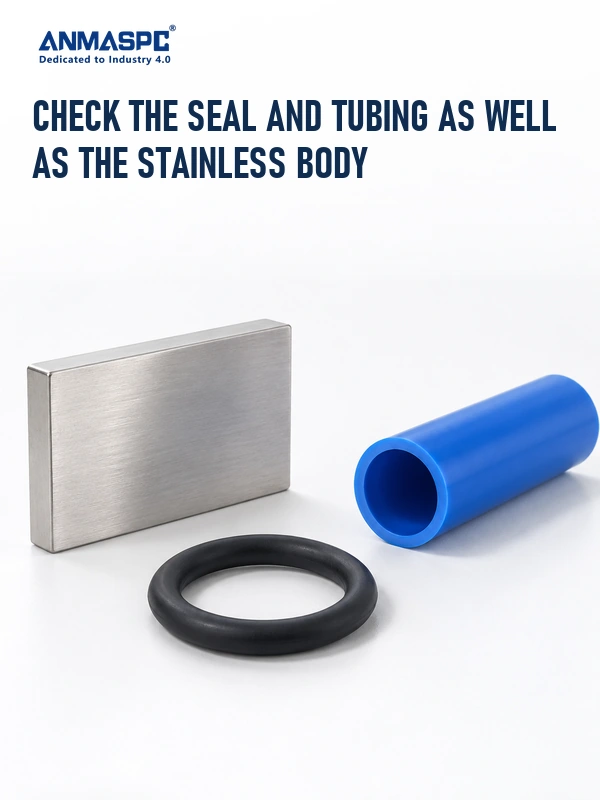
Provjerite brtvljenje i crijevo, kao i kućište od nehrđajućeg čelika.
The kompletna kombinacija materijala određuje da li se spoj može uzeti u obzir za primjenu. Nabavite stvarnu klasu tijela i materijal brtve za navedenu varijantu, zajedno sa materijalom crijeva i dimenzionalnim zahtjevima. Pitajte da li je potrebna revizija bilo kojih drugih komponenti koje dolaze u dodir s medijem. Ne zaključujte skrivenu konstrukciju na osnovu fotografije iz kataloga ni ne zamjenjujte listu materijala druge serije.
Katalog KQG2 tvrtke SMC pruža koristan primjer razlike: identificira materijale za tu navedenu seriju i daje smjernice o hemijskoj otpornosti uz navedene uvjete. Ti podaci pripadaju KQG2-u. Oni ne utvrđuju spojni materijal ni hemijsku prikladnost Oulu armature. Isti pristup se primjenjuje kada se uspoređuju bilo koja dva dobavljača sa proizvodima koji izgledaju slično.
| Element montaže | Informacije za dobijanje | Zašto jedna oznaka materijala nije dovoljna |
|---|---|---|
| Metalno kućište | Razred i primjenjiva dokumentacija materijala | Različita okruženja mogu na različite načine izazvati isti kvalitet. |
| Zaptivni elementi | Stvarni spoj i odobrene tekućinske uslove | Otpornost metala ne utvrđuje prikladnost elastomera. |
| Cijevi | Materijal, dimenzije i granice upotrebe | A fitting approval does not approve every tube |
| Thread or face seal | Sealing method and exposed materials | The equipment-side joint can introduce another compatibility question |
| Complete connection | Model-specific operating and installation restrictions | Separate material results are not a complete performance guarantee |
Does changing from air to water require a new assessment?
Yes. Ask the manufacturer to confirm the new medium for the exact fitting and tube. Consider the full operating cycle, including shutdown, drainage and maintenance. A pneumatic rating should not be relabelled as a water rating simply because both systems operate at the same indicated pressure.
Tubing selection illustrates the problem. SMC’s TU documentation distinguishes general TU/TIUB tubing conditions from restrictions applying to its TUH series, including a water-service restriction associated with hydrolysis. The lesson is to identify the actual polymer product and its instructions. It is not evidence that every polyurethane tube is suitable, or unsuitable, for the same water duty.
Pregledajte differences between PU and PA air hose as part of the tubing enquiry. Then use the selected tube manufacturer’s data to close the material and operating-condition questions. Keep the tube designation in the approved assembly record so maintenance cannot replace it with an unreviewed lookalike.
How should a chemical compatibility chart be read?
First identify what the chart evaluates: a raw material, a seal compound, a component or a complete assembly. Then read the stated temperature, concentration and other conditions. A favorable entry is useful evidence within that scope. It cannot be extended to a different formulation, material grade or exposure condition without support.
A chart also may not address mechanical loading, repeated connection, pressure changes or leakage acceptance. SMC explicitly limits the scope of its KQG2 chemical-resistance information rather than treating it as a guarantee of complete product performance. Retain those limitations when using a chart in an engineering review; copying only the favorable symbol removes essential context.
For a mixture not directly covered, send the supplier its composition information and full duty. Where the material or assembly evidence remains incomplete, the project may need a supplier-agreed evaluation before approval. Define its scope and acceptance criteria in advance. A successful short observation should not be reported as proof of unrestricted lifetime compatibility.
Assess external cleaning separately from the fluid inside
A fitting carrying dry air may still be exposed externally to detergent, splash or retained liquid. Record the cleaner, concentration, temperature, application method, contact period and rinse or drying process. The external environment can reach parts that the operating medium does not, so a fluid approval alone cannot settle the cleaning question.
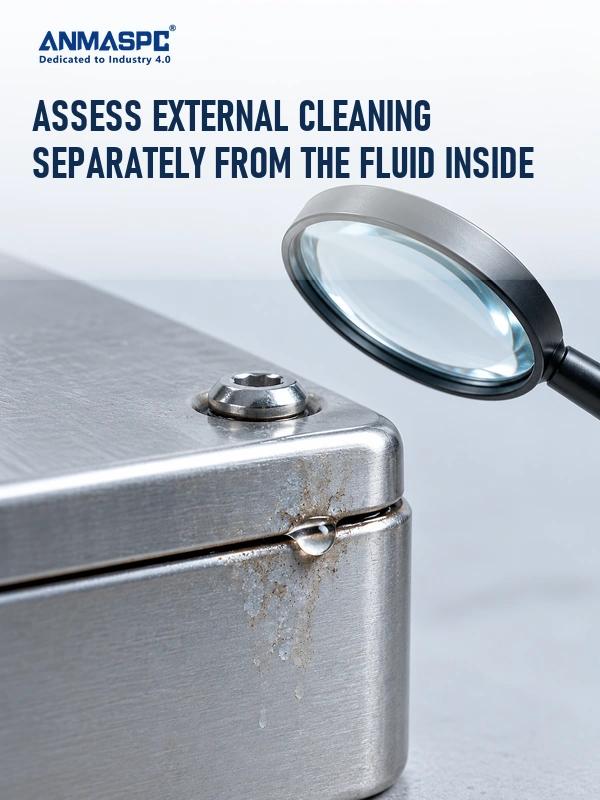
ASSDA’s corrosion guidance explains why concentration, temperature, impurities and local conditions matter to stainless steel. A seam that retains residue may experience a different exposure from the freely draining surrounding surface. Selecting 316 rather than 304 can be relevant to a material review, but neither designation is a universal approval for chloride-bearing cleaners or every chemical mixture.
Do not transfer household stainless-cleaning recipes to assembled pneumatic seals. ASSDA’s cleaning advice concerns surface care; the component maker must still approve the method for the complete connection. If cleaning changes after commissioning, review the fitting, tube and external materials again before the new process is introduced.
Confirm dimensions and installation access after compatibility
Material suitability cannot correct a dimensional mismatch. Specify the tube outside diameter separately from any nominal pipe-thread size. For a threaded variant, identify the exact thread and intended sealing method. Push-in describes the tube-side connection; a single fitting can also have a threaded equipment interface. Use the Vodič za usklađivanje navoja BSP i NPT to organize those separate checks.
A bulkhead connection adds mounting requirements. Oulu’s stainless straight bulkhead union page requests panel thickness, mounting-hole dimensions and tube sizes on both sides. Obtain the selected drawing and plan access to the mounting hardware and release sleeves. Support the tubing independently so panel mounting is not used to carry avoidable side loads.
Check the installation method against both material and cleanliness requirements. A lubricant or thread-sealing product may affect the fluid review. ASSDA’s galling guidance explains why stainless thread assembly needs controlled contact conditions, but a general fastener recommendation is not authority to introduce an unapproved substance into a fluid connection.
What evidence should be retained before purchase?
Build a short approval record that connects each document to the exact part and duty. Include the drawing revision, material information, tube designation, medium specification, operating range and cleaning process. Identify unresolved items explicitly. A material certificate can support a metal-grade claim; it does not by itself demonstrate leakage performance or approval for a particular fluid.
| Selection stage | Record to retain | Reason to reopen the review |
|---|---|---|
| Fluid definition | Composition, concentration and operating conditions | Different cleaner, formulation or temperature |
| Assembly definition | Model, drawing, seals and approved tubing | Supplier or component substitution |
| Instalacija | Mounting, sealing and support instructions | Layout or assembly-method change |
| Prihvatanje | Agreed inspection and test conditions | Failure or duty outside the original scope |
| Održavanje | Inspection findings and replacement decisions | Repeated leakage, damage or changed cleaning |
Before ordering, send Oulu the complete application specification rather than requesting a generic chemical-resistant fitting. Ask for the proposed code and supporting documents, then agree how the delivered assembly will be accepted. Keep a sample evaluation distinct from broad certification or a guarantee of service life.
Često postavljana pitanja
Are push-in and threaded stainless fittings interchangeable?
Not solely from their descriptions. One component may contain both interfaces, while another requires different tubing, port geometry or sealing parts. Compare the complete drawing and approved service conditions before authorizing a substitute. Similar metal appearance does not establish dimensional or chemical equivalence.
How do you clean stainless steel push-in fittings?
Follow the approved method for the complete assembly after safe isolation. Check cleaner compatibility with the seals, tubing and external materials. Do not assume that guidance for bare stainless surfaces permits immersion, flushing or aggressive chemicals in an assembled pneumatic fitting.
What surface finish and seal material should buyers specify?
Specify the finish and seal compound required by the actual fluid, cleaning exposure and application, with a way to verify them. Obtain the selected model’s documents rather than assuming a bright finish establishes a particular surface specification or that all stainless fittings use the same elastomer.
When should the fitting be replaced rather than repaired?
Replace a damaged or unsuitable component when it falls outside the maker’s reuse criteria or the approved application. Use only permitted repairs. Recurrent leakage or a changed fluid requires investigation; installing an identical new fitting does not resolve an underlying compatibility problem.
Why choose stainless steel instead of a plated fitting?
Choose it when the full material and environmental review supports that design. Compare the actual stainless and plated alternatives, including their seals and tubing. Stainless construction does not independently establish compatibility, hygiene approval, leak performance or lower lifetime cost for every application.
How do you match tube OD and thread type?
Identify the tube’s outside diameter, material and applicable tolerance, then confirm the equipment-side thread and seal arrangement where present. Treat these as separate dimensions. Request the selected drawing and installation instructions before assembly instead of testing compatibility by forcing parts together.
Reference
- SMC, KQG2 stainless steel one-touch fittings catalogue: series-specific materials, chemical-resistance scope and installation precautions.
- SMC, TU/TIUB polyurethane tubing catalogue: tubing-specific media and operating restrictions.
- ASSDA, Tehnička često postavljana pitanja 8: Opšta otpornost na koroziju.
- ASSDA, Cleaning your indoor stainless steel: surface-care guidance.
- ASSDA, žarenje i njegova kontrola.
Sažetak
Select the fitting for the defined fluid and complete operating cycle, including external cleaning. Identify the body, seals, tubing and equipment-side sealing materials before using a compatibility chart. Keep the chart’s temperature, concentration and scope attached to the decision; a raw-material result is not an assembly guarantee. Confirm dimensions, panel access and installation products separately, then retain the drawing and supporting evidence for the exact variant. Any change in fluid, cleaner, temperature or supplied components should trigger a review of the approved service conditions. A documented specification and clear acceptance criteria give purchasing and maintenance a consistent basis for selecting, installing and replacing the connection.



