Consider a hypothetical maintenance job: a technician in Birmingham replaces a corroded adapter with a stainless steel reducer, reconnects the air line and restarts the machine. The connection stays dry, but the actuator now moves too slowly. The new part matches the visible tube sizes; its smaller passage and the downstream tubing were never checked against demand. Changing the material has solved one concern while leaving the selection incomplete.
A stainless steel reducer should be specified by both end connections, the actual fluid, the complete operating envelope and the flow requirement. A 316 body does not establish the rating of its seals or the connected tube. Likewise, a nominal pipe-thread size does not identify a push-in socket. These distinctions matter more than choosing the most expensive material on the shelf.
Identify both ends before choosing a reducer
Start with a sketch showing what connects to each end. A pneumatic reducer may join two tube outside diameters, provide a stem that enters another fitting, or adapt between threaded ports. A pipe reducer intended for welding or rigid pipework belongs to a different connection family. Product names can overlap, so the drawing and complete ordering code must settle the question.
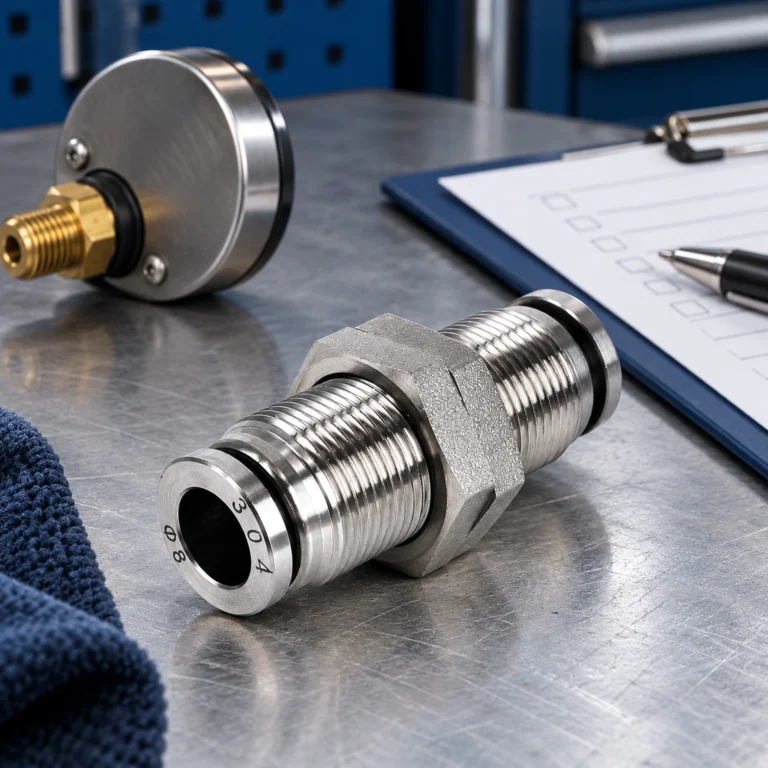
For push-in ends, record tube outside diameter, units, material and allowable dimensional tolerance. For threaded ends, record nominal size, male or female form, thread standard and sealing location. The metal diameter measured across a thread is not the nominal pipe size. Also distinguish a bulkhead mounting thread from a thread carrying pressure: they perform different jobs even when they look similar.
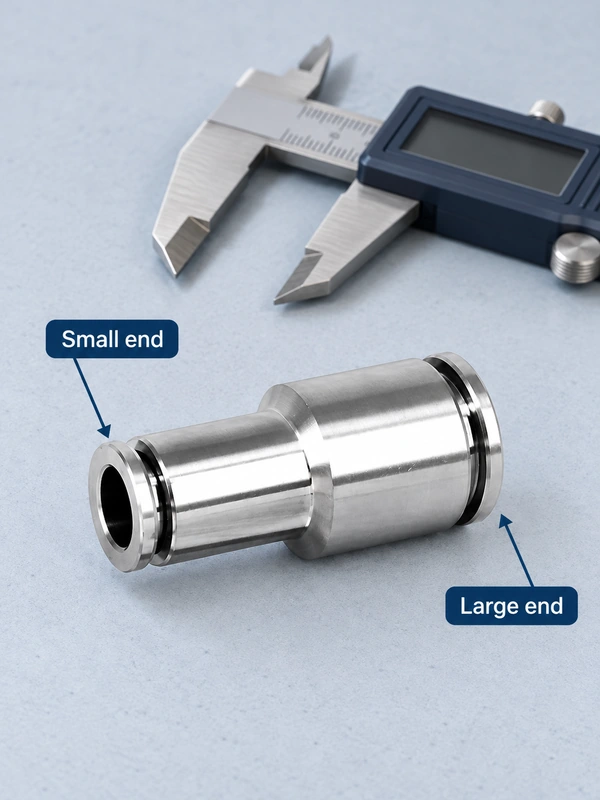
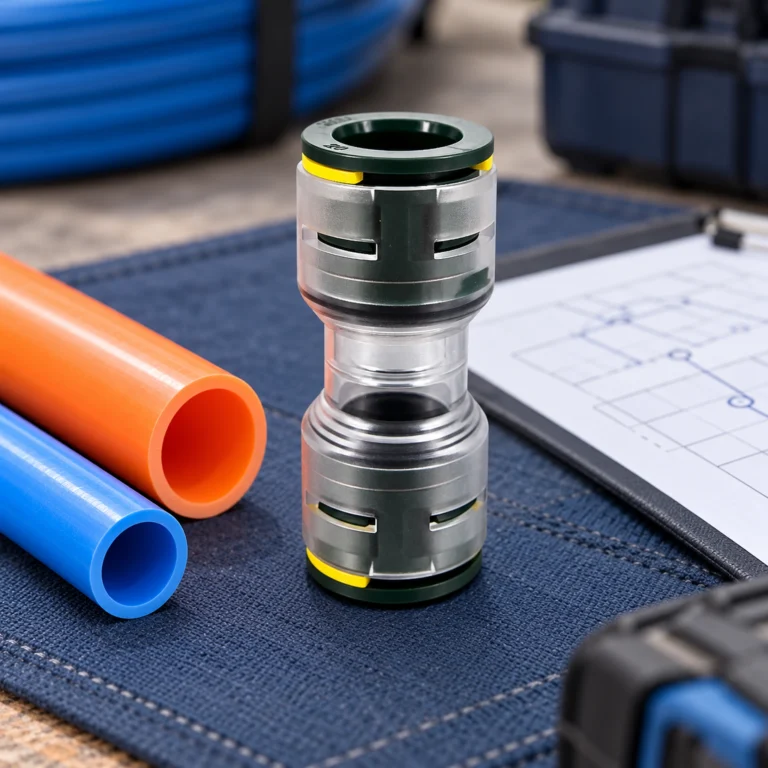
A PG push-in reducer, for example, is presented as a pneumatic tube-size transition. Its stepped body is useful for identifying the connection family, but a photograph cannot establish every available size, stainless grade or working limit. Request the exact variant drawing before treating it as interchangeable with a threaded reducing bush or another manufacturer’s union.
| Connection | Required identification | Frequent ordering error |
|---|---|---|
| Push-in socket | Tube OD, units, approved tube material | Ordering by tube inside diameter |
| Stem adapter | Stem size and approved receiving fitting | Assuming any matching hole accepts the stem |
| Tapered pipe thread | Exact thread form, size and sealant instructions | Mixing similar-looking thread families |
| Parallel threaded port | Thread plus specified face or seal arrangement | Expecting thread tape to replace a missing seal |
Choose the stainless grade for the actual exposure
Material selection begins with what touches the component, both inside and outside. Dry compressed air in a protected cabinet differs from a fitting exposed to salt spray, warm detergent or repeated washdown. Record chemical names, concentration, temperature, contact time and whether residues can remain beneath collars or supports. The word corrosive is too broad to support a defensible purchase.
ASSDA’s guidance on general corrosion explains why temperature, concentration, contaminants and crevices change stainless steel behaviour. Its discussion also shows that 316 is not a universal answer to chloride exposure. A grade that performs acceptably in one water supply may be unsuitable in a much more aggressive environment. Do not interpret an alloy name as permission to use seawater or an unidentified cleaning chemical.
Compare uncoated stainless with a plated fitting in terms of the actual exposure and inspection burden. A plated surface can be appropriate for protected pneumatic service, while scratches or damaged coating deserve attention in harsher surroundings. Stainless may reduce dependence on an external coating, but still requires compatible seals and sensible drainage. Neither material choice excuses a poorly supported tube or contaminated installation.
Cleaning requirements also need their own specification. A smooth-looking body is not evidence of a hygienic surface finish, cleanroom preparation or food-contact suitability. Ask what finish, cleaning process and documentation are supplied for the ordered variant. Where material traceability matters, agree which certificate must identify the delivered batch rather than accepting a generic certificate for an unrelated product family.
Check the complete pressure and temperature envelope
The assembly is constrained by its least suitable component under the actual conditions. Check the reducer body, gripping mechanism, seals, tube and mating port together. Maximum working pressure and maximum temperature cannot automatically be combined as one permitted operating point. Use the relevant pressure-versus-temperature information and include foreseeable pressure surges and the temperature around the machine, not only the room thermostat.
SMC’s KQG2 catalogue illustrates this separation clearly: it identifies a stainless body and seal material while directing users to check the tubing’s operating range separately. That is evidence of a selection method, not a transferable rating for every stainless fitting. Similarly, proof pressure describes a test condition; it is not a continuous operating recommendation for an unspecified reducer.
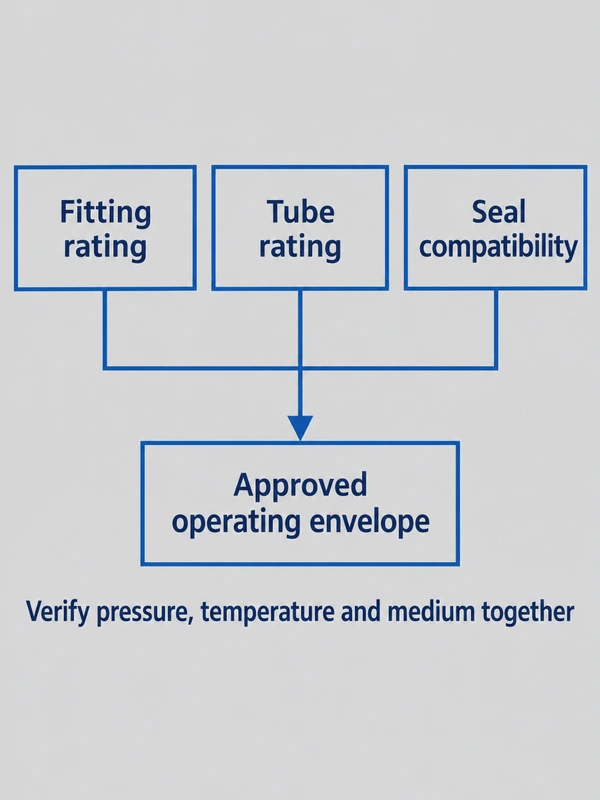
Seal compatibility can be the deciding issue when a line carries water, lubricant or chemicals. The same catalogue separates body and seal responses in its fluid guidance. An acceptable metal body does not rescue an unsuitable elastomer, and a chart for a pure chemical at one temperature does not validate a mixture at another. The related media compatibility guide for stainless push-in fittings explains how to gather the missing duty information.
| Öğe | Information to supply | Talep edilecek kanıt |
|---|---|---|
| Pressure | Normal duty and possible transients | Working limits for the exact assembly |
| Temperature | Fluid and ambient extremes | Applicable derating or restrictions |
| Medium | Composition, concentration and contamination | Body, seal and tube compatibility |
| Tube | OD, ID, polymer and route | Approved sizes, bend limits and retention conditions |
| Çevre | Washdown, salt, abrasion or movement | Material and installation suitability |
Check airflow before reducing a connection size
A reducer provides a size transition; it is not a specified flow controller. The narrow passage, adjacent tube bore, route length and other restrictions all influence delivery during demand. A machine can show normal static pressure when idle and still lack pressure at the actuator during motion. Raising the supply setting may disguise the symptom while increasing leakage and leaving the restriction in place.
Compare candidate parts using manufacturer flow information under stated test conditions. If that information is unavailable, do not rank them by external body diameter. Measure upstream and downstream pressure during the same repeatable operating cycle, then check the smaller tube and nearby valves. Keep the test method and machine load consistent so a change in production demand is not mistaken for an improvement from the replacement.
Prevent thread damage during installation and maintenance
For stainless steel threaded fittings, galling can make an apparently simple replacement difficult to dismantle. ASSDA describes it as local cold welding after rubbing disrupts the protective oxide film. Correct fit, clean undamaged surfaces and controlled friction matter. Its fastener examples explain the mechanism; they do not supply installation torque for an unrelated pneumatic fitting.
Use the fitting manufacturer’s approved sealant and tightening procedure. A general anti-seize compound may be unsuitable for the fluid or cleanliness requirement, and adding lubricant changes the relationship between torque and clamp load. Stop if engagement becomes abnormal instead of forcing the thread. The stainless pneumatic fitting installation guide covers preparation and support alongside thread handling.
Budget for the whole maintenance event: identification, isolation, access, installation, testing and a possible return visit. The cheapest reducer is a poor purchase if the seal type is unknown or the release collar becomes inaccessible after installation. Keeping the approved drawing and replacement code with the machine often prevents more downtime than stocking a large box of visually similar adapters.
Sıkça sorulan sorular
Why choose a stainless steel reducer instead of a plated fitting?
Choose stainless when the documented exposure, cleaning method or material requirement justifies it. Protected dry-air service may not need the same material as a washdown area. Compare seals, tube compatibility and maintenance access as well as the body; a stainless exterior alone does not establish better service life.
How do you match tube OD and thread type to a reducer?
Identify each end independently. Match a push-in socket to the approved tube outside diameter and units, then identify any threaded end by its complete standard, size and sealing arrangement. Do not use a caliper reading alone to decide between similar pipe threads.
Which stainless grade suits corrosive or washdown areas?
The answer depends on the cleaner or contaminant, concentration, temperature and crevice conditions. Obtain a grade recommendation for that exposure instead of assuming 316 covers every environment. Include the seal and tube in the review because they may impose a stricter limit.
How do you prevent galling when installing a stainless reducer?
Check matching thread forms, cleanliness and damage, then follow the manufacturer’s approved sealing and tightening procedure. Do not force a tight thread or transfer a bolt torque chart to a fitting. Lubrication must be compatible with the medium and allowed by the product instructions.
What pressure and temperature rating should the reducer have?
Its approved operating range must cover the real duty, including transients, with the selected tube and seal. Review pressure and temperature together. A body rating or proof-test figure by itself is insufficient to approve the complete connected assembly.
Can the same reducer carry compressed air, water and chemicals?
Only if the exact body, seal, tube and connection combination is approved for each medium and condition. A pneumatic listing is not a blanket chemical-service approval. Provide the actual fluid composition and exposure details before requesting compatibility confirmation.
Kaynakça
- SMC: KQG2 stainless steel one-touch fittings catalogue and precautions
- ASSDA: Galling and its Control
- ASSDA: General Corrosion Resistance
Summary
A reliable reducer selection starts with two fully identified connections and ends with a checked operating envelope. Grade, seal, tube and airflow must agree with the service; none can be inferred from the appearance of the body. For an Oulu quotation, review the pneumatic reducer fitting options and send both end sizes, medium, operating conditions and the required drawing or certificate. That information makes the proposed replacement something maintenance can identify, install and verify consistently.