The best air hose fitting depends on the connection that must be made, not a universal ranking. A quick coupler for frequent tool changes has different evidence requirements from a push-in tube fitting, threaded elbow or barbed hose end. A mechanically similar part can still leak, restrict flow or separate if the tube, thread, medium and pressure are wrong.
The short answer is to compare air hose fittings by tube or hose dimension, port thread, medium, pressure, temperature and service access. ISO 4414 provides pneumatic-system safety principles; the exact fitting documentation defines its permitted tube, medium and service conditions. Choose the fitting type for the duty, then verify the complete compressed-air assembly at the approved test condition.
Which five fitting families cover common industrial duties?
| Family | Best-fit use | Primary check |
|---|---|---|
| Быстроразъемное соединение | Частая смена инструмента | Exact plug/coupler profile and working pressure |
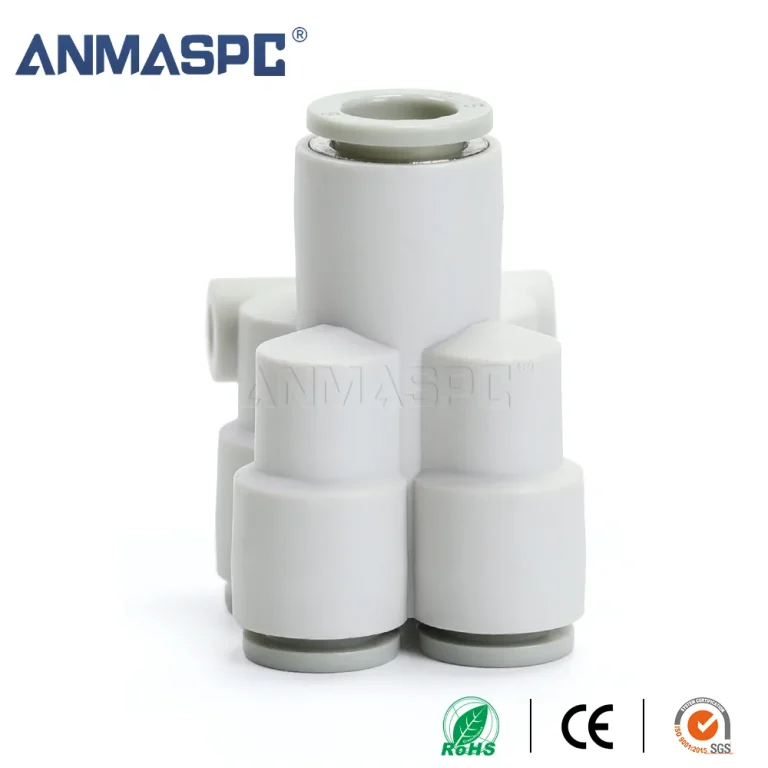
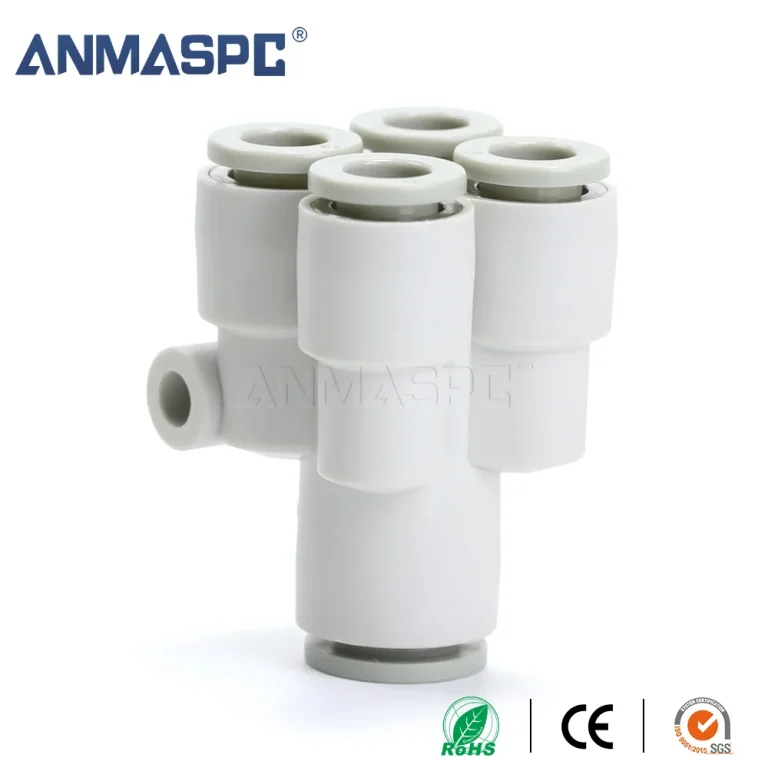
| Push-in fitting | Plastic-tube control circuits | Tube OD, material, cut and seal |
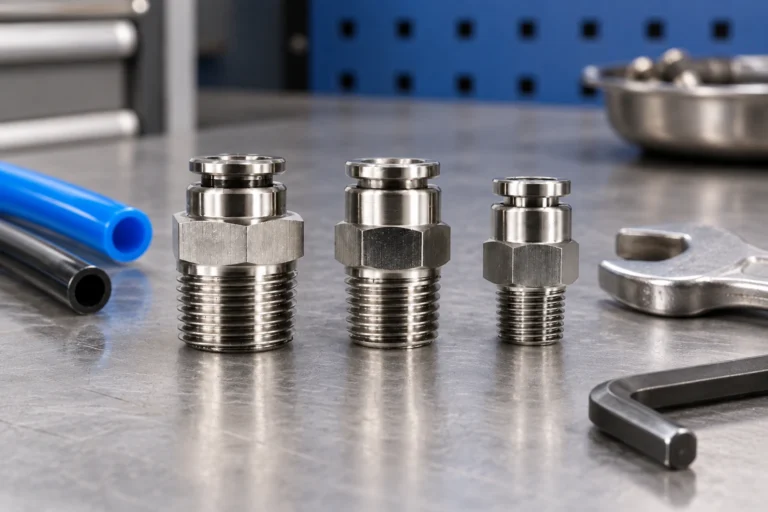
| Threaded adapter, elbow or tee | Port transitions and routing | BSP, NPT or metric thread and sealing method |
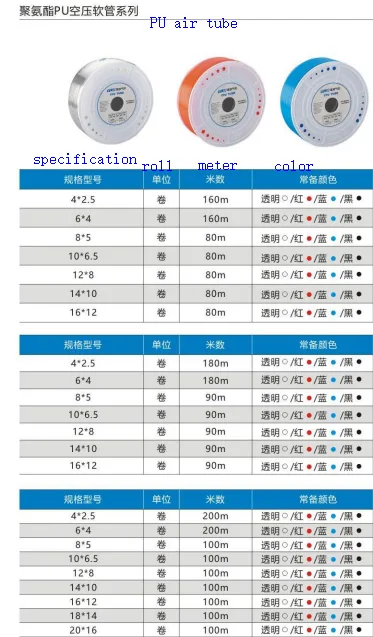
| Barbed fitting | Гибкие шланговые сборки | Hose ID, barb and clamp/crimp method |
| Компрессионный фитинг | Fixed tubing runs | Tube OD, wall, material and assembly instruction |
How should size and thread be measured?
Barbs generally match hose ID; push-in fittings match tube OD. Measure legacy parts with a caliper and thread gauge. NPT, BSPP, BSPT and metric threads can look alike while sealing differently. Record the seal material, body material, temperature, air quality and chemicals before approving a substitution.
What comparison matters beyond unit price?
Include flow restriction, installation time, leak risk, spare complexity and maintenance access. Standardizing an approved interchange profile can simplify repairs, but it must be validated with the equipment and hose. Set the assembly limit at the lowest-rated component and isolate the line before service.
For adjacent choices, compare one-touch operation, review straight fitting layouts and send the complete duty to the engineering team.
How should a maintenance team approve a fitting?
Start at the point of use and work back toward the compressor. List every joint, hose, valve and adapter in the pressure boundary. For each item, record the connection family, nominal and measured dimensions, rated working pressure, temperature range, medium and installation orientation. This simple register makes an emergency replacement repeatable: a technician can select the approved spare without relying on a photograph or a supplier’s shorthand.
Flow is a separate decision from fit. A small coupler or elbow can add restriction even when its threads match. Compare the manufacturer’s flow data at the intended pressure and use the shortest practical hose. Where a tool has a published flow demand, test the complete hose and fitting assembly under load rather than judging performance from a static gauge. If a pressure drop appears only while the tool runs, inspect bore size, coupler profile, hose length and upstream filtration before changing the compressor setting.
| Failure symptom | Likely boundary | First controlled action |
|---|---|---|
| Hiss at a push-in joint | Tube cut, OD, O-ring or insertion depth | Isolate, cut back square and retest with the approved tube |
| Tool starves under load | Restriction, undersized hose or coupler | Measure pressure at the tool while operating |
| Coupler separates | Wrong profile, sleeve wear or side load | Depressurize and compare both halves to the approved part number |
| Thread slowly loosens | Vibration or incorrect seal method | Verify thread form and use the specified sealing practice |
What should be included in a repeat-order specification?
Include the exact fitting family, part number, revision, tube or hose dimensions, thread standard, body and seal material, pressure and temperature limits, medium, surface finish where relevant, packaging and inspection requirement. State whether the part is a safety-critical spare and whether substitutions require engineering approval. A purchase order that says only “1/4-inch air fitting” leaves too many variables open.
How should flow, fit and service cost be compared?
A fitting can match a thread and still restrict a tool or create a maintenance problem. Start at the point of use and list every joint in the pressure boundary. Record tube OD, hose ID, thread standard, medium, temperature, working pressure, flow demand and movement. Then compare the complete assembly, because a small bore coupler, elbow or adapter can dominate the pressure drop even when the compressor gauge looks normal.
ISO 4414 is a system-safety reference, not a universal product rating. The pressure value in a catalogue must be tied to the exact fitting, seal, tube and temperature. For proof and burst information, request the method and scope rather than calculating a continuous rating from a burst number. The practical total-cost comparison includes replacement frequency, downtime, leak diagnosis, tool access, tube waste, inventory complexity and the cost of a failed test.
| Selection factor | What to compare | Useful field question |
|---|---|---|
| Connection | Push-in, threaded, barbed, compression or coupler profile | Can the technician identify the mating part without guesswork? |
| Flow | Bore, port size, coupler restriction and hose length | Does pressure drop appear only when the tool runs? |
| Обслуживание | Release access, seal availability and replacement method | Can a damaged tube be cut back and retested safely? |
| Evidence | Material, pressure, temperature, medium and test record | Does the document apply to this exact model and assembly? |
What failure pattern points to the fitting rather than the machine?
A leak at the tube entry suggests a cut, insertion, OD or seal problem. A leak at the port suggests thread form, sealing method or body damage. A pressure drop under flow suggests bore, coupler profile, hose length or filtration. A fitting that releases under movement suggests inadequate support, wrong tube material or a mismatch between tube tolerance and collet. Isolate the symptom before changing the compressor or replacing every joint.
For procurement, approve one labelled reference assembly and keep the fitting family, part number, revision, tube dimensions and thread standard together. Oulu’s Спектр пневматических деталей can be evaluated with the same checklist used for any supplier. The best fitting is the one whose interface and evidence match the duty, not the one with the shortest catalogue description.
How can two similar flow ratings lead to different choices?
Compare flow values only after checking their stated inlet pressure, pressure difference, temperature and reference conditions. A catalog may describe volumetric flow at a reference condition, whereas another document may report a different flow measure or test arrangement. Equal nominal port sizes do not establish equal restriction through the valve or coupling mechanism. If the documents cannot be compared directly, request matching test conditions rather than deriving a ranking from the largest printed number.
Keep connection type and disconnection procedure together. A coupler intended for frequent tool changes has an operating role different from a fixed tube fitting, and neither should be selected solely by unit price. Assess access to the release mechanism, residual-pressure precautions and the possibility of hose movement during service. ISO 4414:2010 provides system-safety context; the product instruction determines the actual procedure. For hot-work installations, compare the documented tube and cover conditions, such as the SMC series-specific tubing descriptions, before treating ordinary tube-fitting compatibility as sufficient.
Часто задаваемые вопросы
Are all air-hose quick couplers interchangeable?
No. The plug profile, socket mechanism and sealing arrangement must belong to an approved interchange combination. A plug that appears to latch does not establish the correct engagement or flow behavior. Identify both halves by their documented profile and part numbers. Isolate and depressurize before checking a mismatched connection rather than testing interchange by pressurizing it.
Is a push-in fitting sized by tube ID or OD?
Push-in fittings are normally selected against tube outside diameter, material and permitted tolerance. Hose barbs, by contrast, are usually reviewed against hose inside diameter and the approved attachment method. Keep those dimension conventions separate on the purchase order. A matching nominal number can refer to a different physical measurement in another connection family.
Why does an air fitting leak after installation?
The cause depends on where the air escapes. A tube-entry leak may involve a damaged cut, wrong OD, contamination or incomplete insertion; a port leak may involve the thread or its sealing method. Isolate the line before correcting the identified boundary. If the fitting or seal is damaged, replace it according to the maker’s instructions rather than relying on extra force.
Can BSP and NPT air fittings be connected together?
Do not assume compatibility because the nominal size is similar. The thread form and the intended seal location must match the mating port. Record whether a connection seals on a taper, a gasket, an O-ring or another specified surface. Use a documented adapter where a transition is needed rather than treating apparent thread engagement as an approved assembly.
Why is tool pressure low when compressor pressure is normal?
A static upstream reading does not show the loss across a hose and fittings while the tool consumes air. Check pressure at the relevant point during the intended operation and review coupler restriction, hose dimensions, length and upstream treatment. Use flow data with stated measurement conditions. Do not increase compressor pressure before identifying the restriction and confirming the limits of the entire assembly.
When should an air-hose fitting be replaced rather than resealed?
Replace a component with damaged retention parts, threads, sealing surfaces or other defects covered by its service instructions. A leak caused by an incorrectly prepared tube may be corrected without replacing an undamaged fitting, but that distinction requires inspection. Record repeated failures so the approved spare or routing can be reviewed. Recommission the connection under the project’s procedure rather than accepting the absence of an audible hiss as the only check.
Ссылки
- ISO 4414:2010: pneumatic systems and components.
- UK HSE INDG261: pressure-system responsibilities and precautions.
- SMC: tubing series and hot-work material boundaries.
Summary
The best air-hose fitting is the one whose interface, flow behavior and service method match the task. Quick couplers, push-in connectors, threaded adapters, barbs and compression fittings are not ranked by one universal performance number. Begin with the connection family and measured dimensions, then confirm the thread, medium, temperature and complete assembly pressure boundary. Compare pressure loss under the intended operating condition rather than relying on a static compressor gauge. Preserve an approved mating assembly and its documentation so maintenance can repeat the selection without guessing. Oulu’s pneumatic parts range can be evaluated against those requirements, with model-specific evidence and controlled commissioning taking precedence over a generic catalog description.