
Когда Майя, руководитель по монтажу волоконно‑оптических линий, работая в условном сценарии в Роттердаме, обнаружила протечку в соединении, она заново обрезала ПНД‑канал и вставила его в муфту, предназначенную для данной работы. Однако через минуту показания манометра всё равно начали падать. Проверка штангенциркулем подтвердила ошибочность первоначального заключения: проблема заключалась не в самой муфте; в документации по закупкам были смешаны термины, обозначающие номинальный диаметр канала, фактический наружный диаметр и указан неверный тип соединения.
Резюме: Выберите Коннектор для микроканала Dura-Line 12.7mm на основе проверенных размеров воздуховода, а не по приблизительной маркировке. Dura-Line указывает свой прямой соединитель 12.7 мм для микроканала с внутренним диаметром 12.7 мм и OD/10 мм и публикует допустимую нагрузку на соединитель в диапазоне 232–psi/16 бар.[1][2] Измерьте наружный диаметр воздуховода, уточните точный чертёж детали, подготовьте ровный, без повреждений конец и проведите опрессовку собранного участка согласно утверждённой проектной методике с соблюдением установленного времени выдержки.
Примечание о товарном знаке: Dura-Line — сторонний бренд. Настоящее независимое руководство по выбору не утверждает принадлежность, одобрение, идентичность конструкции, взаимозаменяемость, эквивалентность или статус замены для продукции других поставщиков.
Почему маркировка 12.7 мм не подтверждает соответствие
Официальный каталог Dura-Line идентифицирует деталь 20001832 как прямой соединитель с наружным/внутренним диаметром 12.7/10 мм и перечисляет отдельные переходные соединители для неодинаковых диаметров.[1][2] Это имеет значение, потому что 12 мм, 12.7 мм и 14 мм — это разные接口, даже если экипаж неофициально называет их “полудюймовым” воздуховодом.
The Микроканал относится к системе продувки. ITU-T L.108 охватывает характеристики и испытания для волоконных блоков и кабелей, прокладываемых методом продувки, а IEC 60794-5-20:2014 — для наружных микроканальных блоков, микроканалов и защищённых микроканалов.[3][4] Ни один из этих стандартов не делает неопределённый разъём сертифицированным соответствующим. Это Руководство по подбору размера и герметичности объясняет более широкий механизм отказа.
Используйте наружный диаметр для подбора соединителя и внутренний диаметр для проверки воздушного тракта.
Измерьте фактический наружный диаметр с помощью калиброванного штангенциркуля в нескольких точках и при различных ориентациях. В перечне Dura-Line 12.7 мм — это наружный диаметр, определяющий соединение; 10 мм — внутренний диаметр отверстия.[1] Не выбирайте только по идентификатору и не преобразовывайте обозначение в дюймах без контрольного чертежа.
Записывайте овальность, повреждения поверхности, допуск по толщине стенки и то, является ли соединение прямым или переходным. ITU-T L.108 также акцентирует внимание на контроле размеров и низком коэффициенте трения внутренних поверхностей для продувки.[3] Таким образом, для одобрения необходимы как надёжный внешний захват, так и гладкое стыкованное отверстие.
Подготовьте концы из ПЭВП перед установкой муфты.
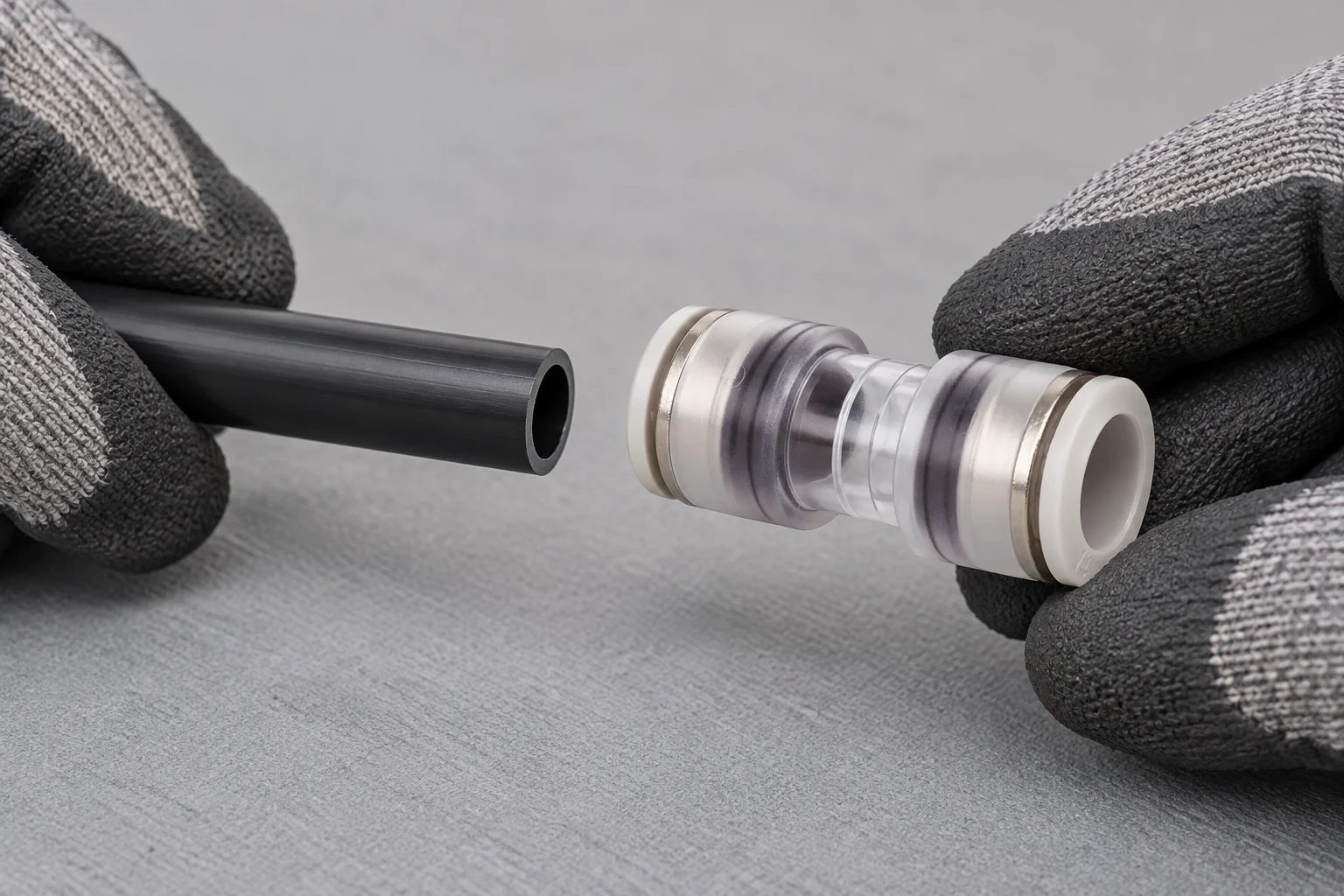
Обрежьте каждый конец из ПЭВП под прямым углом; удалите стружку, воду, остатки и острые кромки; проверьте круглость и наличие насечек. Установите оба конца до указанного упора и зафиксируйте любым требуемым зажимом. Компания Dura-Line указывает на возможность сборки/разборки без инструментов, однако это не определяет универсальную глубину вставки.[1][2] Прозрачный корпус может подтверждать положение, но не обеспечивает герметичность.
Не очищайте, не растягивайте и не смазывайте уплотнительное кольцо, если это не разрешено производителем. Осмотрите корпус, ручку и уплотнение на предмет повреждений или загрязнений. Повторно обработайте Микроканальная трубка когда предыдущий след захвата или повреждение доходит до зоны уплотнения.
Определите источник утечки воздуха перед заменой соединителя.
Утечка снижает давление до того, как полезный воздух достигнет кабеля, что приводит к уменьшению дальности продувки или к повторным остановкам. ITU-T L.108 предоставляет системный контекст, а не одобрение разъёмов.[3] Смотрите это Обзор монтажа микроволокна, укладываемого с помощью воздуха.
Dura-Line выпускает штангу 232 psi/16 для своей линейки микрокоплеров.[1][2] Это предел, установленный производителем, а не автоматическое полевое испытательное давление; контролирующую роль играет компонент с самым низким номинальным давлением. Примерная стоимость: Шесть соединений при 20 минутах изоляции и переделки требуют двух человеко-часов, без учёта повторной мобилизации. Поэтому документированное определение размеров и испытания могут перевесить небольшую экономию по единичной цене.
Проверьте данные об УФ-излучении и температуре для использования на открытом воздухе
Пригодность для наружного применения не может быть определена по цвету или прозрачности. IEC 60794-5-20:2014 охватывает элементы микроканальных систем, предназначенных для наружного применения, а ITU-T L.108 касается испытаний на воздействие окружающей среды, включая методы, связанные с температурой и ультрафиолетовым излучением.[3][4] Эти документы не сертифицируют каждый соединитель. Указанные страницы Dura-Line не содержат числового диапазона температур или результатов испытаний на устойчивость к ультрафиолетовому излучению для 12.7 мм, поэтому запросите актуальный отчёт по конкретной детали с указанием метода, условий и критериев приёмо-сдаточных испытаний.
Сравните муфты по размеру, функциональности и подтверждающим данным.
| Опция | Когда следует это учитывать | Approval evidence | TCO implication |
|---|---|---|---|
| Dura-Line 12.7/10 mm straight coupler | Both ends match the documented OD | Current drawing, part data, and project limits | May reduce approval and rework uncertainty |
| Documented third-party 12.7 mm straight connector | Buyer verifies fit and environment independently | Drawing, tolerance, pressure, material, UV, and temperature data | Include testing, rejects, and downtime |
| Documented transition connector | Verified duct ODs differ | Both end dimensions and bore transition | Can avoid duct replacement if approved |
| Unspecified generic fitting | No approval case without data | Resolve missing evidence before use | Low price may be offset by rework |
The rows are procurement categories, not declarations of equivalence. A third-party connector should be evaluated on its own documentation and sample results; a matching nominal size alone does not establish interchangeability with Dura-Line.
Use Leak and Seating Checks to Guide Maintenance
| Observed signal | Likely specification or process issue | Next controlled check | Commercial consequence if ignored |
|---|---|---|---|
| Pressure falls immediately | Wrong OD, incomplete insertion, damaged seal, or another open route point | Isolate sections; verify part number, OD, insertion, valves, and end caps | Repeated blowing attempts and crew delay |
| Duct pulls out | Grip range, duct surface, locking step, or axial-load requirement is unresolved | Stop testing and compare the assembly with the approved drawing and procedure | Route failure, rework, and possible cable damage |
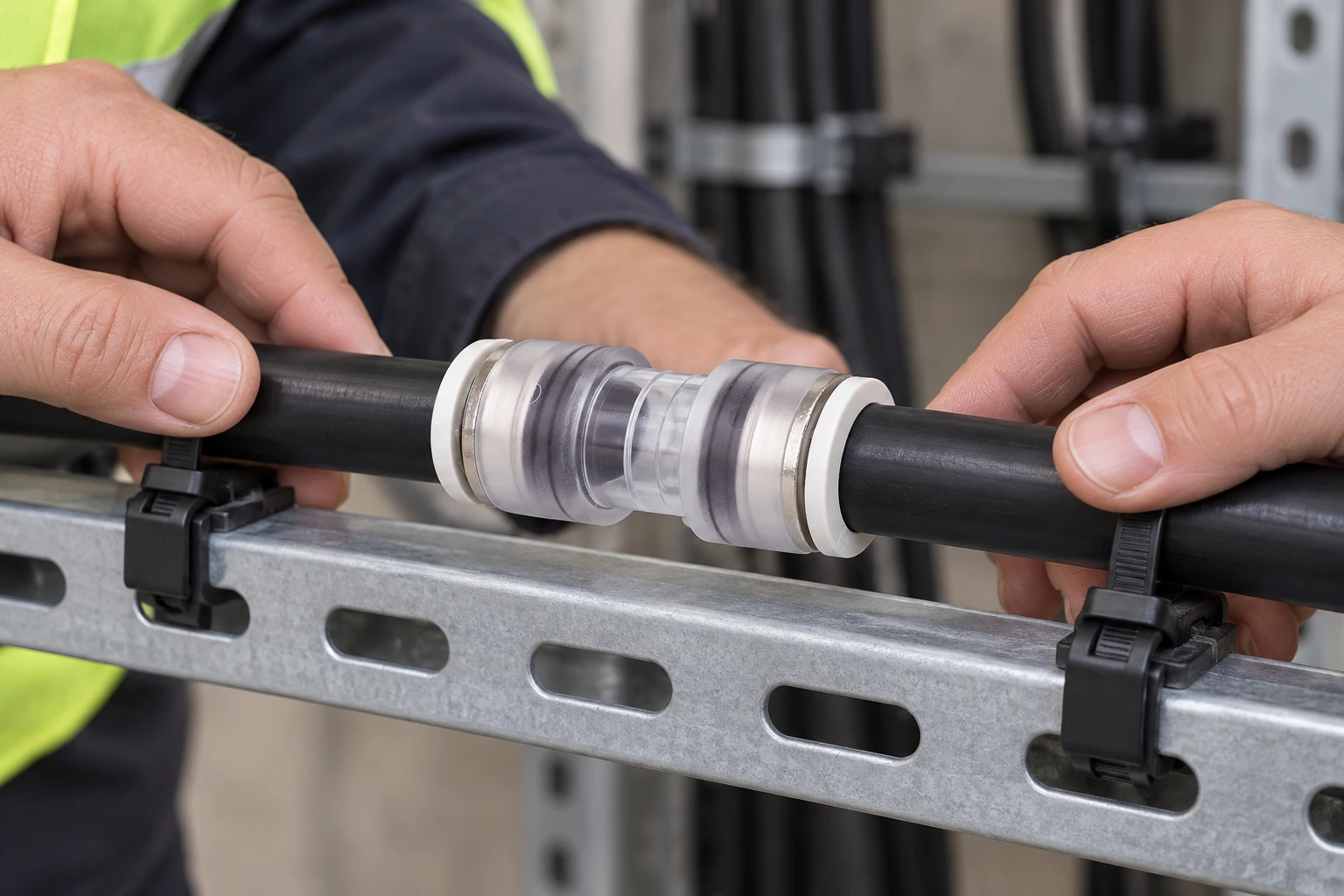
| Visible gap through a clear body | End not fully inserted or cut not square | Depressurize, release correctly, re-cut, clean, and reinstall | Failed inspection and leak investigation |
| Leak appears only in cold or hot conditions | Temperature range or material compatibility is not demonstrated | Request part-specific cycling evidence for the destination conditions | Seasonal callouts and warranty disputes |
| Outdoor body degrades | UV exposure class or installation protection was not specified | Review test method, duration, acceptance criteria, and enclosure/shielding plan | Premature replacement and schedule risk |
Match Each Standard to the Claim It Supports
- Dura-Line documentation: the official micro-coupler page and December 2025 specification sheet identify the 12.7/10 mm straight coupler, state 232 psi/16 bar approved use, and state testing to meet or exceed CENELEC EN 50411-2-8:2009.[1][2] These are manufacturer statements; buyers should obtain current documents for the ordered part and destination.
- EN 50411-2-8: Dura-Line describes this as the standard for microduct connectors used with air-blown optical fibers.[1] Quote the edition and tested configuration rather than saying “EN approved” without a report.
- ITU-T L.108: this recommendation covers use, characteristics, and tests for microduct fiber units and microduct cables installed by blowing.[3] It informs system design and testing but is not, by itself, a connector product certificate.
- IEC 60794-5-20:2014: this family specification covers outdoor microduct fiber units, microducts, and protected microducts for blowing installation.[4] Its presence in a project specification does not prove a coupler’s pressure, UV, or temperature performance.
Unsupported compatibility, certification, UV, or temperature claims can lead to a rejected submittal, failed incoming inspection, field rework, or a warranty dispute. Applicability depends on the destination market, route environment, intended use, contract language, and the exact claims placed on the product or packaging.
Write the Purchase Specification Before Requesting Samples
- Send the controlled duct drawing, nominal OD/ID, OD tolerance, ovality limit, material, and representative production samples.
- Define the route: indoor, ducted outdoor, direct buried, aerial/lashed, chamber, or exposed cabinet; include the actual temperature and UV conditions.
- Set the test plan from the lowest-rated route component. Name the gauge accuracy, stabilization period, pressure, hold time, allowable loss, sample size, and safe depressurization sequence.
- Request part-specific drawings and evidence for pressure, pull-out, water sealing, materials, temperature, UV exposure, and any claimed standard. Check that the report revision and model scope match the purchase order.
- Define maintenance and reuse rules. Specify how gripping parts and O-rings are inspected, when seals or the full connector must be discarded, and which cleaning agents or lubricants are permitted.
For buyers assessing configurable sourcing options, Oulu / ANMASPC can review buyer-supplied drawings and requirements against its micro duct block connector и transparent-inspection straight connector product families. This is an invitation to compare specifications and evidence; it is not a claim that those products are Dura-Line products, approved replacements, interchangeable, or equivalent.
Часто задаваемые вопросы
Where can installers use the Dura-Line Microduct 12.7mm Connector in fiber and telecom networks?
Use it only where the route design, duct dimensions, environment, and approved bill of materials identify the applicable 12.7/10 mm straight coupler. Potential locations may include protected telecom duct routes and access chambers, but outdoor exposure, burial, aerial use, or enclosure installation must be supported by current manufacturer and project documentation.
How do you choose the correct duct diameter for the Dura-Line Microduct 12.7mm Connector?
Match the measured duct outside diameter and its tolerance to the exact connector drawing; Dura-Line lists part 20001832 for 12.7 mm OD/10 mm ID microduct.[1][2] Confirm ID separately for cable clearance and blowing design, and use a documented transition connector when the two duct ODs differ.
How do you install the Dura-Line Microduct 12.7mm Connector without causing an air leak?
Depressurize the route, cut each HDPE end square, remove contamination and burrs, verify roundness, and insert each end to the manufacturer’s stop before applying the specified lock. Inspect positioning where the body permits it, then test the isolated assembly under the approved project procedure.
What pressure and time should be used to test the Dura-Line Microduct 12.7mm Connector?
Use the pressure and hold time in the approved project method, never a value inferred solely from the connector maximum. Dura-Line publishes 232 psi/16 bar for its micro-coupler range, but the cited pages do not provide a universal field hold time; the lowest-rated component and safe working procedure control.[1][2]
Can the Dura-Line Microduct 12.7mm Connector be reused after the duct is disconnected?
Do not assume unrestricted reuse. Dura-Line states that its micro-couplers allow assembly and disassembly without tools, but disassembly is not blanket authorization to reuse a connector after every service condition.[1][2] Follow the current instructions, inspect the body, grip, and seal, prepare a fresh duct end, and replace any questionable component.
Which material and UV rating are best for outdoor Dura-Line Microduct 12.7mm Connector applications?
There is no universal “best” material or UV rating without the exposure, service temperature, chemicals, and design life. The cited Dura-Line sources do not state a numeric temperature range or a 12.7 mm-specific UV result, so request part-specific material and test evidence and compare it with the route conditions and applicable outdoor-system requirements.
Key Checks for a 12.7 mm Microduct Coupler
The 12.7/10 mm designation is useful only after the duct drawing, measured tolerances and route conditions are checked against the exact coupler. Keep Dura-Line’s published 16 bar figure tied to its own product evidence, distinguish a straight coupler from a transition model, and request separate documentation for temperature, UV exposure, maintenance and reuse. The 12 mm specification guide shows the same dimension-first discipline, while the air-blown installation sequence explains how preparation and testing carry that decision into the field.
Ссылки
- Dura-Line, “Micro Couplers” product page.
- Dura-Line, “MicroTechnology Accessories: Straight Couplers and Transition Couplers,” specification sheet, 12.25.
- ITU-T Recommendation L.108, “Optical fibre cable elements for microduct blowing-installation application”.
- IEC 60794-5-20:2014, “Optical fibre cables – Part 5-20: Family specification – Outdoor microduct fibre units, microducts and protected microducts for installation by blowing”.
The decision comes down to four checks: confirm the 12.7/10 mm interface, keep Dura-Line’s published figures tied to Dura-Line evidence, distinguish a straight coupler from a transition coupler, and require current documentation for the route environment and test method. A similarly sized connector should be treated as a separate product until its own drawing and records support the proposed use. That discipline is what prevents a nominal match from becoming an air-loss problem in the field.



