
Когда подрядчик по строительству сетей в Оулу готовил участок с воздушно-впрысковой оптоволоконной линией к сдаче‑приёмке, бригада соединила два трубопровода, приступила к проверке давления и сразу же обнаружила, что показания манометра практически мгновенно падают. Соединитель был выбран на основе номинального обозначения трубопровода, тогда как фактические наружные диаметры и качество торцевых срезов не были проверены. Урок заключался не только в замене фитинга: после того как команда измерила стыки трубопроводов, подготовила ровные торцы и выполнила проверку в соответствии с документированным планом испытаний, участок был приготовлен к монтажу.
Быстрый ответ: Лучший фитинги для микротрубок Выбор осуществляется на основе функционального назначения, фактического наружного диаметра (OD) трубопровода, условий прокладки и установленных испытаний на приёмку — а не по внешнему виду или общему обозначению “микротрубка”. Наружный диаметр трубопровода определяет тип соединительной муфты; внутренний диаметр (ID) помогает оценить проходное сечение для кабеля. Стандарт IEC 60794‑5‑20 распространяется на кабельные системы в микротрубках, предназначенные для установки методом пневмопрокладки, при этом заявленные характеристики соединителей должны подтверждаться документацией, соответствующей конкретной модели. Указывайте параметры каждого порта, проверяйте каждое соединение и проводите испытания готового участка перед началом пневмопрокладки волокон.
Связанное чтение: Руководство по установке концевого упора.
Как неправильная установка фитингов приводит к дополнительным работам на оптоволоконной трассе
Фитинги для микроканалов являются элементами соединения в системе трубопроводов, работающих под давлением. Прямые соединители удлиняют трассу одного и того же диаметра; переходники обеспечивают предусмотренный переход между размерами; отводные фитинги организуют разветвление системы; а заглушки, торцевые колпачки или газоизолирующие элементы закрывают или изолируют участки там, где этого требует проект. Несоответствие может ухудшить герметичность, создать препятствие или затруднить локализацию неисправности после завершения строительных работ.
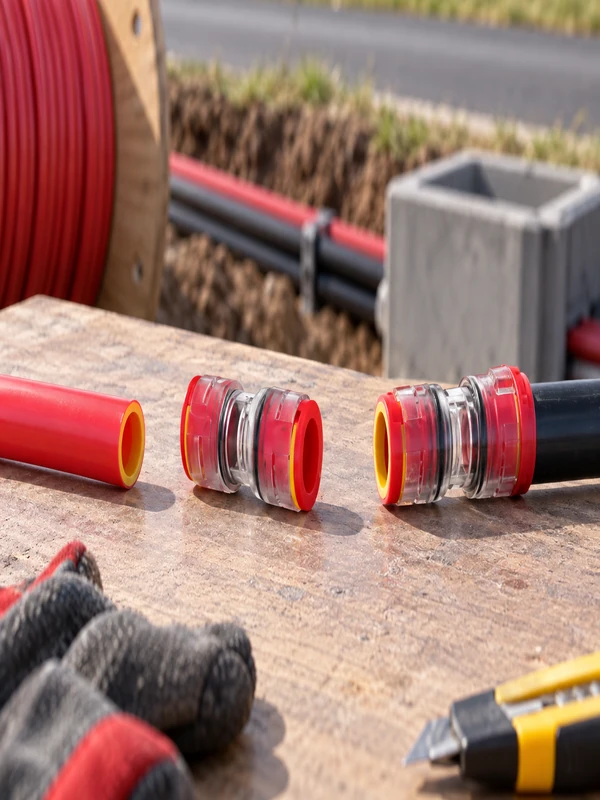
При закупках следует учитывать совокупную стоимость установки, а не только единичную стоимость. Неправильно заданные требования к компоненту могут привести к необходимости повторных испытаний, простою оборудования и задержке приёмки. В проектной спецификации — а не в общих эмпирических правилах — должны быть определены соответствующее испытательное давление, продолжительность испытания и критерии приемлемости.
| Размерность выборки | Вопрос о передовой практике | Коммерческое последствие |
|---|---|---|
| Совместимость | Соответствует ли каждый порт подтверждённому наружному диаметру воздуховода? | Сокращает количество возвратов неподходящих деталей и повторного выполнения работ на объекте. |
| Функция маршрута | Должен ли маршрут продолжаться, сокращаться, разветвляться или завершаться? | Предотвращает функциональное несоответствие в спецификации. |
| Качество монтажа | Можно ли обрезать, очистить и установить воздуховод в соответствии с инструкцией? | Поддерживает повторяемые проверки приемки |
| Документация | Доступны ли сведения об установке и совместимости? | Повышает отслеживаемость для подрядчиков и заказчиков |
| Доступ на протяжении всего жизненного цикла | Останется ли соединение подлежащим проверке или обслуживанию? | Ограничьте время расследования при проведении будущих изменений. |
Выберите фитинг для этап маршрута
Начните с чертежа и определите назначение каждого соединения. Категория изделия может помочь покупателю сравнить доступные варианты, но в каждой строке заказа следует указывать точное требование к типу соединения на обоих концах. Не исходите из того, что воздуховоды с похожими названиями или метрические и дюймовые маркировки, внешне близкие друг к другу, будут надёжно входить в одно и то же фитинговое соединение.
Используйте прямой соединитель для двух концов воздуховода с одинаковым указанным наружным диаметром. Прямой соединитель микротрубок Как правило, это наиболее надёжный вариант для прямолинейного продолжения, при условии, что концы воздуховодов не повреждены и полностью вставлены. Используйте переходник только в случае проектного перехода между указанными размерами; уточните, к какому патрубку подключается каждый воздуховод, и проверьте трассу кабеля ниже по потоку. Соединитель‑редуктор для микровоздуховодов никогда не следует применять для компенсации неточных замеров.
Для резервных трасс и границ участков следует различать функции закрытия и пропуска. Заглушка или торцевой упор перекрывают неиспользуемый участок трубопровода; газоизолирующий элемент имеет чётко определённое назначение по изоляции и должен применяться только в тех случаях, когда этого требует проект сети.
| Тип соединения | Надлежащее использование | Проверка ключа перед заказом |
|---|---|---|
| Прямой соединитель | Прямое соединение воздуховодов одинакового размера | Оба наружных диаметра трубопровода, состояние резки, требования к вставке |
| Редуктор | Спроектированный переход между двумя заданными размерами воздуховода | Проверка ориентации крупных/малых портов и маршрута кабелей |
| Фитинг для разветвления | Планируемое распределение по нескольким маршрутам | Метки портов, карта маршрутов, доступ для будущих работ |
| Концевой упор или заглушка | Закрытие резервного или незавершённого воздуховода | Размер воздуховода и необходимость обеспечения возможности его последующего использования |
| Gas-block component | Isolation where the engineering design specifies it | Location, duct interface, and installation instruction |
Test the joint before fiber blowing
A sound component can still fail when the duct end is oval, contaminated, poorly cut, or not fully seated. Follow the fitting manufacturer’s instructions: cut the duct squarely, remove debris, avoid deforming the tube, and insert it to the stated stop where applicable. A visual insertion mark can assist inspection, but it does not replace the project’s approved pull check or air-tightness test.
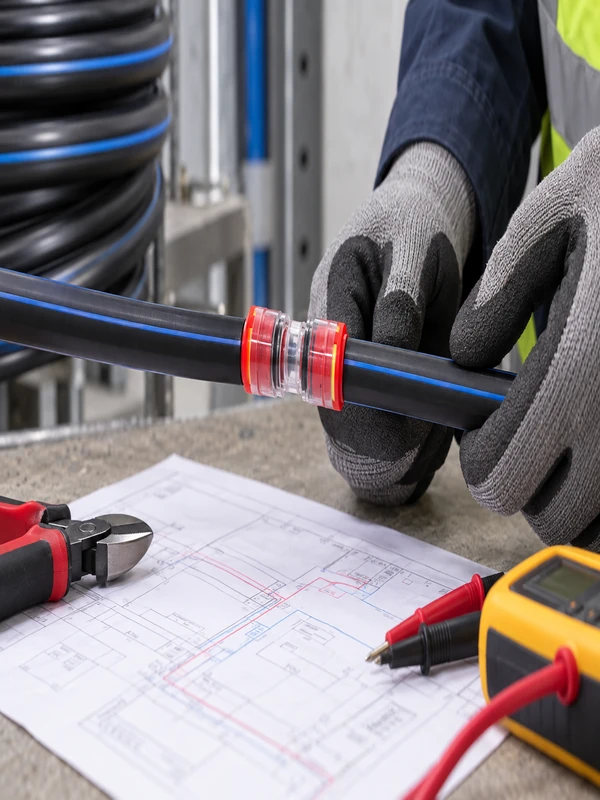
Before blowing fiber, isolate the section and carry out the pressure-decay or other specified test method. Record the route section, test medium, stabilized pressure, duration, instrument, and result. If a test fails, inspect the setup, duct ends, seating, and component condition systematically; raising pressure without diagnosis can obscure the real cause. The test method is not a universal product certification or an automatic rating for every fitting.
Check the standard and the supplier’s evidence
IEC 60794-5-20 addresses microduct cabling intended for blowing; IEC 60794-1-2 provides basic optical-fiber-cable test procedures; and ITU-T L.35 gives installation guidance. They support disciplined system specification, but do not themselves certify a fitting as leak-proof, pressure-rated, or fit for every environment.
Request exact product documentation, duct interfaces, installation instructions, and supportable test information. Destination-market rules, client specifications, and the claimed application determine the evidence required; do not fill gaps with unsupported marketing claims.
What to check before ordering
- Map every joint by location and function before issuing the bill of materials.
- Record duct manufacturer, nominal size, measured OD, wall construction, and ID where cable passage must be assessed.
- Request fitting documentation for the exact duct combination, rather than accepting a broad compatibility statement.
- Set the inspection and pressure-test record before installation begins.
- Keep route labels and spare-path decisions visible for the handover file.
For a specification-led review in Oulu or elsewhere, compare the route needs with documented microduct gas-block options and connector configurations. The productive supplier discussion begins with dimensions, function, route conditions, and required documentation.
Связанное чтение: microduct connector selection guide.
The route stage determines the fitting type
There is no single “best” microduct fitting for every network. The right choice changes with the route stage: equal-size duct extension, planned size transition, unused duct closure, or a boundary that needs an air or water barrier. Add the duct OD tolerance, bore requirement, exposure, access and acceptance test to the purchase request so the supplier is comparing the same duty.
| Route stage | Likely fitting family | Решающая граница |
|---|---|---|
| Same-size repair or extension | Прямой соединитель | Confirm both duct ODs and continuous bore |
| Change in duct size | Редуктор | Use a listed transition; do not improvise two nominal sizes |
| Unused or future duct | End stop or end cap | Confirm closure, storage and re-entry limits |
| Entry or zone separation | Gas-block connector where specified | Request the barrier test and installation orientation |
Before standardizing a part, review the fitting role guide, compare end-stop sourcing evidence, and confirm the measured duct against the Ассортимент соединителей для микротрубопроводов.
How can a team distinguish route stage from pressure state?
The same duct may be vacant, being tested, occupied by cable or reserved for re-entry. Each state changes the fitting duty. An end stop protects an empty opening, a straight connector joins compatible ducts, a reducer handles a designed size transition and a gas block seals around an installed cable. Select the component from the route state and measured OD, not from a generic product family name.
Before blowing, qualify continuity, cleanliness, obstruction and the sealing condition under the project method. A pressure reading that passes an empty route does not prove a cable-entry seal or a future re-entry closure. IEC 60794-5-20 and ITU-T L.35 provide application context; the product drawing and route acceptance record define the actual limit. If a run fails, isolate the nearest transition while preserving the machine and route conditions.
| Route stage | Part role | First evidence |
|---|---|---|
| Empty continuation | Прямой соединитель | Both OD ranges, cut and insertion |
| Переход размера | Редуктор | Each-side dimensions and cable passage |
| Vacant end | Концевой упор | Closure, access and re-entry limit |
| Cable installed | Газовый блок | Cable OD, seal activation and test state |
Часто задаваемые вопросы
How do I choose the best microduct fittings?
Choose by confirmed duct OD at every port, the fitting’s intended function, route environment, and the project’s acceptance method. Compare model-specific documentation and installation instructions, then verify the completed joint before fiber blowing.
What size microduct connector do I need?
Select a connector port that matches the actual outside diameter of the duct it receives. Also confirm the duct ID and cable route, because a fitting can match the OD while the overall pathway is still unsuitable for the planned cable installation.
Are all microduct fittings compatible with HDPE ducts?
No. Compatibility depends on the fitting design, the duct OD, wall construction, and the manufacturer’s stated application. Do not treat “HDPE” as enough information; verify the exact duct and fitting combination in the supplied documentation.
How do microduct fittings affect fiber blowing?
They form part of the air path and cable route, so poor sizing, debris, damage, or incomplete seating can contribute to pressure loss or an obstruction. Test the completed section under the approved project method before a cable-blowing run.
What causes a microduct connector to leak?
Common causes include an incorrect duct OD, an uneven or damaged cut, contamination, incomplete insertion, component damage, or a flawed test arrangement. Investigate each condition against the manufacturer’s instructions and project test record rather than assuming the connector is defective.
Should I use straight connectors, reducers or end stops?
Use straight connectors for equal-size in-line ducts, reducers for a specified size transition, and end stops to close a route that is not meant to pass cable. The route drawing and measured duct interfaces should decide the component, not availability alone.
Связанное чтение: Информация о компании Oulu Connector.
Ссылки
- IEC 60794-5-20 – microduct cabling scope.
- ITU-T L.35 – optical fibre cable installation context.
- ITU-T L.87 – optical cable maintenance context.
- Hexatronic duct-integrity testing guidance.
Краткое содержание
The best microduct fitting is the one whose function matches the route stage and whose dimensions match the measured duct. Keep empty-duct protection, size transitions and occupied-cable sealing separate, then qualify the route before fiber blowing. IEC and ITU references frame microduct cabling and outside-plant work, but the supplier drawing and project procedure control the acceptance decision. Record the joint, insertion, test condition and future re-entry limit so a later crew can diagnose a leak without guessing. Reinspect any route disturbed by excavation or flooding before reintroducing fiber. Oulu’s microduct fitting range can be compared against the route schedule, connector role and evidence required for handover.



