
Uma conexão que funcionou durante anos em um painel fixo pode apresentar vazamento rapidamente quando a mesma conexão é instalada ao lado de um atuador móvel. A causa pode ser a carga sobre o tubo, a contaminação, a exposição à limpeza ou o uso de um tubo de reposição inadequado, e não a idade do corpo em aço inoxidável. Compradores que perguntam quanto tempo dura uma conexão precisam definir o que está se desgastando e em quais condições isso ocorre. Uma garantia baseada apenas na vida útil cronológica, sem essas informações, oferece pouca ajuda quando uma máquina para. Este guia explica como avaliar o conjunto completo, estabelecer critérios para inspeções e investigar vazamentos recorrentes, sem inventar uma vida útil universal nem um número permitido de reconexões.
A conexão de tubo em aço inoxidável Deve permanecer em serviço apenas enquanto seu modelo exato for adequado às condições e sua carcaça, vedações, componentes de fixação e tubos atenderem aos critérios de aceitação documentados. A vida útil depende da pressão, da temperatura, do meio, do movimento, da instalação e da exposição. Os dados do fabricante relativos a uma família de produtos não estabelecem a vida útil de outra. Utilize as instruções de manutenção do fornecedor juntamente com os registros de condição e o histórico operacional da máquina, substituindo posteriormente as peças danificadas ou inadequadas após identificar e corrigir a causa raiz.
O que determina a vida útil além do corpo em aço inoxidável?
O corpo é apenas uma parte de uma conexão de tubo. As vedações podem envelhecer ou tornar-se quimicamente incompatíveis, as peças de fixação podem ser danificadas e um tubo pode sofrer arranhões, ficar achatado ou apresentar desgaste na sua entrada. Alterações em outras partes do circuito também podem expor um componente anteriormente adequado a temperaturas mais elevadas, transientes de pressão ou cargas mecânicas. Registre essas alterações antes de concluir que o metal atingiu o limite de vida útil.
Analise o envelope operacional real das peças montadas. Mantenha separadas as condições de produção normal, os períodos de inatividade, a limpeza e a manutenção, quando essas situações impuserem requisitos diferentes. Não combine a pressão máxima de um documento com a temperatura máxima de outro e não apresente o resultado como uma classificação do conjunto. O fornecedor selecionado deve confirmar a combinação permitida para o encaixe e o tubo específicos.
O catálogo KQG2 da SMC fornece um exemplo específico do fabricante sobre por que a condição da tubulação e as precauções de instalação são importantes, mesmo com um acessório de aço inoxidável. As suas observações sobre tubos usados e a inserção não estabelecem um intervalo de substituição universal, e a sua construção de vedação não garante que todos os produtos de aço inoxidável se comportem da mesma forma. A pergunta útil na hora da compra é: qual evidência se aplica ao modelo real e ao seu serviço pretendido?.
| Condição de serviço | O que gravar | Implicação da inspeção |
|---|---|---|
| Circuito fixo e protegido | Envelope operacional e histórico de manutenção | Inspecione as interfaces documentadas e qualquer vazamento observado. |
| Rota em movimento ou vibratória | Pontos de contato de movimento, suporte e tubo | Look for side load, rubbing and repeated bending |
| Cleaning or chemical exposure | Product, concentration, temperature and duration | Review all wetted or exposed materials |
| Frequent disconnection | Reason for service and supplier reuse rules | Check the tube end and release mechanism before reconnection |
| Recurring fault | Location, operating state and previous repair | Investigate the cause before fitting another identical part |
Which loads shorten the service interval?
Describe the movement instead of writing vibration resistant on a purchase order. State whether the tubing flexes, twists, rubs against a frame or pulls sideways at the connection. Check the full machine travel, including access positions used during maintenance. A body that can be oriented for installation is not automatically a joint approved for continuous rotation.
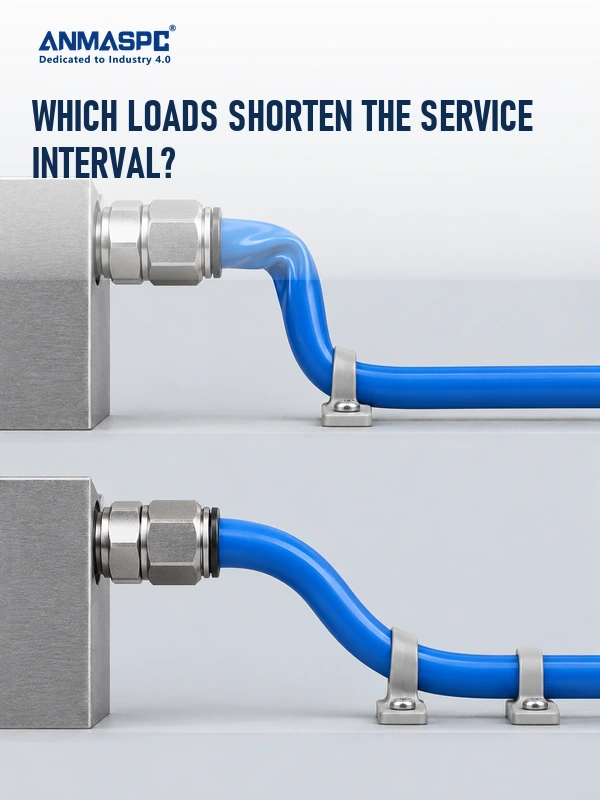
Support the tube and respect its documented bend limit. The critical bend may be immediately behind a release sleeve, where an otherwise generous service loop still applies load at the entry. A standard static rating cannot demonstrate suitability for that moving arrangement. If the chosen layout requires dynamic service, obtain appropriate product approval or revise the route.
A stainless union tee also needs enough space for each branch to leave without avoidable bending or tension. Evaluate the layout with the real tube and neighboring components; a catalogue view cannot establish service clearance in the machine.
How should inspection intervals be established?
Start with the manufacturer’s instructions and the site’s maintenance and risk assessment. Then use records from the relevant machine duty to decide whether observation should become more frequent. An exposed moving connection may warrant a different schedule from an accessible protected line. A high cycle count alone does not provide an inspection interval without knowing how the component is loaded.
Define observations that trigger immediate investigation between planned checks: new leakage, tube movement, an abnormal release sleeve, visible damage, corrosion or a change in process conditions. Identify who can isolate the circuit and what evidence should be retained. The guia de manutenção de conexões pneumáticas provides a related structure for recording connection condition.
Do not claim that one short trial proves years of use. A controlled trial can confirm stated observations under its conditions, such as leakage and routing behavior over the agreed test. Document those conditions and the trial’s limits. A life or endurance claim needs evidence designed to support that specific claim, including the failure definition and the tested configuration.
When should the tube or fitting be replaced?
Follow the supplier’s reuse and replacement criteria. A release mechanism allows removal; it does not automatically approve indefinite reconnection. Inspect the accessible tube surface and component exterior after safe isolation. Replace damaged, cracked, deformed or otherwise unacceptable parts rather than trying repeated insertion until a leak temporarily stops.
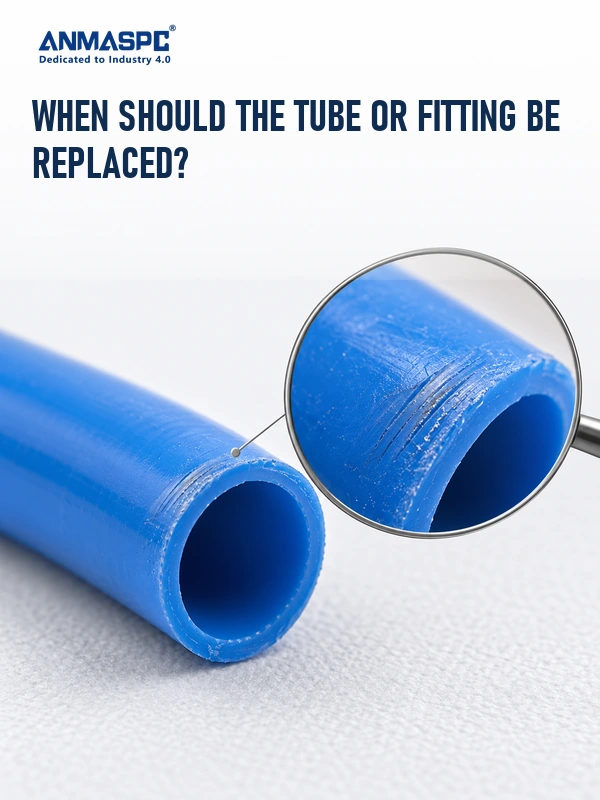
If a tube is permitted to be re-prepared, confirm that enough length remains to avoid tension and preserve the approved route. Cut and insert it according to the instructions using the correct tool and documented insertion depth. Do not reuse a scored section as though moving the grip mark has restored every material property. Where the history is uncertain or the component has been overloaded, obtain a replacement decision from the responsible engineer and supplier.
| Condição observada | Primeira investigação | Replacement decision |
|---|---|---|
| Tube-entry leakage | OD, cut quality, seating, surface and side load | Replace unacceptable tubing or a damaged fitting as instructed |
| Thread leakage | Mating thread and intended sealing method | Reject damaged engagement; correct the identified interface |
| Restricted flow | Tube kinks, contamination and valve/exhaust restrictions | Do not replace an undiagnosed fitting solely because the cylinder is slow |
| Corrosion or chemical damage | Exposure against the approved materials | Review suitability before installing another identical component |
| Damaged release parts | Mechanical contact and service history | Follow the supplier’s rejection criteria and correct the contact source |
How can low flow be distinguished from a worn connection?
Record when the fault appears: at startup, during simultaneous demand, in one direction or at the end of a stroke. Measure at the approved locations during the actual cycle. A regulator reading while idle may miss a restriction that becomes important during motion. Inspect the entire path, including tubing, control valves and exhaust, before concluding that the connection’s age is responsible.
The U.S. Department of Energy identifies fittings, hoses and other point-of-use components as possible leak locations, while distinguishing demand reduction from the compressor response needed for electrical savings. A useful repair report identifies the fault and operating result. It should not attach a standard energy-saving percentage or guaranteed life extension to replacing one fitting.
Which tubing details belong in the replacement specification?
Specify material, exact OD and relevant dimensional tolerance, series or drawing, environmental exposure and the permitted bend and temperature conditions. PU and nylon are families with different product variants; neither is universally preferable. The PU and PA tubing comparison helps frame the questions, while the actual series documentation controls the decision.
For purchasing, retain the fitting reference, drawing revision, tube pairing and agreed replacement criteria. Oulu’s pneumatic component range can be reviewed against that record. Request confirmation of model-specific conditions before changing a body, seal, tube or layout in an existing assembly.
Perguntas frequentes
How do you cut and insert tubing into a stainless steel tube fitting for a reliable seal?
Use the specified tubing and a suitable cutter to make a clean square end. Inspect for distortion and surface damage, then insert to the documented depth and perform the instructed retention check. Work on an isolated, depressurized circuit and verify the assembled connection before service.
Can a stainless steel tube fitting be used with oil, water or chemicals?
Only when the exact fitting, seal and tubing are documented for those conditions. The body material alone does not approve the medium. Include concentration, temperature and exposure duration, and distinguish external cleaning from fluid inside the line.
How often should a stainless steel tube fitting be inspected in an automated line?
Use manufacturer guidance, the machine duty and condition history to establish the interval. Add investigation triggers for leakage, movement, damage or changed exposure. There is no universal calendar interval that covers protected static lines and repeatedly moving connections equally.
What is the difference between polyurethane and nylon hose for this stainless steel tube fitting?
Compare the exact series for stiffness, routing, bend limits, pressure at temperature and media compatibility. Both can have application-specific restrictions. A shared nominal OD does not establish equivalent tube behavior or approval with the chosen fitting.
How do you troubleshoot low flow through a stainless steel tube fitting assembly?
Observe the loaded cycle and inspect tubing, bends, valves, filters and exhaust as well as the fitting. Identify the measurement points and compare dynamic conditions. A slow actuator does not independently prove that a fitting is worn or obstructed.
What bend radius prevents premature failure of a stainless steel tube fitting?
The tubing maker defines the applicable bend limit for its series and conditions. Keep the bend away from the fitting entry and avoid side load. A tube radius from another material or size cannot establish the life of the connection.
Referências
- SMC, KQG2 stainless steel one-touch fittings catalogue: series-specific tubing precautions.
- SMC, TU polyurethane tubing catalogue: model-specific dimensions and operating limits.
- U.S. Department of Energy, Minimize Compressed Air Leaks, Tip Sheet 3.
Resumo
The life of a stainless connection is determined by the whole assembly and its duty. Confirm the operating envelope, inspect the tube route and identify damage or leakage before assigning an age-related cause. Use condition-based inspection alongside the manufacturer’s maintenance requirements, with clear triggers for investigation between scheduled checks. Distinguish insufficient flow from a failed seal, and do not assume a release collar permits unlimited reconnection. Replace unacceptable parts only after checking why they deteriorated, then verify the restored assembly under the same operating conditions. Oulu’s available fittings and tubing can be assessed against a controlled specification that preserves the approved interfaces and documented service conditions.



