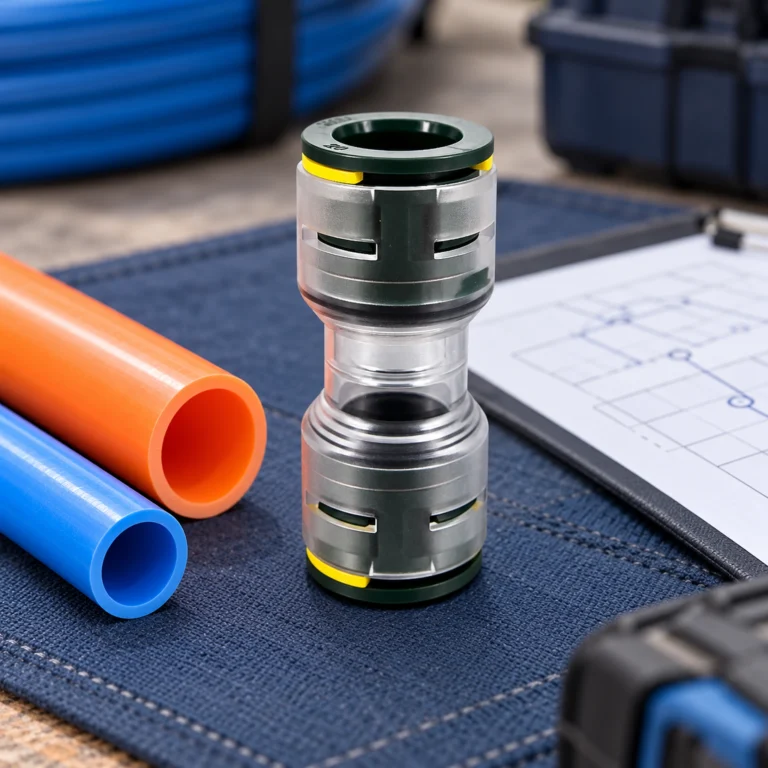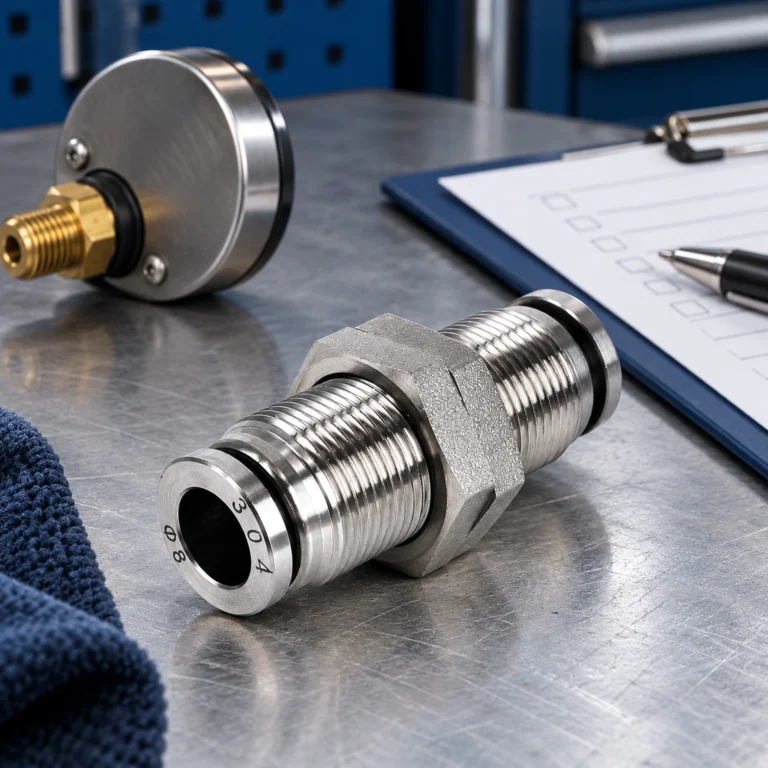
A T-type threaded plastic air push fitting may look unchanged after a tube is removed, but a safe reconnection depends on the condition of several small interfaces. The branch can be stressed by tools, the collet can lose retention, the seal can flatten, and the tube end can carry a score into the new joint. Reuse is therefore neither automatically acceptable nor automatically forbidden. This guide gives engineers a condition-based inspection and reconnection path, with a clear boundary for replacement.
Quick answer: reuse a T-type fitting only when the supplier permits it and the body, branch, thread, collet, seal and tube end pass inspection. Isolate and exhaust air, make a fresh square tube cut when instructed, verify the thread and routing, restore pressure gradually and perform the approved leak test. Replace any damaged or uncertain component. Reconnection must also leave enough tube length for the complete route and machine travel; cutting away a score is insufficient if it creates tension.
Is a threaded tee the same as a three-tube union tee?
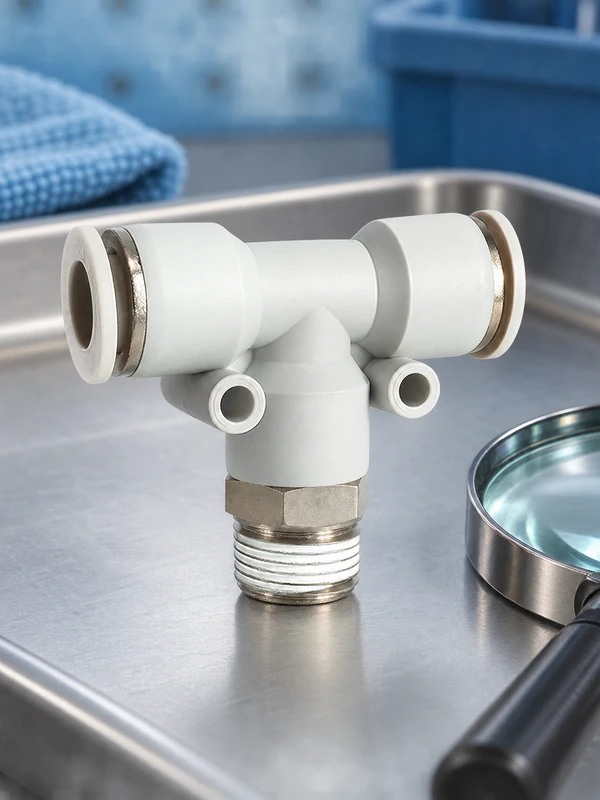
No. A threaded tee commonly combines a machine-port connection with tube connections, while a union tee can connect three tubes. Identify the actual configuration before counting seals or selecting a replacement. The run and branch positions also affect routing, access and the work needed to isolate the line. Use the product drawing to identify which openings are threaded, which accept tube and whether the fitting has a specified orientation. Do not reuse a similar-looking tee solely because its body shape appears to match the removed component. For a replacement search, a PB male-thread tee is a configuration reference; its material, tube connections and port specification must be checked against the original part rather than assumed equivalent.
What should be inspected before reconnecting?
Clean the fitting enough to see the body and branch without sanding the sealing surfaces. Look for cracks, whitening, deformation, impact marks and distortion around the thread. Operate the release collar as instructed and check that the collet retains an approved tube. Inspect the seal for a cut, flattening, hardening, contamination or displacement. The tube should be checked for scoring, ovality, kink and a damaged witness mark. A T fitting has two branches and a run, so inspect every interface rather than only the branch that was disconnected.
Does the threaded port need a new seal?
Follow the product drawing. Some threaded designs seal with a washer, face or O-ring; others use a specified thread-sealing method. Replace a damaged or flattened washer or O-ring, and never assume that additional tape compensates for a wrong thread or damaged face. Confirm BSPP, BSPT or NPT before assembly. If the part history is unknown and the joint is critical, replacing the fitting is often more defensible than trying to infer how the original installer sealed it. Keep the approved thread and seal identification with the work order so reconnection does not depend on how the previous joint looked.
How should the tube be prepared for reconnection?
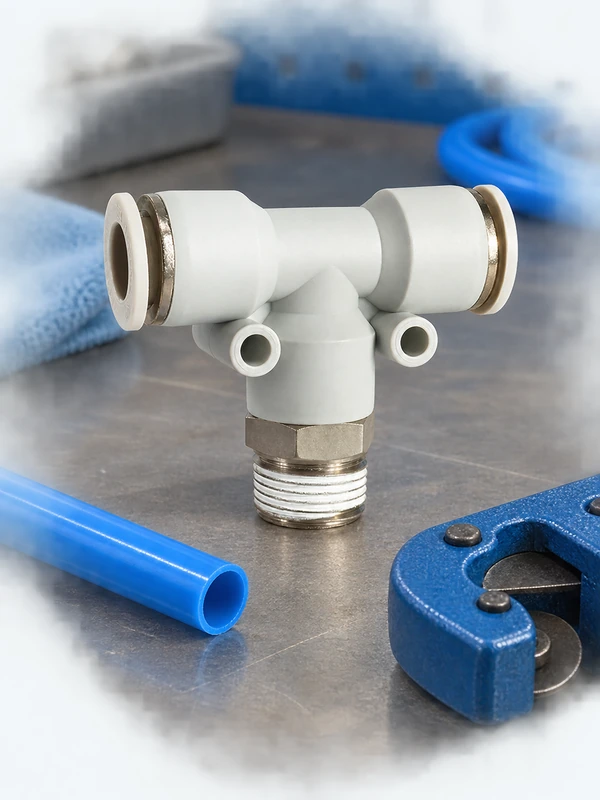
Depressurise the line before removal. When the supplier permits reconnection, cut back to clean, undamaged tube with a square cutter; do not simply push the old scored end deeper. Remove chips and keep the cut aligned with the bore. Check that both branches have enough straight length to avoid bending the fitting during insertion. A new cut does not repair a connector with a worn collet or seal, so complete the inspection before reassembly. Document the new tube-end condition and remaining route length together, because removing a scored section can create a separate routing problem.
How much tube can be cut back before routing becomes a problem?
There is no universal cut-back length. Remove the damaged sealing section according to the tube and connector instructions, then reassess the installed route. The shortened tube must still enter straight, respect the documented bend radius and allow full machine travel without tension. If it no longer reaches with those conditions, install a correctly specified replacement tube. Do not stretch the remaining length or add an unapproved inline joint to avoid replacing it. A clean end is only useful when the finished assembly also has adequate support and service access.
What routing problems can damage a T fitting?
A tee concentrates routing decisions because one branch often turns toward a valve or actuator while the run continues to another device. Side load, insufficient bend radius, unsupported tube weight and vibration can all stress the body and collets. Keep clamps on the tube, not on a release collar, and leave room to isolate or remove each branch. If a fitting repeatedly cracks at the same orientation, review the route and support before selecting a different-looking tee. Review tube routing and support before reconnection so each branch can enter straight and remain accessible through the approved machine movement.
How should reconnection be tested?
Restore pressure slowly after confirming that guards and tools are clear. Use the site-approved leak or pressure method at the relevant test condition, and inspect all three interfaces. A tee can pass a branch check while leaking at the run or threaded port. Record the part reference, tube condition, seal decision, thread standard and result. If the connector moves, leaks or shows a damaged surface, isolate it again and replace it rather than tightening or gluing the plastic body.
When should the entire fitting be replaced?
Replace the fitting when any branch is cracked, whitened or deformed, when the collet does not retain the correct tube, when the seal or thread is damaged, when chemical exposure is suspected, or when the service history is unknown in a critical circuit. Replacement is also appropriate when the supplier prohibits reuse or the part has exceeded its documented duty. Do not file, sand, heat or glue the fitting; those actions change the controlled interface and make later verification harder.
Can replacing an internal seal restore every damaged fitting?
Only perform a seal replacement if the manufacturer documents the fitting as serviceable and provides the approved part and procedure. Many small push-in fittings are replaced as complete assemblies rather than repaired internally. A new O-ring cannot repair a distorted body, damaged retention feature or incorrect thread. Avoid disassembly that exposes an internal part which the supplier does not authorise technicians to service. When the construction or repair policy is unknown, replacing the complete fitting preserves a controlled configuration and avoids inventing a repair process. External inspection cannot prove that inaccessible internal features remain sound. If the supplier does not provide a permitted way to assess them, do not dismantle the fitting merely to satisfy a checklist. Record the inspection limitation and select replacement according to the machine’s failure consequences. A short static test may establish that the assembled joint is not visibly leaking at that moment, but it cannot certify an unauthorised internal repair or prove indefinite retention.
What information should maintenance leave behind?
Record why the tube was removed, which interfaces were inspected, whether a seal was renewed, the thread and tube identity, the test method and the final result. If the fitting was replaced, record the new part number and any adapter. A short note such as “reconnected OK” does not explain whether the body, collet and tube passed inspection. Consistent records help determine whether a recurring problem is caused by reuse, routing, contamination or an unsuitable material.
What makes a reuse decision defensible?
The maintenance record should show supplier permission, the exact part identity, the inspection outcome, tube preparation, seal decision and acceptance result. Note any history that is unknown, especially after overheating, cleaning-agent exposure or an impact. If a leak appears only during motion, investigate side load and routing rather than declaring reuse successful from a stationary check. Use the approved machine cycle for functional verification after local testing. The component’s low purchase price is not the whole comparison: isolation time, repeated shutdown and the consequence of tube release can outweigh the saving from reuse. Make the choice from documented condition and failure consequences, not from an assumption that plastic fittings are either disposable or indefinitely reusable.
Which inspection findings rule out tee fitting reuse?
| Inspection point | Accept when | Reject when |
|---|---|---|
| Plastic body and branch | Clean, undamaged and not deformed | Crack, whitening, impact or distortion |
| Collet and seal | Moves and retains the specified tube | Sticking, cut, flattened or contaminated |
| Tube end | Square, clean and free of scoring | Oval, kinked, scored or too short |
| Thread and test | Standard verified and test passed | Cross-threading, unknown seal or persistent leak |
What should an installer record?
- Isolate and exhaust the complete branch before removal.
- Inspect the body, three interfaces, collet, seal and tube end.
- Verify the thread and sealing method from the product record.
- Support all branches and restore pressure gradually.
- Record the decision and repeat the approved leak test.
Олонтаа асуугддаг асуултууд
Can every T fitting be reused?
No. The supplier’s instructions and condition of each interface determine reuse. Confirm the configuration and service history, then inspect the body, retention features, seals and threads. Unknown condition in a critical circuit needs resolution before reconnection.
Should the old tube end be reinserted?
Only if it remains undamaged and meets the product instructions. Where cutting back is required or permitted, remove the damaged section with a square cut. Recheck route length and bend radius so shortening does not introduce tension.
Can a cracked branch be glued?
No. Replace the fitting and investigate the load or exposure that caused the damage. Adhesive does not restore the manufacturer’s controlled structure or documented pressure boundary, and a successful short leak test cannot prove that repair.
Does a leak prove thread mismatch?
No. Thread mismatch is one possible cause alongside tube damage, poor seating, a worn seal or side load. Identify the leaking interface and inspect under isolation. Correct the confirmed cause and repeat the acceptance check.
Can reconnection be tested at full pressure immediately?
Follow controlled pressure restoration and the site-approved test procedure. Check that personnel, tools and guards are correctly positioned and that all tee interfaces are included. Do not use a test condition above the complete assembly’s approved limit.
What standard helps with safe isolation?
ISO 4414:2010 addresses pneumatic-system safety at system level. The machine’s energy-control procedure and applicable local requirements determine the actual isolation steps. For covered U.S. servicing, OSHA 1910.147 also addresses stored energy and possible reaccumulation.
Дүрийн баримжаа
- SMC, archived KQ2 One-touch Fittings catalogue: construction and configuration illustrations; historical reference, not a specification for ANMASPC/Oulu fittings.
- U.S. Department of Energy, Minimize Compressed Air Leaks, Compressed Air Tip Sheet 3, revised August 2004: leak identification, repair and verification; historical maintenance guidance.
- OSHA 29 CFR 1910.147, Control of hazardous energy: applicable U.S. servicing requirements, including stored energy. Other jurisdictions require their own regulatory review.
Дүгнэлт
Reuse is acceptable only when the evidence supports it. Inspect the T body and all interfaces, renew the tube end when permitted, verify the thread and sealing method, support the branches and test before returning the line to service. A fitting that looks clean can still have a worn collet or damaged seal, so visual similarity is not an acceptance criterion. ANMASPC/Oulu can help identify a replacement configuration, but the supplier instruction, machine risk controls and recorded test result should decide whether the connection is returned to operation. Review the pneumatic parts range with the verified tube, port and service requirements when requesting a configuration.